
SaaStr Annual at Home was not just another virtual conference trying to replace a hotel ballroom with a webcam and a prayer. It was a snapshot of what SaaS founders, operators, and investors urgently wanted to learn in 2020: how to survive uncertainty, scale responsibly, build better products, price smarter, and avoid stepping on the same rake twice. SaaStr described the event as a digital gathering for its large SaaS community, with tactical sessions, smaller roundtables, VC office hours, and thousands of 1:1 attendee meetings designed to preserve the practical value of the in-person experience.
The “most popular sessions” list matters because registration behavior is brutally honest. People may say they love inspirational keynotes, but when the calendar is crowded, they choose sessions that solve painful problems. The original SaaStr leaderboard identified ten sessions drawing the strongest early interest, from Y Combinator’s post-seed survival advice to ZoomInfo’s IPO lessons, Mailchimp’s resilience playbook, BCG’s pricing strategy, Bessemer’s cloud analysis, Twilio’s self-service-to-sales model, ClickUp’s bootstrapping story, Totango’s customer journey framework, and Logi Analytics’ data-driven product strategy.
Why These SaaStr Annual at Home Sessions Became Crowd Magnets
The popularity of these sessions reveals a lot about the SaaS market. Founders were not hunting for vague slogans like “be more innovative” or “delight your customers,” which are about as useful as a screen door on a submarine. They wanted practical answers: What kills startups after seed funding? How do you scale go-to-market without chaos? When should self-service become sales-assisted? How do you price during a downturn? How do you keep customers from quietly slipping out the back door?
That is why the top SaaStr Annual at Home sessions were heavy on operator experience. They featured companies and firms known for real-world growth stories: Y Combinator for early-stage startup survival, ZoomInfo for scaling to IPO, Mailchimp for bootstrapped endurance, BCG for pricing discipline, Bessemer for cloud market perspective, Twilio for platform-led growth, ClickUp for product-led bootstrapping, Totango for customer success, and Logi Analytics for embedded data value.
The Top 10 Most Popular Sessions and the Lessons Behind Them
1. The 5 Things That Kill Startups After Their Seed Rounds with Y Combinator
This session earned the top spot because it addresses a dangerous stage: right after a seed round, when founders suddenly have money, attention, and enough confidence to make creative new mistakes. Y Combinator’s advice on post-seed failure highlights classic startup killers such as failing to find product-market fit, listening too much to investors instead of customers, copying nearby startups, building too slowly, and letting co-founder conflict fester.
The key lesson is simple but not easy: funding is not validation. A seed round buys time, not destiny. The best founders treat capital as oxygen for faster learning, not confetti for hiring sprees, vanity dashboards, or “strategy offsites” that somehow require matching hoodies.
2. From $0 to $400+M: 10 Mistakes the CEO of ZoomInfo Made on His Journey to IPO
ZoomInfo’s session became a favorite because founders love success stories, but they trust scar tissue more. Henry Schuck’s SaaStr Annual at Home appearance focused on mistakes made while building ZoomInfo from scratch into a major public company. ZoomInfo also announced the session as a look at hard leadership choices and lessons learned over 13 years of company building.
The broader ZoomInfo story had extra weight because the company’s 2020 IPO was one of the year’s major tech market moments, with Axios reporting that ZoomInfo raised $935 million and reached an initial market cap around $8 billion. The lesson for SaaS leaders is that growth is not a clean staircase. It is more like assembling IKEA furniture in a wind tunnel: possible, but only if you keep tightening the right bolts.
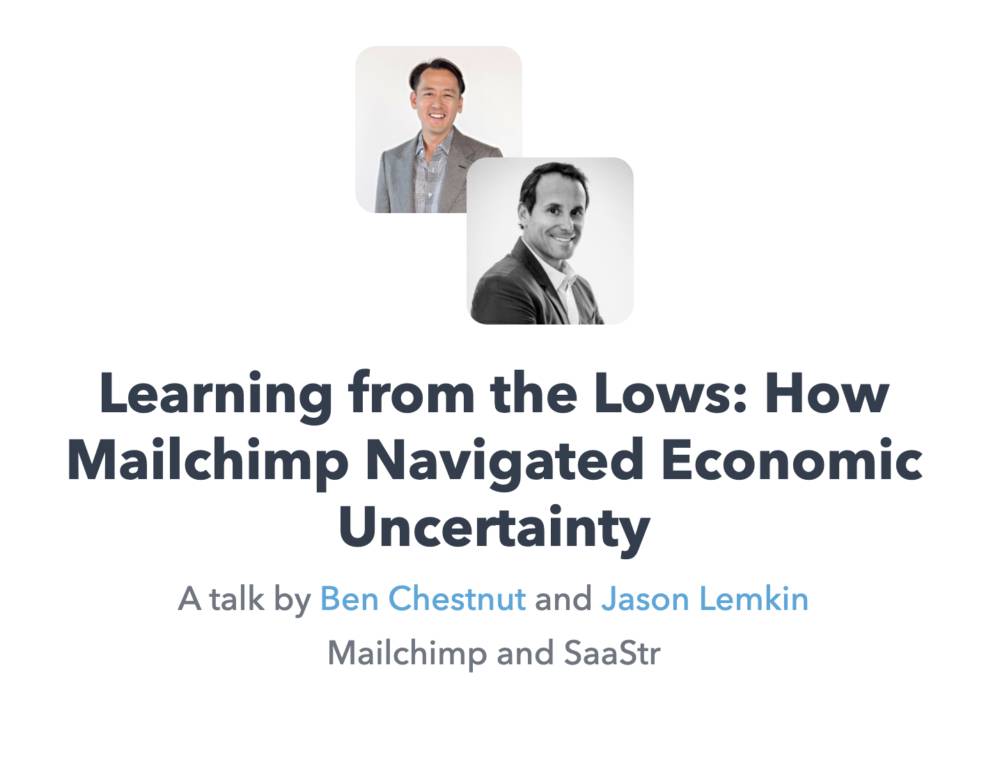
3. Learning from the Lows: How Mailchimp Navigated Economic Uncertainty
Mailchimp’s session stood out because it offered something every SaaS founder needs during chaos: evidence that tough markets can build durable companies. SaaStr described the session as a conversation with Mailchimp co-founder Ben Chestnut about founding the company around the dot-com downturn and navigating key inflection points during its first decade.
Mailchimp’s appeal comes from patience. The company became a classic example of bootstrapped growth, serving small businesses with a product that was easy to adopt and hard to ignore. For SaaS operators, the lesson is not “never raise money.” The lesson is sharper: know your customer so well that capital becomes fuel, not a crutch.
4. 5 Ways to Optimize SaaS Pricing and Sales Strategies to Win the Rebound with BCG
Pricing was a front-burner issue in 2020 because customers were cautious, budgets were frozen, and sales teams were under pressure to “just discount it and pray.” BCG’s pandemic-era pricing guidance emphasized digital war rooms, segment-specific customer strategies, preapproved flexibility options, pricing controls, and a rebound plan.
The SaaS lesson is that discounting without discipline is not empathy; it is margin vandalism wearing a customer-success badge. Smart SaaS companies offered temporary flexibility, deferred payment options, or short-term concessions while protecting long-term value. Good pricing strategy says, “We can help you through this.” Bad pricing strategy says, “Please take 40% off forever because our sales forecast is sweating.”
5. State of the Cloud 2020: The COVID Beneficiaries Edition with Bessemer
Bessemer’s State of the Cloud session was popular because the cloud market was changing fast. SaaS, collaboration, e-commerce infrastructure, automation, and digital operations were moving from “nice to have” to “please deploy this yesterday.” A SaaStr podcast page described Bessemer’s 2020 State of the Cloud discussion as a look at public and private cloud markets, strategic advice for cloud founders, and reasons to remain optimistic about the future.
For SaaS founders, the takeaway is that market timing matters, but preparation matters more. The companies that benefited from cloud acceleration were not lucky in the cartoon sense. They had products ready for urgent demand, distribution channels that could scale, and teams capable of adapting when the market suddenly changed lanes without using a turn signal.
6. The Secrets to Evolving from Self-Service to Sales with Twilio
Twilio’s session hit a nerve because many SaaS companies start with developers, free trials, or self-service signups, then eventually need enterprise selling without destroying the simplicity that made them popular. Twilio’s own customer journey material explains that self-service plays a critical role in SaaS, especially early in the journey, because users often arrive in the product before speaking with anyone at the company.
The lesson is to add sales when complexity demands it, not when the sales team gets bored. Self-service should handle discovery, onboarding, and early activation. Sales should step in where deal size, compliance, integrations, security reviews, or organizational buying committees become too complex for a “start free” button to carry alone.
7. Operate Like a Unicorn: 5 Ways to Align Every Team in Your Org for Growth with Remitly and Ally.io
This session attracted attention because alignment is the unglamorous superpower of scale. Every SaaS company says it wants alignment. Then marketing celebrates MQLs, sales chases logo size, product ships features nobody can explain, customer success fights churn with interpretive dance, and finance asks why the plan looks like it was written during a fire drill.
Remitly and Ally.io represented two useful angles: operational scaling and goal alignment. Ally.io later became part of Microsoft Viva, with Microsoft describing the acquisition as a way to connect work, purpose, and results through OKRs in a hybrid work world. The enduring lesson is that fast growth requires shared definitions. If teams do not agree on what “winning” means, they will all sprint enthusiastically in different directions.
8. Almost Screwed: Bootstrapping from $0 to $20M ARR in 2 Years with ClickUp
ClickUp’s session had a title that basically screamed, “Come for the chaos, stay for the playbook.” SaaStr’s ClickUp article explained how the company bootstrapped to $20 million ARR in a crowded productivity software market by focusing on organic users, feedback loops, speed, and what founder Zeb Evans called natural product-market fit.
The practical takeaway is that product-led growth is not magic dust. It requires obsessive user listening, fast shipping, a strong point of view, and the humility to fix what breaks. ClickUp’s story also reminds founders that crowded markets are not automatically bad. A crowded market means demand exists. The question is whether your product gives users a reason to switch besides “our logo is friendlier.”
9. 7 Must-Haves for the New Customer Journey Playbook: 2020 and Beyond with Totango
Totango’s customer journey session resonated because SaaS growth does not end at the sale. In subscription businesses, the customer keeps voting with renewal dollars. Totango describes a customer success playbook as a system of best practices, KPIs, workflows, templates, and monitoring tools designed to help customers reach desired outcomes at each stage of the journey.
The lesson is that customer success should be proactive, not a polite emergency room. A strong customer journey playbook maps onboarding, adoption, renewal, expansion, and advocacy. It gives teams clear signals before accounts become “at risk,” which is business language for “they have not logged in since the last Olympics.”
10. Delivering Value with Data-Driven Products with Logi Analytics
Logi Analytics closed the top ten with a topic that has only become more important: turning data into product value. Logi Analytics, now part of insightsoftware, positions its platform around embedded analytics, self-service reporting, customization, and interactive dashboards inside software applications.
The lesson for SaaS companies is that data should not sit in a dusty admin tab like a forgotten treadmill. Data should help users make decisions, prove ROI, discover opportunities, and justify renewals. The more your product helps customers see value, the less your renewal conversation sounds like a hostage negotiation.
What the Leaderboard Says About SaaS Buyers and Operators
The top SaaStr Annual at Home sessions were not random. They clustered around five themes: survival after funding, capital-efficient growth, pricing in uncertainty, product-led expansion, and customer retention. That pattern says a lot about SaaS leaders. They were not looking for theater. They were looking for useful tools.
It also shows that the best conference content behaves like market research. When thousands of founders and executives choose sessions, they reveal what hurts. Early-stage founders worry about dying after seed. Growth-stage leaders worry about go-to-market mistakes. Customer success teams worry about churn. Product leaders worry about turning data into defensible value. Everyone worries about pricing, because pricing is where strategy, psychology, math, and panic all meet for coffee.
How SaaS Teams Can Apply These Lessons
A smart SaaS company could turn this top-ten list into an internal operating workshop. Start with the Y Combinator session and run a “startup killer” audit. Are you building fast enough? Are customers pulling the product forward? Are founders aligned? Next, use the ZoomInfo session as a leadership review: where has the company deferred too much to outside advice, old assumptions, or internal politics?
Then borrow from BCG and review pricing discipline. Which discounts are temporary and strategic? Which ones are just fear in spreadsheet form? Use Bessemer’s cloud lens to ask where market demand is accelerating. Use Twilio’s session to define when self-service should hand off to sales. Use ClickUp’s playbook to tighten the feedback loop between users and product. Use Totango to rebuild the customer journey around measurable outcomes. Finally, use Logi Analytics’ topic to ask whether your product’s data actually helps customers look smarter in front of their boss.
That is the real value of the SaaStr Annual at Home leaderboard. It is not just a list of popular talks. It is a diagnostic map of what SaaS companies needed most: clarity, resilience, sharper execution, and fewer expensive face-plants.
Extended Experience Notes: What Attending SaaStr Annual at Home Could Teach a SaaS Team
A realistic SaaStr Annual at Home experience starts with calendar anxiety. The agenda looks exciting, but also dangerous. Every session seems useful. Every title sounds like it was engineered to poke a founder directly in the pain points. The first mistake is trying to attend everything live. That is how people end up with twelve browser tabs, three notebooks, two Slack threads, and the spiritual posture of a raccoon trapped in a vending machine.
The better approach is to attend with intent. A founder should pick sessions based on the company’s current bottleneck. If the company has raised seed funding but lacks product-market fit, the Y Combinator session belongs at the top. If the company is scaling sales but leadership feels chaotic, ZoomInfo and Remitly/Ally.io become priority viewing. If churn is creeping upward, Totango is more useful than another growth-hacking session promising “viral loops” with the confidence of a magician selling accounting software.
For leadership teams, the best experience is shared viewing. Have the CEO, head of sales, head of product, and customer success leader watch one session together, then spend 30 minutes answering three questions: What did we hear? Where are we guilty? What will we change this week? That last phrase matters. Conferences often produce inspiration that evaporates faster than free snacks at a startup office. Turning one insight into one operating change within 48 hours is how the content becomes ROI.
Networking at a virtual event also requires a different muscle. In person, hallway conversations happen by accident. Online, you have to be more deliberate. The best attendee experience comes from sending focused messages: “I’m building a PLG motion and wrestling with enterprise handoff. Want to compare notes?” That beats “Would love to connect,” which is the networking equivalent of room-temperature oatmeal. SaaStr Annual at Home’s digital meetings, roundtables, and VC office hours were designed to make that intentional networking easier.
The most useful experience, though, is pattern recognition. After watching several of the most popular sessions, a theme emerges: durable SaaS companies do not win because they know one secret. They win because they keep tightening the system. They listen to customers, ship faster, price with discipline, align teams, measure outcomes, and use data to prove value. None of that sounds glamorous. But neither does brushing your teeth, and skipping it has consequences.
For a SaaS founder, the lasting takeaway from this topic is that popular sessions are popular for a reason. They reflect common pain. If hundreds or thousands of operators choose the same topics, your company probably has at least one of those issues hiding somewhere in the building. The job is not to admire the agenda. The job is to turn the agenda into action before the next quarter politely arrives with a spreadsheet full of regrets.
Conclusion
The 10 most popular sessions for SaaStr Annual at Home show what serious SaaS operators care about when the noise falls away: surviving the post-seed danger zone, scaling go-to-market, navigating uncertainty, pricing intelligently, building product-led momentum, aligning teams, retaining customers, and making data useful. The ranking was a “so far” snapshot, but its lessons remain relevant because SaaS fundamentals age better than buzzwords.
The biggest lesson is that great SaaS companies are built through accumulated discipline. One better pricing decision, one clearer customer journey, one stronger feedback loop, one faster product release, one more honest leadership conversation. Stack enough of those together, and suddenly the company looks “inevitable.” Of course, behind the scenes, everyone knows it was mostly hard work, customer calls, messy spreadsheets, and a heroic amount of coffee.
Editorial note: This article is based on publicly available information about the SaaStr Annual at Home session leaderboard and related SaaS operator research. The session ranking should be understood as an early popularity snapshot, not a permanent final ranking.