
Your astrological birth chart is often described as a snapshot of the sky at the exact moment you were born. It contains planets, zodiac signs, angles, aspects, and enough mysterious symbols to make a beginner wonder whether they accidentally opened an ancient weather map.
Fortunately, the basic framework is easier to understand than it looks. Planets describe what is happening, zodiac signs describe how that energy behaves, and the 12 astrological houses reveal where in your life the action takes place.
For example, Venus traditionally symbolizes attraction, affection, pleasure, and values. Venus in bold Leo may express love dramatically, while Venus in practical Virgo may show affection by solving problems. Put either placement in the 10th House, and those Venusian qualities become connected with career, reputation, ambition, or public visibility.
Think of your birth chart as a cosmic mansion with 12 rooms. Some rooms are crowded with planets throwing a party. Others appear empty and suspiciously quiet. Every room still matters, however, because each one represents an essential category of human experience.
What Are the Houses in Astrology?
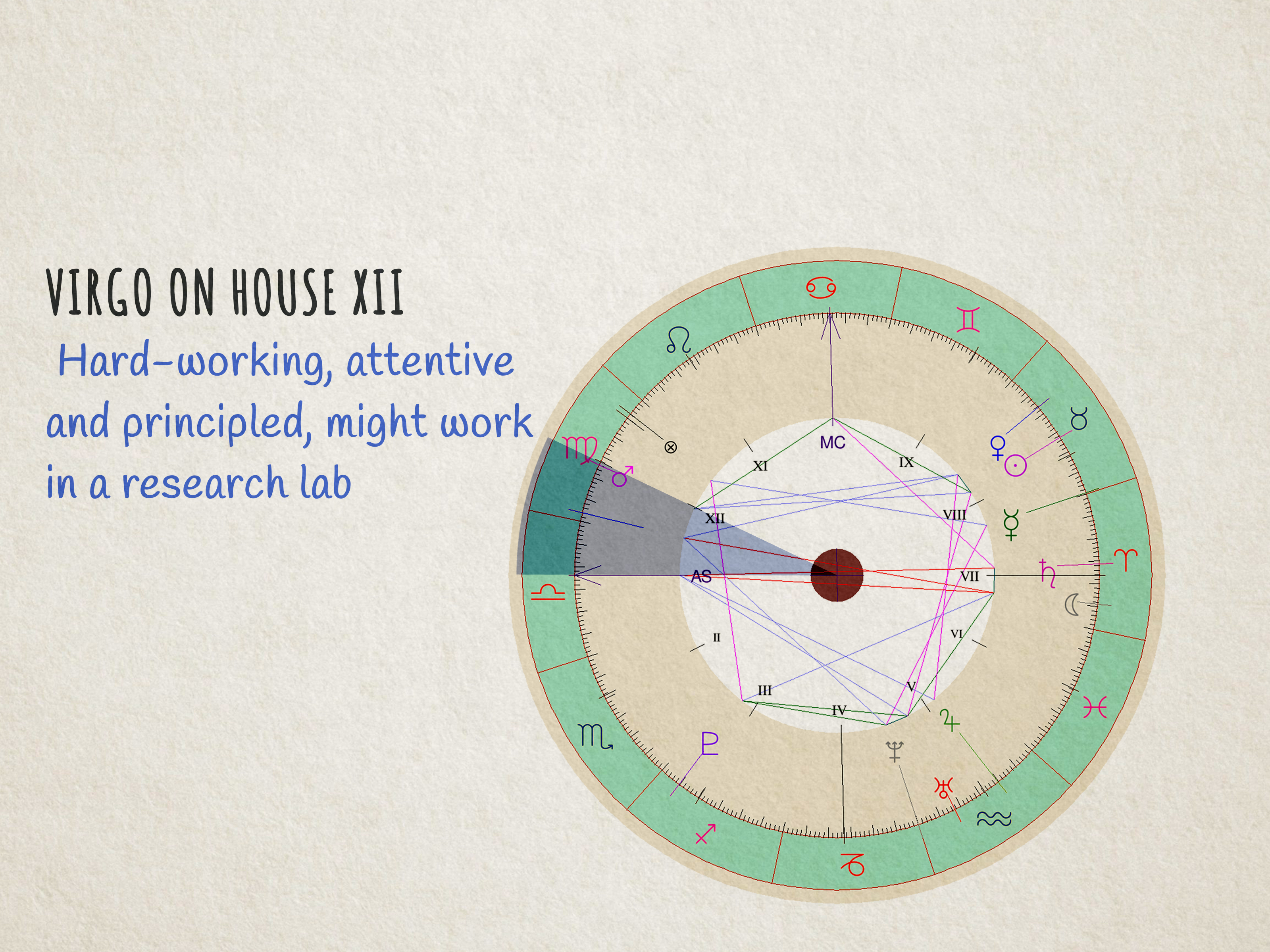
The 12 houses are sections of an astrological birth chart calculated from your birth time and location. Unlike zodiac signs, which follow a fixed sequence around the wheel, the positions of the house cusps depend on the horizon and geographic location at the moment of birth.
The First House begins at the Ascendant, also called the rising sign. From there, the houses continue counterclockwise around the chart. Because the Ascendant changes relatively quickly, an accurate birth time is especially important. A difference of several minutes may alter a house cusp, while a larger error can produce a different rising sign and reorganize the entire chart.
Astrologers also use different house systems, including Placidus, Whole Sign, Equal House, and Porphyry. These systems divide the chart in different ways, so a planet may move from one house to another when you switch methods. This does not necessarily mean one chart is “wrong.” It means astrologers may use different interpretive traditions.
How to Read a House in Your Birth Chart
When examining any astrological house, consider three main ingredients:
- The sign on the house: It describes your general approach to that area of life.
- Planets inside the house: They highlight the energies, needs, challenges, or opportunities expressed there.
- The house ruler: The planetary ruler of the sign on the house cusp connects that house with another part of the chart.
Suppose Capricorn appears on your Second House of money and personal resources. You may approach finances cautiously, strategically, or with a strong desire for long-term security. Saturn, Capricorn’s traditional ruler, would provide additional information through its sign, house, and aspects.
The houses are sometimes associated with corresponding zodiac signsAries with the First House, Taurus with the Second, and so on. These traditional associations are useful learning tools, but they should not be confused with your actual chart. Your First House is not automatically Aries, and your Seventh House is not automatically Libra.
The Meaning of All 12 Astrological Houses
1. The First House: Identity, Appearance, and Beginnings
The First House represents your immediate presence, personal identity, physical expression, instincts, and approach to new experiences. Its cusp is the Ascendant, one of the most important angles in a natal chart.
This house describes the version of you that enters the room before your résumé, childhood stories, and carefully curated playlist receive a chance to explain anything. It may influence first impressions, body language, style, temperament, and the manner in which you initiate action.
Planets in the First House tend to be highly visible. Mars here may produce an energetic, competitive, or direct presentation. Saturn may appear serious or reserved, while Venus may emphasize charm, aesthetics, or social grace. The First House is not your entire personality, but it is the front door through which much of your personality emerges.
2. The Second House: Money, Possessions, and Self-Worth
The Second House governs personal resources, income, possessions, spending habits, material priorities, talents, and values. It asks two closely related questions: “What do I have?” and “What do I believe I am worth?”
A strong Second House does not automatically promise wealth. Instead, it emphasizes your relationship with security and the resources you can develop. Someone with Mercury in this house might earn through communication, commerce, teaching, analysis, or writing. Jupiter could encourage generosity and growth but might also inspire enthusiastic spending that makes a budget quietly leave the room.
Beyond money, this house includes personal abilities and inner resources. Confidence, practical skills, patience, and resilience can be just as valuable as anything listed on a bank statement.
3. The Third House: Communication, Learning, and Local Life
The Third House represents communication, thinking patterns, early education, siblings, neighbors, short trips, everyday information, and your immediate environment. It describes how you gather facts, organize thoughts, ask questions, and exchange ideas.
Mercury in the Third House may create a curious mind and a strong need to communicate. Saturn may produce careful, structured speech or early insecurity about learning. Uranus might favor unconventional ideas, surprising opinions, or a conversational style that travels from weather reports to quantum physics without using a turn signal.
This house also includes routine movement through your surroundings: commuting, running errands, visiting nearby places, messaging friends, and absorbing local news. It is the busy neighborhood café of the chart, where information arrives quickly and everyone seems to know someone’s cousin.
4. The Fourth House: Home, Family, and Emotional Foundations
The Fourth House concerns home, family, ancestry, private life, roots, memory, and emotional security. Its cusp is traditionally associated with the Imum Coeli, or IC, the lowest point of the chart.
While the Tenth House describes public identity, the Fourth House reveals who you are when the performance ends and the front door closes. It can reflect your childhood atmosphere, family patterns, relationship with caregivers, and understanding of belonging.
The Moon in the Fourth House may increase emotional attachment to home and family. Pluto may suggest profound changes, hidden family dynamics, or a need to transform inherited patterns. Venus may inspire a beautiful, peaceful living environmentor at least a heroic determination to buy another decorative pillow.
This house also describes the kind of foundation you seek to create as an adult, whether that means a physical residence, a chosen family, cultural continuity, or an internal feeling of safety.
5. The Fifth House: Creativity, Romance, and Pleasure
The Fifth House governs creativity, self-expression, pleasure, dating, hobbies, entertainment, play, children, and calculated risk. It is where you make something because it delights you rather than because a manager placed it on a spreadsheet.
This house reveals how you seek joy and express your individuality. Venus here may favor art, romance, beauty, or social pleasure. Mars may create a competitive approach to sports, dating, or creative projects. Saturn can bring seriousness or hesitation, although it may also support disciplined artistic work and lasting achievements.
The Fifth House is associated with courtship more than long-term partnership. It covers attraction, flirtation, and the thrilling stage when someone’s mysterious habits still appear charming. It also represents creative offspring: paintings, performances, businesses, stories, inventions, and other things brought into the world through personal inspiration.
6. The Sixth House: Work, Wellness, and Daily Routines
The Sixth House represents everyday work, routines, service, habits, organization, maintenance, health practices, and relationships with coworkers. It is less concerned with glamorous career titles than with what happens on an ordinary Tuesday morning.
Planets here show how you manage responsibilities and care for your physical life. Mars may approach tasks quickly and energetically but risk burnout. Venus may seek pleasant working conditions and harmonious professional relationships. Saturn may bring heavy responsibilities while also developing remarkable discipline.
Traditional astrology connects this house with illness and physical limitations, but modern interpretations often focus more broadly on wellness habits and the relationship between mind, body, work, and routine. Astrological symbolism should never be used to diagnose health conditions.
The Sixth House reminds us that major goals are usually supported by small repeated actions: sleeping, eating, scheduling, cleaning, practicing, and answering the email we have been “circling back” to for four days.
7. The Seventh House: Partnerships and One-to-One Relationships
The Seventh House begins at the Descendant, directly opposite the Ascendant. It governs committed partnerships, marriage, close collaborations, contracts, negotiations, competitors, and open conflict.
Where the First House says “I am,” the Seventh House says “we are.” It describes the qualities you seek, admire, resist, or encounter through other people. The sign on the Descendant may reveal traits you are drawn toward or qualities you need to develop within yourself.
Venus in the Seventh House may emphasize cooperation and partnership. Saturn can indicate serious commitments, cautious relationship choices, or lessons involving boundaries. Uranus may favor unusual arrangements and greater independence within relationships.
This house is not limited to romance. Business partners, clients, legal opponents, and anyone meeting you across a negotiating table belong here. Apparently, the cosmos understands that marriage contracts and business agreements occasionally require similar amounts of diplomacy.
8. The Eighth House: Intimacy, Transformation, and Shared Resources
The Eighth House is associated with shared finances, inheritance, taxes, debt, investments, intimacy, trust, loss, psychological depth, and transformation. It deals with experiences that require us to merge, surrender control, confront vulnerability, or rebuild after change.
While the Second House describes your personal money, the Eighth House covers resources entangled with other people: a partner’s income, a mortgage, insurance, business funding, or family assets. Jupiter here may support growth through shared ventures, while Saturn may demand caution and accountability.
Emotionally, this house explores deep bonding, secrets, fear, power, grief, and regeneration. It is sometimes dramatically called the house of death, but interpretation usually includes symbolic endings and major transitions rather than literal predictions. A career change, divorce, inheritance, psychological breakthrough, or period of reinvention may all carry Eighth House themes.
9. The Ninth House: Travel, Philosophy, and Higher Learning
The Ninth House governs higher education, long-distance travel, philosophy, religion, publishing, law, ethics, and the search for meaning. The Third House collects information; the Ninth House tries to understand what that information means in the grand scheme of things.
Jupiter in the Ninth House may inspire travel, teaching, optimism, or intellectual exploration. Mercury may emphasize languages, writing, research, and debate. Saturn can create a serious relationship with education or belief, sometimes requiring a person to question rigid assumptions.
This house expands your worldview through experiences that challenge familiar habits. Its travel symbolism is not merely about taking photographs in another country. It is about allowing unfamiliar ideas, people, and cultures to alter your perspectivealthough taking photographs remains strongly encouraged when the lighting is good.
10. The Tenth House: Career, Reputation, and Legacy
The Tenth House represents career, ambition, leadership, public image, achievement, authority, and long-term contribution. Its upper cusp is associated with the Midheaven, or MC, one of the chart’s major angles.
This house describes how you participate in public life and what you may wish to be known for. It is broader than a job title. A person’s Tenth House can reflect professional direction, social responsibilities, reputation, leadership style, and relationship with authority figures.
The Sun here may create a strong desire for recognition or meaningful accomplishment. Saturn can bring demanding responsibilities and gradual success. Neptune may indicate a creative, compassionate, spiritual, or confusing career path. Mars may produce competitiveness and initiative, along with occasional arguments in meetings where everyone was supposedly invited to “share openly.”
The Tenth House asks what you are building that could outlast the current moment.
11. The Eleventh House: Friends, Community, and Future Goals
The Eleventh House governs friendships, groups, professional networks, communities, audiences, social causes, technology, collective projects, and hopes for the future. It describes how you connect with people around shared interests or common objectives.
Unlike the intimate partnerships of the Seventh House, Eleventh House connections often involve wider networks. These may include clubs, online communities, professional associations, activist groups, creative teams, or friends who help an idea become possible.
Jupiter here may expand social opportunities and community support. Saturn may produce a smaller but dependable circle. Uranus can attract unconventional friendships or technology-centered groups. The Sun may find purpose through leadership within a community.
This house also represents long-term aspirations. It asks not only what you want for yourself, but what kind of future you hope to help create with other people.
12. The Twelfth House: Spirituality, Solitude, and the Unconscious
The Twelfth House represents solitude, dreams, spirituality, hidden patterns, retreat, compassion, closure, institutions, the unconscious, and experiences occurring behind the scenes. It is often considered the most mysterious house because its themes are difficult to observe directly.
Planets in the Twelfth House may operate privately or unconsciously. Mercury might indicate a rich internal dialogue or preference for private writing. Mars may suppress anger until it emerges indirectly. Venus can suggest hidden affections, private creativity, or a deep need for compassionate love.
Traditional interpretations connect this house with isolation, self-undoing, hospitals, monasteries, prisons, and secret enemies. Modern astrologers often broaden the symbolism to include therapy, meditation, spiritual practice, rest, imagination, and the examination of self-defeating habits.
The Twelfth House is the cosmic storage closet: filled with forgotten memories, unfinished emotions, old costumes, and at least one box nobody wants to open. Exploring it carefully may reveal both hidden difficulties and valuable inner resources.
What Does It Mean If a House Is Empty?
An empty house contains no natal planets, but it is not inactive, unimportant, or destined for failure. Most birth charts have several empty houses because there are more houses than commonly used planets.
To interpret an empty house, examine the sign on its cusp and locate that sign’s planetary ruler. Its position elsewhere in the chart provides information about how the empty house functions. Transiting planets may also activate the house at different stages of life.
For example, an empty Seventh House does not mean permanent singleness. An empty Second House does not guarantee an empty wallet. It simply means those areas may not contain permanent natal planets demanding constant attention.
A Practical Experience of Reading the 12 Houses
My first serious attempt to understand the 12 houses did not feel like receiving a magical answer from the universe. It felt more like assembling furniture without instructions while twelve zodiac symbols watched silently and judged my technique.
I began with the easiest approach: listing every house and writing one ordinary-life question beside it. Who am I becoming? What makes me feel secure? How do I communicate? What does home mean to me? Where do I create for pleasure? Which routines support me? What do I need from partnership? How do I handle trust and shared money? Which ideas expand my worldview? What do I want to contribute publicly? Which communities matter to me? What patterns appear when I am alone?
That exercise immediately made the houses more useful. Instead of treating them as twelve sealed boxes containing fixed predictions, I began seeing them as twelve perspectives from which to examine the same life.
The difference became especially clear when comparing the Second and Eighth Houses. Both can involve money, but they tell very different stories. The Second House led me to think about earning, spending, skills, and personal security. The Eighth House raised questions about debt, shared obligations, trust, dependence, and the discomfort of discussing finances with another person. One house asked, “What is mine?” The other asked, “What happens when mine and yours become ours?” Suddenly, the birth chart sounded less like a fortune cookie and more like a couples therapist with a calculator.
The Fourth and Tenth Houses created another useful contrast. The Fourth House encouraged reflection on privacy, family habits, and emotional foundations. The Tenth House focused on professional visibility and public expectations. I noticed how easily someone can look confident and organized in the Tenth House while returning home to a Fourth House situation involving laundry, leftovers, and a strong desire not to speak for twenty minutes.
The Sixth House produced the most practical insight. It was tempting to focus on dramatic placements involving romance, transformation, or destiny, but the Sixth House kept pointing toward routines. No grand ambition survives indefinitely without ordinary maintenance. Creative work needs practice. Careers need schedules. Relationships need repeated care. Even spiritual development occasionally needs an alarm clock.
I also learned not to interpret a planet, sign, or house in isolation. A difficult-looking placement often became more nuanced when I considered aspects and the house ruler. A supposedly fortunate placement still required choices, effort, and context. Astrology became more interesting when I stopped asking, “Is this placement good or bad?” and started asking, “How might this energy be expressed constructively or destructively?”
Keeping a journal helped test interpretations against real experience. Whenever a major transit entered a house, I recorded changes in the corresponding life area. The results were not always dramatic, literal, or convincing, but the process encouraged observation. Sometimes the symbolism seemed surprisingly relevant. At other times, the universe apparently declined to comment.
The most valuable experience was learning to treat the 12 astrological houses as prompts rather than verdicts. They offered a structured way to consider identity, relationships, work, creativity, community, and private emotional life. Whether viewed as spiritual symbols, cultural traditions, or imaginative tools for self-reflection, the houses became useful when they generated better questionsnot when they pretended to eliminate uncertainty.
Conclusion: Your Birth Chart Is More Than Your Sun Sign
Understanding the 12 houses in astrology adds depth to a birth chart because it reveals where each planetary influence is traditionally interpreted. The First House introduces identity, the Seventh explores partnership, the Tenth addresses public contribution, and the Twelfth turns inward toward hidden patterns and closure. Together, all 12 houses form a symbolic map of everyday life.
No single house determines your fate, and no placement should be interpreted without the rest of the chart. Signs, planets, aspects, house rulers, angles, and transits work together to create a layered picture. Even then, astrology is most constructive when it supports curiosity and personal responsibility rather than fear or rigid prediction.
Your chart may look like a complicated cosmic pie, but learning the houses gives every slice a recognizable purpose. Start with the sign on each house, note any planets inside it, follow the house ruler, and connect the symbolism with lived experience. The stars may supply the vocabulary, but you still write the story.