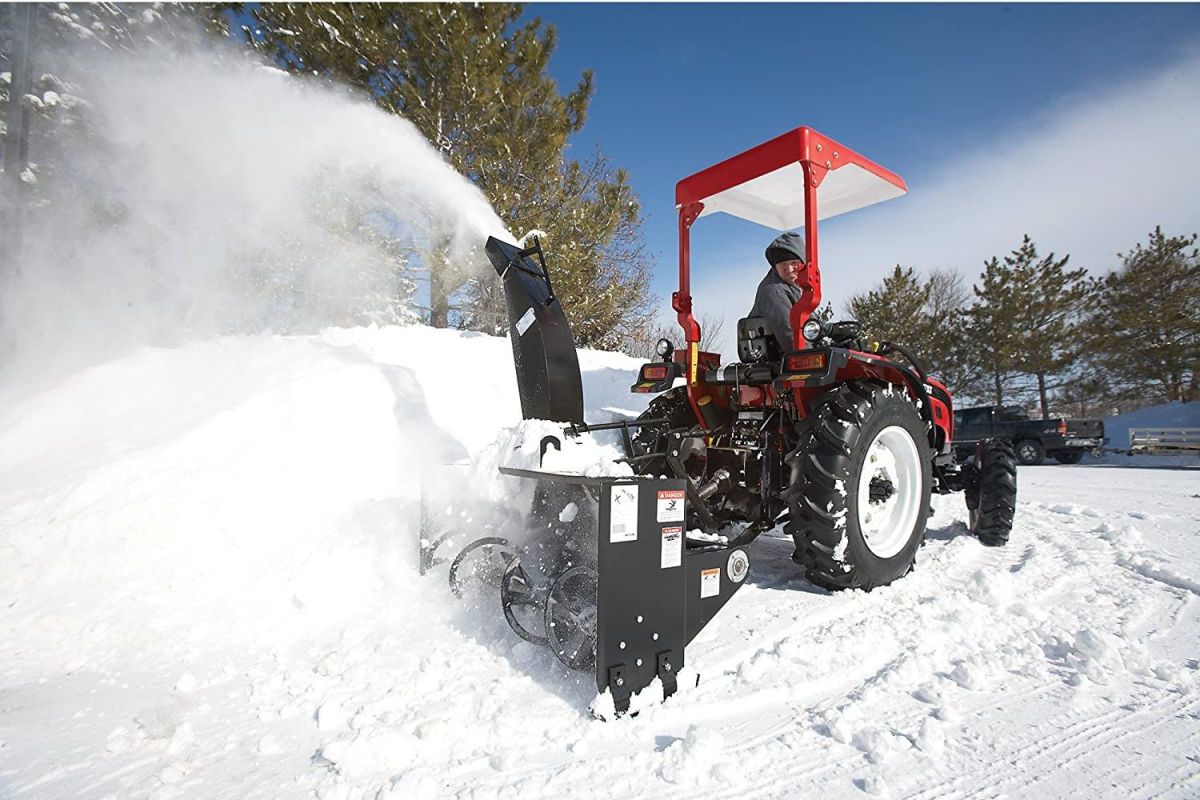

A riding lawn mower spends spring and summer clipping grass, hauling carts, and generally acting like the backyard employee who never asks for vacation. Then winter arrives, the lawn disappears beneath a foot of snow, and that expensive tractor suddenly looks ready for a four-month nap. A lawn mower snow blower combo changes the equation by turning a compatible lawn or garden tractor into a serious snow-removal machine.
Bob Vila’s updated 2026 roundup focuses primarily on snow blower attachments rather than dedicated all-in-one riding snow blowers. That makes sense. For most homeowners, buying a good tractor and adding the correct winter attachment is more practical than owning a specialized machine that only works when the driveway looks like Antarctica.
After comparing Bob Vila’s selections with current information from Husqvarna, Northern Tool, John Deere, Cub Cadet, Consumer Reports, Lowe’s, The Home Depot, Tractor Supply, This Old House, Toro, the Outdoor Power Equipment Institute, and the U.S. Consumer Product Safety Commission, several themes become clear: compatibility matters more than flashy specifications, traction is crucial, and wider is not automatically better.
Best Lawn Mower Snow Blower Combos at a Glance
| Pick | Clearing Width | Best For | Key Requirement |
|---|---|---|---|
| Husqvarna E-Lift 50-Inch 2-Stage | 50 inches | Best overall | Compatible Husqvarna tractor |
| Husqvarna Manual 42-Inch 2-Stage | 42 inches | Best value | Compatible Husqvarna tractor |
| NorTrac 3-Point 72-76-Inch | Up to 76 inches | Large driveways and properties | 35-50 HP tractor, Category 1 hitch |
| Husqvarna E-Lift 42-Inch | 42 inches | Convenient electric operation | Most 2006-and-newer Husqvarna tractors |
| NorTrac 3-Point 50-54-Inch | Up to 54 inches | Compact and utility tractors | 16-35 HP tractor, Category 1 hitch |
1. Husqvarna E-Lift 50-Inch 2-Stage Snow Thrower Attachment: Best Overall
Bob Vila’s best overall choice combines a substantial 50-inch clearing path with features that make a tractor-mounted snow blower less of a wrestling match. Husqvarna specifies a 50-by-19.5-inch opening, two-stage operation, an electric lift, and tool-free attachment or removal after the initial mounting hardware has been installed.
The two-stage system is important. Instead of asking one auger to collect and discharge snow by itself, a two-stage blower feeds snow toward a high-speed impeller that sends it through the chute. This arrangement is particularly useful when the driveway receives deep, packed, or wet snow.
Why it stands out
The electric lift is the star of the show. Being able to raise or lower a heavy front attachment from the tractor seat saves effort every time you transition between pavement, garage floors, and areas you do not want to scrape. The polymer chute resists rust, while the operator can control discharge direction and deflector pitch without repeatedly climbing off the tractor.
There is one important catch: traction. Husqvarna recommends wheel weights and chains, and that recommendation should not be treated as decorative fine print. A heavy snow blower hanging from the front of a two-wheel-drive lawn tractor shifts the weight balance considerably. Rear ballast and tire chains can be the difference between confidently climbing a driveway and performing an embarrassing stationary tire-spinning demonstration for the neighbors.
2. Husqvarna Manual 42-Inch 2-Stage Snow Thrower: Best Bang for the Buck
Not every driveway requires a 50-inch intake or an electric lift. Husqvarna’s 42-inch manual-lift attachment offers the same basic formula in a narrower and generally simpler package.
The attachment uses two 12-inch-diameter serrated augers feeding a high-speed impeller. The discharge chute can rotate 180 degrees, while the deflector can be controlled from the operator’s position. Replaceable skid shoes and a replaceable wear plate are welcome because these are precisely the components that eventually lose arguments with pavement.
Who should buy it?
This option makes particular sense for homeowners who already own a compatible Husqvarna tractor and have a normal residential driveway rather than a half-mile access road. A 42-inch clearing width remains much wider than most walk-behind snow blowers while being easier for a typical lawn tractor to manage than an enormous commercial attachment.
The tradeoff is obvious: raising and lowering the attachment requires more manual effort than with the E-Lift models. If you clear snow frequently, convenience becomes surprisingly valuable around storm number six.
3. NorTrac 3-Point 72-76-Inch Snow Blower: Best for Large Driveways
This is where the term “lawn mower snow blower combo” starts growing a beard and applying for a farm license. The NorTrac 72-inch model is intended for substantially larger tractors equipped with a Category 1 three-point hitch and roughly 35 to 50 horsepower.
Its standard 72-inch body can reach a 76-inch clearing width with the bolt-on wing kit. Northern Tool lists a throwing distance around 40 feet, a 340-degree chute rotation range, and PTO-driven operation.
For large rural driveways, farm lanes, private roads, and parking areas, that width can dramatically reduce the number of passes required. A homeowner clearing a 20-foot-wide driveway with a 76-inch blower is playing a very different game from someone working with a 24-inch walk-behind machine.
The biggest compromise
This is a rear-mounted unit. Unless your tractor and attachment configuration changes the typical operating arrangement, extended snow clearing can mean spending plenty of time checking what is happening behind you. It is powerful and productive, but not necessarily the ergonomic champion of a long winter morning.
The chute is manually controlled in standard form, although hydraulic chute-control hardware is available separately. For frequent use, that upgrade may be worth considering.
4. Husqvarna E-Lift 42-Inch Snow Blower: Best Electric Lift
The 42-inch Husqvarna E-Lift model is a compelling middle ground. It is narrower than the 50-inch flagship yet retains the push-button lift that makes operation much more pleasant.
Husqvarna lists two 12-inch serrated input augers, a high-speed impeller, 180-degree chute rotation, replaceable skid shoes, and a replaceable wear plate. The attachment weighs about 242 pounds and is designed for numerous Husqvarna tractors from model year 2006 onward, although buyers should always confirm their exact tractor model rather than assuming that “probably fits” is a recognized engineering standard.
Like the other Husqvarna attachments, rear weights and tire chains are recommended. Those accessories add cost, but proper ballast should be considered part of the complete winter setup rather than an optional bonus.
5. NorTrac 3-Point 50-54-Inch PTO Snow Blower: Also Consider
For owners of smaller compact tractors, the NorTrac 50-to-54-inch PTO model offers much of the industrial-style construction of the larger NorTrac without requiring 35 to 50 horsepower.
It is designed for Category 1 three-point hitches and tractors in the 16-to-35-horsepower range. Northern Tool lists a 14-inch shear-bolt-protected auger, 24-inch impeller, 340-degree manual chute rotation, adjustable skid shoes, and approximately 25 feet of throwing distance. A bolt-on wing kit expands the working width from 50 to 54 inches.
This model is especially attractive if you already own a compact tractor. In that situation, the machine underneath the attachment has the mass, drivetrain, hitch, and PTO needed for serious winter work. Buying an appropriately sized implement lets that investment keep earning its garage space all year.
How Lawn Mower Snow Blower Combos Actually Work
Most residential combinations are not permanent mower-and-snow-blower hybrids. Instead, the mower deck comes off and a front snow thrower is installed using brackets, belts, pulleys, a mechanical drive system, or a tractor PTO depending on the machine.
Compact tractors frequently use PTO-driven implements and standardized hitch systems. Lawn tractors are more likely to use model-specific frames, mounting brackets, and belt-driven mechanisms. This distinction is why shopping solely by clearing width is a bad idea.
A 42-inch attachment that looks perfect in an online photo is useless if its subframe, belt routing, pulley geometry, lift hardware, or PTO requirements do not match your tractor.
What to Consider Before Buying a Lawn Tractor Snow Blower
Compatibility comes first
Write down the tractor’s complete model and serial information before shopping. Check the manufacturer’s official compatibility information and, for older tractors, confirm fitment with a dealer when necessary.
Do not assume attachments from the same brand automatically fit every generation. Manufacturers change frames, mounting points, PTO systems, and other hardware over time.
Clearing width
A 40-to-50-inch attachment is a practical range for many residential properties. Moving beyond 50 inches becomes more attractive as the driveway gets longer and wider. Attachments exceeding 60 inches are better suited to capable garden, compact, and utility tractors.
More width means fewer passes, but it also means more weight and more snow entering the machine at once. The tractor must have enough power and traction to take advantage of the larger implement.
Single-stage vs. two-stage vs. three-stage
A single-stage machine uses its auger to collect and discharge snow. Two-stage systems add an impeller that throws the collected snow, making them better suited to deeper and heavier accumulation. Three-stage machines add another component designed to accelerate or break up difficult snow.
For a tractor attachment expected to handle substantial winter storms, a two-stage design is generally the sweet spot. It offers strong capacity without the additional complexity and expense associated with specialized three-stage equipment.
Traction and ballast
This factor deserves more attention than horsepower bragging rights. Snow-covered pavement provides far less grip than dry summer turf. Add a few hundred pounds to the front of a tractor, and the lightly loaded rear drive wheels may struggle.
Rear wheel weights, suitcase weights, tire chains, appropriate winter tires, or four-wheel drive can dramatically improve performance. Follow the tractor and attachment manufacturers’ recommendations rather than inventing a backyard ballast system involving cinder blocks and optimism.
Chute controls
Manual chute adjustment is acceptable for occasional use. Seat-operated mechanical, electric, or hydraulic controls become increasingly valuable on large properties because the ideal discharge direction changes constantly.
Good chute control also reduces the likelihood of blowing snow onto freshly cleared pavement and then having to clear it again, a winter activity roughly equivalent to vacuuming the living room while someone follows you dropping crackers.
Skid shoes
Adjustable skid shoes control how closely the blower housing approaches the ground. On smooth paved surfaces, they can be set for a close scrape. On gravel, the attachment should generally ride higher to reduce the chance of ingesting and launching stones.
Lawn Tractor Attachment vs. Walk-Behind Snow Blower
A tractor attachment is not automatically the best choice for every homeowner. A good walk-behind two-stage snow blower may be easier to maneuver around parked cars, narrow sidewalks, patios, and complicated landscaping. It also avoids the seasonal ritual of removing the mowing deck and installing a large attachment.
The tractor combo becomes more convincing when you have a long driveway, broad open areas, substantial annual snowfall, and a compatible tractor already sitting in the garage. It also lets the operator remain seated, which can reduce some of the physical effort associated with pushing and maneuvering a heavy walk-behind unit.
Storage deserves consideration too. The attachment still has to live somewhere during summer, while the mower deck needs a winter parking spot. Combining functions does not make several hundred pounds of steel magically disappear.
Safety and Maintenance Tips
Before the first storm, inspect belts, chains, shear bolts, skid shoes, mounting hardware, lubrication points, tires, controls, and the tractor’s engine. Keep replacement shear bolts specified for the attachment nearby rather than substituting ordinary hardware that may defeat the overload protection.
Never put your hand into a clogged chute or auger housing. The U.S. Consumer Product Safety Commission specifically advises shutting the machine down and using a suitable cleanout tool or long stick to remove packed snow. Stored mechanical tension can allow components to move unexpectedly even when they appear stopped.
Clear rocks, branches, newspapers, extension cords, toys, and other debris from the operating area before snowfall whenever possible. A snow blower is impressively good at throwing snow; unfortunately, it does not suddenly become selective when it discovers a rock.
For gasoline tractors, follow the engine manufacturer’s fuel and seasonal-storage recommendations. Keep the tractor battery maintained, check oil at the recommended intervals, and repair worn belts before winter instead of waiting for them to surrender during the year’s largest storm.
Practical Ownership Experiences: What Specifications Do Not Tell You
The most important real-world lesson with a lawn mower snow blower combo is that the blower itself is only half of the system. Owners often focus on intake width, auger size, and throw distance, but the tractor underneath determines whether those impressive numbers become useful performance.
Experience 1: Traction can become the limiting factor
Imagine a lawn tractor with a powerful two-stage blower moving into 10 inches of wet snow. The auger may have no trouble chewing through the pile, yet the tractor can stop moving because its rear tires start spinning. Adding the manufacturer’s recommended rear ballast and chains can transform the same setup. This is why experienced operators tend to think of the blower, traction equipment, and ballast as one package.
Sloped driveways deserve even more caution. A machine that feels stable while mowing dry grass may behave completely differently on packed snow or hidden ice. Proper speed, ballast, tire setup, and adherence to the tractor’s slope limitations matter more than finishing the driveway two minutes faster.
Experience 2: Installation convenience grows more important every year
The first installation may involve brackets, pulleys, frames, electrical connections, or PTO hardware. After everything is correctly configured, quick-connect or tool-free removal features can save substantial frustration.
This matters most in climates with unpredictable shoulder seasons. If your lawn still needs one final mowing while an early snowstorm is approaching, repeatedly converting the tractor can become annoying. Electric lift systems do not necessarily move more snow, but they can significantly improve everyday ownership because the operator interacts with the lift during nearly every clearing session.
Experience 3: Wet snow changes everything
Five inches of cold powder is very different from five inches of dense, waterlogged snow. Heavy snow places more demand on belts, PTO systems, augers, impellers, traction, and engine output. Going slower and allowing the blower to process the snow is usually more effective than charging forward until the chute clogs.
Planning where the snow lands also matters. If you throw every early-season storm onto the same narrow strip beside the driveway, those piles may freeze into walls. By February, you could run out of places to put new snow. A rotatable chute with convenient controls becomes far more valuable on properties that receive repeated storms.
Experience 4: Wider is wonderful only when the property supports it
A 72-to-76-inch attachment can make a long rural driveway disappear behind you surprisingly quickly. Put that same width near a narrow sidewalk, decorative retaining wall, tightly parked vehicles, or a cramped residential turnaround and suddenly the enormous productivity advantage becomes a maneuverability problem.
Measure gates, paths, garage openings, storage areas, and narrow sections before purchasing. The perfect clearing width is the largest size your tractor and property can comfortably handle, not the largest number available in the catalog.
Experience 5: A combo makes the most financial sense when the tractor already exists
If you already own a compatible tractor, a snow blower attachment can turn one power unit into a four-season tool. If you need to purchase the tractor, attachment, mounting hardware, weights, chains, and other accessories from scratch, however, the total cost may exceed that of a high-quality walk-behind snow blower by a considerable margin.
The calculation therefore depends on the whole property. Someone mowing several acres and clearing a 500-foot driveway can justify a capable tractor throughout the year. Someone with a 40-foot suburban driveway may spend less money, use less storage space, and enjoy easier maneuverability with a conventional snow blower.
Final Verdict
Among Bob Vila’s 2026 picks, the Husqvarna E-Lift 50-Inch 2-Stage Snow Thrower Attachment is the strongest all-around option for owners of compatible Husqvarna tractors. Its 50-inch working width, two-stage design, electric lift, seat-accessible controls, and relatively convenient attachment system make it well suited to serious residential snow removal.
The Husqvarna Manual 42-Inch is the more economical choice for typical driveways, while the 42-Inch E-Lift offers extra convenience without moving up to the larger 50-inch format. Owners of compact tractors should look closely at the NorTrac 50-to-54-inch PTO model, and those maintaining large rural properties can benefit enormously from the productivity of the NorTrac 72-to-76-inch attachment.
Above all, buy for the tractor you actually own and the property you actually clear. Verify compatibility, horsepower, PTO or hitch requirements, traction accessories, and attachment weight before spending money. The right mower snow blower combination can transform a summer lawn machine into a remarkably productive winter workhorse. The wrong one becomes a very expensive garage sculpture.
Note: Product specifications, compatibility lists, pricing, availability, and safety information can change. Confirm your tractor’s exact model and serial number with the equipment manufacturer or authorized dealer before purchasing an attachment, and check current manufacturer instructions and applicable product recalls before operation.