
A dependable tire pressure gauge is hardly the most glamorous tool in the garage. It will not roar, sparkle, or give you an excuse to buy a larger toolbox. Still, this pocket-size device can improve tire life, fuel economy, handling, and safety every time you use it.
The challenge is choosing one that provides repeatable readings without hissing away half the air while you wrestle with the valve stem. Digital, dial, pencil, inflator, and deflator gauges all have their strengths, but accuracy alone does not determine which tool belongs in your glove compartment.
For this guide, current product specifications were compared with hands-on findings from automotive publications, tool-testing organizations, tire manufacturers, retailers, and U.S. safety authorities. The strongest models were evaluated for reading consistency, display clarity, valve-stem engagement, pressure range, durability, portability, and overall ease of use.
Our Top Tire Pressure Gauge Picks
| Category | Recommended Gauge | Best For |
|---|---|---|
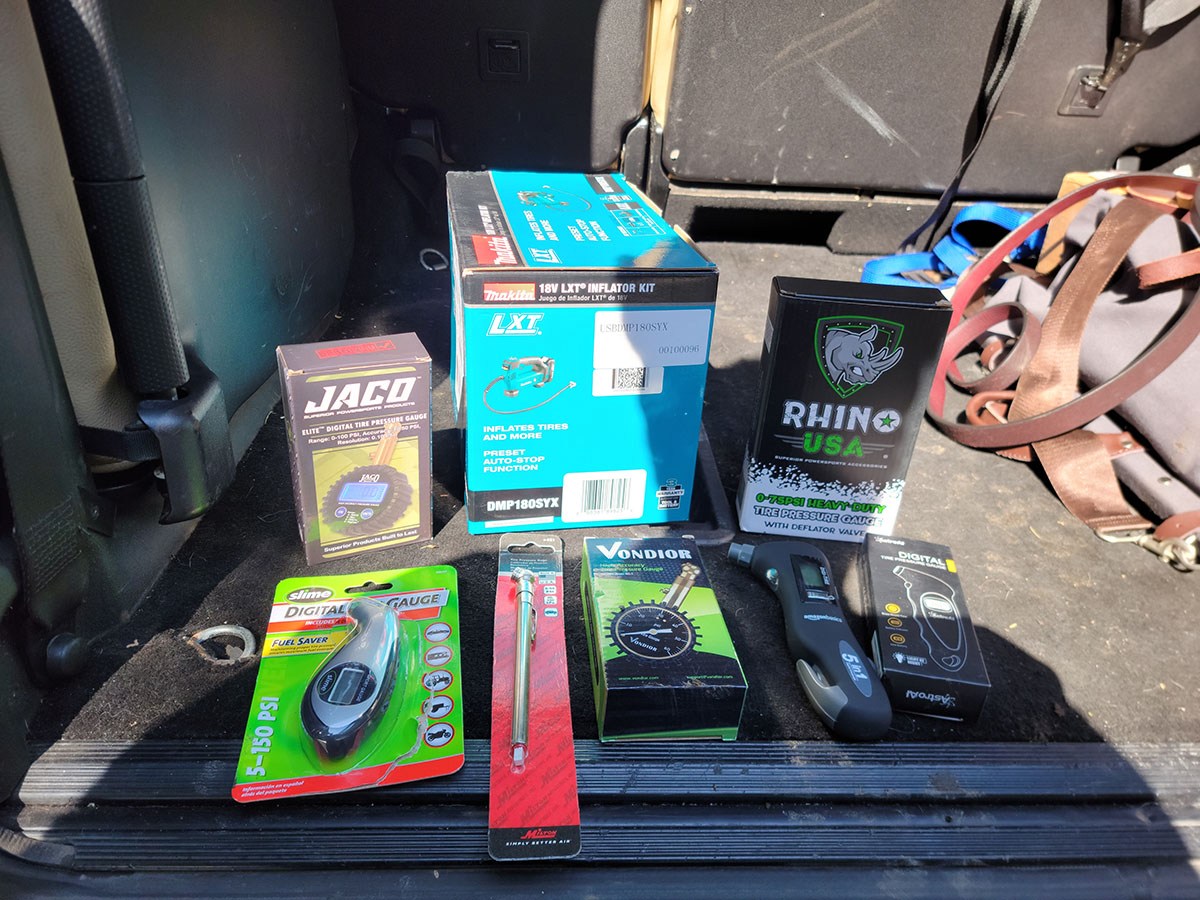
| Best Overall | JACO ElitePro Digital | Accurate everyday and professional use |
| Best Analog | Rhino USA 75 PSI | Battery-free reliability |
| Best Compact Digital | Accutire MS-4021R | Glove compartments and road trips |
| Best Budget Gauge | Milton S-921 | Simple passenger-car pressure checks |
| Best Inflator Gauge | ARB ARB601 | Garages, compressors, and 4×4 vehicles |
| Best for Airing Down | Viair 00032 | Off-road tire pressure adjustments |
| Best Affordable Digital | AstroAI Digital Gauge | Drivers wanting a bright, simple display |
Best Tire Pressure Gauges: Detailed Reviews
Best Overall: JACO ElitePro Digital Tire Pressure Gauge
The JACO ElitePro Digital earns the top position because it combines a clear display, a flexible hose, a rotating chuck, and a rugged protective housing. Its 200-PSI capacity makes it suitable for ordinary cars as well as trucks, trailers, RVs, and many higher-pressure applications.
The screen reports pressure in 0.1-PSI increments, but shoppers should not confuse display resolution with guaranteed accuracy. JACO specifies accuracy of ±0.5 percent of full scale, or approximately ±1 PSI on the 200-PSI model. That is still more than sufficient for routine road-vehicle maintenance.
A built-in bleeder makes small corrections far easier than repeatedly removing the gauge and poking the valve core with a key. The tradeoff is size: this is a substantial tool compared with pocket digital gauges. It is better suited to a garage cabinet, trunk organizer, or serious roadside kit than a crowded center console.
Best feature: Excellent balance of durability, readability, and pressure-control convenience.
Best Analog: Rhino USA 75 PSI Tire Pressure Gauge
The Rhino USA gauge is a strong choice for drivers who want to avoid batteries without returning to a tiny pencil-style scale. Its large two-inch glow dial is protected by a rubber cover, while the braided hose and 360-degree swivel chuck help it reach awkward valve stems.
The 0-to-75-PSI range is well matched to passenger cars, SUVs, motorcycles, and many light trucks. A dedicated bleeder valve allows controlled pressure reduction, and the dial holds its reading after the gauge is removed. That last detail is surprisingly useful when the valve stem is positioned somewhere near your ankle and the lighting resembles a cave.
Because it uses mechanical components, the Rhino should be stored carefully and checked periodically against a trusted reference. It is sturdier than a bargain-bin dial gauge, but no precision instrument becomes more accurate after being bounced around beneath a tow hitch.
Best feature: A large, readable dial with no battery dependency.
Best Compact Digital: Accutire MS-4021R
The Accutire MS-4021R has a long history of use in automotive test garages. Its angled head fits directly over a standard valve stem, and its digital display eliminates the guesswork associated with closely spaced marks on an analog dial.
Readings appear in half-pound increments, which is precise enough for normal passenger-vehicle maintenance. The shape is compact enough for a glove box, although it is not as comfortable around recessed or inward-facing valves as a gauge with a flexible hose.
This model is ideal for drivers who want one-button simplicity. There are no hoses to untangle and few controls to learn. Press it onto the valve, wait for the reading, and move to the next tire. Its principal weakness is shared by most digital tools: eventually, the battery will decide it has retired, usually when the temperature is unpleasant.
Best feature: Proven simplicity in a compact digital design.
Best Budget Gauge: Milton S-921 Pencil Gauge
The Milton S-921 is the automotive equivalent of a cast-iron skillet: old-fashioned, affordable, and difficult to improve without making it more complicated. Its plated-brass body contains a nylon indicator stick marked from 5 to 50 PSI, making it appropriate for most passenger cars.
It requires no batteries and occupies almost no space. The integrated deflator nub can release excess air, although fine adjustments take more patience than they do with a hose-style gauge.
The 50-PSI ceiling limits its usefulness for high-pressure truck, trailer, and compact-spare applications. The sliding indicator also needs to remain clean; dirt can interfere with smooth movement. For an inexpensive backup gauge, however, the Milton is hard to beat.
Best feature: Reliable basic operation at a very low cost.
Best Inflator Gauge: ARB ARB601 Digital Tire Inflator
The ARB ARB601 is more than a pressure checker. Connected to an air compressor, it can measure, inflate, and deflate through one handheld unit. A large backlit display, thumb-operated inflation lever, separate bleed control, and long braided hose make repeated adjustments efficient.
ARB lists a measurement range up to 200 PSI and accuracy within approximately ±1 PSI between 25 and 75 PSI. The protective rubber boot and corrosion-resistant body suit garage and off-road environments, while the dual-swivel hose reduces the likelihood of fighting the tool at an inconvenient angle.
This is overkill for someone who checks a sedan once a month and uses a gas-station compressor. For off-road drivers, home mechanics, or anyone managing several vehicles, its speed and convenience can justify the higher cost.
Best feature: Inflation, deflation, and measurement in a single durable tool.
Best for Airing Down: Viair 00032 Air Down Gauge
Off-road drivers frequently lower tire pressure to increase the contact patch on sand, dirt, or rocky terrain. The Viair 00032 is designed specifically to make that process faster. It combines a twist-on chuck, analog gauge, and deflation control in a compact package.
Its 0-to-60-PSI range is sensible for passenger vehicles and light trucks, and the 8.5-inch hose provides useful reach. The twist-on connector creates a secure seal, though it takes longer to attach than a push-on chuck. This is not the best choice for high-pressure RV tires, but it is a practical trail companion.
Best feature: Fast, controlled pressure reduction for off-road use.
Best Affordable Digital: AstroAI Digital Tire Pressure Gauge
AstroAI offers several low-cost digital gauges, and its common handheld design is popular for good reason. The illuminated nozzle helps locate a valve stem at night, while the backlit screen is easier to read than a small mechanical scale. Multiple pressure units also make the gauge useful for drivers who switch between PSI, bar, and kPa.
The plastic body is lighter and less robust than the reinforced JACO or ARB designs. It also lacks the flexible reach of a hose-style model. Nevertheless, it is an approachable option for everyday drivers who want a clear digital reading without spending heavily.
Best feature: Bright, straightforward operation at an accessible price.
How the Gauges Were Evaluated
A useful tire gauge must do more than display an impressive number of decimal places. The most important quality is repeatability: several readings from the same tire should remain close together. A gauge that reports 34.2, 31.7, and 36.1 PSI in consecutive checks is not precision equipment; it is an automotive fortune cookie.
Published hands-on results and product specifications were assessed using five practical criteria:
- Reading consistency: Whether repeated measurements stayed within a narrow range.
- Seal quality: How easily the chuck engaged the valve without prolonged air loss.
- Readability: Display size, lighting, scale spacing, and visibility at awkward angles.
- Durability: Protection from drops, moisture, dirt, cold storage, and normal garage abuse.
- Convenience: Hose flexibility, swivel movement, bleeder control, portability, and battery requirements.
Pressure range also mattered. A 50-PSI pencil gauge can be excellent for a sedan but unsuitable for a high-pressure spare or heavy-duty trailer. The best tire pressure gauge is therefore the one that is accurate within the pressure range you actually usenot necessarily the model with the largest number printed on the package.
How to Choose a Tire Pressure Gauge
Digital vs. Analog vs. Pencil
Digital gauges provide fast, unambiguous readings and are especially helpful in low light. They may offer several measurement units, but they require batteries and can be less dependable after long exposure to extreme temperatures.
Dial gauges are easy to read, usually include bleeder valves, and work without electrical power. Quality varies considerably, and a hard impact can affect calibration. A rubber protective boot is worth having.
Pencil gauges are inexpensive, compact, and mechanically simple. Their narrow scales are harder to read precisely, and they must stay clean to operate properly. They make excellent emergency backups.
Choose the Right Pressure Range
Select a range that comfortably includes your vehicle’s recommended pressure. Most passenger cars operate around 30 to 35 PSI, but the correct number is vehicle-specific. Trucks, trailers, bicycles, and temporary spare tires may require substantially more.
A narrowly focused 60- or 75-PSI gauge often provides a more useful scale for car tires than a 200-PSI model. The larger range becomes valuable when one tool must serve several types of vehicles.
Look for a Good Chuck and Flexible Hose
A precise gauge is not very helpful if its chuck cannot seal against the valve. Angled, rotating, and dual-head chucks improve access around large wheels and recessed valve stems. Flexible hoses reduce wrist strain and make the display easier to position.
Do Not Confuse Resolution with Accuracy
A screen that displays tenths of a PSI may look authoritative, but that last decimal does not guarantee laboratory accuracy. Resolution describes the smallest displayed increment. Accuracy describes how close the reading is to the true pressure. Manufacturer calibration claims and repeatable measurements matter more than an abundance of digits.
How to Check Tire Pressure Correctly
- Find the recommended cold tire pressure on the driver-side door jamb, fuel door, or owner’s manual.
- Check the tires before driving or after the vehicle has been parked for at least three hours.
- Remove the valve cap and press or attach the gauge squarely to the valve stem.
- Take two or three readings if the first measurement seems unusual.
- Add or release air until the pressure matches the vehicle manufacturer’s recommendation.
- Recheck the pressure, reinstall the valve cap, and inspect the tire for visible damage.
Do not use the maximum pressure molded into the tire sidewall as the normal inflation target. That number describes the tire’s maximum permitted cold pressure, not the pressure selected by the automaker for your vehicle’s weight, handling, and ride characteristics.
Check all tiresincluding the spareat least monthly and before long trips, towing, or carrying a heavy load. A tire-pressure monitoring system is not a replacement for a gauge. Federal standards generally require the warning to appear only after pressure has fallen significantly, potentially around 25 percent below the recommended cold setting.
Why Correct Tire Pressure Matters
Underinflation increases tire flex and heat buildup. It can accelerate shoulder wear, reduce fuel efficiency, dull steering response, and raise the risk of tire damage. Overinflation can make the ride harsher, reduce the tire’s ability to absorb impacts, and contribute to uneven center wear.
Temperature changes also affect pressure. A drop of roughly 10 degrees Fahrenheit can lower tire pressure by about 1 PSI, although real-world changes vary. That is why a warning light may appear on a cold morning and disappear later. The disappearing light does not mean the tire has magically negotiated a better contract with winter; it still deserves a cold-pressure check.
Real-World Experience: What Using These Gauges Actually Teaches You
Specifications tell only part of the story. Across garage tests, roadside checks, daily commuting, and off-road pressure adjustments, the biggest difference between gauges is often not absolute accuracy but how easily each model produces a clean reading.
A compact digital gauge feels wonderfully efficient when the valve stem is easy to reach. Press the head against the stem, wait for the beep or stabilized display, and you are finished. On deeply recessed wheels, however, that same gauge can force your hand against the rim. A hose-equipped model immediately feels less elegant but much more civilized.
Seal technique matters too. New users sometimes blame the tool when they hear a quick burst of escaping air. Usually, the chuck has approached the valve at an angle. A firm, straight connection produces a short initial hiss followed by silence and a stable reading. Swivel chucks make this easier, particularly on motorcycles, dual-wheel trucks, and wheels with decorative covers.
The value of a pressure-hold feature becomes obvious after the first nighttime check. With a holding dial or digital memory, you can remove the gauge and read it under a light instead of crouching beside the tire like a mechanic searching for a lost contact lens. Backlit displays are even better, provided the controls remain simple enough to operate with cold fingers.
Bleeder valves are another feature that sounds optional until you use one. Suppose the placard recommends 35 PSI and the tire reads 38. With a bleeder-equipped gauge, you can release air in short taps and watch the pressure settle. Without one, you remove the tool, depress the valve core, reconnect the gauge, and repeat. That routine is not difficult, but by the third tire it begins to feel like paperwork.
Pencil gauges perform best as permanent backups. They can remain in a glove compartment for years without battery anxiety, and a quality model is perfectly capable of identifying meaningful underinflation. Their weakness appears when you want to distinguish between closely spaced readings. A slightly dirty indicator stick or an awkward viewing angle can turn 34 PSI into “somewhere around 35-ish,” which is adequate for emergencies but less satisfying during careful maintenance.
Digital gauges inspire confidence because their numbers look exact, yet repeated checks remain essential. If a gauge produces a suspicious reading, remove it and measure again. Consistency across three attempts is more persuasive than one unusually precise-looking decimal. Owners who maintain several vehicles may also benefit from keeping a second trusted gauge and comparing the two occasionally.
Cold-weather experience favors simple tools. Batteries weaken, LCD screens respond more slowly, and plastic housings become less pleasant to grip. Analog and pencil gauges avoid battery problems, while rugged digital models with replaceable batteries remain preferable to cheap sealed units. Whatever the design, storing the gauge in a protective pouch helps keep dirt out of the chuck and prevents damage from loose cargo.
Finally, convenience influences maintenance frequency. Drivers are more likely to check their tires when the gauge is readable, reachable, and stored near the vehicle. A professional-grade tool buried at the back of a workshop is less useful than a dependable compact gauge sitting in the glove box. The smartest arrangement is often two gauges: a durable hose-style model for accurate home adjustments and an inexpensive backup for roadside checks.
Final Verdict
The JACO ElitePro Digital is the best tire pressure gauge for most buyers because it combines consistent measurements, a large display, a flexible hose, and a convenient air bleeder. Drivers who prefer battery-free equipment should consider the Rhino USA 75 PSI, while the Accutire MS-4021R offers excellent portability for routine passenger-car use.
For the lowest-cost emergency option, the Milton S-921 remains a dependable classic. Off-road enthusiasts will get more value from the Viair 00032 or the compressor-compatible ARB ARB601. Whichever model you choose, use it monthly, check tires cold, and follow the pressure listed by the vehicle manufacturer.
Note: Product specifications, packaging, availability, and model revisions may change. Confirm the current pressure range and compatibility before purchasing.