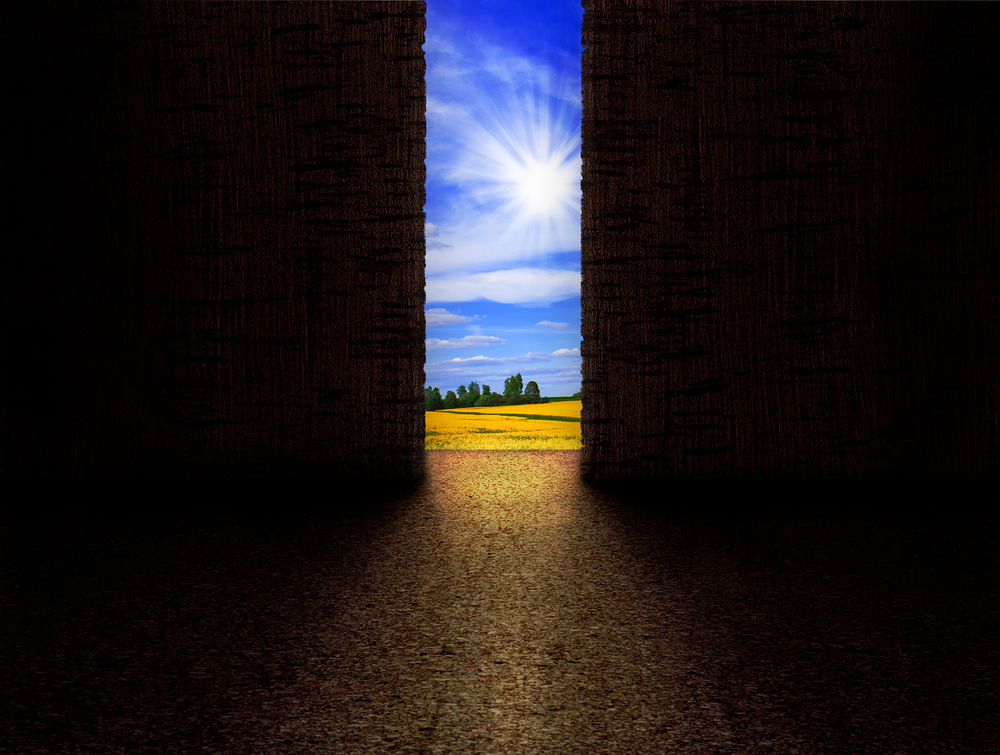

Somewhere between science, philosophy, and late-night movie marathons, humanity keeps returning to one deliciously strange idea: what if there were a door connecting two worlds? Not a wooden door with a squeaky hinge and a suspiciously dramatic breeze behind it, but a cosmic doorwaya shortcut through space-time, a bridge between galaxies, dimensions, timelines, or even parallel universes. It is the kind of idea that makes physicists sharpen pencils, science fiction writers rub their hands together, and the rest of us wonder whether our closet is underperforming.
The phrase “the door that connects two worlds is still elusive” captures a deep modern fascination. We want the universe to have hidden corridors. We want reality to be bigger, weirder, and maybe a little more convenient than a 13-hour flight with no legroom. In physics, the closest real concept to such a door is often called a wormhole, or more formally, an Einstein-Rosen bridge. The idea suggests that two distant regions of space-time might be connected by a tunnel-like structure. Walk in on one side, step out somewhere unimaginably far away. Simple? Not even slightly.
Based on what scientists currently know, wormholes remain theoretical. Black holes are real. Gravitational waves are real. Light bending around massive objects is real. Quantum entanglement is real. But a stable, traversable portal connecting two worlds? That cosmic door has not shown up on the universe’s floor plan yet.
What Does “A Door Between Two Worlds” Really Mean?
In popular culture, a door between two worlds can mean many things: a portal to another planet, a gateway to a parallel dimension, a tunnel through time, or a shortcut across the universe. In science, the phrase usually points toward three big ideas: wormholes, black holes, and the multiverse.
A wormhole is the most literal version of the cosmic door. It is a hypothetical tunnel through space-time. Instead of traveling across the surface of the universe from point A to point B, a wormhole would connect the two places through a deeper shortcut. The classic analogy is folding a sheet of paper so two distant dots touch, then poking a hole between them. It is a great classroom demonstration and a terrible instruction manual for interstellar engineering.
A black hole, meanwhile, is not a portal in the ordinary scientific sense. NASA describes black holes as regions where gravity is so intense that nothing, not even light, can escape after crossing the event horizon. They are detected by their effects on nearby matter, light, stars, and gravitational waves. They bend reality beautifully, but they do not currently function as cosmic subway stations.
The multiverse adds another layer of intrigue. Some cosmological theories suggest that our universe may not be the only one. There could be other regions of reality with different histories, constants, or physical laws. But even if such universes exist, there is no verified doorway connecting them. In other words, the multiverse may be a mansion, but no one has found the hallway.
The Einstein-Rosen Bridge: The Original Scientific Doorway
The modern wormhole idea traces back to Albert Einstein and Nathan Rosen, who explored a mathematical bridge in general relativity in 1935. Their work came from studying the equations around extreme gravity. Later, physicist John Wheeler helped popularize the term “wormhole,” giving science one of its most memorable names. Frankly, “Einstein-Rosen bridge” sounds like a very serious engineering project. “Wormhole” sounds like something that might ruin an apple and the structure of space-time. Much better branding.
The problem is that the original Einstein-Rosen bridge is not the kind of doorway anyone could walk through. In standard interpretations, it collapses too quickly for matter, light, or information to cross safely. It is less like a useful tunnel and more like a cosmic tease: mathematically interesting, physically uncooperative.
That distinction matters. Science fiction often treats wormholes as stable tunnels. Physics treats them as delicate possibilities buried inside equations that may or may not describe anything nature actually builds. The math allows certain structures, but math also allows frictionless surfaces, perfect spheres, and budgets that survive home renovation. Reality tends to be pickier.
Why Wormholes Are So Hard to Keep Open
For a wormhole to become a true door between two worlds, it must be traversable. That means something could enter one side and exit the other without being crushed, trapped, vaporized, or converted into a cautionary footnote. The challenge is stability.
Most theoretical wormholes would collapse almost instantly. Gravity wants to pinch the throat shut. To keep it open, many models require something called exotic matter, often described as matter with negative energy density. Ordinary matter attracts gravitationally. Exotic negative energy, in theory, could push outward and hold the wormhole open.
Here is where the cosmic door starts asking for materials that are not available at your local hardware store. Negative energy appears in limited quantum contexts, such as effects related to quantum fields, but scientists have not found a way to gather enough of it to prop open a human-sized wormhole. A stable portal would require control over space-time on a scale that makes current technology look like stone tools with Wi-Fi.
The Null Energy Problem
In general relativity, many traversable wormhole models violate what physicists call energy conditions. These conditions describe how matter and energy normally behave. When a theory requires matter to behave in ways we have never observed at cosmic scale, scientists do not throw a party and book tickets through the portal. They investigate carefully, argue politely, publish papers, and add more coffee.
Some newer models explore whether wormholes could exist without traditional exotic matter or with only tiny violations of energy conditions. These studies are valuable because they test the boundaries of gravitational theory. However, they do not mean a physical doorway has been discovered. They mean the mathematics is still alive, still weird, and still refusing to sit quietly.
Black Holes Are Real, But They Are Not Easy Doors
Black holes are often dragged into portal conversations because they are the most extreme gravitational objects we know. They warp space-time dramatically. They can bend light into rings. They can form from collapsed massive stars. Supermassive black holes live at the centers of galaxies, including Sagittarius A* at the heart of the Milky Way.
But real black holes are not currently considered practical gateways. NASA explicitly notes that black holes do not provide shortcuts to other regions of space or portals to other dimensions. Their event horizons are one-way boundaries. Once something crosses, it cannot send information back to the outside universe. That is not a door. That is a “Do Not Enter” sign written by gravity in very large letters.
Still, black holes are central to the mystery because they expose the gap between general relativity and quantum mechanics. General relativity describes gravity and the large-scale universe beautifully. Quantum mechanics describes the microscopic world with astonishing accuracy. But inside black holes, both theories are pushed to their limits. The elusive door between two worlds may not be a spaceship tunnel. It may be a theoretical bridge between two great frameworks of physics.
Quantum Entanglement: A Different Kind of Connection
Another reason scientists keep discussing wormholes is their possible relationship with quantum entanglement. Entanglement occurs when quantum systems share a connection so deep that measuring one tells us something about the other, even if they are far apart. This does not allow faster-than-light messaging, despite what your favorite sci-fi villain might claim while wearing a dramatic cape.
In 2013, physicists Juan Maldacena and Leonard Susskind proposed a famous idea called ER = EPR. “ER” refers to Einstein-Rosen bridges, while “EPR” refers to Einstein, Podolsky, and Rosen’s work on quantum entanglement. The conjecture suggests that wormholes and entanglement may be two ways of describing related underlying physics.
This idea does not mean every pair of entangled particles contains a tiny sci-fi tunnel ready for delivery service. Instead, it hints that space-time geometry and quantum information may be deeply connected. If true, the most important “door” may not connect planets or parallel Earths. It may connect gravity with quantum theory.
The Quantum Computer Wormhole: A Portal, But Not That Kind
In 2022, a team involving researchers from Caltech, MIT, Harvard, Fermilab, Google, and other institutions reported an experiment using Google’s Sycamore quantum processor to simulate wormhole-like dynamics. Headlines understandably had a field day. “Physicists create wormhole” sounds like the opening scene of either a Nobel Prize ceremony or a movie where someone should have read the safety manual.
The careful version is more interesting and less apocalyptic. Researchers did not open a physical tunnel in space. They created a quantum system whose behavior mathematically resembled certain properties of a traversable wormhole in a simplified holographic model. Information moved through the system in a way analogous to traveling through a wormhole. That is impressive. It is also not a doorway you can step through while carrying luggage.
The experiment matters because it gives scientists a way to test ideas about quantum gravity in controlled systems. It suggests that quantum computers may become laboratories for exploring the relationship between information, gravity, and space-time. The elusive door remains closed, but researchers may now have a better flashlight.
The Multiverse: Many Worlds, No Confirmed Entrance
The phrase “two worlds” naturally invites the idea of parallel universes. Cosmology offers several versions of the multiverse. Some come from inflation, the theory that the early universe expanded extremely rapidly. Others arise from string theory landscapes or interpretations of quantum mechanics. The basic idea is that what we call “the universe” might be only one region within a much larger reality.
But the multiverse remains controversial because direct evidence is hard to obtain. If another universe is causally disconnected from ours, we may not be able to observe it at all. Some scientists search for possible clues in cosmic background radiation or mathematical consistency. Others warn that theories must remain testable to stay within science rather than drift into elegant speculation.
This is why the door between worlds is still elusive. The problem is not simply distance. It is evidence. A true scientific portal requires more than imagination, more than equations, and definitely more than a glowing circle in the basement. It requires observable, repeatable, testable signs that nature actually provides such a connection.
Why We Keep Looking for the Door
Human beings love thresholds. Doors divide here from there, known from unknown, ordinary from extraordinary. Every culture has stories about hidden gates: caves to underworlds, mirrors to alternate realms, wardrobes to enchanted lands, star gates to distant civilizations. Science did not invent the dream of crossing between worlds. It inherited the dream and asked for measurements.
That is the beautiful tension. Science does not kill wonder. It disciplines wonder. It says, “Amazing idea. Now show your work.” Wormholes, quantum bridges, and multiverse theories remain powerful because they sit at the edge of what is known. They are not random fantasies. They emerge from serious attempts to understand gravity, time, information, and the origin of the universe.
The elusive door also reflects something emotional. We imagine other worlds because we sense the limits of this one. We want to know whether reality has hidden rooms. We want to believe the universe is not a sealed box but a vast structure with secret architecture. Physics has not confirmed that such doors exist, but it has revealed a universe far stranger than common sense ever expected.
Specific Examples That Keep the Mystery Alive
1. Gravitational Lensing
Massive objects bend light, creating arcs and rings that reveal invisible gravity. This does not prove wormholes exist, but it shows that space-time behaves like a flexible structure rather than a fixed stage. If gravity can bend light across cosmic distances, it is reasonable for physicists to ask what other geometries might be possible.
2. Gravitational Waves
Detected ripples in space-time confirm that violent cosmic events can shake the fabric of the universe. Black hole mergers have become real data, not just chalkboard drama. These discoveries strengthen confidence in general relativity while also highlighting where deeper theories may be needed.
3. Quantum Teleportation
Quantum teleportation transfers quantum information between systems using entanglement and classical communication. It does not teleport people, coffee, cats, or unpaid bills. Still, it proves that information behaves in ways that seem almost magical until the math arrives wearing sensible shoes.
4. Holographic Duality
Some theories suggest that gravitational systems can be described by lower-dimensional quantum systems, almost like a hologram. This idea has become central to modern wormhole research because it may connect space-time geometry with quantum information.
5. Black Hole Information Research
The black hole information paradox asks what happens to information that falls into a black hole. Wormholes appear in some theoretical approaches to this puzzle. Again, they may not be travel tunnels, but they could be conceptual tools that help physicists understand reality’s deepest bookkeeping system.
So, Will We Ever Open the Door?
The honest answer is: no one knows. A traversable wormhole may be impossible. Or it may require forms of matter, energy, and engineering beyond anything we can currently imagine. Or wormholes may exist only as mathematical tools, useful for understanding quantum gravity but not as physical tunnels. Science often advances by discovering that the universe is both more restrictive and more creative than expected.
What seems clear is that the search will continue. Physicists will keep testing general relativity. Quantum researchers will keep exploring entanglement. Cosmologists will keep studying the early universe. Astronomers will keep observing black holes, gravitational waves, and cosmic structures. Each field approaches the same locked door from a different hallway.
Even if no portal ever opens, the search itself may reveal something more important: how space-time emerges, why gravity works, whether quantum information is fundamental, and what kind of universe we actually inhabit. The door that connects two worlds may remain elusive because we have misunderstood what the “two worlds” are. Perhaps they are not two planets or two universes. Perhaps they are the world of gravity and the world of quantum mechanics, waiting for a theory that finally lets them speak the same language.
Personal Experiences and Reflections: Living With the Idea of an Unopened Door
The idea of “the door that connects two worlds” has a strange way of following people around. You do not need to be a physicist to feel its pull. Anyone who has stood under a dark sky has probably experienced a quiet version of it. The stars look close enough to touch, yet every point of light is separated from us by distances so enormous that ordinary language starts wheezing. A door would be convenient. A shortcut would be comforting. The universe, however, appears to prefer long routes and dramatic scale.
One relatable experience is the moment a person first learns that the stars they see may no longer exist in the same form. Light takes time to travel. Looking at space is looking into the past. That realization feels like a doorway, even if it is not a physical one. It connects the present with ancient cosmic history. The night sky becomes less like a ceiling and more like an archive. Suddenly, “two worlds” can mean now and then, Earth and deep space, human time and cosmic time.
Another experience comes from technology. Video calls, virtual reality, online games, and digital communities already create emotional doors between worlds. A teenager in Vietnam can talk instantly with someone in California. A student can explore a simulation of Mars. A gamer can walk through a fantasy city with friends who are physically thousands of miles away. These are not wormholes, but they shape our expectations. Because information now moves so easily, we start wondering why bodies cannot do the same. The internet made distance feel negotiable. Physics has not signed that agreement.
Science fiction deepens the feeling. Movies and novels often present portals as symbols of courage, escape, discovery, or danger. A door to another world is never just transportation. It is a test. Should we open it? Are we ready for what is on the other side? Would we bring wisdom, or just snacks and bad decisions? The best portal stories work because they reflect real scientific humility. Unknown worlds are thrilling precisely because they are unknown.
There is also a personal side to the phrase. Many people experience “two worlds” in everyday life: childhood and adulthood, home and school, online identity and offline reality, memory and ambition. The elusive door can represent the desire to move smoothly between versions of ourselves. We want access to the person we were, the person we might become, or the life we imagine just beyond current circumstances. In that sense, the cosmic metaphor becomes human. The universe is not the only thing with hidden architecture.
Studying wormholes and parallel worlds can also teach patience. Modern culture loves instant answers. Physics does not. The biggest questions may take generations. Some ideas remain theoretical for decades before evidence appears. Gravitational waves were predicted long before they were detected. Black holes were once treated by some as mathematical oddities before observations made them unavoidable. This history encourages curiosity without gullibility. The right attitude is neither “portals are definitely real” nor “wonder is silly.” The better answer is: keep asking, keep testing, and keep your spaceship insurance updated just in case.
The elusive door matters because it keeps imagination connected to discipline. It reminds us that real discovery begins with a question bold enough to sound unreasonable, then survives only if evidence supports it. Whether wormholes become physical realities or remain theoretical tools, they have already opened a different kind of door: a doorway into deeper thinking about space, time, gravity, and the limits of human knowledge.
Conclusion
The door that connects two worlds is still elusive because nature has not yet shown us a stable, traversable passage through space-time or into another universe. Wormholes remain theoretical. Black holes are real but not confirmed portals. Quantum entanglement is real but not a magic tunnel. The multiverse is fascinating but still difficult to test. Yet the search is far from pointless. Every serious attempt to understand cosmic doors pushes science closer to the deepest questions: What is space? What is time? How does gravity fit with quantum mechanics? And is reality larger than the universe we can observe?
For now, the door remains closed. But the knocking continues.
SEO Tags
Note: This article is written for web publication in standard American English and synthesizes real scientific information from reputable U.S.-based science sources including NASA, Caltech, MIT, Scientific American, Quanta Magazine, Smithsonian Magazine, Harvard & Smithsonian, Space.com, Live Science, Nature, and the American Physical Society.