
Note: This article is written for web publication and synthesized from real Open Hardware Summit, OSHWA, open hardware certification, and electronic conference badge history.
When a Conference Badge Becomes the Main Character
At most conferences, a badge is a rectangle of plastic that says your name, your company, and possibly whether you are important enough to receive a slightly better sandwich. At the Open Hardware Summit, the badge is something else entirely. It is a tiny manifesto, a wearable circuit board, a conversation starter, a technical workbook, and sometimes a small electronic creature that seems one firmware update away from asking for coffee.
The exquisite badges of Open Hardware Summit are not just souvenirs. They are physical expressions of what open source hardware means: design files in the open, documentation that invites participation, components selected with purpose, and a community that treats learning as a shared sport. A good Open Hardware Summit badge says, “Welcome,” but it also whispers, “Unscrew me, inspect me, reprogram me, improve me, and please do not panic if the LED blinks in Morse code.”
This is why electronic conference badges matter so much in the maker and hardware world. They are not merely decorative. They compress industrial design, printed circuit board layout, firmware, supply-chain decisions, accessibility, branding, manufacturing, and community culture into one object small enough to hang around your neck. The result is part name tag, part development board, part art piece, and part nerdy friendship bracelet.
What Makes an Open Hardware Summit Badge Different?
The Open Hardware Summit is organized around the idea that hardware can be shared the way software has long been shared: with source files, licenses, documentation, and the freedom to study, modify, make, distribute, and sell designs based on the original work. That philosophy changes the meaning of a conference badge. In a closed system, the badge is finished when the event begins. In an open hardware system, the badge is only beginning its second life when the attendee takes it home.
An Open Hardware Summit badge is successful when it does three jobs at once. First, it identifies the attendee. Second, it teaches. Third, it becomes reusable after the conference. That last point is crucial. The best badges are not destined for a drawer full of mystery USB cables and one lonely hotel key card. They become reference designs, soldering practice boards, CircuitPython playgrounds, e-textile experiments, or small monuments to the beautiful chaos of open collaboration.
The 2018 Badge: E-Paper Elegance With ESP32 Brains
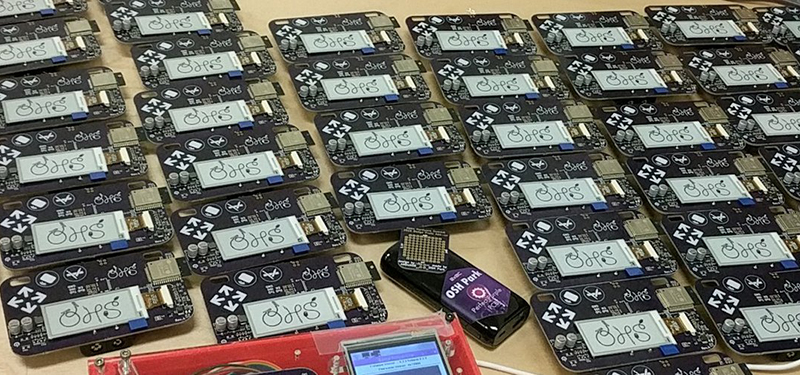
The 2018 Open Hardware Summit badge is one of the most beloved examples because it looked refined while hiding serious engineering under the surface. It used an e-paper display, an ESP32 processor, WiFi capability, and individually programmed attendee information. That combination made it both elegant and ambitious. The e-paper screen gave the badge a calm, polished look, like a name tag designed by someone who owns both a soldering iron and a carefully labeled spice rack.
What made the 2018 badge especially impressive was not only the technology, but the logistics. Programming a few boards is fun. Programming hundreds of boards with unique attendee names and details is where fun puts on steel-toed boots and becomes production engineering. Each badge needed to be assembled, flashed, verified, and matched to a real person. That process turned the badge into a miniature lesson in manufacturing discipline.
The 2018 badge also showed why certification matters. Its listing as certified open source hardware gave the project a formal identity and made it easier for others to confirm that the design met open hardware expectations. In practical terms, certification gives a badge more than bragging rights. It gives future builders a clear trail to follow.
Why E-Paper Was Such a Smart Choice
E-paper is not flashy in the usual conference-swag sense. It does not scream for attention like a wall of RGB LEDs at midnight. But that is exactly the point. E-paper is readable, power-efficient, and visually distinctive. On a badge, it feels intentional. It turns the object from “gadget” into “designed artifact.” The display can hold an image or name without constantly draining the battery, which is extremely helpful when a summit day stretches from morning coffee to evening hallway debates about connector standards.
The ESP32 also made sense. It brought wireless capability and enough computing power to make the badge hackable beyond its original function. In other words, the 2018 badge was not only a pretty face. It had a brain, and unlike many pretty faces, it came with documentation.
The 2020 Wrist-Watch Badge: Wearable, Hackable, and Very Summit
The 2020 Open Hardware Summit badge moved in a different direction: a wrist-watch form factor. This was a clever shift because it changed the relationship between person and object. A lanyard badge hangs passively. A wrist badge feels like a device. It sits where a smartwatch would sit, inviting button presses, glances, experiments, and the occasional dramatic gesture during technical conversations.
The 2020 badge included a Nordic nRF52840-based design capable of running CircuitPython, a small IPS LCD, user buttons, sensors, and a rechargeable battery system. It was designed in KiCad and documented openly, which matters because KiCad has become one of the most important tools in modern open hardware design. By using accessible tools and open files, the badge became more than summit swag. It became a study guide for people who want to understand how real wearable electronics are designed.
There is also something poetic about a badge that runs CircuitPython. Python has long been a welcoming language for beginners, and CircuitPython extends that friendliness into physical computing. A summit attendee could look at the badge, connect it, edit code, and see the hardware respond. That is the open hardware learning loop in its purest form: curiosity, access, experiment, result, repeat.
Badges as Tiny Museums of Open Hardware Values
Every Open Hardware Summit badge carries layers of meaning. The PCB layout is a design lesson. The bill of materials is a supply-chain story. The firmware is a software lesson. The enclosure, fabric, display, LEDs, or buttons are industrial design decisions. Even the mistakes are educational. Especially the mistakes. Hardware is a stern teacher with a hot soldering iron and no patience for assumptions.
This is why open documentation is so important. A beautiful badge without design files is a magic trick. A beautiful badge with schematics, board files, firmware, licenses, and build notes is a classroom. Open source hardware turns admiration into participation. You do not merely say, “That is cool.” You can ask, “How does it work?” and then actually find out.
That shift is powerful. It lowers the wall between expert and beginner. It also respects the intelligence of the community. Open hardware assumes that users are not just consumers. They are potential collaborators, repairers, educators, remixers, and future designers.
The Aesthetic Side: Why These Badges Look So Good
Electronic badges can easily become component confetti: a board, a battery, a screen, a few buttons, and enough silkscreen jokes to make an oscilloscope roll its eyes. The best Open Hardware Summit badges avoid that trap. They treat the PCB as a visual medium. Copper, solder mask, exposed pads, traces, vias, and silkscreen are not just technical necessities. They are part of the graphic design.
A well-designed open hardware badge often has visual hierarchy. The name or identity area is clear. Interactive elements are easy to find. Connectors are labeled. The board shape feels intentional. The sponsor marks, if present, do not overpower the artifact. The badge looks like something a person wanted to make, not something that escaped from a parts bin during a thunderstorm.
The art also serves the mission. A badge that looks inviting encourages people to touch it, ask about it, and open the documentation. That matters at a summit where the whole point is to connect people across electronics, science, education, manufacturing, digital fabrication, accessibility, sustainability, and community practice.
The Engineering Challenge Behind the Beauty
Conference badges seem playful from the outside, but producing them is not a casual weekend project. A summit badge has deadlines that cannot move, quantities that are large enough to punish small mistakes, and attendees who expect the object to function when they arrive. It must survive shipping, registration tables, backpacks, coffee spills, static electricity, and the eternal human urge to press all buttons immediately.
Designers must balance cost, reliability, battery life, parts availability, manufacturability, and educational value. A rare component may be exciting, but if it cannot be sourced in time, it becomes a tiny villain. A dense layout may look impressive, but if it is hard to assemble or debug, it can turn production into a group therapy session. Good badge design means choosing features that serve the experience rather than collecting specifications like trading cards.
Manufacturing Is Where Dreams Meet Invoices
The most elegant badge ideas still have to pass through fabrication, assembly, flashing, testing, packaging, and distribution. This is where open hardware badges become serious professional exercises. Board houses, assembly partners, component distributors, firmware maintainers, and volunteers all become part of the story. A badge may fit in a palm, but the workflow behind it can involve many hands.
That manufacturing reality is one reason these badges are so valuable as learning objects. They show that hardware is never only about a clever schematic. It is also about repeatability. Can the design be built 300 times? Can it be tested quickly? Can problems be diagnosed without heroic detective work? Can a beginner understand the documentation after the original designer has moved on to the next beautiful headache?
From PCB Badges to E-Textiles: The Badge Keeps Evolving
Recent Open Hardware Summit badge concepts have expanded beyond traditional rigid circuit boards. The 2025 badge, for example, explored an e-textile direction, using fabric and sewn electronics as part of the experience. That is a meaningful evolution. It reminds the community that open hardware is not limited to rectangular PCBs, microcontrollers, and the smell of flux. Hardware can be soft, wearable, tactile, inclusive, and artistic.
E-textiles also invite different kinds of makers into the conversation. Sewing a circuit changes the emotional texture of electronics. It feels less like assembling a machine and more like crafting an object with personality. For people who might be intimidated by soldering, fabric-based electronics can offer another doorway into hardware. For experienced engineers, it is a delightful reminder that electrons do not care whether the conductor is on a purple PCB or stitched into cloth, as long as the circuit works.
Why Open Hardware Summit Badges Matter for Education
One of the greatest strengths of these badges is that they compress complex subjects into approachable objects. A single badge can introduce a learner to microcontrollers, displays, batteries, sensors, PCB design, firmware, licensing, documentation, and manufacturing. That is a lot of education dangling from a lanyard.
For teachers, a summit badge can become a curriculum seed. Students can trace signals, identify components, modify code, compare design revisions, or discuss why certain parts were selected. For self-taught makers, the badge can be a friendly challenge. It says, “Here is a real object from a real event. Now take it apart intellectually.” That is far more engaging than a generic development board with no story attached.
The story matters because people remember stories. They remember that a badge was made for a specific summit, that it had a display, that it ran CircuitPython, that it used an e-paper screen, or that it could be sewn together. Those details make technical learning sticky. The badge becomes a character in the learner’s memory.
Community, Conversation, and the Joy of Visible Circuits
At a normal conference, networking often begins with awkward small talk. At Open Hardware Summit, a badge can do the heavy lifting. Someone notices a display, a blinking LED, a clever board outline, or a strange connector, and suddenly the conversation has a natural beginning. “Did you hack yours yet?” is a much better opener than “So, what do you do?” It is also less likely to make everyone stare into their coffee.
Badges also create shared rituals. People compare modifications, trade add-ons, debug problems together, and celebrate small victories. One attendee might help another load new firmware. Someone else might explain how the power circuit works. A third person might arrive with a sticker, a patch, or a tiny board that makes the badge do something unexpected. This is community formation through objects.
The Badge as a Post-Conference Artifact
The best Open Hardware Summit badges do not retire when the closing talk ends. They travel home and become desk ornaments, teaching tools, reference designs, or hacking targets. Their open files keep them alive. A closed badge becomes nostalgia. An open badge becomes possibility.
This post-conference life is one of the great advantages of open hardware. A person can revisit the project months or years later, study the design, fork the files, reuse a circuit block, or teach from the documentation. The badge stops being a one-time object and becomes part of a broader knowledge commons.
What Designers Can Learn From These Exquisite Badges
Designers of future conference badges can learn several lessons from Open Hardware Summit. First, make the object useful after the event. Second, document everything in formats people can actually modify. Third, choose features that support learning and interaction. Fourth, treat manufacturing as part of the design, not an annoying chore performed by gremlins after midnight. Fifth, remember that beauty matters.
Beauty does not mean decoration for decoration’s sake. It means coherence. A beautiful badge has a reason for its shape, its interface, its materials, and its behavior. It communicates care. In open hardware, care is contagious. When a project is thoughtfully designed and clearly documented, other people are more likely to respect it, use it, improve it, and share their improvements.
Experiences Inspired by the Open Hardware Summit Badge Culture
Imagine arriving at an Open Hardware Summit-style event and receiving a badge that feels heavier than expected. Not heavy in a bad way, but heavy with promise. You turn it over and see labeled pins, a microcontroller, perhaps a tiny screen, and traces that curve with the confidence of a designer who has spent quality time negotiating with PCB layout software. Before the first session begins, the badge has already started teaching.
The first experience is curiosity. You look around and realize everyone else is doing the same thing: tilting the badge toward the light, pressing buttons, reading silkscreen labels, and pretending they are not secretly impressed. Someone nearby says, “I think this connector exposes serial,” and suddenly a small crowd forms. Nobody planned a workshop, but one appears anyway. That is the magic of a well-designed hardware badge. It creates spontaneous learning.
The second experience is humility. Hardware has a way of reminding people that reality is not impressed by confidence. A wire goes to the wrong pin. A battery is not charged. A driver is missing. A button behaves differently than expected. But in an open hardware community, these moments are not failures. They are invitations. Someone has a cable. Someone else has a laptop. A third person has seen the issue before and explains it with the calm voice of a person who has already made that mistake in three different decades.
The third experience is delight. When the badge finally responds, changes text, blinks, displays an image, logs sensor data, or runs a small script, the satisfaction is completely out of proportion to the size of the object. That is because the reward is not just technical. It is personal. You touched the system and the system answered. You were not locked out. You were invited in.
The fourth experience is connection. Badges make people easier to approach. A student can ask an engineer about a component. An artist can ask a firmware developer about animation. A teacher can ask a designer how to adapt the board for a classroom. The badge becomes a passport into conversations that might otherwise remain sealed behind job titles and nervous introductions.
The final experience comes later, after the summit is over. The badge sits on a desk, still carrying the memory of talks, workshops, hallway conversations, and small technical triumphs. One day, you pick it up again. Maybe you open the design files. Maybe you borrow a circuit idea. Maybe you show it to someone younger and say, “This is what open hardware looks like.” That moment is the real success of the badge. It outlives the schedule. It keeps teaching.
Conclusion: A Badge, a Board, and a Beautiful Argument
The exquisite badges of Open Hardware Summit prove that small objects can carry big ideas. They show that openness is not an abstract slogan. It can be held, worn, programmed, sewn, repaired, studied, and shared. From e-paper ESP32 badges to CircuitPython wrist badges and e-textile experiments, these objects turn conference identity into hands-on education.
In a world where too many devices are sealed, undocumented, and allergic to screwdrivers, Open Hardware Summit badges make a cheerful counterargument. They say that technology is better when people can understand it. They say that documentation is an act of generosity. They say that a badge can be more than a badge. It can be a tiny, blinking, beautifully routed invitation to participate.