
Editorial note: This article synthesizes publicly available historical information from U.S. Navy, U.S. Air Force, museum, military aviation, and defense-history sources. It is written for web publication in standard American English and avoids unnecessary source-link formatting.
Introduction: Before the Movie, There Was a Problem
Long before Hollywood gave us aviator sunglasses, beach volleyball, and pilots who speak almost entirely in cool one-liners, the real history of Topgun began with a hard military question: why were highly trained American fighter crews struggling in the skies over Vietnam?
The answer was not simple. U.S. aircraft were advanced, missiles were supposed to make close-range dogfighting obsolete, and many planners believed the age of turning fights was fading into history. Then reality taxied onto the runway, lit the afterburner, and ruined everyone’s neat theory. In Vietnam, American pilots faced agile MiG fighters, strict rules of engagement, unreliable missiles, surface-to-air missiles, anti-aircraft artillery, and enemy tactics that did not politely follow U.S. expectations.
Out of that uncomfortable lesson came two of the most important ideas in modern military aviation: the U.S. Navy Fighter Weapons School, famously known as TOPGUN, and the U.S. Air Force Aggressor squadron system. Both were built around a brutally practical concept: if pilots were going to survive real combat, they needed realistic combat training before the shooting started.
This is the real history of Topgun and Aggressor Squadron pilotsnot the movie version, not the recruiting-poster version, but the fascinating story of how American air combat training changed from classroom theory to high-speed, high-pressure, sweat-inside-the-helmet realism.
The Vietnam Wake-Up Call
By the 1960s, many military thinkers believed air combat had changed forever. Missiles were the future. Radar-guided and heat-seeking weapons seemed to promise kills from a distance. Guns were even removed from some fighter designs because old-school dogfighting was supposedly yesterday’s news. That prediction aged about as well as milk left on a carrier deck in July.
In Vietnam, U.S. Navy and Air Force crews discovered that technology alone did not guarantee victory. Rules of engagement often required pilots to visually identify enemy aircraft before firing. That meant fighters had to close the distance, maneuver aggressively, and sometimes fight within gun range. Missiles failed, missed, or were launched outside their ideal parameters. Meanwhile, North Vietnamese pilots used MiG-17s, MiG-19s, and MiG-21s with smart tactics, ground-controlled intercept support, and the advantage of fighting near home.
The result was sobering. American pilots were brave and well trained by the standards of the day, but many had not received enough realistic dissimilar air combat training. Too often, they practiced against aircraft similar to their own, flown by pilots using familiar American methods. Real enemy pilots did not fly like squadron buddies. They flew differently, used different strengths, and forced U.S. aviators into uncomfortable situations.
That gap between expected combat and actual combat became the seed of change. Both the Navy and Air Force started asking sharper questions. What did enemy pilots actually do? What did Soviet-designed aircraft do well? How could American crews learn to recognize, counter, and defeat those tactics before combat?
The Ault Report and the Birth of TOPGUN
For the Navy, the turning point came through an investigation led by Captain Frank W. Ault. The resulting study, commonly known as the Ault Report, examined why Navy air-to-air performance had fallen short of expectations. It identified shortcomings in training, weapons employment, tactics, maintenance, and aircrew preparation. One of its most famous recommendations was the creation of an advanced fighter weapons school.
In 1969, the United States Navy Fighter Weapons School was established at Naval Air Station Miramar in California. Its nickname, TOPGUN, stuck quickly because it was shorter, punchier, and frankly much easier to paint on a sign than “United States Navy Fighter Weapons School.” The early school was modest in size but enormous in ambition. It was not built to create swagger. It was built to create teachers.
The original TOPGUN instructors focused on fundamentals: fighter maneuvering, missile employment, threat knowledge, disciplined briefing, and brutally honest debriefing. Students learned how to fight one-on-one, how to understand the enemy’s strengths, and how to return to their fleet squadrons as instructors. That “train the trainers” model became one of TOPGUN’s greatest contributions. A graduate was not simply a better pilot; he became a multiplier for the entire fleet.
Early TOPGUN students flew aircraft such as the F-4 Phantom II, while instructors used smaller, more agile adversary aircraft to simulate enemy fighters. The point was not to make training fair. The point was to make it useful. If a Navy crew could defeat a sharp instructor flying like a MiG pilot, that crew had a much better chance in the real world.
Why Dissimilar Air Combat Training Changed Everything
Dissimilar air combat training, often called DACT, sounds technical, but the idea is simple: do not practice only against yourself. A football team does not improve by running plays against a defense that already knows the script. A boxer does not prepare for a southpaw by sparring only with right-handed friends. Fighter pilots needed opponents who looked, flew, and thought differently.
TOPGUN’s adversary aircraft played the role of the enemy. They were not enemy aircraft, of course, but they were flown in ways that replicated enemy tactics. A small A-4 Skyhawk could imitate some of the turning characteristics and visual challenges of a MiG. The F-5 Tiger II became useful because its size, speed, and handling could approximate certain threat aircraft. Later, aircraft such as the F-16 also became valuable adversary platforms.
The breakthrough was not just the airplane. It was the mindset. Instructors studied enemy doctrine. They learned how opposing pilots used formations, radar control, missile envelopes, and altitude. They then used that knowledge to create uncomfortable, realistic training fights. TOPGUN was not about proving who had the biggest ego in the ready room. It was about exposing mistakes before combat exposed them permanently.
The Air Force Builds Its Aggressor Squadrons
The U.S. Air Force faced many of the same lessons from Vietnam. Its own analysis of air combat performance, including studies such as Project Red Baron, showed that pilots needed more realistic preparation. The Air Force response took shape through Aggressor squadrons and the Red Flag exercise system.
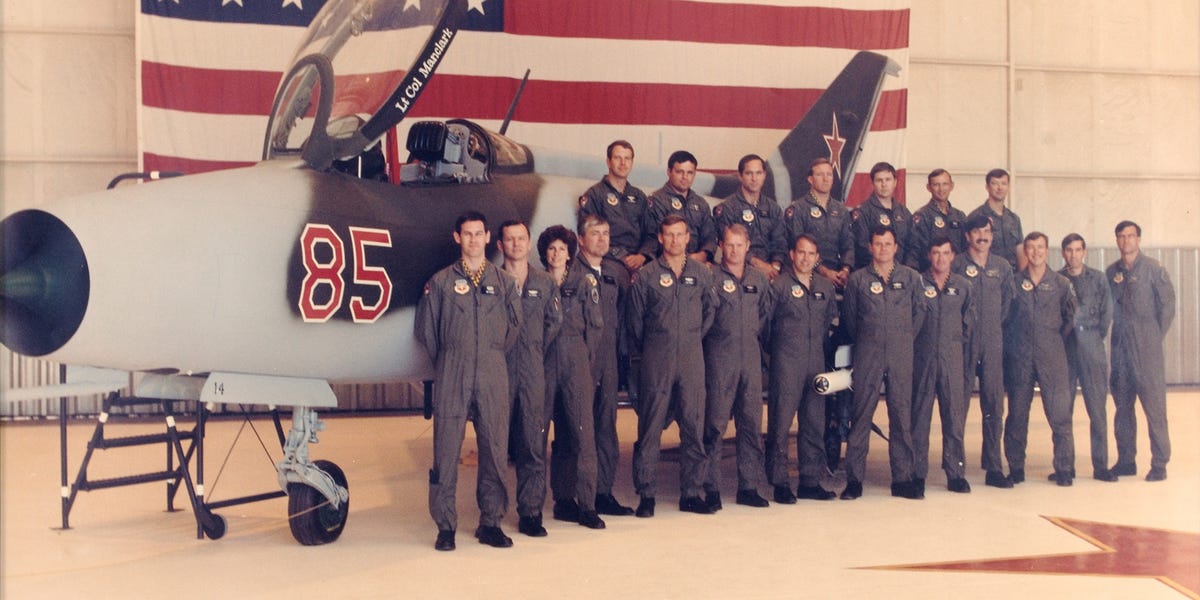
The first Air Force Aggressor program began in the early 1970s, with the 64th Aggressor Squadron at Nellis Air Force Base becoming one of the best-known units. Its mission was direct and demanding: know the adversary, teach the force, and replicate the threat. That three-part philosophyknow, teach, replicatestill captures the spirit of Aggressor work.
Aggressor pilots were not pretending to be movie villains. They were professional educators flying as the “red air” opponent. Their job was to study foreign aircraft, foreign doctrine, foreign weapons, and foreign command-and-control methods, then reproduce them in training. They flew U.S. aircraft such as the T-38, F-5, F-15, and F-16, but they used them to simulate adversary behavior. In other words, the airplane might have had an American data plate, but the tactics were deliberately foreign-flavored.
Red Flag: The University of Air Combat
Red Flag began at Nellis Air Force Base in 1975 as one of the most influential training exercises in aviation history. Its logic was both simple and sobering: if aircrews survived their first ten combat missions, their odds of surviving later missions improved. So why not give pilots those first ten high-stress missions in training instead of war?
Red Flag became a large-scale, realistic combat exercise involving aircraft, ground threats, electronic warfare, command and control, intelligence, space, cyber, and coalition operations. Blue forces represented friendly units. Red forces, including Aggressor squadrons, created the enemy problem. The Nevada Test and Training Range gave crews enormous airspace in which to practice complex missions that could not be safely or realistically duplicated near a home base.
The Aggressors made Red Flag bite. They forced visiting pilots to fight opponents who knew how to exploit mistakes. They used unfamiliar tactics, realistic threat presentations, and disciplined debriefs. A pilot might leave a sortie slightly bruised in pride, but that was the point. Better to lose a simulated fight over Nevada than learn the lesson for the first time over hostile territory.
TOPGUN Moves from Miramar to Fallon
For many people, TOPGUN will always be associated with Miramar because of the 1986 film Top Gun. Historically, Miramar was indeed the school’s birthplace and long-time home. But the real school moved in 1996 to Naval Air Station Fallon, Nevada, as part of a broader restructuring that created the Naval Strike and Air Warfare Center, now known as the Naval Aviation Warfighting Development Center.
Fallon offered something Miramar increasingly could not: vast training ranges and the ability to integrate air-to-air, air-to-ground, electronic warfare, maritime strike, and large-force training in one environment. Modern naval aviation is not just about one fighter defeating another fighter. It is about integrating aircraft, sensors, weapons, ships, networks, and commanders across a battlespace that moves very fast and forgives very little.
At Fallon, TOPGUN became part of a larger ecosystem of naval weapons schools. The classic air-to-air mission remained central, but the school’s world expanded. Strike Fighter Tactics Instructors, adversary instructors, and air intercept controllers all became part of the larger mission: make the fleet tactically sharper before deployment.
The Real TOPGUN Pilot Is Usually a Teacher First
Hollywood naturally focuses on the hotshot fighter pilot because that is more fun than watching someone spend hours building slides for a tactics lecture. But the real TOPGUN graduate is often less “lone wolf” and more “elite instructor with a terrifyingly organized notebook.”
The school’s purpose is to send graduates back to the fleet with the ability to teach. They help squadron commanding officers, junior pilots, weapons systems officers, and aircrew understand current tactics and threats. They refine training plans, lead briefs, conduct debriefs, and translate lessons from high-end tactical development into everyday squadron performance.
The debrief is especially important. In fighter aviation, the debrief can be longer, harder, and more valuable than the flight. Every decision is reviewed. Every radar call, missile shot, turn, communication error, and missed opportunity gets examined. Rank matters less than truth. If the lieutenant made the right call and the senior officer made the wrong one, the tape will say so. The goal is not embarrassment. The goal is improvement.
Aggressor Pilots: The Good Guys Who Play the Bad Guys
Aggressor pilots occupy one of the strangest and most important roles in military aviation. Their mission is to lose strategically by winning tactically. In plain English, they try very hard to defeat friendly pilots in training so those friendly pilots can survive and win in combat.
To do that well, Aggressors must understand more than aircraft performance charts. They study adversary culture, doctrine, weapons, radar behavior, formations, decision-making, and command systems. Some Aggressor work also involves ground controllers, intelligence specialists, electronic warfare experts, and mission planners. The pilot in the jet is only the visible tip of a much larger training iceberg.
Aggressor aircraft often wear distinctive camouflage schemes inspired by potential adversary aircraft. The paint is not just for style, though it definitely looks cool on a flight line. It helps pilots visually recognize that they are facing an opponent, and it reinforces the training environment. When a pilot sees a specially painted F-16 coming fast across the range, the brain gets the message: this is not business as usual.
From F-5s to F-16s, F-15s, and F-35s
The aircraft used by TOPGUN and Aggressor squadrons have changed as threats have changed. Early adversary aircraft included the A-4 Skyhawk, T-38 Talon, and F-5 Tiger II. These jets were smaller and often cheaper to operate than frontline fighters, yet they could replicate important aspects of enemy aircraft performance.
As potential adversaries fielded more advanced fighters, U.S. training had to evolve. The Air Force used F-16s and F-15s in Aggressor roles to better represent modern threats. The Navy also used aircraft such as the F-16N and F-5 variants in adversary training. More recently, fifth-generation threats have pushed the training world toward even more advanced replication, including the reactivation of the 65th Aggressor Squadron with F-35 aircraft at Nellis.
This evolution matters because modern air combat is not just about turning performance. Sensors, electronic warfare, data links, stealth, long-range missiles, and information control now shape the fight. A pilot may lose before seeing the opponent visually. That does not make dogfighting irrelevant; it means dogfighting is only one layer of a much larger contest.
Myths About TOPGUN and Aggressor Squadrons
Myth 1: TOPGUN Is Just a School for Cocky Fighter Pilots
The real school values confidence, but confidence without discipline is just noise with a flight helmet. TOPGUN is academically demanding, tactically serious, and built around teaching the fleet.
Myth 2: Aggressors Simply Fly Around as Targets
Aggressors are not target drones with better parking spots. They are experts trained to replicate adversary tactics with precision. Their job is to make training realistic, not easy.
Myth 3: Modern Missiles Made Dogfighting Obsolete
Missiles changed air combat, but history has repeatedly warned against declaring any form of combat obsolete too early. Visual identification, rules of engagement, electronic warfare, and tactical surprise can still force close-range engagements.
Myth 4: The Movie Shows How It Really Works
The film captured the excitement and intensity of naval aviation, but real TOPGUN is more professional, more academic, and much less likely to include spontaneous shirtless sports as official curriculum. Probably.
Why This History Still Matters
The real history of Topgun and Aggressor Squadron pilots matters because it shows how military organizations learn. The Navy and Air Force did not respond to Vietnam simply by buying better aircraft. They changed how people trained, how tactics were taught, and how mistakes were handled. They built institutions that turned painful lessons into repeatable excellence.
That is the deeper story. TOPGUN and Aggressor squadrons are not just about fast jets. They are about humility under pressure. They prove that even advanced technology needs skilled humans, honest feedback, and relentless practice. They also show that realistic opposition is one of the best teachers. A friendly instructor who can defeat you like an enemy may be the best friend you have.
Experiences and Lessons from the TOPGUN and Aggressor World
To understand the experience of TOPGUN and Aggressor training, imagine combining graduate school, competitive sports, engineering analysis, and a roller coaster that can pull enough Gs to make your neck file a complaint. The experience is not simply “fly fast and look heroic.” It is a cycle of preparation, execution, criticism, correction, and repetition.
A typical high-end training event begins long before engines start. Pilots study the mission, the threat, the weather, the weapons, the range rules, and the roles of every aircraft involved. They review intelligence products and determine what the adversary is expected to do. They plan communications, formations, fuel timing, tanker support, emergency procedures, and decision points. The brief can feel like a courtroom, a chess lesson, and a physics exam all at once.
Then comes the flight. In the air, the world compresses. A pilot may be managing radar information, radio calls, aircraft energy, fuel, formation spacing, threat reactions, missile timelines, and the uncomfortable fact that the “enemy” is actively trying to ruin the plan. The Aggressor’s job is to create pressure. If blue forces make a lazy assumption, the Aggressor attacks it. If they miss a radar picture, the Aggressor exploits it. If they communicate poorly, the scenario punishes them. It is not personal. It is professional discomfort, carefully engineered.
After landing, the real learning begins. The debrief strips away ego. Modern instrumentation, video, radar tracks, and communication recordings allow instructors to reconstruct the fight. Nobody gets to hide behind “I thought I was winning.” The data tells the story. A good debrief identifies what happened, why it happened, and how to fix it. That culture can be difficult, but it is one of the reasons these programs are respected. Feelings may be gently bruised; tactics get better.
For Aggressor pilots, the experience is especially unusual because success often means making someone else better. They study adversary tactics deeply, then fly in a way that helps friendly forces learn. Sometimes that means overwhelming a student who needs to feel the speed of failure. Sometimes it means shaping a scenario so a squadron can practice a specific skill. The Aggressor is part opponent, part instructor, part actor, and part tactical scientist.
For fleet pilots and visiting aircrews, the experience can be humbling. Many arrive highly capable. Then they meet instructors who have spent years studying exactly how to expose weaknesses. That humility is valuable. Combat is not impressed by confidence unless confidence is backed by preparation. TOPGUN and Aggressor training teach that the best pilots are not the ones who never make mistakes. They are the ones who identify mistakes quickly, learn faster than the opponent, and bring those lessons back to the team.
The broader lesson reaches beyond aviation. Any high-performance field can learn from this model. Practice against realistic opposition. Invite criticism before reality delivers it more harshly. Study competitors honestly. Train teachers, not just stars. Build a culture where truth matters more than rank, comfort, or ego. That is the real legacy of TOPGUN and the Aggressor squadrons. The jets are spectacular, yes. The afterburner is cool, obviously. But the lasting achievement is a training culture that turned hard-earned history into disciplined readiness.
Conclusion
The real history of Topgun and Aggressor Squadron pilots is more impressive than the myth because it was born from failure, analysis, and reform. Vietnam exposed weaknesses in American air combat preparation. TOPGUN and the Aggressor squadrons transformed those lessons into a new training philosophy based on realism, adversary knowledge, dissimilar air combat, and honest debriefing.
From Miramar to Fallon, from Nellis to Eielson, from A-4s and F-5s to F-16s, F-15s, and F-35s, the mission has evolved with the threat. But the core idea remains the same: train against the toughest possible opponent before facing the real one. The pilots who wear TOPGUN patches or fly as Aggressors are not just performers in the theater of speed. They are teachers, analysts, tacticians, and professional sparring partners whose work has shaped generations of American and allied aircrews.
Hollywood made TOPGUN famous. History made it necessary. And the Aggressor squadrons made sure that when American pilots step into combat, their first hard lesson does not have to be their last.