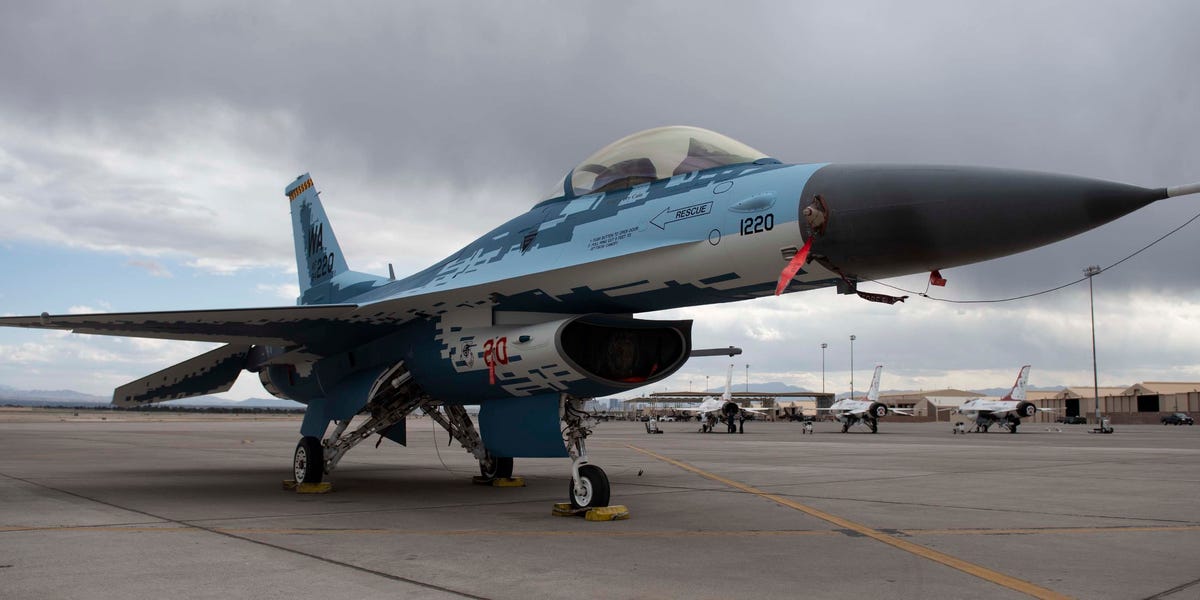

Some aircraft paint jobs whisper. Others politely introduce themselves. And then there are the ones that taxi by wearing a digital gray suit so dramatic it looks like it just walked out of a spy thriller with a wind machine and a suspicious accent. That is exactly the vibe created by an F-16 wearing a paint scheme inspired by Russia’s Su-57 “Felon,” a stealthy-looking fighter famous for its jagged gray camouflage and futuristic silhouette.
At first glance, the idea sounds like aviation cosplay: take a classic American F-16 Fighting Falcon, cover it in angular, pixel-like grays, add a visual attitude problem, and suddenly it looks less like a familiar Western workhorse and more like a Russian superfighter’s stunt double. But this is not just a beauty contest for people who own too many airplane patches. Paint schemes like this have a serious purpose in military aviation training. They help pilots recognize, react to, and mentally process threat-like aircraft during high-end exercises.
The result is a fascinating blend of art, psychology, and air combat training. It is also a reminder that even in the age of sensors, data links, and stealth design, what a pilot sees still matters. The F-16 may be decades old, but give it the right livery and it can still make aviation fans spill coffee on their keyboards.
Why This F-16 Looks So Familiar to Russian Aircraft Watchers
The F-16’s new paint job borrows visual cues from the Sukhoi Su-57, Russia’s fifth-generation fighter. The Su-57 is often associated with sharp gray camouflage patterns, angular transitions, and a digital or splintered look that breaks up the aircraft’s outline. On the F-16, that design language becomes instantly noticeable because the jet’s normal silhouette is so recognizable. The F-16 has a bubble canopy, single engine, and compact frame; it is not shaped like a Su-57. Yet the right paint can trick the eye just enough to create an “I know what that reminds me of” moment.
That is the magic of adversary paint schemes. They do not turn one aircraft into another. Nobody is looking at an F-16 and genuinely mistaking it for a twin-engine Russian stealth fighter after a second glance. But from certain angles, at speed, under real training pressure, the visual suggestion can be powerful. The brain fills in gaps faster than a comment section fills with arguments.
The most recognizable feature is the gray-on-gray pattern. Instead of a smooth, traditional camouflage layout, the scheme uses hard edges and broken geometry. It feels modern, almost digital, as though a graphic designer and a radar engineer got trapped in the same room and came out with a paint booth appointment. This visual style is especially associated with recent Russian fighter presentations, where aircraft such as the Su-57 have appeared in dramatic pixelated or splinter-style camouflage.
The Real Reason Aggressor Jets Wear Strange Paint
Military aggressor aircraft exist to play the role of the opposition in training. Their job is not to look pretty, though some of them clearly did not get that memo. Their real purpose is to give pilots realistic, challenging, threat-representative scenarios before they ever face real danger. In U.S. Air Force training, aggressor squadrons have long used distinctive paint schemes, markings, and tactics to create a more convincing red-air environment.
The 64th Aggressor Squadron at Nellis Air Force Base is one of the most famous examples. Its mission centers on preparing warfighters for air combat by replicating potential adversary behavior and appearances. The squadron operates F-16 aircraft and participates in high-end training events such as Red Flag, where U.S. and allied aircrews practice complex missions in realistic conditions.
That is where paint becomes more than decoration. When a pilot sees a gray, angular, unfamiliar-looking aircraft across the training space, it adds realism. It helps create the feeling that this is not just another friendly jet wearing the same old gray office uniform. It is a visual cue: think differently, react quickly, and remember that the aircraft across from you is playing a threat role today.
Why Use an F-16 to Imitate a Russian Superfighter?
The F-16 Fighting Falcon is one of the most successful fighter aircraft ever built. It is compact, agile, widely used, and familiar to generations of pilots. It has served the United States and many allied nations in a variety of roles, from air defense to ground attack support. In training, that flexibility makes it a useful platform for adversary work.
Of course, an F-16 is not a Su-57. The shapes, engines, systems, and design philosophies are different. But the F-16 has a major advantage: it is available, proven, maintainable, and capable of providing challenging air-to-air training. In other words, it may not be the same animal, but it can still make pilots sweat in the simulator’s more expensive cousin: the sky.
The point is not perfect imitation. The point is useful replication. Aggressor aircraft are designed to represent threat concepts, not clone every rivet of a foreign jet. A painted F-16 can provide the visual impression of a different aircraft type while experienced pilots and training planners shape the scenario around the learning objective. The paint gets the pilot’s attention; the training environment does the rest.
The Su-57 Connection: Why the “Felon” Look Gets Attention
The Su-57, known by NATO reporting name “Felon,” is Russia’s most visible attempt at a fifth-generation fighter. Its public appearances have made its sharp lines and distinctive camouflage familiar to aviation followers. Whether one views the Su-57 as a cutting-edge fighter, a limited-production prestige aircraft, or a very expensive flying argument depends on which aviation forum one accidentally opened at midnight.
What is not debatable is that the Su-57 has a memorable look. Its gray digital camouflage helps create a sense of speed and stealth even when the aircraft is standing still. That kind of visual identity is exactly why an F-16 painted in a similar style grabs attention. It borrows the Su-57’s mood, not its engineering.
In 2019, U.S. aviation watchers noticed an F-16 aggressor scheme designed to resemble the Su-57’s digital gray pattern. Years later, private adversary-air provider Top Aces also drew attention with an F-16A wearing a Su-57-inspired “Felon” paint job. These examples show that the theme has staying power. Apparently, “make the F-16 look like a Russian stealth fighter” is not a one-time idea; it is a recurring character in the theater of aviation coolness.
Top Aces and the Rise of Private Aggressor F-16s
Top Aces has become an important name in the private adversary-air world. The company operates former military aircraft for advanced training support, including F-16s upgraded for aggressor missions. Its Su-57-inspired F-16 livery attracted attention because it combined a real adversary training role with a striking visual tribute to one of the world’s most talked-about fighter designs.
This matters because modern air training is increasingly complex. U.S. and allied pilots do not just need to fly against another aircraft. They need to practice in environments that feel crowded, unpredictable, and realistic. Private aggressor companies can help provide additional aircraft and specialized training services, freeing military units for other demands while still giving frontline pilots valuable experience.
The Top Aces F-16 wearing a “Felon”-style paint scheme is not simply an aviation influencer looking for likes, although let’s be honest, it absolutely earned them. It represents a broader trend: adversary training is becoming more sophisticated, more visual, and more tailored to the aircraft and threats pilots may need to understand.
Does Camouflage Still Matter on Modern Fighter Jets?
In the age of radar, infrared sensors, and networked warfare, aircraft camouflage does not have the same role it had in earlier eras. A fighter jet is not hiding behind a cloud wearing a mustache and hoping nobody notices. Modern detection depends on many factors beyond paint color. Radar signature, heat signature, electronic emissions, mission planning, altitude, and weather all matter.
Still, camouflage has not become irrelevant. It can affect visual recognition, contrast, and perception, especially in close-range encounters or during training. It also affects psychology. A jet painted like a potential adversary immediately changes the mood. The pilot looking at it is reminded that the exercise is not casual. This is not “two jets going for a friendly jog.” This is practice for serious situations.
That psychological effect is one reason aggressor paint schemes remain useful. A pilot’s brain is part of the battlefield, even in training. If a paint job makes a pilot process the target differently, it has done something valuable. Think of it as theater with a purpose: costumes, lighting, and choreography, except the actors wear helmets and the stage has a ceiling measured in thousands of feet.
Why Aviation Fans Love These Paint Schemes
For aviation enthusiasts, special paint schemes are irresistible because they combine technical meaning with visual drama. A standard gray fighter jet can look impressive, but after a while, rows of gray aircraft begin to resemble a very expensive parking lot. An aggressor F-16 in Su-57-style camouflage breaks the pattern. It looks strange, sharp, and slightly mischievous.
There is also a collector’s instinct at work. Aviation fans love rare configurations: unusual tail markings, anniversary schemes, test colors, and adversary liveries that appear for a specific unit or training purpose. A Su-57-inspired F-16 checks every box. It is rare, meaningful, photogenic, and guaranteed to start a debate.
Some fans see it as practical training art. Others see it as geopolitical theater painted onto aluminum and composite surfaces. Many simply see it as cool, which is a valid scholarly position when the subject is a fighter jet that looks like it escaped from a video game loading screen.
Red Flag, Aggressor Training, and the Value of Realism
Red Flag exercises at Nellis are built around realism. Pilots face complex scenarios that test planning, coordination, decision-making, and adaptability. Aggressor units help create the opposition force, often using aircraft and tactics designed to challenge participants in ways ordinary training cannot.
The visual identity of the aggressor aircraft supports that realism. When aircraft are painted to resemble potential adversaries, the training environment becomes more immersive. The pilot is not merely told, “Pretend this is a threat.” The aircraft itself helps sell the idea. That may sound theatrical, but theater is useful when it prepares people to perform under pressure.
Realistic training also helps pilots make mistakes safely. That is the whole point. The sky over a training range is the right place to learn what confusion feels like, how quickly a plan can change, and why assumptions are dangerous. An eye-catching paint scheme is just one small piece of that larger training puzzle, but it is a visible and memorable one.
What the Paint Job Does Not Mean
It is important not to overread the paint scheme. An F-16 painted like a Su-57 does not mean the F-16 has become a stealth fighter. It does not mean the aircraft has the same capabilities as the Russian jet. It also does not mean pilots are being trained with a perfect copy of a foreign aircraft. Paint is paint, not a magic spell from the classified engineering department.
Instead, the scheme is best understood as visual threat representation. It helps approximate an adversary look while the aircraft and pilots perform within a broader training framework. The F-16 remains an F-16. It just happens to be wearing a costume that says, “Today I am the problem.”
Why This F-16 Paint Job Works So Well
The design succeeds because it respects both aircraft identities. The F-16’s shape is clean and familiar, which makes the Su-57-inspired pattern stand out even more. The angular camouflage gives the compact airframe a sharper, more exotic personality. It does not hide the F-16; it transforms the mood around it.
Good aircraft paint schemes do three things: they look memorable, they support a mission, and they tell a story. This one does all three. It looks like a Russian superfighter. It supports adversary-style training. And it tells a story about how modern air forces prepare for uncertain skies by making training as realistic as possible.
Experience Section: What It Feels Like to See a “Russian-Style” F-16
Imagine standing near a flight line on a bright desert morning. The air smells like sun-baked pavement, jet fuel, and the kind of expensive maintenance that makes accountants blink slowly. Then an F-16 rolls into view. You expect the usual gray jet. Instead, you see angular patches of dark and light gray breaking across the airframe like shattered ice. Your brain pauses. The aircraft is clearly an F-16, but it is wearing the attitude of something else.
That moment is why these paint schemes matter to people outside the cockpit too. They make military aviation easier to understand visually. A normal gray jet says, “I am a fighter aircraft.” A Su-57-inspired aggressor F-16 says, “I am here to play the villain in today’s lesson.” It gives the aircraft a role before it even takes off.
For photographers, the scheme is a gift. The jagged pattern catches light differently from a plain finish, especially during takeoff, banking turns, or low-angle taxi shots. The aircraft looks different from every direction. One side might appear dark and predatory; another angle reveals the lighter panels and makes the pattern look almost icy. It is the aviation equivalent of a jacket that somehow looks good in every mirror, which is frankly unfair.
For airshow visitors and aviation students, the paint job also opens the door to bigger questions. Why would an American jet look Russian? What is an aggressor squadron? Why does visual recognition still matter? What makes a training environment realistic? Suddenly, a flashy paint scheme becomes an educational tool. It pulls people into a conversation about strategy, readiness, and design without requiring them to read a manual thick enough to stop a door.
There is also a human element. Pilots and maintainers often take pride in distinctive aircraft. A special scheme gives a jet personality. It becomes “that one,” the aircraft people point to, photograph, discuss, and remember. In a world where many modern fighters wear similar low-visibility gray, a bold aggressor livery feels almost rebellious. It says that practical aviation can still have style.
The experience is not just about looking at a cool airplane. It is about seeing training philosophy made visible. The paint says that realism matters. It says that pilots learn better when the scenario feels convincing. It says that even a familiar F-16 can become something surprising with the right mission and the right design. And yes, it also says that sometimes the best way to get everyone’s attention is to dress an American fighter like a Russian superfighter and let the internet do what the internet does best: zoom in, argue, admire, and ask for more photos.
Conclusion: More Than a Cool Coat of Paint
This F-16’s Russian superfighter-style paint job is more than aviation eye candy, though it is definitely that too. It reflects the serious world of adversary training, where realism can sharpen decision-making and prepare pilots for complex encounters. The Su-57-inspired camouflage gives the F-16 a new visual identity while reminding observers that modern air combat training is as much about perception and preparation as it is about machinery.
The F-16 remains one of the most adaptable fighters ever built, and this paint job proves it still has fresh ways to surprise people. Whether flown by a military aggressor unit or a private adversary-air provider, an F-16 dressed like a Russian “Felon” turns a familiar aircraft into a flying lesson in recognition, psychology, and style. Not bad for a jet old enough to have seen several generations of pilots, technology shifts, and internet arguments.