
Some garden trends arrive with a drumroll. Others arrive quietly, wearing linen, carrying a market basket, and whispering, “Have you considered clipping your shrubs into clouds?” The phrase Trending on Gardenista: Hedge Fun in France captures exactly that mood: a charming detour into French garden style, where boxwood hedges behave like architecture, topiary gets theatrical, and even a tiny Paris flower shop can feel like a secret garden with better lighting.
French gardens have long understood something many of us discover only after buying our third random patio chair: outdoor spaces look better when they have structure. Hedges, clipped shrubs, zinc planters, striped awnings, gravel paths, and garden “rooms” create a sense of intention. The plants may be alive, unruly, and occasionally dramatic, but the design says, “Relax, I have a plan.”
This article explores the Gardenista-inspired fascination with French hedges, cloud-shaped boxwoods, formal topiary, and the practical ways American gardeners can borrow the look without needing a château, a gardener named Étienne, or a mysterious inherited estate in Provence.
Why French Hedges Still Feel So Fresh
The French garden tradition is famous for geometry, perspective, and order. Think parterres, clipped boxwood borders, long sightlines, gravel walks, and carefully framed views. But the best French-inspired gardens are not stiff in the boring sense. They are structured in a way that makes everything else feel more romantic. A hedge can frame lavender. A clipped sphere can make wild herbs look intentional. A row of hornbeam can turn a plain path into a leafy hallway.
That is why the Gardenista theme feels so appealing. “Hedge fun” sounds almost contradictory, because hedges are often treated like suburban chores: trim, sweep, repeat, complain about the extension cord. But in France, hedges can be witty. They curve, bulge, march, spiral, soften, and occasionally look as if they are thinking deep philosophical thoughts.
At iconic French gardens such as Marqueyssac in the Dordogne, hand-pruned boxwoods ripple like green waves across a hilltop. At Eyrignac, topiary becomes a full vocabulary of cones, cylinders, spirals, and leafy walls. At Villandry, hedges outline ornamental beds with mathematical elegance. In Provence, gardens inspired by designers such as Nicole de Vésian show how clipped shrubs can feel modern, sculptural, and surprisingly relaxed.
The Gardenista Moment: Cloud Boxwoods, Paris Florals, and French Details
The original Gardenista-style inspiration leaned into a full French mood board: cloud-shaped boxwoods, striped window awnings, zinc window boxes, herb bundles, and a tiny Paris flower shop with more personality per square foot than many large backyards manage in an acre. It was not only about hedges. It was about atmosphere.
That is the secret sauce. French garden style rarely depends on one single feature. A hedge looks better beside gravel. Gravel looks better beside a weathered pot. A zinc planter looks better with herbs. A striped awning looks better when it shades a window with something green below it. The design is layered but not cluttered, polished but not fussy. It is the garden equivalent of a perfectly wrinkled linen shirt.
What Makes a French Hedge Different?
A French-inspired hedge is not just a green boundary. It performs a job. Sometimes it frames a view. Sometimes it divides a garden into rooms. Sometimes it outlines a parterre. Sometimes it creates privacy without shouting, “I am hiding from my neighbors.” The difference is intention.
1. It Uses Shape as Structure
Boxwood, yew, hornbeam, privet, and holly can all be used to build shape in the garden. A low hedge can trace the edge of a bed. A taller hedge can create enclosure. A clipped ball can serve as punctuation, like a leafy period at the end of a path.
2. It Balances Formal and Soft Elements
The most appealing French gardens often pair clipped plants with looser plantings. A precise boxwood border around lavender, roses, herbs, or ornamental grasses creates contrast. Without that structure, the bed may look messy. With it, the same planting looks charmingly abundant. The hedge is basically the garden’s belt: not always glamorous, but it keeps the outfit together.
3. It Rewards Repetition
French garden design loves repetition. Matching pots, repeated shrubs, symmetrical beds, and mirrored plantings create rhythm. You do not need a giant estate to use this trick. Two clipped evergreens flanking a doorway can bring the same sense of ceremony to a small front porch.
Best Plants for French-Inspired Hedges in American Gardens
Boxwood is the classic choice for formal hedges and topiary because it has dense evergreen foliage and responds well to clipping. It is ideal for low borders, spheres, cones, and parterre outlines. However, modern gardeners must be realistic. Boxwood blight, winter burn, pests, and poor airflow can cause trouble, especially in humid or poorly drained sites.
Fortunately, French hedge style is not limited to boxwood. American gardeners have several excellent alternatives depending on climate, sun exposure, soil, and maintenance tolerance.
Boxwood
Best for classic low hedges, formal borders, small topiary, and traditional garden rooms. Choose disease-resistant varieties when possible, plant in well-drained soil, mulch lightly, and avoid overcrowding. Boxwood appreciates airflow, which is also good advice for humans at crowded garden parties.
Yew
Yew is excellent for larger clipped forms, deep green structure, and shade-tolerant hedging. It can be shaped into balls, cubes, cones, and tall screens. It is more forgiving of hard pruning than many evergreens, though it should still be maintained regularly rather than ignored until it resembles a woodland creature.
Inkberry Holly
Inkberry holly, especially compact cultivars, can mimic the tidy evergreen look of boxwood while offering good resilience in many American landscapes. It works well for low hedges and rounded forms, especially in areas where boxwood disease pressure is a concern.
Japanese Holly
Japanese holly has small leaves and a boxwood-like texture, making it a useful substitute in many formal designs. It prefers acidic, well-drained soil and benefits from thoughtful placement. In the right conditions, it clips beautifully.
Hornbeam
Hornbeam is wonderful for taller hedges, pleached screens, and leafy garden rooms. It is deciduous, but its branching structure still provides winter interest. A hornbeam room sounds fancy, and frankly, it is. Even saying it improves the patio by 12 percent.
Privet
Privet grows quickly and clips well, making it practical for gardeners who want faster results. It may require more frequent trimming and should be chosen carefully because some privet species can be invasive in certain regions. Always check local recommendations before planting.
How to Create the “Hedge Fun in France” Look at Home
You do not need to recreate Versailles. In fact, please do not try unless you also have a staff, a fountain budget, and very patient neighbors. The better approach is to borrow principles from French garden design and scale them down.
Start with One Strong Line
A French-inspired garden begins with structure. Add a low hedge along a walkway, around a kitchen garden, or at the front of a border. Even a single clean line can make the whole space feel more designed.
Add a Pair of Clipped Forms
Place two rounded shrubs at an entry, near a gate, or beside steps. Matching forms create instant order. If your garden currently looks like a committee meeting of unrelated plants, two clipped evergreens can become the adults in the room.
Use Gravel for Texture
Gravel paths are a major part of the French garden mood. They are practical, permeable, and visually calm. Pea gravel, decomposed granite, or compacted stone can make a modest garden feel more intentional while giving you that satisfying crunch underfoot.
Frame Views from Indoors
One of the smartest French garden ideas is to make outdoor features visible from inside the house. Place a clipped shrub, potted citrus, bench, urn, or small hedge where it can be seen through a window. Suddenly, washing dishes becomes slightly less tragic.
Keep the Palette Controlled
French gardens often rely on greens, grays, whites, soft blues, and muted purples. Lavender, rosemary, santolina, thyme, catmint, white roses, and silvery foliage pair beautifully with clipped hedges. A restrained palette helps the shapes stand out.
Cloud Pruning: The Playful Side of Hedge Design
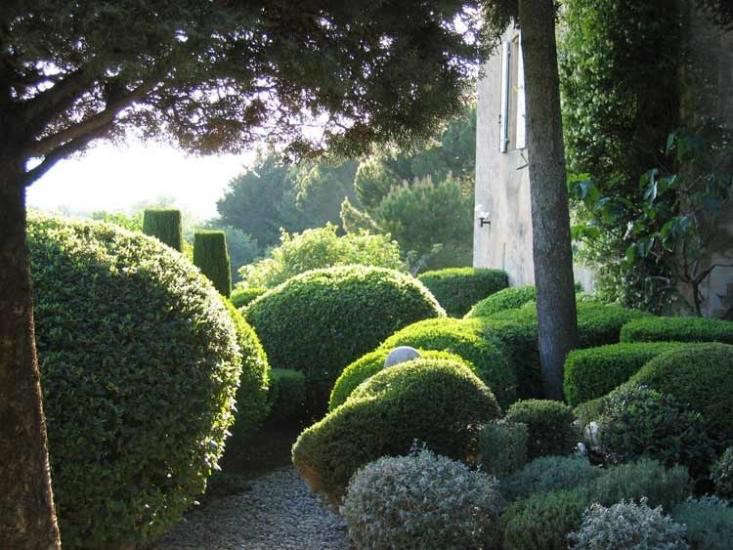
Cloud pruning is where hedge discipline takes off its shoes. Instead of cutting shrubs into strict cubes or rectangles, the gardener clips them into rounded, billowing forms. The result can look like green clouds, rolling hills, or a shrub having a very stylish dream.
In Provence-style gardens, cloud-shaped shrubs work especially well with stone, gravel, drought-tolerant herbs, and muted foliage. The effect is sculptural but soft. Unlike a rigid hedge, cloud pruning allows movement and personality. It is ideal for gardeners who like structure but do not want the garden to look as if it is preparing for inspection.
To try cloud pruning at home, start with a naturally dense shrub. Work slowly. Remove small amounts at a time. Step back often. Never prune while angry, rushed, or holding a large coffee and false confidence. Topiary is patient work; panic is not a design style.
Maintenance: The Part Instagram Usually Crops Out
Beautiful hedges require care. Formal hedges usually need trimming at least once or twice a year, and fast-growing plants may need more attention. The goal is not to scalp the plant but to guide it.
When trimming a hedge, keep the base slightly wider than the top so light reaches the lower branches. This helps prevent bare legs, which are awkward on both hedges and formal trousers. Thin dense shrubs periodically to improve airflow and encourage interior growth. Use sharp, clean tools, and avoid pruning too early in spring if frost is still possible.
Boxwood in particular benefits from careful care. Plant it where it has well-drained soil, some protection from harsh winter sun and wind, and enough space for air circulation. Mulch lightly but avoid piling mulch against stems. Remove dead or damaged branches and monitor for pests or disease.
French Hedge Ideas for Small Spaces
Small gardens may actually be perfect for French-inspired hedging because structure has a big impact in limited space. A tiny courtyard, balcony, townhouse patio, or front walk can all borrow the look.
For a Front Entry
Use two clipped evergreens in matching pots. Add a gravel strip or stone landing. Keep the plant palette simple. The result feels polished without needing a landscape crew.
For a Patio
Create a low hedge around the seating area or use rectangular planters filled with evergreen shrubs. This defines the space and makes outdoor furniture feel anchored.
For a Kitchen Garden
Use low boxwood, germander, lavender, or compact herbs to edge vegetable beds. The contrast between tidy borders and productive plants is classic, practical, and extremely photogenic.
For a Side Yard
A narrow path lined with clipped shrubs can turn a forgotten passage into a destination. Add wall-mounted planters, a mirror, or a small bench at the end to create a focal point.
Design Lessons from French Topiary Gardens
The great topiary gardens of France teach several useful lessons. Marqueyssac proves that repetition can feel playful when the shapes are organic and rolling. Eyrignac shows how many shades of green can create drama without relying on flowers. Villandry demonstrates the power of viewing a garden from above, where hedges become patterns and beds become living embroidery.
For home gardeners, the takeaway is simple: decide what your hedge is supposed to do before planting it. Is it a border, a wall, a sculpture, a backdrop, or a visual joke? A hedge clipped into a sphere says something different from a hedge clipped into a straight line. One is punctuation; the other is architecture.
Common Mistakes to Avoid
The first mistake is choosing a plant that wants to grow much larger than the intended hedge. If you want a two-foot border, do not plant a shrub that dreams of becoming twelve feet tall. You will spend the rest of your weekends negotiating with it.
The second mistake is shearing only the outer surface and never thinning the interior. This can create a dense shell with a weak, bare center. A healthy hedge needs light and air inside the plant.
The third mistake is chasing perfection too early. Young hedges need time to fill in. Prune to encourage branching, but do not expect instant maturity. A good hedge is a long-term relationship, not a one-weekend makeover show.
Experience Notes: Living with the “Hedge Fun in France” Mindset
The most useful experience I can share about French-inspired hedge design is that it changes how you look at a garden. Before you start thinking in hedges, you may focus mainly on flowers: what blooms, what color, what looks good this month. Flowers are wonderful, of course. Nobody is here to insult a peony. But flowers are seasonal performers. Hedges are the stage.
Once you add structure, even ordinary plantings look more deliberate. A messy herb bed becomes a charming kitchen garden when framed by a low clipped border. A plain patio becomes a courtyard when two rounded evergreens mark the entrance. A narrow walkway feels more inviting when a hedge guides the eye forward. The magic is not only in the plants themselves; it is in the way they organize space.
Another lesson is that small rituals matter. Trimming a hedge is not just maintenance. It is a conversation with the garden. You notice where the plant is thick, where it is thin, where it needs light, where it has been nibbled, and where your previous “quick trim” was perhaps a crime against geometry. The more regularly you care for hedges, the less dramatic the job becomes. Five calm trims are better than one heroic battle with an overgrown shrub and a pair of exhausted shoulders.
French hedge style also teaches restraint. It is tempting to add too many elements: a fountain, five pots, three colors of gravel, lavender, roses, a bistro table, a statue, and possibly a rooster. But the best French-inspired spaces leave room for the eye to rest. Green shapes, pale stone, muted flowers, and one strong focal point often work better than a crowded collection of “French things.” The goal is not to build a theme park called Little Provence. The goal is atmosphere.
One of the easiest experiments is to place a clipped shrub where you can see it from indoors. This sounds almost too simple, but it changes the relationship between house and garden. A round boxwood outside a kitchen window or a pair of potted hollies near French doors gives the interior a borrowed view. Even in winter, when flowers are sleeping and the garden looks slightly grumpy, that evergreen shape continues doing its quiet design work.
There is also humor in topiary, and that should not be underestimated. A garden that takes itself too seriously can feel stiff. A cloud-pruned shrub, a round hedge beside a straight path, or a tiny parterre around herbs adds a wink. French gardens may be famous for order, but the best ones have personality. They remind us that control and play can live together. The hedge can be disciplined and still look like it is having fun.
For American gardeners, the smartest approach is adaptation. Use the French ideas that fit your climate, budget, and patience level. In a hot, dry region, choose drought-tolerant plants and gravel. In a humid area, prioritize airflow and disease-resistant shrubs. In a small urban yard, use containers and low hedges rather than large formal layouts. The spirit of Trending on Gardenista: Hedge Fun in France is not about copying France plant by plant. It is about borrowing the confidence to shape space beautifully.
Conclusion
Trending on Gardenista: Hedge Fun in France is more than a catchy design headline. It is an invitation to see hedges as creative tools rather than green chores. French garden style uses clipped shrubs, topiary, gravel, symmetry, and framed views to create outdoor spaces that feel elegant, calm, and full of character. Whether you have a courtyard, a suburban front walk, a balcony, or a full garden, the lesson is the same: structure brings charm.
Start small. Clip a pair of evergreens. Edge a bed. Add gravel. Frame a view from indoors. Let one hedge do one clear job. With time, patience, and sharp shears, your garden can borrow a little French wit without needing a passport. And if your first topiary sphere comes out slightly lopsided, call it “organic Provence” and keep going.
Note: This article is written for web publication as original editorial content inspired by real French garden design principles, hedge care practices, and Gardenista-style outdoor living themes.