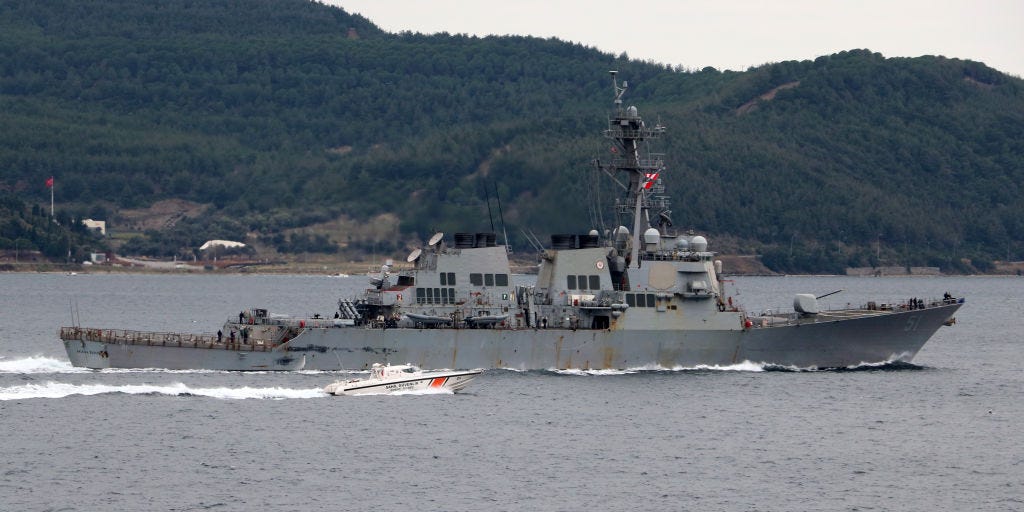

The USS Arleigh Burke is the kind of warship that refuses to exit quietly. Some vessels retire with a polite handshake, a framed photo, and a “thanks for your service” cake. DDG 51, on the other hand, seems to have looked at the calendar, adjusted its metaphorical necktie, and said, “Actually, I still have things to do.”
Commissioned on July 4, 1991, the USS Arleigh Burke became the lead ship of what would grow into one of the most successful destroyer classes in U.S. Navy history. More than three decades later, the ship’s service life has been extended, carrying it toward the 40-year mark. That does not mean the original destroyer is beginning another literal 40-year career from scratch. It means something just as interesting: the Navy believes the ship, after modernization and careful assessment, still delivers enough value to remain useful far longer than many expected.
In plain English, the Arleigh Burke-class destroyer has become the Navy’s reliable multi-tool. It is part air-defense shield, part submarine hunter, part command-and-control platform, part escort, and part floating reminder that good engineering ages better than most office printers.
What Makes the USS Arleigh Burke So Important?
The USS Arleigh Burke is the first ship in the DDG 51 class of guided-missile destroyers. It was named after Admiral Arleigh A. Burke, a legendary U.S. Navy officer who served in World War II and the Korean War and later became Chief of Naval Operations. Naming a destroyer after him was not a casual branding exercise. Burke represented speed, discipline, innovation, and aggressive leadership at sea. The ship that bears his name was expected to carry those same qualities into the missile age.
The DDG 51 class replaced older destroyer designs and introduced a more modern blend of survivability, sensors, weapons control, and flexibility. Built with an all-steel hull and designed around the Aegis Combat System, the class became a foundation of U.S. surface warfare. The first ship was not merely another hull in the fleet; it was the opening chapter of a design that would keep evolving for decades.
That is the secret sauce. The Arleigh Burke design was not frozen in 1991 like a museum exhibit with better paint. The class has been upgraded through multiple “Flights,” including Flight I, Flight II, Flight IIA, and Flight III. Each generation brought improvements in combat systems, aviation capability, radar, electronics, and shipboard systems. The result is a destroyer family that has stayed relevant while threats, technology, and naval strategy have changed dramatically.
The 40-Year Service Life: What It Really Means
The headline may sound like the USS Arleigh Burke will sail for another four decades, but the more accurate story is that the Navy approved a service-life extension carrying DDG 51 through fiscal year 2031, when the ship will be 40 years old. Originally, the ship’s expected service life was about 35 years, with retirement expected around fiscal year 2026. The extension reflects a judgment that the ship’s material condition, maintenance history, and modernization work justify additional service.
That may sound like a small administrative update, but for the Navy it matters. Building new warships takes time, money, skilled labor, and industrial capacity. Keeping an older but capable destroyer in service helps preserve fleet numbers while newer Flight III ships arrive and future destroyer concepts continue to develop. In other words, extending DDG 51 is not nostalgia. It is fleet math.
The Navy needs ships that can escort aircraft carriers, defend against air and missile threats, support maritime security, conduct presence missions, and work with allies. A modernized Arleigh Burke-class destroyer can contribute to all of that. If the hull is healthy and the combat systems remain relevant, retirement becomes less of a birthday party and more of a strategic decision.
Why the Arleigh Burke Class Became So Prolific
The Arleigh Burke-class destroyer has succeeded because it balances capability and repeatability. Some military platforms are technological fireworks: impressive, expensive, and hard to build in large numbers. The Burke class is different. It has been produced across decades by major U.S. shipyards, refined over time, and continuously adapted to new missions.
1. It Is a True Multi-Mission Ship
The DDG 51 class was designed to operate offensively and defensively, independently or as part of larger naval formations. These destroyers can sail with carrier strike groups, amphibious ready groups, surface action groups, or coalition forces. Their mission set includes air defense, missile defense, anti-submarine warfare, anti-surface warfare, strike support, and maritime security.
That range is one reason the class has lasted. A ship that can only do one job becomes vulnerable when strategy changes. A ship that can do many jobs becomes the Navy’s first call when the global schedule gets messy. And the global schedule is almost always messy.
2. Aegis Made the Ship a Fleet Defender
The Aegis Combat System is central to the Arleigh Burke story. It gives the ship an integrated system for detecting, tracking, and responding to threats. Instead of treating radar, command systems, and weapons control as separate islands, Aegis connects them into a coordinated combat network.
That matters because modern naval threats move quickly. Aircraft, missiles, drones, submarines, and surface vessels can all appear in the same operating environment. A destroyer needs to process information fast enough to help commanders make decisions before the situation has already changed. Aegis is one of the main reasons Burke-class ships have remained valuable in high-demand regions around the world.
3. The Design Could Grow
One underrated strength of the Arleigh Burke class is that it had room to evolve. Newer variants added helicopter hangars, improved electronics, upgraded combat systems, and stronger air and missile defense capabilities. Flight III ships represent a major leap, especially with the AN/SPY-6 radar and Aegis Baseline 10.
That growth path has kept the class alive. A ship design that cannot accept upgrades eventually becomes boxed in by its own architecture. The Burke class has stretched, adapted, and absorbed new technology like a veteran smartphone user finally accepting software updatesonly with much higher stakes.
Modernization: The Reason Old Ships Stay Dangerous
A service-life extension only makes sense if a ship is modernized enough to be useful. The Navy’s DDG modernization program has focused on keeping in-service destroyers relevant through upgrades to hull, mechanical, electrical, combat, communications, radar, sonar, navigation, and computing systems.
For the USS Arleigh Burke, modernization is the difference between being an aging first-in-class ship and remaining an operational contributor. A destroyer is not judged only by the year it entered service. It is judged by what it can sense, how it can communicate, how well it can defend itself and the force, and whether its machinery and structure can sustain demanding deployments.
This is where maintenance discipline matters. A ship that has followed class maintenance plans and received timely upgrades has a far better chance of earning extra years. The Navy did not extend DDG 51 simply because the ship has a famous name. It did so because the ship’s condition and capability supported the decision.
Flight III: The Future of the Burke Family
While the original USS Arleigh Burke is moving toward 40 years of service, the class itself is still advancing. Flight III destroyers are the newest major version of the DDG 51 design. These ships include the AN/SPY-6 radar, a powerful sensor designed to improve air and missile defense, and Aegis Baseline 10, a modern combat-system upgrade built for increasingly complex threats.
The first Flight III ship, USS Jack H. Lucas, marked a new stage for the class. Additional Flight III ships are being built by U.S. shipyards, including Huntington Ingalls Industries’ Ingalls Shipbuilding and General Dynamics Bath Iron Works. This continued production shows how deeply the Burke design remains embedded in U.S. naval planning.
Flight III also illustrates why the phrase “old destroyer class” can be misleading. A 1991 lead ship and a newly delivered Flight III destroyer belong to the same broad family, but they are not identical twins. Think of it more like a long-running pickup truck model: same bloodline, but the latest version has a very different dashboard, engine management system, and safety package.
Strategic Value: Why the Navy Still Needs These Ships
The U.S. Navy operates in a world where maritime competition is rising. The Indo-Pacific, Europe, the Middle East, and the Arctic all place different demands on the fleet. Destroyers are especially valuable because they can deploy forward, operate with allies, escort larger ships, and provide commanders with flexible options.
Arleigh Burke-class destroyers are often described as workhorses, but that word may understate their role. A workhorse pulls a cart. A Burke-class destroyer helps protect carrier groups, supports missile defense, tracks underwater threats, and shows up in tense regions where presence itself sends a message. That is less “workhorse” and more “Swiss Army knife wearing a Navy uniform.”
The class also helps bridge the gap between current needs and future designs. The Navy’s next-generation destroyer planning continues, but new ship classes take time to design, fund, test, and produce. Until those ships arrive in meaningful numbers, the DDG 51 class remains the backbone of the surface fleet.
Shipbuilding and the Industrial Base
The Arleigh Burke program is not only a Navy story. It is also an industrial-base story. Bath Iron Works in Maine and Ingalls Shipbuilding in Mississippi have played major roles in building these destroyers. Their work supports skilled trades, engineering teams, suppliers, and regional economies.
Continuing DDG 51 production helps maintain shipbuilding expertise that cannot be recreated overnight. Welders, naval architects, electricians, pipefitters, combat-system integrators, and quality-control specialists are part of the invisible machinery behind every destroyer. The ship may get the dramatic photos at sea, but the industrial workforce deserves its own applause track.
That workforce matters because naval power is not created by budget slides alone. It is created in shipyards, supply chains, dry docks, and testing facilities. The Burke class has endured partly because the Navy and industry built an ecosystem around it.
Challenges Facing the Arleigh Burke Class
No ship class, no matter how successful, gets a free pass from reality. The Arleigh Burke class faces challenges related to age, maintenance demand, crew workload, modernization cost, and evolving threats. Older ships need more careful upkeep. Newer systems require more power, cooling, software integration, and training. The ocean is not gentle, and neither is the maintenance schedule.
There is also the issue of capacity. Destroyers are in high demand because they are useful in so many missions. High demand can lead to long deployments and heavy operational tempo. A ship may be capable on paper, but crews, maintenance yards, and spare-parts pipelines all need breathing room.
The Navy must balance keeping older ships in service with avoiding a fleet that becomes too expensive to maintain. A service-life extension is smart only when the ship can still contribute without draining resources better spent elsewhere. For DDG 51, the Navy’s assessment indicates the balance remains favorable.
Why the USS Arleigh Burke Still Matters Symbolically
Lead ships carry symbolic weight. The USS Arleigh Burke represents the beginning of a destroyer line that reshaped the U.S. surface fleet. Seeing the first ship reach toward 40 years of service is a reminder that successful naval design is not only about futuristic technology. It is about building something strong enough, flexible enough, and maintainable enough to stay useful when the future arrives wearing different shoes than expected.
DDG 51 also reflects the value of incremental improvement. The Navy did not replace the entire class every time a new threat appeared. Instead, it upgraded sensors, combat systems, software, communications, and shipboard equipment. That approach may not be as flashy as unveiling a brand-new class every decade, but it can be more practical.
Experience Section: What the USS Arleigh Burke Teaches About Longevity
When people talk about warships, they often focus on speed, radar, missiles, and dramatic photos of gray hulls slicing through blue water. But the real lesson of the USS Arleigh Burke is not just about hardware. It is about endurance through maintenance, adaptation, and purpose. That lesson applies far beyond the Navy.
Imagine buying a tool in 1991 and still using it effectively in 2031. Not as a dusty keepsake in a garage, but as something still trusted for serious work. That kind of longevity does not happen by accident. It requires good design at the beginning, regular care along the way, and smart upgrades when the world changes. The Burke class shows that “old” and “obsolete” are not the same word. A well-maintained system with a strong foundation can remain useful long after trendier alternatives have come and gone.
There is also a human side to this story. Every destroyer is more than steel, radar arrays, and engineering diagrams. It is a workplace, a training ground, and a temporary home for sailors. Crews learn the personality of a ship: which spaces are too hot, which passageways are always busy, which routines keep the day moving, and which small rituals make long deployments feel manageable. A ship that serves for decades carries layers of experience from crew to crew.
That continuity matters. A young sailor stepping aboard DDG 51 today is joining a story that began before many current crew members were born. The ship has seen generations of technology change around it. Phones went from bricks to pocket computers. Maps went digital. The internet became everything. Yet the destroyer’s core missionprotect the fleet, operate forward, and be ready when calledremained recognizable.
From a leadership perspective, the USS Arleigh Burke is also a case study in practical modernization. Not every challenge requires throwing everything away and starting over. Sometimes the smarter move is to inspect honestly, upgrade carefully, and keep the proven platform working. That mindset is useful in business, engineering, education, and even personal life. Before replacing something, ask whether its foundation is still strong. If it is, improvement may beat replacement.
The ship’s extension also highlights the importance of unglamorous discipline. Maintenance rarely gets applause. Nobody writes action-movie trailers about corrosion control, inspections, spare parts, or scheduled repairs. Yet those are exactly the things that allow a destroyer to reach 40 years of service. The spectacular moments depend on the boring routines. That is true for ships, athletes, companies, and students trying to survive finals week with dignity intact.
Finally, DDG 51 reminds us that legacy is active, not passive. A legacy is not just what something did in the past; it is what it continues to make possible. The USS Arleigh Burke launched a class that still shapes U.S. naval power. Its continued service is not only a tribute to history. It is proof that durable ideas, when maintained and improved, can keep working long after the original headlines fade.
Conclusion: A Destroyer That Refuses to Become Yesterday’s News
The USS Arleigh Burke is more than the first ship in a famous destroyer class. It is a symbol of how smart naval design can evolve across generations. Its service-life extension to the 40-year mark shows that the Navy still sees value in a ship that has been modernized, maintained, and tested by time.
The broader Arleigh Burke class remains one of the most important families of warships in the world. From early Flight I ships to advanced Flight III destroyers, the class continues to adapt to new missions and new technology. In a fleet that needs capable, flexible, forward-deployed ships, the Burke destroyers remain essential.
So yes, the USS Arleigh Burke is getting older. But in naval terms, it is aging less like forgotten leftovers and more like a cast-iron skillet: seasoned, proven, and still very much ready for serious work.