‘What is This? A Center for Ants?’: 22 Trivia Tidbits About ‘Zoolander’ for Its 22nd Anniversary

Some movies age like fine wine. Zoolander ages like a tiny orange mocha Frappuccino left under a tanning lamp: suspicious, absurd, and somehow still irresistible. Released in 2001, Ben Stiller’s fashion-world satire has become one of those rare comedies that can be quoted in a grocery store line, at a Halloween party, during a corporate presentation, or while staring at a miniature architectural model and feeling personally insulted by its scale.
For its 22nd anniversary, Zoolander deserves more than a polite nod. It deserves a dramatic runway turn, a camera flash, and maybe one deeply confused male model asking why computers are so difficult. The film’s reputation has only grown since its original theatrical run, thanks to its quotable dialogue, celebrity cameos, sharp parody of fashion culture, and the eternal mystery of how one facial expression can have so many names.
Below are 22 Zoolander trivia tidbits that explain why Derek Zoolander, Hansel, Mugatu, Matilda, and the world’s most emotionally important model school still live rent-free in pop culture. And yes, this article is big enough for children to fit inside.
Why ‘Zoolander’ Still Looks Really, Really Ridiculously Relevant
At first glance, Zoolander is a goofy comedy about beautiful people who treat left turns like advanced mathematics. But underneath the silliness, the movie works because it targets an entire culture of image-making. Fashion shows become sacred ceremonies. Magazine profiles become career-destroying weapons. Personal branding becomes a life-or-death mission. In 2001, that felt like an exaggerated joke. In the age of selfies, influencers, and algorithm-approved cheekbones, it feels more like a documentary wearing tiny sunglasses.
The brilliance of the film is that it never lectures. It lets the jokes do the posing. Derek is vain, yes, but he is also oddly sincere. Hansel is competitive, but not cruel. Mugatu is ridiculous, but terrifyingly confident. The result is a comedy that can mock fame, beauty, masculinity, celebrity culture, and consumerism without turning into a homework assignment. It is satire with hair gel.
22 Trivia Tidbits About ‘Zoolander’
1. Derek Zoolander was born before the movie existed
Before Zoolander became a feature film, Derek Zoolander appeared in short comedy segments connected to the VH1 Fashion Awards in the mid-1990s. That origin matters because the character was not created in a vacuum. Derek emerged from the exact celebrity-fashion ecosystem the movie would later parody. In other words, he did not crash the runway; he was manufactured on it.
2. The movie expanded a sketch into a full satire
Turning a sketch character into a feature film is risky. One joke can work beautifully for a few minutes and collapse like an overconfident runway cape at 90 minutes. Zoolander survived the expansion because it did not simply ask, “What if a male model were dumb?” It asked, “What if the fashion industry were secretly powerful enough to reshape global politics?” That upgrade gave the comedy a bigger engine.
3. Ben Stiller wore several hats, and all of them were dramatic
Ben Stiller directed, starred in, co-wrote, and co-produced the film. That level of involvement helped keep the tone consistent. Zoolander needed to be silly without becoming careless, glossy without becoming empty, and weird without drifting into random nonsense. Stiller’s control gave the movie its specific flavor: part fashion commercial, part spy thriller, part cartoon about cheekbones.
4. Owen Wilson’s Hansel was written as the perfect rival
Hansel is not just Derek’s competition. He is Derek’s nightmare in linen pants. He is newer, cooler, more relaxed, and somehow able to make nonsense sound philosophical. Owen Wilson gives Hansel a breezy confidence that makes the rivalry funny instead of mean-spirited. The joke is not that Hansel is smarter than Derek; it is that he is equally confused but much better at pretending it is wisdom.
5. Will Ferrell’s Mugatu is villainy with volume control broken
Jacobim Mugatu is one of Will Ferrell’s most memorable early film characters because he commits to everything at full runway intensity. The hair, the outfits, the yelling, the smugness: all of it turns Mugatu into a designer-dictator hybrid. He is ridiculous, but the movie treats his power seriously enough that the comedy lands. He looks like a fashion disaster and behaves like a supervillain with a fabric budget.
6. The plot is basically a fashion version of a conspiracy thriller
One reason Zoolander remains funny is that its plot is wildly overbuilt for such a foolish hero. Derek becomes part of a scheme involving brainwashing, political assassination, labor issues, and fashion executives with suspiciously high confidence. The structure borrows from conspiracy thrillers, but swaps grim paranoia for runway poses. It is the kind of story where global stakes depend on whether a model can understand a computer.
7. ‘Blue Steel’ predicted the selfie era
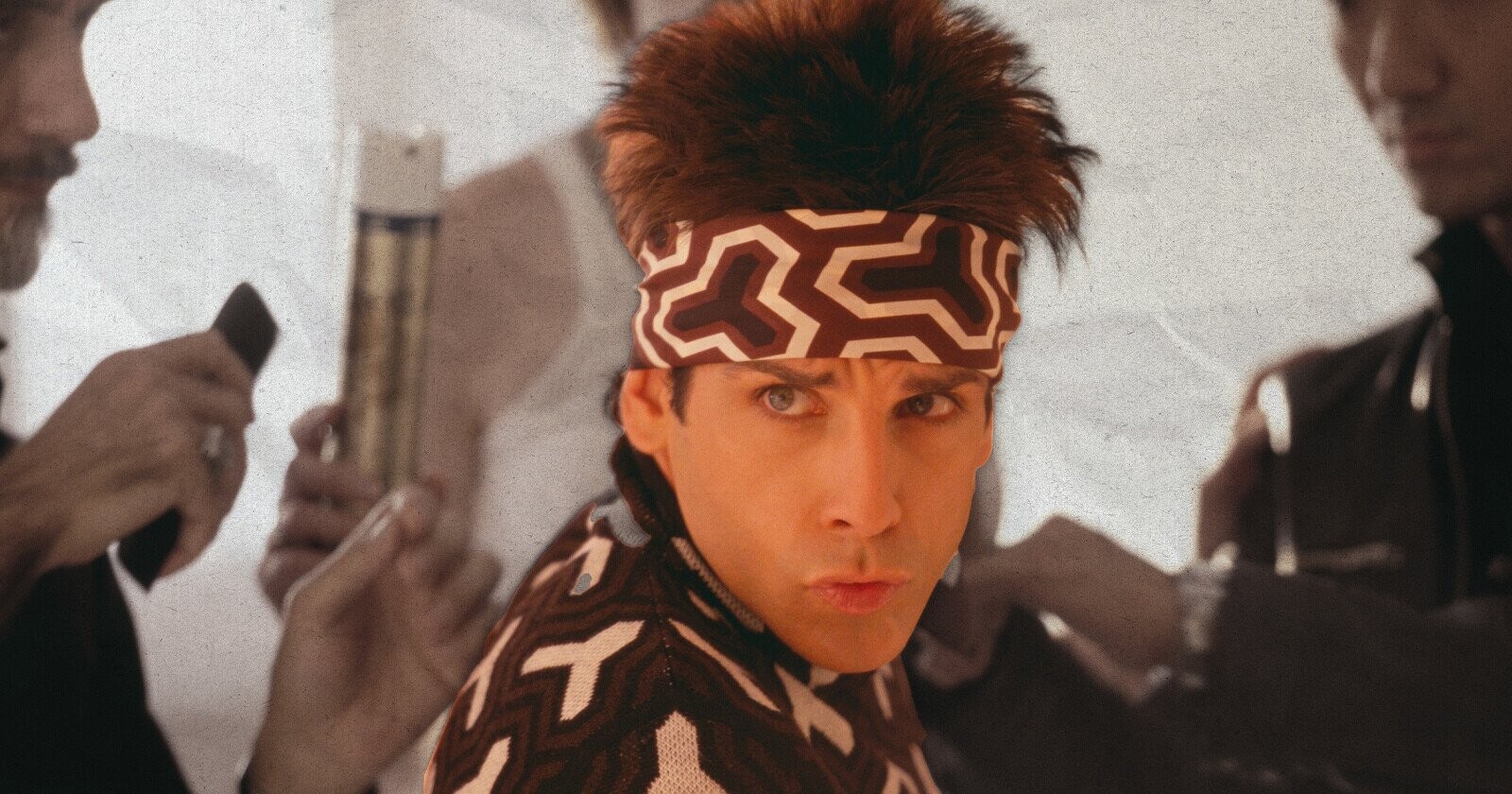
Derek’s signature look, Blue Steel, was originally a joke about self-serious modeling faces. Years later, it feels weirdly prophetic. Social media turned personal image-making into a daily performance, and suddenly Derek’s obsession with the perfect expression looked less absurd. The joke aged forward. What once mocked magazine vanity now also mocks phone-camera vanity, influencer branding, and everyone who has ever taken 14 photos to choose one “candid.”
8. The funniest part of Derek’s looks is that they barely differ
Blue Steel, Le Tigre, Ferrari, Magnum: the names suggest an entire catalog of elite facial techniques. The gag, of course, is that Derek’s expressions are nearly identical. That is the joke in miniature. The fashion world often gives grand language to tiny differences, and Zoolander exaggerates that habit until it becomes beautifully stupid. Derek does not just pose; he rebrands micro-movements as destiny.
9. David Bowie’s cameo gave the movie instant cool
The walk-off scene is already a classic because Stiller and Wilson treat runway competition like an ancient martial art. Then David Bowie appears, and the whole scene gets a glittering stamp of approval. Bowie playing himself as the judge is funny because it is both absurd and completely believable. If anyone could fairly evaluate a battle of style, mystery, and cheekbone discipline, it would be Bowie.
10. The movie is packed with celebrity cameos
Zoolander uses cameos like accessories: flashy, brief, and strategically placed. Viewers can spot musicians, actors, models, designers, and media personalities throughout the film. The cameos work because they make Derek’s world feel strangely legitimate. If famous people keep showing up to comment on this ridiculous man, maybe he really is a major cultural force. Or maybe fame is just deeply unserious. Both readings work.
11. Billy Zane became a walking punchline of calm authority
One of the movie’s best running pleasures is the way Billy Zane appears as himself and is treated like a voice of reason. The humor comes from the specificity. It is not just “listen to a celebrity.” It is Billy Zane, delivered with total confidence. The joke became one of the film’s most beloved throwaway moments because it feels random, elegant, and weirdly persuasive.
12. The ‘center for ants’ scene is a masterclass in comic scale
The architectural model scene is famous because the joke is instantly understandable. Derek sees a tiny model of his dream school and reacts as if the building itself is unusably small. It is simple, visual, and perfectly in character. The scene also works because Mugatu briefly becomes the sensible person in the room, which is alarming. When Mugatu is the adult, civilization has left the chat.
13. The school name is intentionally overstuffed
The Derek Zoolander Center for Kids Who Can’t Read Good and Who Wanna Learn to Do Other Stuff Good Too is funny because it turns a noble idea into a grammatical obstacle course. Derek wants to help children, which is sweet. He also names institutions like a man trying to win a sentence-length contest. The title is ridiculous, but it also makes Derek weirdly lovable.
14. Christine Taylor’s Matilda keeps the story from floating away
Matilda Jeffries, played by Christine Taylor, is essential because she gives the movie a grounded perspective. Around her, everyone else seems to be speaking fluent fashion hallucination. She functions as a journalist, a skeptic, and eventually an ally. Without Matilda, the film might become pure cartoon. With her, the nonsense has someone to bounce against, which makes the absurdity sharper.
15. Jerry Stiller’s Maury adds show-business bite
Jerry Stiller plays Maury Ballstein with the energy of a manager who has seen every bad idea, approved half of them, and billed someone for the rest. His presence gives the movie an old-school entertainment-business flavor. Maury is loud, slippery, funny, and oddly affectionate. Casting Jerry Stiller opposite Ben Stiller also adds a family-comedy charge without making the scenes sentimental.
16. The film arrived at a difficult moment in American culture
Zoolander opened in theaters on September 28, 2001, shortly after the September 11 attacks. That timing shaped its early reception. A broad, strange fashion satire was not exactly the easiest movie to market during a national tragedy. Over time, though, audiences rediscovered it through home viewing, cable, and endless quoting. Its cult status grew because comedy sometimes takes the scenic route to affection.
17. It made a solid box-office showing
The film was not an instant mega-blockbuster, but it performed respectably against its reported production budget. Its longer life came from repeat viewings and cultural stickiness. Some comedies burn hot and vanish. Zoolander did the opposite. It strutted into theaters, then became more famous in dorm rooms, living rooms, quote threads, and anywhere people needed a dramatic excuse to say “walk-off.”
18. The Malaysia plot caused real-world controversy
The story’s assassination plot involving Malaysia led to censorship controversy in parts of Southeast Asia. For a comedy this silly, that is surprisingly serious trivia. It also reveals how outrageous the movie’s premise really was. Zoolander may look like a parade of wigs and poses, but its central conspiracy touched enough political nerves to become more than a harmless fashion joke.
19. The rating history shows how edgy the comedy was
The film ultimately reached audiences as a PG-13 comedy, but its humor pushed into adult territory through suggestive jokes, party scenes, and drug references. Modern viewers may remember the movie as endlessly quotable and goofy, but it was not a children’s comedy. Its sweetness is wrapped inside early-2000s irreverence, which helps explain why it feels both nostalgic and slightly chaotic today.
20. The original ending was reportedly much darker
One famous behind-the-scenes tidbit is that an early version of the ending involved Derek dying in an extremely dramatic way and going to heaven. Thankfully, the finished movie chose a more fitting comic conclusion. Killing Derek would have been bold, but also wildly wrong for the tone. The final version lets him grow just enough while remaining gloriously, professionally clueless.
21. Fashion insiders eventually embraced the joke
One reason Zoolander endured is that the fashion world did not simply reject it. Over time, designers, models, magazines, and style commentators treated the film as part of fashion’s pop-culture mythology. The movie mocks the industry, but it also understands its spectacle. It laughs at fashion’s drama while secretly admiring how cinematic a runway can be when everyone commits.
22. The movie became bigger than the movie
Not every comedy creates reusable cultural language. Zoolander did. Blue Steel became shorthand for exaggerated posing. Mugatu became shorthand for ridiculous authority. The center-for-ants line became the internet’s preferred response to anything comically small. The film’s jokes escaped the screen because they describe real behaviors: vanity, branding, competition, confusion, and the human need to look important while having no idea what is happening.
What Makes the ‘Zoolander’ Humor Work?
The secret is sincerity. Derek is not winking at the audience. Hansel is not secretly a genius. Mugatu is not aware that he looks absurd. Everyone plays the world of the film as if it matters. That is why the jokes remain sturdy. Comedy this broad collapses when actors apologize for it. Zoolander never apologizes. It struts.
The movie also understands visual comedy. Costumes, poses, tiny models, runway lighting, magazine covers, and dramatic entrances all become punchlines. Even before a character speaks, the film is already joking. That gives it rewatch value because viewers can catch background details, facial reactions, and celebrity appearances they missed the first time.
The Cult Legacy of ‘Zoolander’
Many early-2000s comedies are remembered for one or two lines. Zoolander is remembered for an entire comic vocabulary. It helped define a style of absurd celebrity satire that still feels recognizable. Its world is shallow but elaborate, stupid but stylish, exaggerated but strangely accurate. That balance is difficult to achieve. Too much realism, and the joke dies. Too much nonsense, and the story becomes noise. Zoolander hits the sweet spot where ridiculous behavior reveals something true.
Its legacy also comes from how well it fits internet culture. A still image of Derek’s face can communicate confusion, vanity, confidence, or total intellectual defeat. Mugatu’s fury works as a reaction meme. Hansel’s relaxed nonsense feels like the ancestor of a thousand faux-spiritual lifestyle captions. The film was made before social media dominated pop culture, yet it accidentally gave social media a toolkit.
Experience Section: Rewatching ‘Zoolander’ in the Age of Selfies, Memes, and Miniature Problems
Rewatching Zoolander today is a strange experience because it feels both ancient and brand-new. Ancient, because the movie belongs to a world of cable television, glossy magazines, and celebrity culture before smartphones turned everyone into their own publicist. Brand-new, because Derek Zoolander’s emotional universe now surrounds us. People curate their faces. Brands speak like people. People speak like brands. A coffee shop opening can look like a fashion editorial. A gym mirror can become a personal press conference. Derek would not be confused by the selfie era. He would ask why it took the rest of us so long to catch up.
The best way to experience Zoolander is with a group, especially if at least one person has never seen it. The first-time viewer usually spends the opening scenes trying to understand the rules of the world. Are these characters supposed to be this strange? Is the plot really going there? Why is everyone taking male modeling so seriously? Then the rhythm clicks. By the time the walk-off arrives, the room usually understands that the movie’s stupidity is highly engineered. It is not lazy dumb comedy. It is ornate dumb comedy, which is a very different species.
Another joy of rewatching the movie is noticing how many jokes are built on confidence rather than punchlines. Derek says absurd things with the certainty of a TED Talk speaker who has never opened a book. Hansel floats through scenes as if confusion is a lifestyle choice. Mugatu screams like every inconvenience is a personal betrayal by the universe. Their confidence makes the comedy contagious. Viewers do not simply laugh at the lines; they start borrowing the posture, the rhythm, and the dramatic seriousness.
The center-for-ants scene remains especially satisfying because almost everyone has encountered a version of that moment in real life. We have all misunderstood something obvious. We have all reacted too strongly to a minor detail. We have all stared at a mock-up, a plan, a diagram, or a tiny sample and briefly lost faith in humanity. Derek just says the quiet part with runway-level commitment. That is why the joke travels so well. It is not only about a miniature building. It is about the universal panic of not understanding scale.
For fans, Zoolander is also a comfort watch. It does not require deep lore, complicated continuity, or emotional preparation. You can drop into its world and immediately know the terms: beauty is power, nonsense is normal, and a good look can apparently solve problems that diplomacy cannot. That simplicity is part of the charm. The movie gives viewers permission to enjoy absurdity without overexplaining it.
On its 22nd anniversary, the film feels less like a relic and more like a mirror with professional lighting. It exaggerates vanity, but modern culture has done a heroic job of catching up. It mocks branding, but now every lunch photo needs a caption strategy. It laughs at fashion’s seriousness, but also celebrates the joy of spectacle. That is why Zoolander still works: it is ridiculous enough to be funny and accurate enough to sting. Not a lot. Just enough to make Blue Steel feel personal.
Conclusion: ‘Zoolander’ Is Still More Than a Pretty Face
Zoolander endures because it is not just a collection of funny outfits and quotable lines. It is a clever, strange, high-gloss parody of a culture obsessed with image, status, celebrity, and performance. Ben Stiller and the cast created a world where stupidity has structure, vanity has mythology, and a single facial expression can become a legend.
Twenty-two years later, the film remains funny because the world it mocked has only become more pose-ready. We may have better phones, faster trends, and more advanced filters, but Derek Zoolander still understands something essential about modern life: sometimes people just want to look impressive while having absolutely no idea what is going on.
Note: This article is a newly written, publication-ready synthesis based on verified public film information, entertainment reporting, review archives, and cultural analysis. It is written in original language for web publishing and contains no source-link clutter inside the article body.