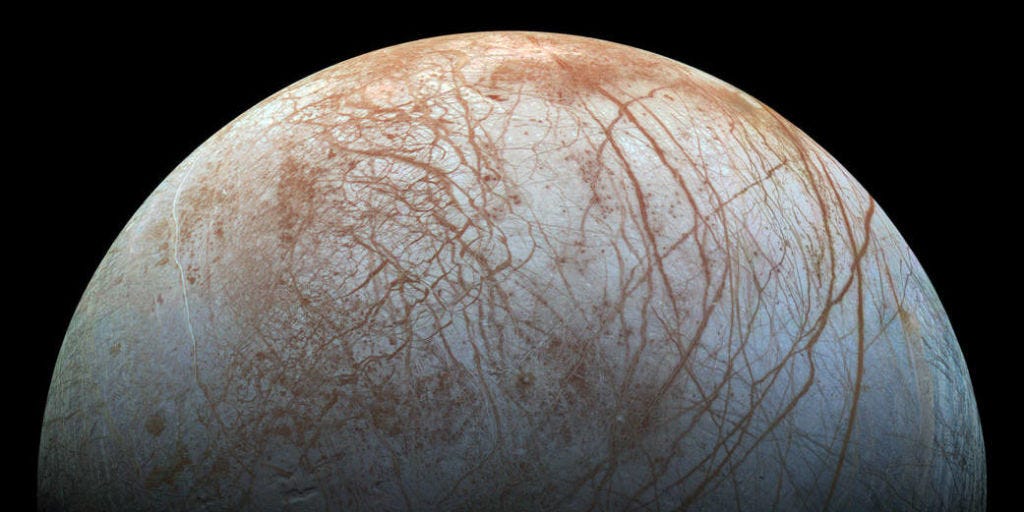

If the Solar System had a “Most Likely to Host Weird Neighbors” yearbook award, Europa would be wearing the sash, holding the trophy, and pretending it’s totally no big deal. From the outside, Jupiter’s moon looks like a polished cue ball someone cracked with a cosmic hammer. But beneath that ice? Europa is hiding a global oceansalty, restless, and potentially loaded with the kind of chemical drama life loves.
Mars gets all the headlines, Titan gets the moody aesthetics, and Enceladus basically sprays ocean into space like it’s auditioning for a water park commercial. Yet when you stack the evidence, ingredients, and sheer scale of “habitable real estate,” Europa keeps floating to the top. Not because it’s easy (it isn’t), but because it’s plausibleand plausibility is gold in astrobiology.
Europa in One Bite-Sized Orbit
Europa is roughly one-quarter Earth’s diameter, but it may have more than twice the volume of water in all of Earth’s oceanslocked beneath an ice shell often estimated around 10–15 miles thick, with an ocean possibly 40–100 miles deep. That’s not a puddle. That’s an entire world of liquid water doing its thing in the dark.
Europa orbits Jupiter inside a magnetic and radiation environment that would make most electronics cry. But the same harshness that threatens spacecraft can also power chemistry on the surfacechemistry that might, under the right circumstances, feed an ocean ecosystem below. Europa is an “ocean world,” and ocean worlds are where the Solar System gets interesting.
The Habitability Checklist: Water, Energy, Chemistry
When scientists talk about whether a place could support life, they’re usually asking three questions: Is there liquid water? Is there an energy source? Are there the right chemical building blocks? Europa doesn’t just check these boxesit underlines them, doodles stars in the margins, and quietly slides the paper back across the table like, “So… are we doing this or what?”
1) Liquid Water: Europa’s Ocean Isn’t Just a Vibe
Europa’s case for a subsurface ocean is unusually sturdy by planetary standardsmeaning it’s not based on one clue, but a pile of them. A major linchpin is how Europa interacts with Jupiter’s magnetic field. Measurements from NASA’s Galileo mission showed disruptions consistent with an induced magnetic field, which strongly suggests a global layer of electrically conductive fluidmost plausibly a salty oceanbeneath the ice.
Then there’s the surface: Europa is crisscrossed by ridges and fractures, and it has regions called chaos terrainareas that look like the ice was broken into giant rafts, shuffled, and refrozen. That kind of geology hints at heat, movement, and (at least occasionally) liquid or slushy water closer to the surface than you’d expect on a frozen moon.
2) Energy: The Moon That Won’t Sit Still
Europa is kneaded by Jupiter’s gravity. As it orbits, Jupiter’s pull flexes Europa’s interior, creating tidal heating. This matters because sunlight out at Jupiter is weakEuropa’s ocean can’t rely on surface photosynthesis like Earth’s oceans do. If life exists there, it would need chemical energy, likely from interactions between water and rock, or from oxidants and other reactive compounds supplied from above.
On Earth, some of the most compelling analogs for “life without sunlight” are deep-sea hydrothermal ecosystems. If Europa has a rocky seafloor and long-term water–rock interaction, it could generate chemical gradients that microbes would treat like an all-you-can-eat buffet. That said, Europa’s seafloor activity is still a live scientific debate. Some recent modeling work has raised the possibility that Europa’s ocean floor may be less tectonically active than once hoped, which could limit “classic” hydrothermal vent activity. The key point is: the energy story is promising, but not fully written yet.
3) Chemistry: Europa May Be Making Battery Acid (Affectionately)
Europa’s surface gets bombarded by charged particles trapped in Jupiter’s magnetic field. That radiation can split water molecules and help create oxidantsthink oxygen-bearing compounds and peroxide-like chemistryon or near the surface. In everyday Earth terms, that’s like Europa is manufacturing chemical “fuel” where radiation meets ice.
The habitability magic happens if those oxidants and other surface products make their way downward through cracks, recycling of ice, briny pockets, or slow churning of the shellinto an ocean that also has reduced chemicals from rock interaction. Put oxidants and reductants together and you’ve got chemical disequilibrium, which is science-speak for “life could run on this.”
Plumes: Europa’s Potential “Sample Without Drilling” Cheat Code
Drilling through miles of ice on an alien moon is… ambitious. (Translation: your budget will burst into flames and your timeline will retire before launch.) That’s why Europa’s possible plumes are so tantalizing. If water vapor or icy grains are venting from the subsurface, a spacecraft might “taste” ocean-derived material without landing, drilling, or reenacting an extreme version of an ice fishing trip.
Observations from the Hubble Space Telescope have reported evidence consistent with intermittent plume activitysuggesting water vapor could sometimes rise high above the surface. Ground-based observations using the Keck Observatory have also reported detections of water vapor associated with Europa, but these events appear to be sporadic. The plume picture, in other words, is intriguing but not settled: there may be vents, but they may not be reliably “on,” and some signals could trace to surface or near-surface processes rather than a direct pipeline to the deep ocean.
Even with those caveats, the mere possibility of plume sampling is a big reason Europa ranks so high. It offers a potential shortcut to ocean chemistryone of the hardest things to access on any ocean world.
Europa Clipper: The Most Important “Well, Let’s Go Look” Mission in Decades
Europa is no longer just a fascinating hypothesis. NASA’s Europa Clipper is en route to do a detailed investigation of Europa’s habitabilityspecifically, whether there are places below the surface that could support life. The mission is built around repeated close flybys (not a single dramatic plunge), because Jupiter’s radiation belts are intense and prolonged exposure is a bad time for spacecraft.
According to NASA’s mission overview and quick facts, Europa Clipper will travel roughly 1.8 billion miles to reach Jupiter in April 2030 and aims to conduct 49 close flybys of Europa. Its suite of nine instruments works together to map the surface, probe the ice shell, analyze the thin atmosphere, and assess the ocean’s propertiesessentially building a 3D, chemistry-aware “habitability report card.”
What Clipper Will Actually Measure (The Fun Part)
- Ice shell structure using radar to look into and through the ice, hunting for pockets of water, layering, and the ice–ocean interface.
- Ocean confirmation and salinity clues through magnetic and plasma measurements that refine how conductive (salty) the ocean is.
- Surface composition to identify salts, potential organics, and radiation products that could feed the ocean if transported downward.
- Thermal and geologic activity to spot regions where heat or recent resurfacing hints at active exchange between the ocean and the surface.
- Possible plume sampling by sniffing the environment near Europa for water vapor and other molecules.
Surviving Jupiter’s Radiation: The Spacecraft’s “Armor”
Europa Clipper has an electronics vault designed to protect sensitive systems from radiation. NASA and partners describe a shielded vault made using metals such as titanium and aluminum, part of the mission’s strategy to keep the spacecraft functional during repeated flybys. If Europa is the icy boss level, the radiation belts are the part where the background music turns ominous and you realize you forgot to save.
Why Europa Beats Mars, Titan, and Even Enceladus (With Respect)
“Best bet” doesn’t mean “only bet,” and it definitely doesn’t mean “guaranteed.” It means that, based on what we know today, Europa offers one of the strongest combinations of probable liquid water, potential energy sources, useful chemistry, and scientific accessibility.
| World | Why It’s Tempting | Why Europa Often Ranks Higher |
|---|---|---|
| Mars | Nearby, explored, evidence of ancient water | Today’s surface is harsh and dry; long-term liquid water is uncertain compared with Europa’s ocean |
| Titan | Organic chemistry powerhouse; intriguing atmosphere | Surface liquids are hydrocarbons, not water; water ocean is deeper and harder to access |
| Enceladus | Active plumes and strong “sample the ocean” appeal | Much smaller ocean and potentially less stable long-term environment than Europa’s massive system |
| Europa | Global salty ocean, tidal heating, surface oxidant chemistry, possible plumes | Large, long-lived ocean world with multiple pathways for energy and chemistry |
Scale Matters: Europa Has a Lot of Ocean to Work With
A larger ocean can mean more stable habitats over geologic time and more room for chemical cycling. Europa’s water inventory is enormous for a moon its size, and stability matters if you want life to do the slow work of evolving from chemistry into biology. If alien microbes need billions of years to get organized, a long-lived ocean is a very nice place to rent an apartment.
Europa Has a Built-In Chemical Generator
Jupiter’s radiation is brutalbut it may also help generate oxidants at Europa’s surface. If those materials can get transported downward, Europa could have something like an energy pipeline between the surface and ocean. That’s a big deal because energy is often the limiting factor for life in dark environments.
Europa Is About to Get a Deep Scientific Audit
We’re not just guessing anymore. Europa Clipper is built to answer the practical questions: How thick is the ice? Where is exchange happening? What chemicals are on the surface, and how do they connect to the interior? “Best bet” also means “best chance to learn the truth soon,” and Europa is at the front of that line.
So What Would “Evidence of Life” Look Like?
Europa won’t hand us a neon sign that says “ALIENS LIVE HERE.” Science is annoyingly subtle like that. Instead, we’d look for patterns that are hard to explain without biology:
- Persistent chemical disequilibrium (certain oxidants and reductants coexisting in ways that suggest active replenishment).
- Organic molecules with distributions or complexities that hint at biological processes.
- Isotopic signatures that resemble known biological fractionation patterns (tricky, but powerful).
- Salts and minerals that imply ocean–rock interaction, plus pathways that could move those materials upward.
Europa Clipper isn’t a life-detection mission in the strict “microscope on the seafloor” sense. But it can identify the most promising regions, characterize the ocean’s habitability, and set up future missions that could sample fresher materialespecially if plumes or shallow brines cooperate.
Conclusion: Europa Is the Solar System’s Most Persuasive “Maybe”
Europa wins the “best bet” argument because it combines a global salty ocean, tidal energy, and a surface chemistry factory that may deliver useful oxidants to the deep. It also offers multiple plausible routes for exchangefractures, chaos terrain, brines, and perhaps plumesmaking it more than a sealed ice box.
Are we certain Europa hosts life? Not even close. But if you’re placing a rational wager inside our Solar Systemone that balances evidence, ingredients, and what we can test in the near futureEuropa is the moon that keeps showing up with receipts.
Experiences That Make Europa Feel Real (Earth Edition)
You don’t need a Jupiter-bound spacecraft to “get” why Europa is compellingyou just need the right Earthly experiences to rewire your intuition. Europa is alien, sure, but it’s also oddly familiar once you’ve seen how stubborn life can be when it finds liquid water and a little chemical opportunity.
Start with the most Europa-like sensation humans regularly experience: standing on ice while knowing there’s water underneath. On Earth, sea ice in the Arctic and Antarctic is not a static lid; it creaks, fractures, refreezes, and quietly reshapes itself. If you’ve ever heard lake ice groan in winterlike the planet is slowly exhalingyou already understand Europa’s soundtrack. Scale that up, let Jupiter do the flexing, and you can almost picture Europa’s shell acting like a living skin.
Then there’s the “life without sunlight” mind trick. Visit an aquarium exhibit about deep-sea vents or read about chemosynthetic ecosystems, and suddenly photosynthesis stops being the main character. On Earth, entire communities thrive where sunlight never reaches, powered by chemistryhydrogen sulfide, methane, and other compounds that microbes can “burn” in a biochemical sense. Translate that to Europa, and the question becomes less “Can life exist without the Sun?” and more “Does Europa provide steady chemical gradients long enough for biology to move in and redecorate?”
If you want a more hands-on analogy, think about the first time you saw (or even just learned about) hot springs or geothermal areas. The ground is cold, the air might be freezing, and then suddenly there’s steam and mineral-stained rock announcing, “Heat is happening below your feet.” Europa could have the same plot twistan ocean world under a frozen crust, with localized hotspots and chemical zones that matter more than the average temperature ever will.
Another surprisingly Europa-esque experience is looking at cracked sidewalks after a hard freeze. Water seeps in, freezes, expands, and breaks things apart. On Europa, water ice is the building material, and the cracking and shifting is the story written on the surface. When you see images of chaos terrain, imagine an ice sheet that has been fractured into rafts, nudged around, and then refrozen. It’s the same “freeze–break–rebuild” logic, just running on planetary time and gravitational muscle.
And finally, there’s the emotional experience scientists often describe (and anyone can share): the feeling of realizing that a place can be both hostile and promising at the same time. Europa’s radiation is dangerous, its ocean is hidden, and the logistics are absurd. Yet the physics and chemistry keep pointing to a world that might be quietly habitable right now. That tensionbetween “this is impossible” and “this is plausible”is exactly where the most exciting discoveries tend to live.
So yes, Europa is far away, and yes, it’s wrapped in ice like a cosmic burrito. But the next time you hear ice crack, see steam rising from cold ground, or learn about microbes thriving in darkness, you’re essentially rehearsing for the Europa story. The Solar System might not be full of civilizations sending postcardsbut Europa makes a strong case that life, at least in microbial form, could find a way.