
Some inventions arrive wearing a lab coat. Others arrive wearing a tiny red-and-yellow plastic case, spinning a child’s toy record while trying its best to play Led Zeppelin. The project known as Zeppelin on the Fisher Price record player thanks to a 3D printer sits joyfully in the second category. It is part nostalgia, part engineering puzzle, part musical joke, and part proof that makers will look at almost any object and ask, “Could this play Stairway to Heaven?”
The short answer is yes. Sort of. Beautifully, weirdly, mechanically yes.
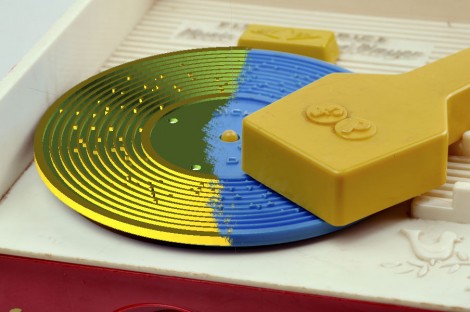
The classic Fisher-Price Music Box Record Player was never a true vinyl turntable. It did not read analog sound waves from a groove. It did not need an amplifier, a stylus cartridge, or a lecture from someone named Brent about “warmth.” Instead, it worked more like a music box. Its plastic records carried tiny bumps and notches that triggered a comb-like mechanism inside the tonearm. As the disc turned, the raised features plucked tuned metal teeth, producing simple melodies. That means a custom disc could theoretically play a custom song, as long as the melody was translated into the toy’s mechanical language.
That is where 3D printing enters the room, kicks open the nursery door, and politely asks the toddler toys to make space for classic rock.
How A Toy Record Player Became A Maker Playground
The Fisher-Price record player is one of those toys that lives in a strange emotional neighborhood: half childhood memory, half mechanical marvel. It was first released in the early 1970s and became recognizable for its chunky design, bright colors, carry handle, wind-up operation, and five double-sided plastic records. Each side played a short tune, and the whole thing felt like a baby’s first DJ booth, minus the nightclub fog machine and poor decisions.
For most people, the toy was charming because it was simple. For makers, that simplicity is exactly what made it irresistible. The discs are not mysterious black vinyl. They are physical data storage. Each bump is an instruction. Each track is a mechanical sequence. Each rotation is a loop of encoded music. Once you understand that, the toy stops being just a toy and becomes a tiny programmable music machine.
British maker Fred Murphy explored that idea by creating custom records for the Fisher-Price player. Early efforts involved a subtractive manufacturing approach, milling discs from solid plastic. That worked, but milling means cutting material away. It is accurate and satisfying, but it also creates waste. The 3D-printed method changed the workflow: instead of carving a record out of a sheet, the disc could be built layer by layer from a digital model. Less mess, more repeatability, and more room for experimentation.
Why Led Zeppelin Is Funny On A Fisher-Price Record Player
Choosing Led Zeppelin, especially “Stairway to Heaven,” is not just a technical choice. It is comedy with gears. The original song is long, dramatic, and deeply embedded in rock culture. It starts with delicate guitar and grows into a towering anthem. It is the kind of track that makes people close their eyes, nod seriously, and pretend they understand every mystical lyric.
Now imagine that same musical ambition squeezed into the polite plink-plink voice of a toddler music box. The result is not a concert. It is a miniature tribute. It sounds like a tiny medieval robot practicing classic rock during snack time. And that contrast is the entire magic.
The Fisher-Price mechanism cannot reproduce the full arrangement, the guitar tone, the vocal performance, or the epic build. What it can do is carry a simplified melody. That limitation is not a failure; it is the point. A 3D-printed Fisher-Price record turns a giant song into a playful mechanical sketch. It is a reminder that music is not only about fidelity. Sometimes music is about recognition, memory, and the delight of hearing something familiar come from the wrong machine.
How The 3D-Printed Fisher-Price Record Works
To understand the project, think of the disc as a physical music file. Instead of storing sound as digital audio or analog grooves, the record stores note events as raised structures. When the player spins, the “needle” area interacts with those structures. The bumps pluck the music-box comb inside the player, and each pluck creates a note.
Step 1: Simplify The Song
A song like “Stairway to Heaven” has multiple instruments, changing dynamics, and expressive timing. The toy cannot handle all of that. The maker must reduce the song to a melody that fits the available notes and mechanical spacing. This is similar to arranging a full orchestra piece for a toy piano, except the toy piano is also arguing with you in plastic.
Step 2: Map Notes To Physical Positions
Each note needs to correspond to a mechanical trigger on the disc. In a digital design environment, the tune becomes geometry. A note is no longer just “A” or “C.” It becomes a bump in the correct location at the correct moment along the rotating path. Timing depends on angular position. Pitch depends on which tine gets plucked. The song becomes a circular pattern of musical instructions.
Step 3: Generate A 3D Model
Tools such as OpenSCAD are useful for this kind of parametric design because they allow makers to describe geometry with code. Instead of dragging shapes around by hand, the designer can define rules: disc size, groove paths, note positions, bump heights, spacing, and structure. The final model can be exported for 3D printing.
Step 4: Print, Test, Adjust, Repeat
Anyone who has used a 3D printer knows the first print is often not the final print. It is a physical draft. Maybe the bumps are too shallow. Maybe the disc binds. Maybe the timing sounds like Led Zeppelin falling down a staircase rather than climbing one. That is normal. Maker projects thrive on iteration. Print, test, sand, modify the file, print again, and celebrate small improvements with the seriousness of a NASA launch.
Why This Project Still Matters
At first glance, printing a novelty record for an old Fisher-Price toy might seem like a delightful waste of time. But that is too small a reading. This project demonstrates several important ideas in modern making: reverse engineering, digital fabrication, mechanical music, low-volume customization, and the creative reuse of old consumer objects.
It also shows why 3D printing is so powerful for niche problems. No major manufacturer is likely to mass-produce a Fisher-Price-compatible Led Zeppelin music-box disc. The market is probably smaller than the number of people who can identify every member of Led Zeppelin by silhouette. But with a 3D printer, one enthusiast can make the object anyway. That is the charm of desktop fabrication: it does not need a million customers to justify an idea. Sometimes one curious person is enough.
3D printing also changes the economics of replacement and customization. Vintage toys often survive longer than their accessories. Records get lost, cracked, chewed, or mysteriously absorbed into the same household dimension that eats socks. When a compatible part can be modeled and printed, an old toy gets a second life. Add custom songs, and it gets a second personality.
The Sweet Spot Between Nostalgia And Technology
This project hits the internet’s favorite emotional chord: old object, new tool. People love seeing modern technology revive analog gadgets because it feels both clever and comforting. A 3D printer is often associated with prototypes, robotics, engineering labs, and futuristic manufacturing. The Fisher-Price record player belongs to playrooms, grandparents’ attics, and childhood afternoons. Put them together, and you get a story that feels like time travel with a spool of filament.
The best part is that the original toy’s low-tech nature is exactly what makes the upgrade possible. If the player were a sealed digital device with proprietary chips and encrypted audio files, the project would be far less approachable. Because it is mechanical, it invites observation. You can see the disc. You can study the bumps. You can understand the cause and effect. The toy teaches the hacker how to hack it.
What Makers Can Learn From The Fisher-Price Zeppelin Project
The Fisher-Price 3D-printed record project is funny, but it is also a useful case study. It offers lessons that apply far beyond toy music.
Start With A Clear Mechanical System
The project works because the toy has a readable mechanism. The disc rotates. The bumps trigger notes. The comb makes sound. There is no hidden cloud account or firmware update waiting to ruin the weekend. For beginner makers, projects with visible mechanics are often the best teachers.
Accept The Limits Of The Medium
A Fisher-Price music-box record cannot sound like a high-fidelity Led Zeppelin recording. Trying to force it to do so would miss the fun. Good making often means respecting the tool’s personality. The goal is not perfect reproduction; the goal is a charming translation.
Use Software To Solve Repetitive Geometry
Designing every note bump manually would be tedious. Code-based CAD turns the process into a system. Once the rules are written, different melodies can be generated more easily. That is where the project becomes more than a one-off gag. It becomes a platform for making many custom toy records.
Prototype Like A Comedian
Great maker projects often have a punchline. They make people smile before they understand the engineering. “Led Zeppelin on a Fisher-Price record player” is instantly funny. That humor helps the project travel online, but it also keeps the maker motivated. A project with personality is easier to finish than one that feels like homework with fumes.
3D Printing, Repair Culture, And The Return Of Small Objects
One of the most exciting things about 3D printing is not that it can make giant futuristic structures. It is that it can make tiny, specific, almost absurdly personal objects. A missing knob. A bracket for an old appliance. A custom adapter. A replacement toy part. A music-box record that plays a rock anthem in toddler language.
Repair culture depends on this kind of specificity. Mass manufacturing is excellent at producing huge numbers of identical items. It is less interested in helping one person restore a toy from 1971 or print a novelty disc for a family gift. Desktop fabrication fills that gap. It lets individuals solve small problems that are too unusual for retail shelves.
This is why projects like the Fisher-Price Zeppelin disc are more than internet curiosities. They show a future where personal manufacturing is not only about new products, but about extending the lives of old ones. The most sustainable gadget may be the one you do not throw away because someone figured out how to print the part it needed.
Is This A Music Project, A Toy Project, Or An Engineering Project?
Yes.
That is the best answer. It is a music project because it arranges a famous melody for a limited instrument. It is a toy project because it revives and reimagines a beloved children’s object. It is an engineering project because it requires measurement, modeling, prototyping, and mechanical understanding. It is also a culture project because it connects generations: a 1970s toy, a 1971 rock song, and a 21st-century 3D printer all spinning together on the same table.
That mixture is why the story is so appealing. It refuses to stay in one category. It belongs equally to makers, musicians, collectors, parents, retro-tech fans, and anyone who believes the world is better when silly ideas are executed with technical seriousness.
Practical Tips For Creating Custom Fisher-Price Records
If you want to experiment with custom Fisher-Price records, start with a simple melody. Nursery rhymes, short TV themes, folk tunes, and recognizable riffs are better candidates than dense arrangements. The more complex the source material, the more aggressive the simplification must be.
Use a durable material and print with enough precision to preserve small raised details. The disc must rotate cleanly, sit flat, and interact with the tonearm without forcing the mechanism. A rough print may technically fit but sound unreliable. Fine-tuning the bump height and placement can make the difference between “recognizable melody” and “haunted dishwasher.”
Also, remember that copyright matters if you plan to sell or distribute music-based files. Making a playful personal experiment is one thing; commercializing discs based on famous songs may require permission. The safest public projects use original melodies, public-domain tunes, or properly licensed material.
Why The Internet Loves This Kind Of Build
The internet is overflowing with projects that are impressive but emotionally cold. This one has warmth. It has a familiar toy, a famous song, a clever method, and a result that is technically limited in the funniest possible way. You do not need an engineering degree to understand why it is delightful. You only need to imagine a tiny plastic player bravely taking on Led Zeppelin and doing its best.
That emotional accessibility is a major reason maker stories spread. People may not understand parametric CAD, STL files, tolerances, or additive manufacturing, but they understand the joy of making an old thing do a new trick. The project becomes a doorway. First you laugh at the toy playing Zeppelin. Then you learn how music-box mechanisms work. Then you discover OpenSCAD, 3D modeling, mechanical encoding, and the broader world of digital fabrication. The joke becomes an education.
Experience Notes: What It Feels Like To Work On A Project Like This
Working on a project like Zeppelin on the Fisher Price record player now thanks to a 3D printer feels less like building a product and more like negotiating with a tiny musical creature from the past. The first experience is usually nostalgia. You pick up the toy, wind the knob, place the plastic record on the turntable, and hear that bright mechanical sound. It is not loud. It is not polished. But it has character. The sound is honest in the way only a spring-powered toy can be honest.
Then comes curiosity. You stop seeing the toy as a closed object and start seeing it as a system. The record is not just a record. It is a map. The tonearm is not just pretend. It is a reader. The plastic shell is not just decoration. It acts like a small resonating body that helps the music carry. Suddenly, the whole toy becomes a lesson in mechanical design.
The next stage is false confidence. This happens in nearly every maker project. You think, “How hard can it be? It is just bumps on a disc.” Then you remember that music is timing, timing is geometry, geometry is tolerance, and tolerance is where optimism goes to get humbled. A bump that is slightly misplaced can make a melody stumble. A disc that is slightly warped can drag. A print setting that seemed harmless can turn a crisp note into a sad little clack.
But that is also the fun. Each failed print teaches something physical. The printer becomes part of the band. The slicer settings become production notes. The first recognizable phrase feels like a standing ovation, even if the audience is just you, a desk lamp, and possibly a confused cat. When the toy finally plays a melody that resembles the intended song, it feels wildly satisfying. Not because the sound is perfect, but because the chain of translation worked: song to notes, notes to code, code to geometry, geometry to plastic, plastic to motion, motion to sound.
There is also a special pleasure in making modern technology serve an old object rather than replace it. Many gadgets become obsolete because newer devices do the same job more conveniently. This project does the opposite. It uses a 3D printer to make the old toy more interesting. It does not turn the Fisher-Price player into a Bluetooth speaker. It respects the original mechanism and feeds it new material. That feels surprisingly humane.
Another memorable part of the experience is sharing it. People react quickly because the concept is instantly understandable. You do not have to explain the entire design process up front. You can simply say, “This Fisher-Price toy plays Led Zeppelin now,” and people lean in. The project has a headline built into it. It is ridiculous enough to be funny and real enough to be impressive.
For parents, collectors, and retro-tech fans, the build can also become a bridge between generations. An adult remembers the toy from childhood. A child sees a funny plastic music machine. A maker sees a programmable mechanical interface. A music fan recognizes the melody. Everyone gets a different doorway into the same object.
That may be the most valuable experience of all: the reminder that creativity often lives in combinations. Old toy plus classic rock. Music box plus CAD. 3D printer plus childhood memory. None of these pieces need to belong together, which is exactly why they become interesting when someone connects them.
Conclusion
The story of Zeppelin on the Fisher-Price record player thanks to a 3D printer is a perfect example of maker culture at its best. It is clever without being cold, nostalgic without being dusty, and technical without losing its sense of humor. By translating a famous rock melody into the mechanical language of a children’s music-box toy, the project turns a simple object into a tiny celebration of engineering imagination.
It also shows what 3D printing does especially well: it gives individuals the power to create highly specific objects that traditional manufacturing would never bother to produce. A custom Fisher-Price record is not a mass-market necessity. It is better than that. It is a personalized, playful, technically fascinating artifact that exists because someone wondered whether it could.
And when a little plastic toy record player takes on Led Zeppelin, the result may not shake an arena. But it does something just as wonderful: it makes people grin, listen closer, and remember that invention is allowed to be silly.
Note: This article is written as an original SEO-friendly synthesis based on real maker, toy-history, 3D-printing, and mechanical music information. It does not copy source text or include unnecessary citation placeholders.