
Editorial Note: This article is written for web publishing and synthesizes reputable folklore, museum, encyclopedia, and cultural references. Source links are intentionally not inserted in the article body, as requested.
Japanese folklore is not short on imagination. While some cultures gave the world a few tidy monstersperhaps a dragon here, a witch thereJapan built an entire supernatural neighborhood and filled it with river goblins, long-necked women, fox tricksters, umbrella spirits, bathroom-cleaning nightmares, and mountain beings who may or may not teach you swordsmanship if they are in a decent mood.
These strange beings are commonly grouped under the term yōkai, a broad word used for supernatural creatures, mysterious phenomena, spirits, demons, transformed animals, and things that simply refuse to behave like normal reality. Some yōkai are terrifying. Some are funny. Some are moral warnings dressed in fur, feathers, scales, or household items. And a surprising number seem to exist mainly to remind humans not to be rude, greedy, careless, dirty, or foolish after dark.
What makes Japanese folklore creatures so fascinating is that they are rarely just “monsters.” They reflect old fears, seasonal dangers, religious beliefs, village humor, natural forces, and social etiquette. A kappa warns children about rivers. A yuki-onna embodies the danger and beauty of snow. A tanuki turns mischief into a full-time career. Even a haunted umbrella has a lesson: do not abandon your old things unless you are ready for them to hop back into your life with one eye and a tongue.
Below are ten of the most bizarre creatures from Japanese folkloreeach one strange enough to make a horror movie, a comedy sketch, and a cautionary bedtime story all at once.
What Are Yōkai in Japanese Folklore?
Before meeting the creatures, it helps to understand the world they come from. In Japanese folklore, yōkai can be spirits, demons, monsters, magical animals, ghosts, living curses, or even ordinary objects that have transformed after years of neglect. They may haunt mountains, rivers, roads, abandoned houses, old tools, bathhouses, snowy paths, or the uncomfortable space behind your imagination.
Many yōkai stories grew from attempts to explain the unexplainable. Strange sounds in the forest? Perhaps a tanuki was drumming its belly. A dangerous river current? Maybe a kappa was waiting below the surface. A lonely traveler lost in a snowstorm? That could be the work of the yuki-onna. These legends helped people give shape to danger, mystery, and moral behavior.
Yōkai also became a major part of Japanese art. Picture scrolls such as the famous “Night Parade of One Hundred Demons” imagined supernatural creatures marching through streets at night. Artists from the Edo period and beyond gave these beings memorable visual identities, turning folklore into an enormous illustrated universe long before modern manga, anime, and video games made monsters global celebrities.
1. Kappa: The Polite River Menace
The kappa is one of the most famous creatures in Japanese folklore, and for good reason: it is both ridiculous and genuinely alarming. Usually described as a small, greenish, water-dwelling humanoid, the kappa lives in rivers, ponds, and marshes. It often has webbed limbs, a beak-like mouth, a turtle-like shell, and a dish-shaped depression on top of its head filled with water.
That head-water is the secret to its power. If the water spills, the kappa becomes weak. This leads to one of folklore’s funniest survival tips: bow. Kappa are said to be extremely polite. If you bow deeply, the kappa may bow back, spill the water from its head, and suddenly become much less impressive. Imagine defeating a river monster with etiquette. Your grandmother would be proud.
Kappa legends warned people, especially children, about the dangers of deep water. They were said to pull victims into rivers, but they also had a civilized side. Some stories portray them as capable of speech, promise-keeping, and even medical knowledge. Like many Japanese yōkai, the kappa is not simply evil. It is a strange mix of danger, humor, manners, and cucumber enthusiasmbecause, yes, kappa are famously fond of cucumbers.
2. Tengu: Mountain Spirits with Big Noses and Bigger Attitudes
Tengu are powerful mountain beings often associated with forests, martial skill, pride, and mischief. Older depictions gave them bird-like features, while later art often shows them with red faces, fierce expressions, long noses, robes, wings, and feather fans. If a kappa is a river troublemaker, a tengu is the dramatic mountain neighbor who knows sword fighting and absolutely wants you to notice.
In folklore, tengu can be tricksters, protectors, warriors, or dangerous spirits. They are linked to mountain asceticism and remote sacred spaces, where humans enter nature’s territory and must behave with respect. Some tales describe tengu as arrogant beings, sometimes connected with people who were proud in life. Others present them as teachers of martial arts, including legends in which they instruct heroic warriors.
The tengu’s bizarre appeal lies in its contradictions. It is part bird, part monk, part warrior, part forest guardian, and part supernatural prankster. A tengu might punish vanity, protect a sacred mountain, or confuse a traveler just because the day felt too quiet. In SEO terms, the tengu has excellent brand consistency: dramatic, mysterious, and always slightly judgmental.
3. Kitsune: The Fox That Knows Too Much
Kitsune are magical foxes and among the most beloved creatures in Japanese mythology. They are famous for intelligence, shapeshifting, illusion, longevity, and trickery. A kitsune may appear as a fox, a beautiful human, a mysterious stranger, a helpful guardian, or someone who is definitely not being honest about why they know your secrets.
In many stories, kitsune grow more powerful with age. Some are mischievous tricksters who deceive greedy, arrogant, or foolish people. Others are benevolent spirits connected with Inari, the Shinto deity associated with rice, prosperity, and fox messengers. This double nature makes kitsune unusually flexible figures in folklore: they can be romantic, eerie, sacred, funny, or morally complicated.
The classic kitsune story often asks a simple question: can humans trust appearances? A fox may look like a person. A gift may hide a trick. A charming visitor may be more ancient than the village itself. Kitsune legends are bizarre because they blur boundariesanimal and human, sacred and mischievous, love story and warning label. They are proof that in Japanese folklore, the smartest creature in the room may have a tail.
4. Tanuki: The Shapeshifting Party Animal
The tanuki, or Japanese raccoon dog, is a real animal with a legendary alter ego. In folklore, the supernatural tanukioften called bake-danukican shapeshift into people, objects, or other creatures. It is known for pranks, illusions, belly-drumming, and a general commitment to making human life slightly more confusing.
Unlike some sinister yōkai, tanuki stories often lean toward comedy. The tanuki might transform to fool travelers, scare hunters, or sneak into human society for food, drink, and fun. Over time, its image softened from bad omen to cheerful trickster. Today, tanuki statues are common outside restaurants and shops in Japan, often symbolizing hospitality, luck, prosperity, and a good time.
What makes the tanuki bizarre is not just shapeshiftingit is the personality. The tanuki is folklore’s chaotic friend who borrows your jacket, pretends to be a monk, drums on its stomach, and somehow gets invited back for dinner. It represents the playful side of Japanese mythology, where deception is not always evil; sometimes it is just the universe wearing a funny hat.
5. Rokurokubi: The Woman with the Stretching Neck
At first glance, a rokurokubi appears to be an ordinary person, usually a woman. By day, nothing seems unusual. She may live, work, and speak like anyone else. But at night, her neck stretches to impossible lengths, allowing her head to roam while her body remains behind. Some related legends describe a version called nukekubi, whose head detaches completely and flies about.
The rokurokubi is one of the most visually bizarre creatures in Japanese folklore because it turns the familiar human body into something uncanny. It is not a dragon, demon, or animal. It is almost normaland that “almost” does all the spooky work. A long neck sliding through a room at midnight is not the sort of surprise anyone wants after a peaceful cup of tea.
Some tales treat rokurokubi as cursed humans rather than creatures born monstrous. That detail gives the legend a tragic layer. The yokai may not fully control what happens at night. As with many Japanese ghost stories, the horror comes from hidden guilt, secret transformation, and the fear that the person beside you may not even know what they become after dark.
6. Yuki-onna: The Snow Woman
Yuki-onna, the snow woman, is one of the most haunting figures in Japanese folklore. She appears in snowy regions and winter tales, often as a beautiful woman with an icy presence. She may be calm, silent, pale, and gracefulless like a monster crashing through the door and more like winter itself deciding to wear a human face.
In many legends, yuki-onna appears to travelers trapped in snowstorms. She can be merciful in one story and dangerous in another. Sometimes she spares a person under strict conditions, only for that promise to become the emotional center of the tale. Other times, she represents the deadly power of cold weather, especially in mountains and isolated villages.
The yuki-onna is bizarre because she is both beautiful and terrifying. She is not a clumsy beast or a loud demon. She is quiet, elegant, and unforgettable. Her stories often feel less like monster encounters and more like sad winter dreams. She reminds readers that nature can be breathtaking and dangerous at the same timea snow globe with a warning label.
7. Noppera-bō: The Faceless Stranger
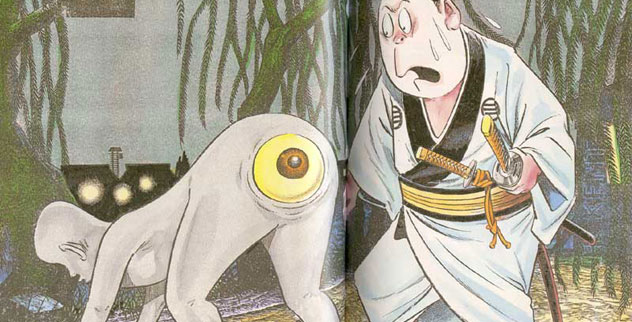
The noppera-bō is one of the simplest and most effective nightmares in Japanese folklore. It looks like a normal person until the moment it turns aroundor lowers its handsand reveals a blank, featureless face. No eyes. No nose. No mouth. Just smooth nothingness where identity should be.
Stories of the noppera-bō often use a double-scare structure. A frightened person sees a faceless figure, runs away, finds someone safe, explains what happened, and then the “safe” person reveals the same blank face. It is the folklore equivalent of thinking you escaped the horror movie, only to realize the sequel started immediately.
The noppera-bō may be linked in some tales to shapeshifting animals such as foxes or tanuki, suggesting the faceless form is a trick rather than a separate species. Either way, its power is psychological. It does not need claws or thunder. It terrifies by removing the most human thing about a person: the face. In a world where recognition creates trust, the noppera-bō is pure social panic.
8. Nue: The Original Mythological Mash-Up
The nue is a legendary chimera-like creature from Japanese folklore, famous for having a body assembled from several animals. Descriptions vary, but classic versions include features such as a monkey’s head, tiger’s limbs, a raccoon dog’s body, and a snake-like tail. In other words, the nue looks like someone shook a mythology box too hard and decided, “Yes, all of it.”
The nue is associated with eerie cries, illness, bad omens, and legendary warrior tales. In some versions, it appears near the imperial palace and causes mysterious trouble until a heroic archer defeats it. The creature’s strange mixed body makes it an ideal symbol of chaos. It is not one fearit is several fears stitched into a single night visitor.
Among bizarre creatures from Japanese folklore, the nue stands out because it feels ancient and cinematic. It is not playful like the tanuki or politely beatable like the kappa. It is ominous, stormy, and difficult to classify. If yōkai had a “most likely to appear during dramatic thunder” award, the nue would arrive early and accept it loudly.
9. Karakasa-kozō: The Haunted Umbrella with One Leg
The karakasa-kozō, or umbrella spirit, belongs to the category of transformed objects sometimes called tsukumogami. These are items that become animated after long use or neglect. The karakasa-kozō is usually pictured as an old paper umbrella with one eye, a long tongue, arms, and a single leg that hops around causing mischief.
Unlike many darker yōkai, the karakasa-kozō is usually more silly than sinister. It may jump out to startle people, lick unsuspecting victims, or simply behave like an umbrella that has had enough of being left in corners. It is a perfect example of how Japanese folklore gives personality to everyday objects.
The idea behind tsukumogami is both funny and oddly thoughtful. Old tools, containers, and household items are not just disposable things; they have histories. Treat them carelessly, and they may develop feelingsor legs. The karakasa-kozō turns clutter into comedy and reminds us that even an umbrella deserves a little respect. Also, maybe do not store one in a dark hallway unless you enjoy cardio.
10. Akaname: The Filth-Licking Bathroom Goblin
Of all bizarre creatures from Japanese folklore, the akaname may win the award for “most likely to improve household hygiene through fear.” Its name is commonly understood as “filth licker” or “scum licker,” and it is associated with dirty bathrooms and neglected bath areas. It is often depicted as a small goblin-like yōkai with a long tongue used to lick grime.
The akaname is gross, yes, but it is also practical. Like many folklore creatures, it transforms a daily chore into a memorable warning. Do not let your bathhouse become filthy, or something strange may arrive to enjoy the mess. It is basically a supernatural cleaning reminder, though admittedly less charming than a calendar notification.
This creature shows how yōkai stories could teach behavior without sounding like boring instructions. Instead of saying, “Please clean the bathroom regularly,” folklore says, “A goblin with a tongue may visit.” Which version would you remember? Exactly. The akaname proves that Japanese folklore can make even housekeeping weirdly unforgettable.
Why Japanese Folklore Creatures Still Fascinate Modern Audiences
The lasting appeal of Japanese folklore creatures comes from their variety. Western monster categories often separate ghosts, demons, beasts, and enchanted objects. Yōkai cheerfully ignore those filing cabinets. A yōkai can be an animal spirit, a haunted tool, a snow apparition, a faceless stranger, or a creature that teaches swordsmanship in the mountains before vanishing like a dramatic theater student.
These stories also survive because they are adaptable. Yōkai appear in museum exhibitions, woodblock prints, manga, anime, video games, films, novels, and local festivals. They can be cute mascots or serious symbols of fear. They can teach children to avoid rivers, remind adults not to act arrogantly, or offer artists a bottomless supply of strange visual ideas.
Most importantly, yōkai make mystery feel close. They do not always live in distant castles or underworld kingdoms. They live in rivers, kitchens, umbrellas, snowy roads, public baths, forests, and alleys. They transform ordinary places into story-rich spaces. After learning about them, a quiet street at night or an old object in the closet can feel just a little more alive.
Experiences Related to “10 Bizarre Creatures from Japanese Folklore”
Exploring Japanese folklore creatures is not only an exercise in reading old stories. It can feel like walking through a cultural funhouse where every mirror reflects a different human fear, habit, or joke. One of the best experiences for readers is realizing that many yōkai are tied to everyday life. They are not random monsters tossed into tales for decoration. They explain why people feared rivers, respected mountains, cleaned bathhouses, treated tools carefully, and paid attention to manners.
Imagine learning about the kappa before visiting a quiet river in Japan. Suddenly, the water is not just water. It carries centuries of cautionary storytelling. Parents may once have used kappa legends to keep children from playing too close to dangerous currents. The creature’s strange politeness also adds humor: the idea that a bow could defeat a water monster makes the story memorable without reducing its warning. That is the genius of folkloreit can be scary and useful at the same time.
Another memorable experience comes from seeing yōkai in art. In old prints and picture scrolls, these creatures often look expressive, busy, and oddly alive. The “Night Parade” theme is especially fascinating because it imagines supernatural beings marching through human streets after dark. Viewers are not simply looking at monsters; they are watching a hidden world temporarily take over the familiar one. That feeling is one reason yōkai remain popular in modern visual culture. They invite artists to ask, “What if the ordinary world is only ordinary during business hours?”
Yōkai also create a richer travel experience. A tanuki statue outside a restaurant becomes more than a cute decoration once you know the folklore behind it. A fox image near a shrine feels more meaningful when connected to kitsune stories and Inari worship. A mountain path becomes more atmospheric when you have read about tengu. Even a paper umbrella in a traditional display might make you smile if you remember the karakasa-kozō hopping around on one leg like a prankster with weather protection.
For writers, artists, and content creators, Japanese folklore offers a master class in character design. The best yōkai are simple enough to remember but strange enough to stand out. A faceless human. A snow woman. A long-necked sleeper. A filth-licking bathroom goblin. These concepts are instantly visual, emotionally clear, and loaded with symbolic meaning. They show how folklore can turn a small idea into a lasting cultural image.
The most rewarding experience, however, is noticing how human these bizarre creatures really are. They reflect fear of nature, anxiety about strangers, respect for old objects, humor about bad habits, and curiosity about the unseen. Japanese folklore does not just ask, “What monsters are out there?” It asks, “What do our monsters say about us?” That question is why yōkai continue to feel fresh, funny, eerie, and deeply fascinating today.
Conclusion
Japanese folklore is a treasure chest of strange beings, and the ten creatures above barely scratch the surface. From the river-dwelling kappa to the snow-cold yuki-onna, from the shapeshifting kitsune to the one-legged umbrella spirit, these yōkai show how imagination can transform daily life into myth. They are bizarre, yes, but they are also meaningful. They warn, tease, protect, punish, entertain, and explain.
What makes these creatures unforgettable is their balance of humor and mystery. A tengu may be majestic. A tanuki may be ridiculous. A noppera-bō may be terrifying precisely because it has no expression at all. An akaname may be disgusting, but it probably gets results. Together, they reveal a folklore tradition where every mountain, river, object, storm, and shadow might have a story waiting inside it.
So the next time an old umbrella leans in the corner, a snowy road looks too quiet, or a river makes a strange sound, remember: in Japanese folklore, the world is rarely empty. It may simply be waiting for nightfall.
SEO Tags