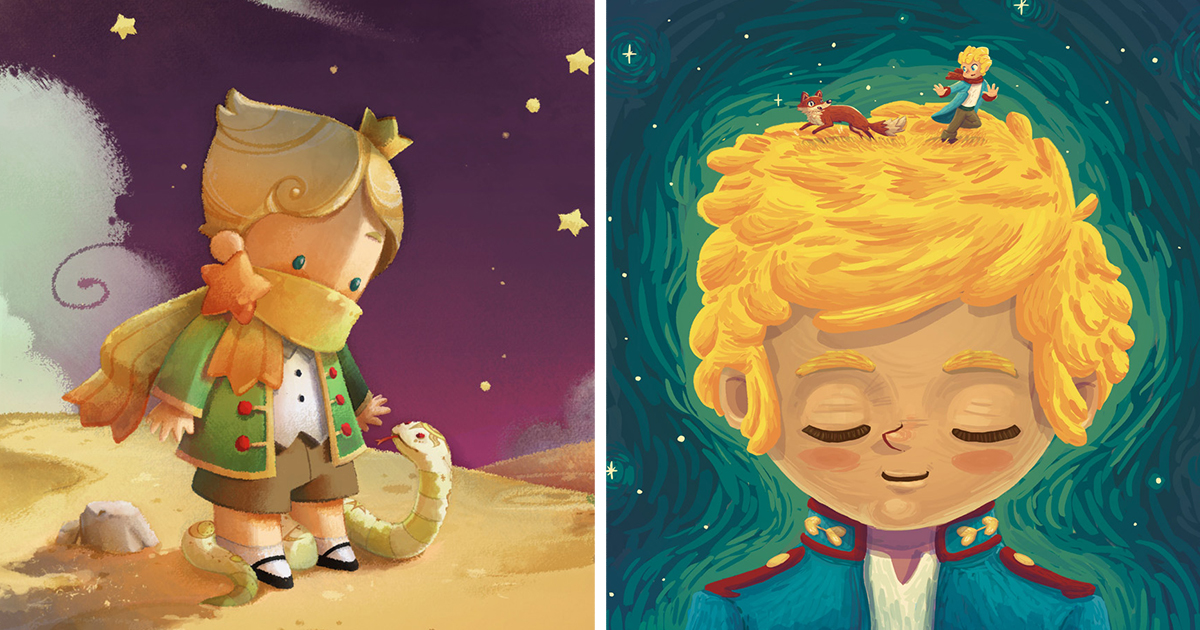

What happens when more than 150 artists are invited to visit the same tiny asteroid? Noer of makeovers, and the fox becomes one of the most creatively interpreted animals on the internet.
That, in spirit, is what happened with Invisible a los ojos, a large-scale collaborative art project inspired by Antoine de Saint-Exupéry’s Le Petit Prince, known in English as The Little Prince. Illustrators from across Latin America and the United States joined virtually to reinterpret the classic story, producing an interactive tribute filled with dramatically different techniques, moods, palettes, and visual personalities.
More than 150 artists from Argentina, Chile, Colombia, Mexico, Ecuador, Costa Rica, Brazil, Uruguay, Puerto Rico, and the United States participated. Instead of assigning one illustrator to the entire book, the organizers invited roughly four to six artists to respond to each chapter. The project eventually assembled more than 100 illustrations covering the story’s 27 chapters. p>The result is not merely another illustrated edition of a famous book. It is a visual conversation between generations, countries, artistic traditions, and readers who have carried the Little Prince in their imaginations for years.
A Classic Story Becomes a Collective Canvas
The Little Prince may appear to be a simple tale about a golden-haired traveler from Asteroid B-612, but simplicity is part of its clever disguise. Beneath its stars, sunsets, sheep, volcanoes, and baobabs are serious questions about loneliness, friendship, responsibility, adulthood, and the strange human habit of measuring everything except what matters.
The story follows a pilot stranded in the Sahara Desert who meets the mysterious Little Prince. As the boy recounts his travels from planet to planet, readers encounter a king obsessed with authority, a vain man desperate for applause, a businessman who believes he owns the stars, and other grown-ups who have become trapped inside their own narrow definitions of success.
The book was first published in the United States in English and French on April 6, 1943. Saint-Exupéry wrote and illustrated much of it while living in New York during World War II, including time spent in a rented house on Long Island. The original working materials reveal a far less effortless process than the finished book suggests: repeated drafts, major cuts, revised conversations, stained pages, preliminary sketches, and late-night creative experiments. p>This background makes the collaborative tribute especially fitting. Saint-Exupéry’s apparently spontaneous story was itself shaped by experimentation. Invisible a los ojos extends that creative process, allowing dozens of contemporary artists to ask the same question: What does this chapter look like through my eyes?
Inside the “Invisible a los ojos” Art Project
A Virtual Meeting of Artists
The project’s Spanish title, Invisible a los ojos, refers to the book’s central idea that life’s essential qualities cannot be understood through superficial observation alone. The title also provides an excellent description of online collaboration. The artists were separated by cities, borders, and thousands of miles, yet their work became part of one shared visual universe.
Participants did not have to surrender their identities to create a perfectly uniform edition. Quite the opposite: difference was the main attraction. The tribute welcomed individual techniques rather than forcing every contributor to imitate Saint-Exupéry’s delicate watercolors.
Published chapter credits included illustrators such as Gabriel Fermanelli, Fabricio Díaz, Maximiliano Dall’o, Sebastian Infantino, Sara Niett, Leonardo Rodriguez, Natalia Bellagamba, Tatiana Pollero, Felipe Niño, Pamela Barbieri, Nicolas Brondo, Daniel Gallego, and Marcelo Miraglia. The full roster stretched far beyond the selections displayed in early online features. h3>Multiple Images for Every Chapter
Assigning several artists to the same chapter transformed the project from a conventional book illustration exercise into a comparative gallery. One artist might emphasize emotional isolation, another might focus on humor, and a third might turn the same scene into a surreal explosion of shape and color. This structure encourages readers to slow down. In a traditional illustrated book, an image often becomes the accepted visual answer to a passage. Here, there is no single answer. Each chapter becomes a collection of possibilities. The baobabs, for example, may be interpreted as literal oversized trees, creeping threats, environmental warnings, psychological burdens, or symbols of neglected problems. Illustrator Sara Niett’s contribution specifically explored the baobab theme through digital painting, demonstrating how one familiar element can support a complete visual statement of its own. h3>An Open, Digital Tribute
The project was described by participating artists as a collaborative digital version released under a Creative Commons license. That choice supported the tribute’s broader philosophy: art gains cultural energy when it can be shared, discussed, discovered, and connected to new creative communities. Open licensing does not mean that artists disappear into an anonymous creative soup. Properly structured Creative Commons projects can preserve attribution while making it easier for audiences to encounter and circulate creative work. Similar illustration collaborations have shown how open distribution can introduce artists to new audiences and encourage further cultural exchange. h2>Why Le Petit Prince Welcomes So Many Art Styles
Few books offer artists such a recognizable collection of symbols. The scarf, rose, fox, sheep, stars, snake, planets, sunsets, volcanoes, and baobabs can be drawn with only a handful of lines, yet each object carries emotional and philosophical weight. A rose is not simply a flower. It represents beauty, pride, vulnerability, misunderstanding, devotion, and the responsibilities created by love. A fox is not merely a woodland animal with excellent branding. It becomes a teacher who explains that meaningful relationships require time, patience, and emotional risk. These symbols can survive radical changes in technique. They work in watercolor, collage, ink, vector graphics, editorial illustration, surrealism, comic art, minimalist linework, digital painting, and even three-dimensional sculpture. The story has also been adapted into film, theater, ballet, opera, graphic novels, animation, radio, and interactive media, proving that its emotional structure can travel comfortably between formats. h3>Saint-Exupéry Left Room for Imagination
Saint-Exupéry’s original illustrations remain inseparable from the book. Their fragile lines and translucent colors make the characters feel as though they have been remembered rather than manufactured. Yet the drawings are not overloaded with detail. They leave generous amounts of visual space around the characters. That openness invites participation. Readers mentally complete the planets, landscapes, and emotional atmospheres. Artists simply make their private versions visible. The Morgan Library & Museum preserves the bulk of the surviving manuscript and preliminary artwork, including a 140-page working draft. Those materials show that Saint-Exupéry repeatedly revised both language and imagery before reaching the apparent lightness of the published book. The finished simplicity was carefully engineered, not casually tossed together during a coffee break on Asteroid B-612. h2>A Latin American Perspective on a Global Book
Although the participating artists came from several countries, the project had a particularly strong Latin American identity. That matters because every culture brings its own color relationships, visual traditions, humor, landscapes, and emotional vocabulary to a classic text. A desert may resemble Patagonia, northern Mexico, or another familiar environment. The rose may carry the dramatic energy of a mural, the elegance of editorial fashion art, or the warmth of a handmade children’s book. Stars can become decorative folk motifs, geometric patterns, cosmic abstractions, or quiet dots surrounding a lonely traveler. International artistic exchange can expand professional networks, expose artists to unfamiliar approaches, and generate new ways of thinking about creative practice. Community-centered art also works best when people are active collaborators rather than passive recipients. Invisible a los ojos reflects both ideas: a geographically distributed group produced something that no individual contributor could have created alone. p>The book’s message also complements the project’s structure. The Little Prince repeatedly challenges rigid categories, national boundaries, adult status systems, and numerical thinking. Bringing together artists from many places turns those themes into a working method rather than leaving them safely parked inside the text. Many collaborative projects fail because organizers confuse consistency with conformity. A shared project needs enough structure to remain understandable, but too many restrictions can flatten the individual contributions. Invisible a los ojos found an effective organizing principle: one book, 27 chapters, recurring characters, and multiple artists interpreting each section. The story created unity. The illustrators supplied contrast. For creative directors, teachers, publishers, and independent artists, this offers a useful model. Establish a clear framework, define how contributors will be credited, organize submissions carefully, and then leave enough room for surprises. Nobody gathers 150 illustrators because they hope every picture will look as though it came from the same slightly overworked intern. Seeing several responses to a chapter reminds readers that illustration is not decoration pasted around a finished meaning. It is interpretation. Artists make decisions about scale, expression, lighting, distance, symbolism, and what should remain unseen. A picture of the Little Prince leaving his rose can emphasize freedom, guilt, grief, curiosity, or emotional immaturity. None of those readings must cancel the others. The gallery format allows them to coexist. This is one reason the original book continues to attract artists and institutions. Anniversary exhibitions, museum displays, tactile editions, sculpture projects, cinematic adaptations, and newly discovered sketches have repeatedly returned audiences to Saint-Exupéry’s visual world. A bronze Little Prince was even installed in Manhattan near Central Park, not far from the museum that preserves the manuscript. h3>It Gives Emerging Artists a Shared Stage
A collective tribute can help individual illustrators reach readers who might never discover their personal portfolios. Someone may arrive because of the book and leave remembering a particular artist’s treatment of the fox, rose, or businessman. That visibility is valuable, but so is the creative challenge. Interpreting a beloved work forces an artist to balance recognition with originality. Copy the original too closely, and the contribution becomes imitation. Change everything, and the emotional connection may vanish. The sweet spot lies somewhere between respect and rebellion. Exploring a project like Invisible a los ojos feels less like turning through a standard picture book and more like walking through a lively international exhibition. You recognize the characters, but the atmosphere changes every few steps. One moment feels quiet and nostalgic; the next is bold, comic, dark, decorative, or wonderfully strange. The repeated scenes create a particularly interesting viewing experience. When several artists illustrate the same chapter, viewers begin noticing decisions that would otherwise remain invisible. Why did one illustrator make the Little Prince tiny beneath an enormous sky? Why did another place his face close to the viewer? Why is one rose delicate while another seems capable of winning an argument with a lawn mower? These differences teach visual literacy without turning the experience into homework. Scale tells us what feels powerful. Color suggests emotional temperature. Empty space can express loneliness. Distorted proportions may communicate fear or absurdity. Even the direction of a scarf can make a still image feel hopeful, restless, or ready to fly away. For artists, participating in such a collaboration would bring a different kind of pressure. The source material is loved intensely, and readers already carry private images of its characters. The task is not simply to draw a charming blond child on a planet. It is to offer a fresh interpretation without breaking the story’s emotional spell. A productive process might begin by rereading one assigned chapter without studying other artists’ versions. The illustrator could list its emotional tensions, choose one dominant idea, and build the image around that idea. A chapter about the businessman might inspire rigid grids and repetitive stars. The fox’s chapter might call for warmer textures, gradually narrowing distances, or visual patterns that suggest trust forming over time. The project also creates a strong sense of artistic companionship. Illustration is often solitary work: one person, one screen or sheet of paper, several cups of coffee, and a deadline that appears to move faster whenever it is observed. A large collaboration connects those separate studios. Each artist contributes one piece, but no piece stands entirely alone. For readers returning to The Little Prince as adults, the gallery can produce another experience: rediscovery. Scenes remembered as whimsical may now feel painfully accurate. The businessman resembles modern productivity culture. The lamplighter looks like an exhausted employee following procedures nobody has reviewed in decades. The rose becomes less like a difficult flower and more like a complicated lesson about communication. Children may respond first to the planets, animals, and colors. Adults may notice regret, responsibility, and the danger of becoming too busy to understand why they are busy. The illustrations provide multiple entry points, allowing viewers of different ages to meet inside the same story without necessarily seeing the same thing. Teachers could use the project as an imaginative classroom exercise. Students might compare two visual interpretations of one chapter, identify the artistic choices, and then design a third version. Families could choose favorite images and explain their selections. Illustration groups could organize a similar chapter-sharing challenge around another public-domain classic, provided copyright and licensing requirements are handled correctly. The most memorable part of the experience is the realization that familiarity does not exhaust a story. A book can be read millions of times and still contain unopened doors. Give the same chapter to 150 artists, and those doors become windows, tunnels, trapdoors, and perhaps one suspiciously stylish interplanetary elevator. The success of a large illustration tribute depends on more than collecting attractive images. Organizers need a clear concept, transparent contributor credits, realistic technical requirements, dependable communication, and an accessible presentation platform. Projects should also explain licensing before artwork is submitted. Contributors need to understand how their pieces may be displayed, shared, printed, modified, or reused. Open distribution can be powerful, but openness works best when expectations are explicit and artists retain meaningful recognition for their labor. Editors can strengthen the final collection by balancing experienced illustrators with emerging voices, avoiding the temptation to select only one fashionable visual style. The point of a multi-artist book is not to produce 150 variations of the same portfolio trend. It is to reveal how widely a story can travel. Finally, the digital edition should not be treated as a consolation prize while everyone waits for print. Interactive navigation, artist profiles, chapter comparisons, process notes, and multilingual access can offer experiences that paper cannot easily reproduce. Digital books are not printed books with electricity attached; they can become their own creative environments. Invisible a los ojos demonstrates why The Little Prince remains such fertile ground for illustrators. Its language is economical, its symbols are memorable, and its questions remain inconveniently relevant. Are we caring for what we claim to love? Have numbers replaced understanding? Are we building relationships, or merely collecting contacts like stars in a spreadsheet? By inviting more than 150 artists to respond, the project did not replace Saint-Exupéry’s original images. It showed how much imaginative life those images continue to generate. Every artist arrived with a different visual language, yet all gathered around the same prince, fox, rose, pilot, and star-filled sky. The collaboration’s greatest achievement is therefore not size, although coordinating that many creative people deserves at least one medal and possibly a very long nap. Its real achievement is proving that a classic can remain recognizable while continually becoming new. Editorial note: This independent article synthesizes information from project records, participating artists’ portfolios, museum archives, publishing sources, arts organizations, and historical coverage. The prose and analysis are original, and quoted source links have not been reproduced in the article.Its Symbols Are Simple but Flexible
Why the Project Still Matters
It Demonstrates That Collaboration Does Not Require Sameness
It Turns Reading Into Active Interpretation
The Experience of Entering a 150-Artist Little Prince Universe
What Future Collaborative Book Projects Can Learn
Conclusion: One Prince, Hundreds of Ways to See