
Formatting a quote in MLA style can feel like trying to fold a fitted sheet: everyone says it is simple, yet somehow the corners keep attacking you. The good news is that MLA quotation rules are actually manageable once you understand the three situations you will meet most often: short quotes, long block quotes, and special quoted material such as poetry, dialogue, or edited wording.
MLA style is commonly used in English, literature, language arts, cultural studies, and other humanities courses. Its main job is not to make your paper look fancy. Its job is to help readers see exactly where your borrowed words came from, while keeping your own argument in charge. A quote should support your point, not walk into the paragraph wearing sunglasses and steal the show.
This guide explains 3 simple ways to format a quote in MLA, with practical examples, punctuation tips, and common mistakes to avoid. Whether you are writing a high school essay, a college research paper, or a literary analysis that has already eaten your weekend, these steps will help you quote with confidence.
What MLA Quote Formatting Means
In MLA style, a quote is a direct copy of someone else’s words. Because those words belong to another writer, speaker, poet, researcher, or character, you need to do two things: place the quoted words correctly in your sentence and provide an in-text citation that points to the full Works Cited entry.
Most MLA in-text citations use the author-page format. That means the author’s last name and the page number usually appear in parentheses, like this: (Morrison 42). If you already name the author in your sentence, you usually need only the page number in parentheses: Morrison writes that memory can feel “alive” (42).
For online sources without page numbers, MLA usually does not ask you to invent page numbers from your browser or count paragraphs like you are measuring spaghetti. Instead, use the author’s name when available, or a shortened title if there is no author. The goal is always the same: help your reader find the source in your Works Cited list.
Way 1: Format a Short Quote in MLA
Use quotation marks for short prose quotes
A short quote in MLA is usually four typed lines or fewer of prose. Prose means regular writing, such as a sentence from a novel, article, essay, or speech. Short quotes stay inside your paragraph and are placed in double quotation marks.
Here is the basic pattern:
Your sentence + “quoted words” + parenthetical citation + period.
Example:
According to Rivera, the city becomes “a map of private memories” (18).
Notice three things. First, the quote is introduced smoothly. Second, the borrowed words are inside quotation marks. Third, the period comes after the parenthetical citation, not before it. In MLA, the citation is part of the sentence, so the sentence is not finished until the citation has had its little moment.
Use a signal phrase to introduce the quote
A signal phrase tells readers who is speaking or writing before the quote appears. It prevents the quote from landing in your paragraph like a refrigerator dropped from a helicopter.
Good signal phrases include:
- Smith argues that
- Jordan explains,
- According to Lee,
- The narrator observes,
- The article suggests that
Example with a signal phrase:
Lee argues that social media can create “a constant pressure to perform identity” (73).
Because the author’s name appears in the sentence, the citation includes only the page number. That keeps the sentence clean and avoids repeating the author’s name like a broken classroom printer.
Place punctuation correctly
For most short MLA quotes, the period goes after the citation:
Correct: The speaker calls the house “a museum of unfinished conversations” (Nguyen 91).
Incorrect: The speaker calls the house “a museum of unfinished conversations.” (Nguyen 91)
Question marks and exclamation points are a little different. If the question mark or exclamation point belongs to the quoted material, keep it inside the quotation marks. If it belongs to your own sentence, place it after the citation.
Quoted question: The character asks, “Who will remember us?” (Alvarez 56).
Your question: Why does the narrator describe the room as “too quiet for comfort” (Bennett 14)?
Way 2: Format a Long Block Quote in MLA
Know when to use a block quote
A block quote is used when a prose quotation runs more than four typed lines in your paper. For poetry, block formatting is generally used when quoting more than three lines of verse. A block quote is set apart from the main paragraph, indented from the left margin, and written without quotation marks.
Think of a block quote as the formal dining room of quotations. It is useful, but you do not need to eat every snack there. Long quotes should be used only when the exact wording matters and when you plan to analyze that wording carefully.
Follow the MLA block quote layout
Here is the basic MLA block quote format:
- Introduce the quote with your own sentence.
- Use a colon if the introduction is a complete sentence.
- Start the quote on a new line.
- Indent the entire quote one-half inch from the left margin.
- Do not use quotation marks around the block quote.
- Keep the text double-spaced.
- Place the parenthetical citation after the final punctuation.
Example:
In her essay, Carter shows how memory changes ordinary places into emotional landmarks:
The street was not remarkable to anyone else. It had a bus stop, two tired trees, and a bakery that closed too early. Yet to me, every doorway seemed to hold a version of my childhood, waiting patiently for me to notice it again. (Carter 104)
In a normal MLA paper, the block quote would be double-spaced and indented. In web writing, the visual layout may vary, but the academic rule remains the same: block quotes are separated from the paragraph and cited after the closing punctuation.
Explain the block quote after using it
Never drop a block quote into your paper and run away. Teachers notice. Readers notice. Even the stapler on your desk looks disappointed.
After a block quote, explain why the passage matters. Connect it back to your thesis or paragraph claim. A strong follow-up sentence might begin like this:
- This passage matters because…
- The description reveals…
- By repeating this image, the author emphasizes…
- The contrast between these details suggests…
For example:
This passage matters because Carter turns an ordinary street into a symbol of personal history. The plain details make the memory feel more believable, while the phrase “waiting patiently” suggests that the past has not disappeared; it has simply been overlooked.
That analysis is where your essay earns its grade. The quote provides evidence, but your explanation provides the thinking.
Way 3: Format Poetry, Dialogue, and Edited Quotes in MLA
Use slashes for short poetry quotes
When quoting one to three lines of poetry inside your paragraph, use quotation marks and show line breaks with a slash. Put a space before and after the slash.
Example:
The speaker describes the evening as “soft with rain / and restless with birds” (12-13).
If there is a stanza break, use a double slash with spaces around it:
The poem shifts mood when the speaker says, “I waited by the shore / for a voice I knew // but only the tide answered” (8-10).
For longer poetry quotes, use block format and preserve the original line breaks as closely as possible. Poetry cares about line breaks the way cats care about knocking things off tables: deeply and with purpose.
Quote dialogue clearly
Dialogue can appear in fiction, drama, interviews, and scripts. For short dialogue quoted within your paragraph, use quotation marks and cite the source as usual.
Example:
When Maya says, “I am not leaving without the truth,” she turns the conversation into a direct challenge (Patel 88).
For longer dialogue from a play or script, MLA formatting can become more detailed. In many cases, speakers’ names are written in capital letters, and each speaker’s lines are formatted in a block style. Always follow your instructor’s directions for drama, because plays may be cited by act, scene, and line numbers rather than page numbers.
Use brackets when you change or add words
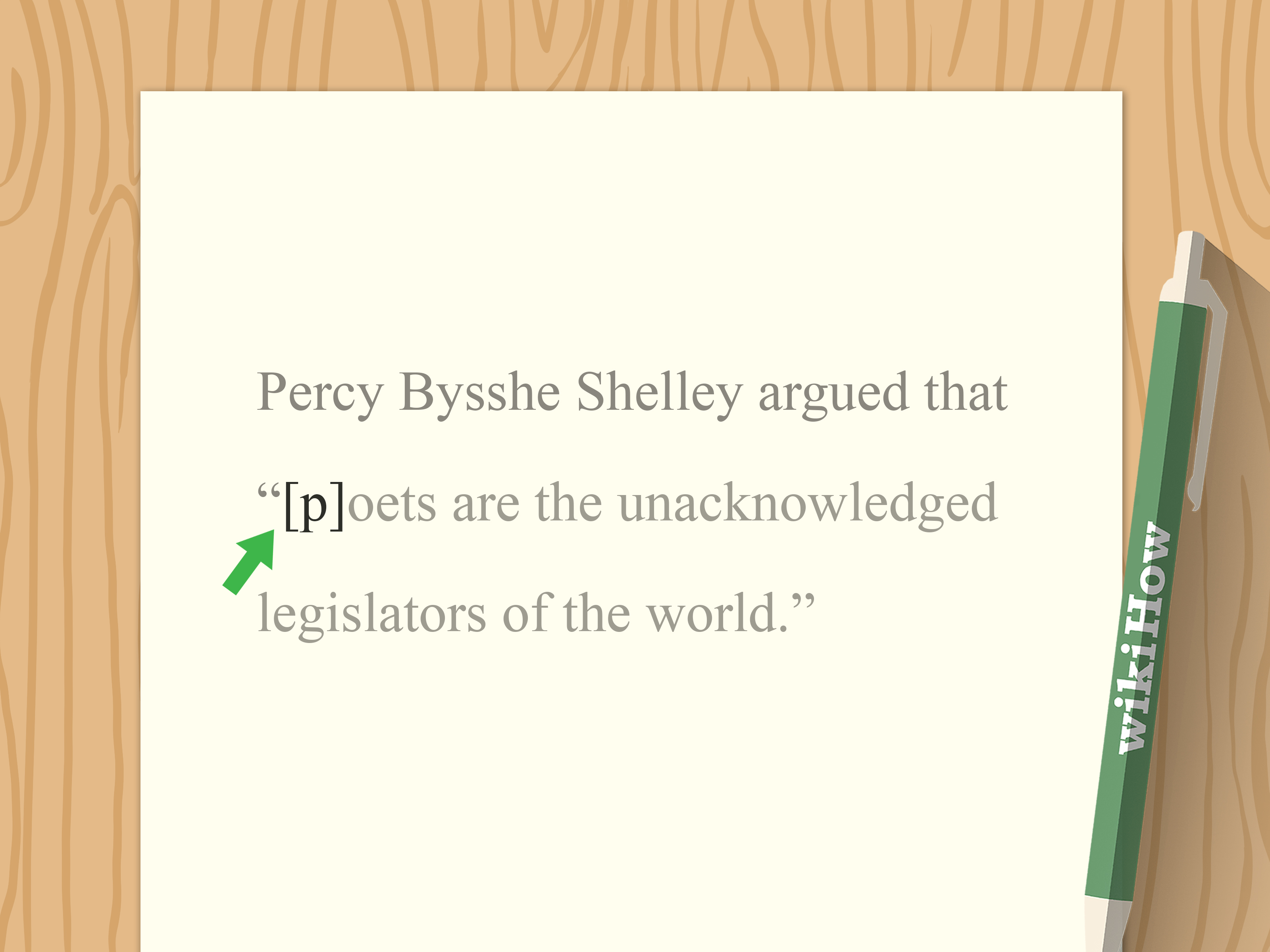
Sometimes a quote does not fit your sentence grammatically unless you adjust a word. MLA allows you to use square brackets to show that you changed or added something. Brackets are your way of saying, “Tiny edit here, nothing sneaky.”
Original sentence:
“They were unable to understand the warning.”
Integrated quote:
The report explains that the villagers “were unable to understand the warning” (Lopez 31).
Edited with brackets:
The report explains that “[the villagers] were unable to understand the warning” (Lopez 31).
Use brackets honestly and sparingly. Do not change the meaning of the original source. Your job is to make the quote fit your sentence, not give it a fake mustache and a new identity.
Use ellipses when you remove words
An ellipsis shows that you have left out part of a quote. In MLA style, ellipses are often written as three spaced periods. The key rule is simple: do not use ellipses in a way that changes the author’s meaning.
Original:
“The town changed slowly during the first decade, but by the second decade its streets, schools, and public spaces reflected a very different community.”
Shortened:
The historian notes that “the town changed slowly during the first decade . . . [and later] reflected a very different community” (Harris 212).
The shortened version keeps the original idea intact. That is the goal. Cutting a quote should make it clearer, not suspiciously convenient.
Common MLA Quote Formatting Mistakes
Mistake 1: Dropping quotes without context
A dropped quote appears without introduction or explanation. It makes the reader do all the work. Instead, introduce every quote with context and follow it with analysis.
Weak: “The garden had become a country of shadows” (Miles 44).
Better: Miles uses setting to reflect the narrator’s grief, describing the garden as “a country of shadows” (44).
Mistake 2: Citing only direct quotes
In MLA, you must cite not only direct quotes but also paraphrases and summaries of specific ideas from a source. Changing the wording does not magically make the idea yours. Sadly, plagiarism does not disappear just because you bought it a new hat.
Mistake 3: Overusing long quotes
Long quotes can be useful, but too many of them make your paper feel like a scrapbook of other people’s thoughts. Use block quotes only when the full passage deserves close attention. Otherwise, quote the most important phrase and explain it well.
Mistake 4: Forgetting the Works Cited page
An in-text citation is only half of the system. MLA also requires a Works Cited entry that gives full publication details. The in-text citation points readers to that entry. Without a Works Cited page, your citation is like a road sign pointing into fog.
Quick MLA Quote Formatting Checklist
- Is the quote necessary for your point?
- Did you introduce the quote with a signal phrase or context?
- Are short quotes inside double quotation marks?
- Are long quotes formatted as block quotes?
- Is the citation placed correctly?
- Did you explain the quote after using it?
- Does the Works Cited entry match the in-text citation?
Practical Experiences: What Students Learn When Formatting MLA Quotes
After working with MLA essays for a while, one pattern becomes very clear: most quote-formatting problems are not really quote problems. They are paragraph problems. Students often know a quote is important, but they are not sure how to make it belong inside their own writing. The quote sits there like an awkward guest at a party, holding a paper cup and wondering where the snacks are.
The first useful experience is learning to choose shorter quotes. Many writers begin by copying entire sentences because they feel safer using the whole thing. But strong academic writing often uses only the sharpest part of a sentence. Instead of quoting five lines about a character’s sadness, you might quote one vivid phrase, such as “a silence that followed him from room to room.” That small phrase gives you plenty to analyze, and it keeps your own voice in control.
The second experience is discovering that introductions matter. A quote without a lead-in can feel random, even when the evidence is good. A simple signal phrase can fix this quickly. Compare “The room was bright but joyless” with “The narrator’s description of the room reveals emotional emptiness: ‘The room was bright but joyless’ (22).” The second version gives the reader a reason to care before the quote appears.
The third experience is realizing that citations are not decorations. They are functional tools. A citation tells readers where the words came from and helps protect your credibility. When the author is named in the sentence, the page number alone is usually enough. When the author is not named, include the author’s last name and page number. Once this pattern clicks, MLA becomes much less intimidating.
Another lesson comes from block quotes. Many students use long quotes because they want to fill space. Teachers can usually spot this from across the room, possibly through walls. A block quote should be used when the entire passage needs attention. If you include a long quote, plan to spend several sentences analyzing it. Explain word choice, tone, structure, imagery, or contrast. Otherwise, the quote is doing all the talking while your essay quietly leaves the building.
Students also learn that brackets and ellipses are helpful but powerful. Brackets can make a quote fit grammatically, and ellipses can remove unnecessary words. But both tools require honesty. If the original meaning changes, the edit has gone too far. A good rule is to reread the original passage after editing the quote. If the author would still recognize the idea, you are probably safe. If the quote now says the opposite, back away from the keyboard.
Finally, experience teaches that MLA formatting gets easier with repetition. The first essay may feel slow because every comma and parenthesis seems suspicious. By the third or fourth essay, the pattern becomes familiar: introduce, quote, cite, explain. That rhythm is the heart of good source integration. MLA is not trying to ruin your afternoon. It is trying to make your writing clearer, fairer, and easier to verify.
Conclusion
Learning how to format a quote in MLA is much easier when you divide the task into three simple methods. Use quotation marks for short quotes, block formatting for longer passages, and special rules for poetry, dialogue, brackets, and ellipses. The real secret is not memorizing every tiny rule at once. The secret is understanding the purpose behind the format: give credit, guide the reader, and keep your own analysis at the center.
A strong MLA quote does not just sit in your paper looking scholarly. It supports your claim, fits your grammar, includes a clear citation, and gives you something meaningful to explain. Do that consistently, and your essay will look polished, credible, and far less likely to make your instructor reach for the emergency red pen.