
Turns look simple until you are sitting at a busy intersection with a delivery truck beside you, a cyclist in your mirror, a pedestrian stepping into the crosswalk, and the navigation app cheerfully announcing, “Turn now.” Suddenly, a basic maneuver feels like a live-action puzzle game.
Knowing how to make safe right turns, left turns, and U-turns is one of the most important everyday driving skills. Good turns are smooth, legal, predictable, and boring in the best possible way. Nobody should remember your turn because it was dramatic.
This guide explains three essential turning techniques for drivers in the United States: making a right turn, making a left turn, and making a U-turn. You will also learn how to choose the correct lane, signal early, watch for pedestrians and bicycles, handle traffic lights, and avoid the little mistakes that turn a normal commute into an unnecessary insurance conversation.
Why Proper Turns Matter More Than Most Drivers Think
Turning is not simply changing direction. It is a sequence of decisions: identifying the correct lane, reading signals and signs, checking mirrors, checking blind spots, judging the speed of other vehicles, yielding when required, and entering the destination lane without cutting someone off.
Intersections are especially demanding because different road users are moving in several directions at once. Cars may be traveling straight, turning, merging, stopping, or trying to beat a yellow light. Meanwhile, pedestrians may be crossing in front of you, cyclists may be approaching from behind on your right, and a truck may need extra space to complete a turn.
The safest driver is not necessarily the fastest driver. The safest driver is usually the one who creates enough time and space to make a calm decision. That means slowing early, signaling before the last possible second, and refusing to force a turn just because the driver behind you has developed strong feelings about your brake lights.
1. How to Make a Safe Right Turn
A right turn may seem like the easiest maneuver in driving, but it is also one of the most common places for drivers to overlook pedestrians, bicycles, motorcycles, and vehicles approaching from the left.
Step 1: Prepare Early
Begin preparing before you reach the intersection. Check your mirrors, confirm that the right lane is the correct lane for your turn, and activate your turn signal with enough time for other road users to understand your intention.
Many state driver manuals recommend signaling well before the turn. In several states, drivers are expected to signal at least 100 feet before turning when practical. The exact legal requirement may differ, but the safety principle stays the same: do not surprise people. Your turn signal is not a decorative blinking accessory. It is an announcement.
Move toward the right side of your lane without drifting onto the shoulder, bike lane, sidewalk, or parking area. If there is a dedicated right-turn lane, enter it only when pavement markings and traffic conditions allow.
Step 2: Slow Down Before the Corner
Brake before entering the turn rather than while sharply turning the steering wheel. Reducing speed early gives you more control and gives drivers behind you a clearer warning that you are slowing down.
A right turn taken too quickly can cause several problems. Your vehicle may swing wide into another lane, you may fail to notice a pedestrian in the crosswalk, or you may clip a curb. Curbs have no sympathy and no sense of humor. They will happily introduce themselves to your tires.
Approach the intersection slowly enough that you can stop if needed. This matters even more near schools, shopping centers, transit stops, downtown streets, and neighborhoods with frequent pedestrian traffic.
Step 3: Scan for Pedestrians, Cyclists, and Motorcycles
Before turning right, scan the crosswalk ahead and the area beside your vehicle. Look left, right, forward, and over your right shoulder when appropriate. A cyclist may be approaching from behind in a bike lane or near the curb, and a pedestrian may be entering the crosswalk just as you begin turning.
Pedestrians have particular risk at turning locations because drivers often focus heavily on vehicles approaching from the left while forgetting to check the crosswalk directly in front of them. Federal and state safety guidance repeatedly warns drivers to yield to pedestrians when turning through a crosswalk.
Do not rely on a cyclist or pedestrian to “probably stop.” Assume they may continue lawfully through the crossing area. Wait until the path is fully clear.
Step 4: Turn Into the Nearest Legal Lane
In most standard right-turn situations, make the turn into the nearest available lane on the right. Do not swing wide into a farther lane unless road markings specifically direct you to do so.
For example, if you turn right onto a road with two lanes traveling in your direction, enter the right-most lane first. Once you have completed the turn, signal again, check mirrors and blind spots, and change lanes only when it is safe.
This keeps your movement predictable. Drivers entering the other lane may expect you to remain in the closest lane, and turning directly into a far lane can create a side-impact crash. Ohio and Illinois guidance, for example, specifically emphasizes turning into the nearest appropriate lane rather than drifting across multiple lanes during the turn.
Right Turn on Red: Proceed Carefully, Not Automatically
In many U.S. locations, a right turn on red may be allowed after a complete stop, but only when there is no sign prohibiting it, no red arrow restricting the movement, and the way is clear. You must yield to pedestrians, cyclists, and cross traffic before proceeding.
However, this is not a universal invitation to roll through the corner at walking speed and call it a stop. A complete stop means the vehicle stops moving. Your wheels should not keep creeping like they are searching for snacks.
Some cities and intersections prohibit right turns on red, especially in dense pedestrian areas. A red arrow generally means stop and wait for a green indication unless a sign specifically says otherwise. Always read the signal and signage at that intersection.
2. How to Make a Safe Left Turn
Left turns are usually more complicated than right turns because they often involve crossing oncoming traffic. A safe left turn requires patience, accurate judgment, and the ability to ignore the imaginary countdown clock in your head.
Step 1: Enter the Correct Left-Turn Position
Move into the designated left-turn lane when one is available. If there is no separate turn lane, position your vehicle near the centerline or in the left-most legal lane for your direction of travel.
Do not use a two-way left-turn lane as a travel lane. These center lanes are generally intended for turning into or out of driveways and side streets, not for speeding ahead of traffic like you have discovered a secret shortcut. Oregon and Illinois guidance both warn drivers not to misuse shared center turn lanes for passing or merging.
Step 2: Signal and Reduce Speed
Activate your left turn signal early enough for drivers behind you to recognize your plan. Slow down gradually and avoid sudden braking whenever possible.
Check your mirrors before moving into the left-turn lane. A vehicle, motorcycle, or cyclist may be approaching from behind. Mirrors help, but they do not reveal everything, so perform a quick blind-spot check before changing position.
Good drivers do not make abrupt lane changes because they missed their turn. Missing a turn is inconvenient. Causing a crash is much more inconvenient, and it usually comes with forms.
Step 3: Yield to Oncoming Traffic and Pedestrians
When making a left turn on a green light without a green arrow, you normally must yield to oncoming vehicles traveling straight or turning right. You must also yield to pedestrians and cyclists crossing the road you are entering.
A green light means you may proceed when safe; it does not mean you own the intersection, the road, and possibly nearby counties. A green arrow is different because it generally provides a protected turn movement, but drivers should still scan for pedestrians, cyclists, and vehicles that may have entered the intersection late.
State manuals consistently explain that left-turning drivers must yield to opposing traffic moving straight through the intersection.
Step 4: Turn Into the Correct Lane
As you complete the turn, enter the closest legal lane rather than drifting across the roadway. On a typical two-way road, that usually means entering the lane nearest the centerline for your direction of travel.
For instance, imagine you are turning left onto a four-lane road with two lanes heading your way. Your first destination is generally the inside lane, not the far-right lane near the curb. Once you finish the turn, you can signal and change lanes when traffic conditions permit.
This lane discipline matters even more when there are multiple left-turn lanes. Follow the lane arrows and stay in your assigned path. If you begin in the left-most turn lane, complete the turn into the corresponding lane. Treat the painted lines like helpful instructions, not optional modern art.
Protected Left Turns vs. Unprotected Left Turns
A protected left turn occurs when a green arrow allows you to turn while opposing traffic is stopped. This is the easiest type of left turn because the signal separates conflicting traffic movements.
An unprotected left turn occurs when you have a green circular light but must wait for a safe gap in oncoming traffic. This requires more judgment. Watch the speed of approaching vehicles, consider weather and road conditions, and do not assume a distant vehicle is moving slowly just because it looks small.
If the gap is not clearly safe, wait. The person behind you may honk. They may sigh. They may communicate through interpretive horn music. None of that changes the physics of two vehicles arriving at the same point.
Can You Turn Left on Red?
In some states, a left turn on red may be permitted only from a one-way street onto another one-way street after a complete stop and after yielding to all traffic and pedestrians. Other locations restrict this movement, and local signs may prohibit it.
Because this rule varies widely, do not assume it is legal simply because you saw someone do it three cars ahead. Drivers have been confidently wrong since the invention of roads. Check local law, posted signs, and signal indications before attempting a left turn on red.
3. How to Make a Safe U-Turn
A U-turn reverses your direction of travel using a continuous left-turn movement. It can be useful when you miss a driveway, enter the wrong street, or discover that your navigation app has chosen chaos. But U-turns require excellent visibility, enough space, and a location where the movement is legal.
Step 1: Confirm That a U-Turn Is Allowed
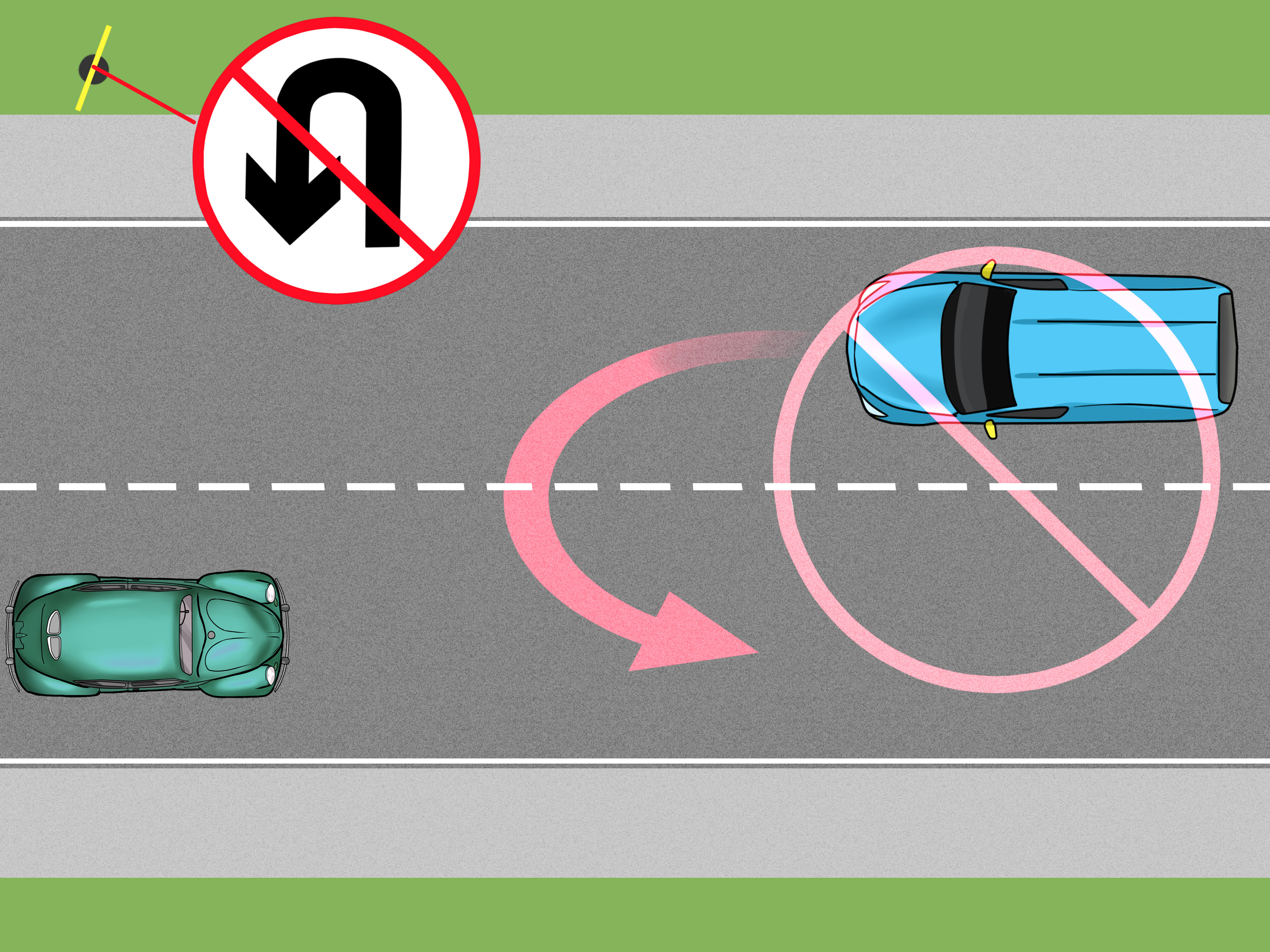
Before making a U-turn, look for “No U-Turn” signs, “No Left Turn” signs, pavement arrows, traffic signal restrictions, or local rules that prohibit the maneuver. Some intersections allow U-turns only from specific turn lanes. Others prohibit them completely due to limited sight distance, high traffic volume, pedestrian activity, or highway design.
Never assume that a wide road automatically permits a U-turn. A wide road may still have signs, medians, highway access rules, or local restrictions that make the maneuver illegal or unsafe.
Official driver manuals also warn against U-turns on hills, curves, and locations where you cannot see approaching traffic clearly. Illinois guidance, for example, says drivers should not make a U-turn on curves or hills unless they can see at least 500 feet in all directions.
Step 2: Choose a Safe Location
The best location for a U-turn is usually a controlled intersection with a designated left-turn lane, sufficient space, clear visibility, and no sign prohibiting the movement.
Avoid making U-turns near hill crests, curves, railroad crossings, narrow bridges, freeway entrances, school crossings, busy driveways, or heavily congested intersections. These locations reduce visibility and increase the chance that another driver, cyclist, or pedestrian will appear unexpectedly.
It is also wise to avoid U-turns in front of large trucks and buses. Large vehicles need extra turning space and may swing wide. Never try to squeeze between a turning truck and the curb. That space is not a bonus lane. It is a danger zone.
Step 3: Signal, Stop, Yield, and Turn Smoothly
Use your left turn signal well before beginning the maneuver. Move into the designated left-turn lane if one exists. Stop if required by the traffic light, sign, or traffic conditions.
Yield to oncoming vehicles, pedestrians, bicycles, motorcycles, and any traffic that has the right-of-way. Once the path is clear, make the turn smoothly into the correct lane for your new direction of travel.
Do not force the U-turn if your vehicle cannot complete it cleanly. A three-point turn may be safer on a quiet residential street when legal and when traffic conditions allow. On a major road, though, it is usually smarter to continue forward and find a safer route rather than attempting a dramatic multi-step reversal in traffic.
When a U-Turn Is the Wrong Choice
Sometimes the best U-turn is no U-turn at all. Continue ahead when visibility is poor, traffic is moving quickly, lanes are narrow, pedestrians are nearby, or you are uncertain about the legality of the maneuver.
Missing a turn can feel frustrating, especially when you are late. But the safest drivers accept the extra minute and choose a better place to turn around. A navigation app can recalculate. A damaged vehicle cannot simply reboot.
Common Turning Mistakes to Avoid
Turning From the Wrong Lane
Turning from a through lane when a turn-only lane is available can surprise other drivers and create conflicts. Read pavement arrows early and position your vehicle before reaching the intersection.
Failing to Signal
Failing to signal removes valuable information for everyone around you. Signal before slowing, turning, or changing lanes. Do not wait until your vehicle is already halfway into the maneuver.
Cutting Across Multiple Lanes
Complete the turn into the nearest proper lane. Change lanes afterward, one lane at a time, with a new signal and a fresh mirror-and-blind-spot check.
Ignoring Crosswalks
Before every turn, scan the crosswalk. Pedestrians may be difficult to see at night, in rain, behind parked vehicles, or near larger vehicles. A turn is not complete until you have cleared the crosswalk safely.
Trusting Another Driver’s Turn Signal
A vehicle’s signal suggests an intention, not a legally binding promise. A driver may leave the signal on, change their mind, or signal too early. Do not pull into traffic solely because another vehicle appears to be turning.
Practical Experiences: What Drivers Learn About Right, Left, and U Turns
Most drivers remember their early turning lessons because they are humbling. You can study lane diagrams all day, but the first time you approach a busy intersection with cars behind you, your brain may suddenly forget what a steering wheel is for. That is normal. Experience turns complicated movements into habits.
One of the first lessons many drivers learn is that right turns require more attention than expected. On a quiet suburban road, a right turn feels effortless. In a busy downtown area, however, there may be pedestrians stepping off the curb, cyclists moving beside traffic, delivery vans blocking the view, and vehicles creeping forward from driveways. The experienced driver slows down early and scans the entire corner rather than staring only at the car ahead.
Left turns teach patience. Nearly every driver has experienced waiting at a green light while oncoming traffic keeps coming. It can feel awkward when cars are behind you, especially if someone honks. But a safe driver does not turn because another person is impatient. The right moment to turn is when the gap is truly safe, the crosswalk is clear, and your vehicle can finish the maneuver without forcing another driver to brake suddenly.
Experienced drivers also learn that lane discipline prevents confusion. A common beginner mistake is turning right and immediately drifting into the left lane because that lane looks more convenient. Another is turning left and crossing two lanes at once to reach a store entrance. These shortcuts may save three seconds, but they create uncertainty for nearby drivers. The better habit is to finish the turn in the nearest legal lane, stabilize the vehicle, then make a normal lane change when it is safe.
U-turns create their own collection of memorable moments. Some drivers try to make them too quickly after missing an exit or driveway. Others attempt them on narrow roads and discover that their car has a larger turning circle than their confidence suggested. The experienced approach is simple: if the U-turn does not look easy, legal, and clearly safe, keep driving until you find a better location.
Weather also changes how turns feel. Rain can make road markings harder to see and increase stopping distance. At night, glare from headlights can hide pedestrians and bicycles. In snow, ice, or heavy rain, turn more slowly and avoid sharp steering inputs. A smooth turn is safer because it gives your tires a better chance to maintain traction.
Another real-world lesson involves larger vehicles. Trucks and buses often need more room than passenger cars. A truck turning right may begin by moving slightly left to create space for its rear wheels. That does not mean it is inviting you to pass on the right. Staying beside or behind a turning truck can place you in a blind spot or trap you near the curb.
Finally, experienced drivers understand that a missed turn is not an emergency. You can circle the block, use the next intersection, or let your navigation app find another route. The safest turn is often the one you decide not to force. Calm driving is not slow driving; it is smart driving.
Conclusion: Smooth Turns Start With Smart Decisions
Safe right turns, left turns, and U-turns all follow the same basic formula: prepare early, signal clearly, choose the correct lane, reduce speed, scan carefully, yield when required, and complete the turn in the appropriate lane.
Right turns demand attention to pedestrians, cyclists, and red-light restrictions. Left turns require patience and careful judgment of oncoming traffic. U-turns require legal permission, enough space, good visibility, and the willingness to keep driving when conditions are not right.
The goal is not to make the fastest turn. The goal is to make a turn that everyone around you can predict. When you drive that way, intersections become less stressful, passengers stay relaxed, and your car gets to keep its paint where it belongs.