
History is supposed to be the story of what happened. In practice, it is often the story of what made it into textbooks, documentaries, monuments, and the collective family conversation after dinner. That leaves plenty of room for catastrophe to slip through the cracks.
Some disasters were eclipsed by bigger headlines. Others were minimized because the victims were poor, Black, Indigenous, migrant workers, or simply far away from the people writing the national narrative. A few were buried under wartime propaganda, local embarrassment, or the human urge to move on before anyone has properly processed what happened.
Note: “Edited out” does not mean every event was erased by one secret committee armed with black markers and suspiciously tidy paperwork. It means these tragedies were often ignored, softened, undercounted, or left out of the history many people were taught.
Why Forgotten Disasters Matter
A disaster does not disappear simply because it stops being discussed. The survivors still lived with it. Communities still rebuilt around it. Families still carried names, absences, debts, injuries, and stories that never made the official version.
These overlooked historical disasters also reveal something uncomfortable: catastrophe is rarely “equal opportunity.” A hurricane may hit everyone in its path, but wealth affects who has transportation, sturdy housing, insurance, access to medical care, and a name that makes it into a death record. History can be just as uneven. The people with the least power are often the easiest to lose twice: first in the disaster itself, then in the telling of it.
Here are six horrifying disasters that deserve far more room in America’s memory.
1. The Peshtigo Fire of 1871: The Inferno That Lost a Publicity Contest
On October 8, 1871, much of the United States was focused on one famous urban blaze: the Great Chicago Fire. That same night, a far deadlier firestorm tore through northeastern Wisconsin and parts of Michigan. The Peshtigo Fire did not merely burn. It behaved like a nightmare with weather attached.
A Firestorm With Nowhere to Run
Months of drought, logging debris, brush fires, and strong winds created ideal conditions for disaster. When the fires merged, witnesses described a roaring wall of flame so violent that it created its own wind patterns. Some people fled to rivers and wells. Others sheltered in cellars, fields, or railroad cuts. Many never had a chance.
Death estimates vary because records were incomplete and entire families vanished, but the Peshtigo Fire likely killed between 1,200 and 2,500 people. That makes it the deadliest fire disaster in United States history. Yet it remains much less familiar than Chicago’s blaze, partly because Chicago was a major city with newspapers, politicians, wealthy residents, and a much better public-relations machine. Fire, apparently, also has a media market.
Why It Faded From National Memory
Chicago became a story about rebirth, architecture, business, and a city rebuilding bigger than before. Peshtigo became a story about lumber towns, rural families, and communities that had little political influence beyond the region. The contrast is revealing: one disaster became mythology; the other became a footnote.
The fire also changed how Americans thought about forest management. It exposed the danger of unchecked logging practices and dry, debris-filled landscapes. In that sense, Peshtigo is not just an old tragedy. It is an early warning about how environmental neglect, weather, and human industry can combine into something monstrous.
2. The 1900 Galveston Hurricane: America’s Deadliest Natural Disaster
Before Houston became Texas’s giant economic powerhouse, Galveston was the Gulf Coast city with swagger. It was a booming port, a commercial center, and a place many believed could rival New Orleans. Then, on September 8, 1900, a hurricane arrived and made that confidence look painfully fragile.
The Storm That Erased a Cityscape
Galveston sat on a low barrier island, and at the time it had no substantial seawall. Modern satellite tracking, hurricane hunter aircraft, and around-the-clock weather alerts were still science-fiction material. Forecasters had limited information, communication systems were slow, and many residents did not understand the scale of the danger approaching from the Gulf.
The storm surge swept over the island, tearing houses from foundations and smashing buildings into giant piles of debris. Estimated deaths commonly reach about 8,000, though the actual number may never be known. Entire households disappeared. Bodies were initially taken out to sea for burial, but some washed back onto shore, forcing survivors to use mass burials and funeral pyres.
How Galveston Rebuilt, but Never Fully Recovered
Galveston did rebuild. Engineers raised the grade of much of the city and constructed a seawall, a colossal project that remains a symbol of resilience. But the storm permanently changed the city’s future. Commercial influence gradually shifted toward Houston, whose inland location and shipping channel made it a more attractive long-term center of trade.
The Galveston Hurricane should be remembered not only for its horrifying death toll but also for what it teaches about coastal risk. Nature did not “surprise” Galveston because nature is sneaky. Human systems were simply not prepared for the geography they had chosen to build on. That lesson has aged far too well.
3. The 1918 Influenza Pandemic: The Global Catastrophe Everyone Tried to Forget
When people think of 1918, they often picture World War I, soldiers in muddy trenches, armistice celebrations, and grainy photographs of uniforms. What they may not picture is influenza killing an estimated 675,000 people in the United States and at least 50 million people worldwide.
Not “Just the Flu”
The 1918 influenza pandemic was unusually lethal, including among healthy young adults. Hospitals filled beyond capacity. Families cared for sick relatives at home because there was nowhere else to take them. Cities closed schools, theaters, churches, and public gathering places. Medical workers wore masks, and some communities ran out of coffins.
The name “Spanish flu” was misleading. Spain did not create the virus. Spain simply had less wartime censorship than many countries, so Spanish newspapers reported openly on the outbreak while other nations were busy trying to avoid looking weak during war. The result was one of history’s most unfair branding decisions, right up there with naming a terrible snack after a country that had nothing to do with it.
Why the Pandemic Slipped Out of Everyday Memory
Despite its staggering toll, the pandemic was overshadowed by the war and the rush to return to normal life. Families grieved privately. Governments focused on victory, reconstruction, and economic recovery. Many survivors did not talk much about it, perhaps because the scale of suffering was too overwhelming to explain.
Its relative absence from popular memory became especially striking after the COVID-19 pandemic, when many people wondered why the 1918 outbreak had not been discussed more often in schools. The answer is not simple, but it includes war, censorship, trauma, fragmented records, and a cultural habit of treating public health disasters as unpleasant interruptions rather than defining historical events.
4. The 1928 Okeechobee Hurricane: A Disaster Made Worse by Racism and Neglect
In September 1928, a powerful hurricane crossed the Caribbean, devastated parts of Puerto Rico, and struck Florida as a major storm. It then pushed water across Lake Okeechobee, where inadequate earthen dikes failed and sent a massive flood across surrounding agricultural communities.
Water, Darkness, and Thousands of Missing Names
Floodwaters rushed through communities around the lake, destroying homes and trapping people who had little warning and few escape routes. The official death count stood for years at 1,836, but later reassessments estimated more than 2,500 people may have died in Florida. The true number may never be known.
Many of the victims were poor Black migrant farm workers living in low-lying areas. Their bodies were often handled differently from white victims. Some were placed in mass graves, while others were burned on large funeral pyres because authorities faced flooding, decomposition, and an urgent public-health crisis. The practical emergency was real, but the unequal treatment of victims was real too.
When a Disaster Becomes a Question of Whose Lives Counted
The Okeechobee Hurricane was not forgotten because it was small. It was one of the deadliest hurricanes in American history. It was forgotten because many of its victims had little social power, little wealth, and limited representation in official records.
The disaster eventually led to major flood-control efforts around Lake Okeechobee, including stronger infrastructure. But infrastructure cannot correct the historical record on its own. Remembering the storm means remembering that disaster response is not only about engineering. It is also about dignity, documentation, and whether every victim is treated as someone whose life deserves to be counted.
5. The Tulsa Race Massacre of 1921: A Human-Made Catastrophe Buried in Plain Sight
Not every disaster arrives with wind, water, fire, or disease. Some are created by people, enabled by institutions, and then concealed by silence. The Tulsa Race Massacre was one of the worst examples in American history.
The Destruction of Greenwood
On May 31 and June 1, 1921, a white mob attacked Tulsa’s Greenwood District, a thriving Black community often called Black Wall Street. Homes, churches, businesses, and cultural institutions were destroyed. Residents fled under terror. Thousands were left homeless, and death estimates vary widely, with many historians citing figures as high as 300.
Greenwood was not simply a neighborhood. It was a powerful example of Black entrepreneurship and community-building during an era of segregation. Its success made the destruction even more devastating. The massacre did not just take lives and property; it attacked the possibility of economic security, generational wealth, and civic confidence.
Decades of Silence
For decades, many local and national accounts softened the language, calling the event a “riot” rather than acknowledging the targeted racial violence that occurred. Records were limited, stories were suppressed, and many survivors were discouraged from speaking publicly. The event was barely taught in many schools for much of the twentieth century.
That silence is why Tulsa belongs in any discussion of disasters edited out of history. It was not a random outburst of chaos. It was a catastrophe shaped by racism, unequal power, and failures of law and government. Its later rediscovery through historians, journalists, descendants, archives, and public memorial efforts shows that historical memory is often something communities must fight to recover.
6. The Texas City Disaster of 1947: When Fertilizer Turned a Port Into a Blast Zone
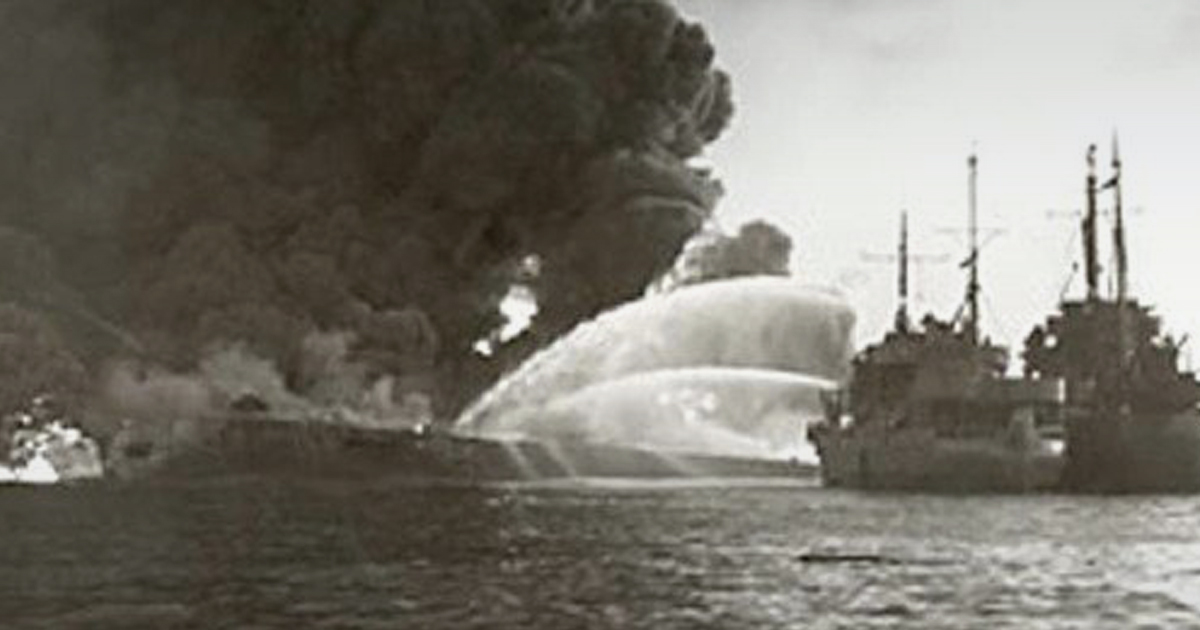
On April 16, 1947, the French cargo ship SS Grandcamp caught fire while docked in Texas City, Texas. Its cargo included ammonium nitrate fertilizer, a substance useful in agriculture but dangerously unstable under certain conditions. What happened next became one of the deadliest industrial disasters in United States history.
The Explosion That Shook the Coast
As smoke poured from the ship, people gathered nearby to watch. At 9:12 a.m., the Grandcamp exploded with extraordinary force. The blast destroyed much of the dock area, damaged factories and homes, and killed firefighters who had rushed toward the burning ship. A second ship carrying ammonium nitrate, the High Flyer, later exploded as well.
More than 500 people were killed, thousands were injured, and large parts of Texas City were devastated. The disaster was so destructive that it rattled windows far from the site and sent shock waves through an industrial coastline built around chemicals, refineries, shipping, and fuel storage.
The Safety Lessons That Came at an Awful Price
Texas City exposed serious gaps in how hazardous materials were classified, stored, transported, and regulated. It demonstrated that an industrial accident is never merely an industrial accident. It affects workers, firefighters, families, hospitals, schools, housing, and entire local economies.
Yet outside Texas and industrial safety circles, the disaster is rarely discussed. Perhaps it lacks the cinematic familiarity of a hurricane or earthquake. Perhaps Americans prefer not to think too hard about how close everyday infrastructure can sit to catastrophic risk. Either way, Texas City remains a chilling reminder that some of history’s largest explosions began with something people thought they understood.
What These Forgotten Disasters Have in Common
These six tragedies were different in cause, location, and scale. One was fire. One was a hurricane. One was a pandemic. One was a flood. One was racial violence. One was an industrial explosion. But they share a pattern: they became easier to overlook because their victims were scattered, marginalized, rural, politically inconvenient, or overshadowed by other events.
History often rewards the clean narrative. It prefers a heroic rebuilding story, a famous photograph, a single villain, or a tidy lesson at the end. Real disasters are not tidy. They involve bureaucratic mistakes, class differences, racial injustice, incomplete records, messy grief, and survivors who do not always have the money or influence to preserve their stories.
That is why remembering these disasters matters. Memory is not just about looking backward. It is a safety feature for the future.
The Experience of Discovering the Missing Pages of History
Learning about overlooked disasters can feel strangely personal, even when the events happened long before we were born. It begins with a small moment: a photograph of a ruined street, a newspaper headline, a name carved on a memorial, or a sentence buried in an old local archive. Suddenly, history stops feeling like a neat timeline and starts feeling like a crowded room full of people who were never properly introduced.
The experience can be unsettling because it changes how we look at familiar places. A sunny coastal city becomes the site of a storm surge that carried homes away. A quiet Midwestern town becomes the center of a firestorm. A prosperous commercial district becomes a place where families once ran for their lives. A lake that looks peaceful in a vacation brochure becomes a reminder that water can turn violent in a matter of hours.
There is also an emotional whiplash in realizing how easily public memory can shrink. A catastrophe that killed thousands may be reduced to a local plaque, a museum display, or one paragraph in a textbook. Meanwhile, a much smaller event may remain famous because it happened in a major city, involved wealthy people, or produced dramatic images that newspapers kept circulating.
That does not mean famous disasters are unimportant. It means attention is not the same thing as significance. A disaster does not become less devastating because fewer people know its name. The families in Peshtigo did not suffer less because Chicago received more headlines. The victims around Lake Okeechobee did not become less real because incomplete records made their deaths harder to count. The residents of Greenwood did not lose less because later generations were taught a softened version of what happened.
Reading these stories can also create a healthy distrust of overly simple history. When a disaster is described as “natural,” it is worth asking what human decisions made people vulnerable. Were homes built in dangerous areas? Did officials ignore warnings? Were workers forced to live near hazards? Did racism, poverty, or political neglect determine who received help first?
Those questions matter because disasters are rarely only about nature. Hurricanes are natural. Unequal evacuation options are not. Disease outbreaks are biological. Censorship, poor public communication, and unequal healthcare access are human choices. Industrial chemicals may be useful, but weak safety systems are not inevitable acts of fate.
The most meaningful experience of studying forgotten disasters is not shock for shock’s sake. It is recognition. It is the realization that historical memory can be repaired. Archives can be reopened. Graves can be documented. School curricula can change. Descendants can be heard. Museums can tell fuller stories. Communities can choose to preserve names that earlier generations ignored.
Remembering does not undo what happened. It does something quieter but still important: it refuses to let catastrophe have the final word. It says that the victims were here, their lives mattered, and their stories deserve more than a disappearing footnote.
Conclusion
The six disasters in this article were not truly erased. Evidence remains in photographs, archives, cemeteries, survivor accounts, public records, memorials, and the memories of descendants. But being preserved somewhere is not the same as being remembered everywhere.
From the Peshtigo Fire to the Texas City Disaster, these events show how history can overlook suffering when it is inconvenient, geographically distant, politically uncomfortable, or difficult to package into a comforting story. Looking directly at those missing pages makes history more honestand makes the future a little harder to sleepwalk into.
SEO Tags