
The 606 Universal Shelving System is what happens when a storage product refuses to become yesterday’s furniture. Designed by German industrial designer Dieter Rams for Vitsœ in 1960, it has remained in continuous production for more than six decades. During that time, interior trends have marched through shag carpeting, inflatable chairs, mirrored walls, industrial farmhouse signs, and several regrettable encounters with gray laminate. The 606 has simply carried on.
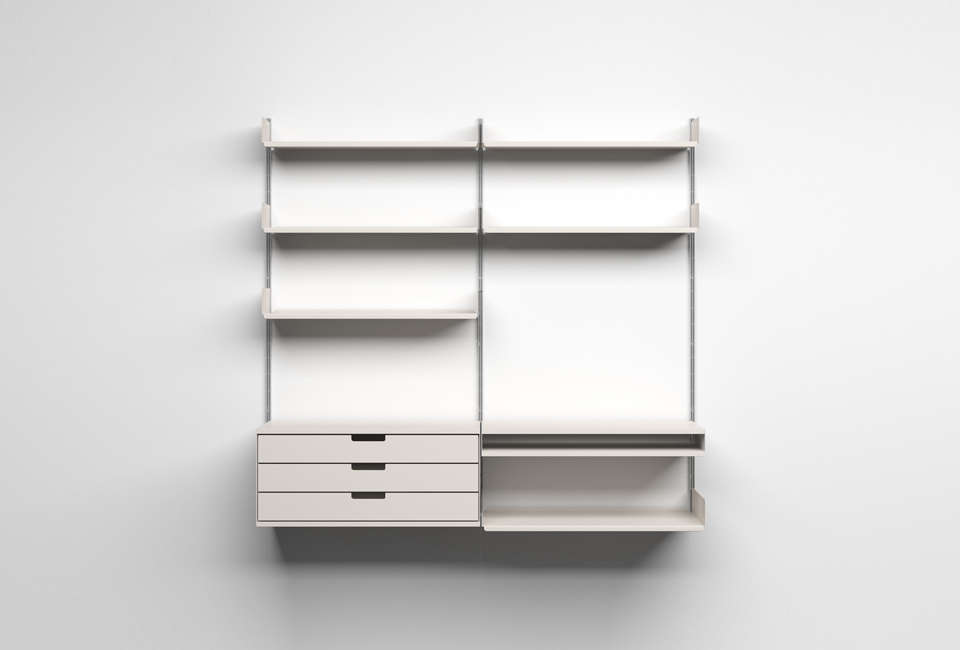
At first glance, the system appears almost suspiciously simple: slender aluminum tracks, horizontal shelves, a few cabinets, and small pins holding everything in place. Look closer, however, and the intelligence becomes obvious. The shelving can grow, shrink, move to another room, become a desk, organize a wardrobe, divide a space, or follow its owner to a new home.
That adaptability explains why the 606 Universal Shelving System is frequently described as a modern design classic. It does not try to dominate a room. Instead, it creates an orderly framework for books, records, artwork, office equipment, cookware, clothing, and the mysterious box of cables nobody is emotionally prepared to discard.
What Is the 606 Universal Shelving System?
The 606 is a modular storage system made from interchangeable structural and functional components. Its foundation is a series of vertical aluminum tracks or posts. Shelves, cabinets, desks, tables, hanging rails, and other accessories connect to that structure in different arrangements.
Rather than purchasing one fixed bookcase, an owner builds a configuration for a particular wall, room, or purpose. A compact arrangement might contain two shelves above a small desk. A larger installation can cover an entire wall with bookshelves, cabinets, record storage, display surfaces, and a workspace.
The word “universal” is therefore more than confident marketing. The system can be used in living rooms, bedrooms, kitchens, offices, libraries, galleries, hallways, retail spaces, and studios. It can even operate without a conventional wall when supported by floor-to-ceiling or freestanding posts.
The Dieter Rams Design Story
Dieter Rams developed the idea that became the 606 while working with Braun during the postwar period. European homes were often smaller than the heavily furnished interiors of previous generations. Traditional cabinets occupied substantial floor space and visually crowded a room.
Rams explored wall-mounted shelving while designing displays for Braun products. Raising storage from the floor made an interior feel lighter, provided greater flexibility, and allowed the architecture to breathe. He later developed the concept for Vitsœ, creating the shelving system in 1960 while still in his twenties.
The result reflected the philosophy that would eventually be summarized by Rams as “less, but better.” The 606 does not use decoration to disguise its construction. The vertical tracks remain visible. Shelf edges are crisp. Fasteners are discreet but understandable. Every component appears to have a job, and none seems to be auditioning for a lifestyle catalog.
The system’s cultural importance extends beyond enthusiastic homeowners. Examples have entered major museum and design collections, while architects, graphic designers, publishers, and collectors continue to use the shelving in working interiors. Its longevity is especially notable because many modular furniture lines disappear when manufacturers discontinue finishes, change dimensions, or replace the entire range with something “new and improved.”
Why the 606 Design Still Works
It Creates Visual Lightness
Conventional bookcases usually rely on thick side panels, a base, and a solid back. The 606 removes most of that visual weight. Because the wall remains visible between shelves, even a large installation can feel architectural rather than bulky.
This is particularly useful in apartments and smaller rooms. Storage capacity increases vertically without consuming unnecessary floor area. A low configuration can make a narrow space feel wider, while a tall library wall uses otherwise wasted height.
It Separates Structure From Function
The vertical tracks provide the supporting framework, while the removable components determine how the system is used. That distinction is the secret sauce, although Dieter Rams would probably prefer a less saucy technical term.
A shelf can be moved when a taller book arrives. A cabinet can replace open storage when visual clutter starts plotting a takeover. A desk can be repositioned for a child, a seated adult, or a standing workstation. The structure remains in place while the functional parts evolve.
It Avoids a Trend-Driven Identity
The limited palette includes off-white, black, silver, and beech finishes. These choices are intentionally restrained. They work with modern, traditional, industrial, Scandinavian, and eclectic interiors without tying the system to a particular decorating decade.
The shelving also allows the objects placed on it to provide color and personality. Books, ceramics, plants, photographs, and artwork become the visual focus. The furniture behaves more like a calm gallery assistant than an attention-seeking celebrity.
How the 606 Universal Shelving System Works
E-Tracks and Posts
Wall-mounted installations use vertical anodized-aluminum E-Tracks secured to an appropriate wall structure. These tracks contain regularly spaced positions for the small aluminum pins that support shelves and other components.
Once the tracks or posts have been installed correctly, rearranging the system is straightforward. Components can be lifted away, pins can be repositioned, and the shelves can be placed at a different height. Routine reconfiguration generally does not require a collection of tools large enough to frighten the neighbors.
Shelves, Cabinets, Desks, and Accessories
The available components allow a 606 configuration to perform several jobs at once. Common choices include:
- Powder-coated metal shelves for books and everyday storage
- Deeper shelves suitable for records and larger objects
- Sloping shelves for magazines, shoes, or display material
- Open and closed cabinets with drawers or doors
- Adjustable desk shelves for seated or standing work
- Integrated tables for dining, meetings, or studio work
- Bookends, hanging rails, cable-management features, and small accessories
The useful detail is not merely the number of components. It is their ability to coexist. One bay might function as a workstation, the next as a record library, and the next as closed household storage. The system can provide order without forcing every possession into the same rectangular routine.
Four Main Installation Options
Wall-mounted: E-Tracks are attached directly to a suitable solid or gypsum-board wall. This creates the cleanest and most visually minimal installation.
Semi-wall-mounted: Tracks are attached to posts positioned in front of the wall. This approach can help accommodate baseboards, pipes, radiators, uneven surfaces, and other architectural obstacles.
Floor-to-ceiling compressed: Posts are held between the floor and ceiling. Components may be placed on one or both sides, making this structure useful as a room divider or storage island.
Freestanding: Stabilized posts allow the system to stand without depending on a wall or ceiling. This can be valuable in open-plan spaces and properties where permanent wall attachment is undesirable.
Best Uses for the 606 Shelving System
Living-Room Library
A full-wall installation can hold books, speakers, records, framed artwork, and a television while keeping the floor relatively open. Closed cabinets can conceal electronics, paperwork, controllers, and the remote control that was supposedly “right here a second ago.”
The modular layout also allows a media wall to change. A television may be removed later without leaving behind a piece of furniture permanently shaped around a black rectangle.
Home Office
The adjustable desk shelf makes the system especially effective in home offices. Storage can be positioned above and beside the work surface, creating a compact workstation without a separate desk, bookcase, and filing cabinet.
A desk height can also be altered as needs change. That is useful for growing children, shared offices, accessibility requirements, and users who alternate between sitting and standing.
Kitchen and Dining Storage
Metal shelves can hold cookware, dishes, cookbooks, and frequently used ingredients. Hanging rails add storage for pans or utensils, while cabinets provide a home for smaller items. In an open kitchen, a double-sided compressed structure can separate cooking and dining zones without building a permanent wall.
Wardrobe and Entryway
Hanging rails, shelves, cabinets, and sloping shoe storage can turn the 606 into a wardrobe system. In an entryway, a smaller arrangement can organize coats, bags, keys, mail, and footwear while maintaining a relatively slim profile.
Retail, Gallery, and Studio Spaces
The system is popular in creative workplaces because displays can be changed without replacing the furniture. A bookstore can reorganize titles, a gallery can adjust object spacing, and a design studio can combine sample storage with work surfaces.
Materials, Construction, and Finish
The main structural elements, including tracks and posts, are made from anodized aluminum. Metal shelves use powder-coated steel, while selected cabinets, shelves, desks, and tables are available with laminate or beech-veneer surfaces.
These materials support the system’s understated industrial character. Aluminum provides a precise, lightweight-looking framework. Steel shelves offer durability and relatively thin profiles. Beech introduces warmth without turning the installation into a rustic lumber festival.
The mechanical construction also supports maintenance and repair. Individual components can be replaced rather than requiring the entire installation to be discarded. Newer parts are designed to remain compatible with systems purchased or inherited from earlier decades, which is one of the strongest practical arguments for the 606’s sustainability claims.
Planning and Installation Considerations
A successful 606 installation begins with accurate measurements and an honest assessment of how the space will be used. Buyers should record wall width and height, baseboard depth, outlet positions, radiators, windows, door swings, ceiling conditions, and any obstacles that could interfere with tracks or shelves.
The wall type is especially important. Brick, concrete, wood framing, plaster, and gypsum board require different fixing methods. Shelves loaded with books or records place meaningful forces on the structure, so guessing what lies behind the paint is not a charming act of optimism.
Vitsœ offers a planning service that helps buyers develop a configuration from measurements and photographs. This is useful because the most expensive layout is not always the best layout. Starting with fewer components leaves room to understand how the system functions in daily life before expanding it.
Competent DIYers may be able to install a wall-mounted system, but professional help is sensible for uncertain wall construction, heavy loads, floor-to-ceiling arrangements, or large configurations. Once the supporting structure is level and secure, later adjustments are considerably easier.
Advantages and Potential Drawbacks
Major Advantages
- Long-term adaptability: The system can expand, contract, and change function.
- Efficient use of space: Wall-mounted storage preserves floor area and reduces visual bulk.
- Component compatibility: Older and newer parts can often be combined.
- Repairability: Damaged or outdated individual parts can be replaced.
- Design longevity: Restrained materials and colors resist short-lived trends.
- Moving potential: The installation can be dismantled and reconfigured in another property.
Potential Drawbacks
- Premium initial cost: A complete system can cost substantially more than a mass-market bookcase.
- Planning is required: The modular freedom can feel overwhelming without a clear storage plan.
- Installation matters: Tracks must be level and securely fixed with hardware appropriate for the wall.
- Open storage reveals everything: Beautiful shelves will not magically transform random paperwork into sculpture.
- Rental limitations: Direct wall mounting may not suit tenants, although compressed and freestanding structures provide alternatives.
Is the 606 Universal Shelving System Worth It?
The answer depends on whether the buyer views shelving as a temporary purchase or long-term infrastructure. A basic bookcase may offer more storage per dollar today. The 606 makes a different economic argument: buy a durable framework, keep it for decades, and modify it rather than repeatedly replacing furniture.
That proposition is strongest for people who expect their needs to change. A desk can become a media shelf. A living-room system can move into an office. Components from a large installation can be divided between smaller rooms. Additional parts can be purchased when the collection of books, records, or ceramic frogs inevitably expands.
It may not be worthwhile for someone seeking inexpensive storage for a short-term apartment. It can be compelling for design-conscious homeowners, serious collectors, creative professionals, and anyone tired of furniture that survives exactly one move before developing the structural confidence of wet toast.
Living With the 606: A Real-World Ownership Experience
The Planning Stage Feels Different
The experience begins less like ordinary furniture shopping and more like planning a small piece of architecture. Instead of selecting a standard bookcase and hoping it fits, the owner considers wall dimensions, object sizes, work habits, and future expansion. This process can feel slow, but it prevents common mistakes such as creating shelves too shallow for records or placing a desk directly in the path of an opening door.
The most practical approach is to inventory what the system must hold. Count oversized books, measure audio equipment, estimate drawer needs, and decide which possessions deserve display space. This exercise may reveal that the household owns seventeen reusable shopping bags and no convincing explanation for them.
Installation Day Brings the Precision Into Focus
Before installation, the individual tracks and shelves may appear almost underwhelming. Once the vertical structure is aligned, the logic becomes visible. Every shelf position relates to a consistent grid, and small changes in height can dramatically alter the balance of the wall.
A carefully installed system tends to look quieter than a conventional bookcase because it has no heavy base or enclosing sides. The room may feel larger even though its storage capacity has increased. This is one of the first benefits owners notice: the furniture is clearly present, yet it does not behave like a large object blocking the wall.
Daily Use Encourages Small Adjustments
During the first few months, an owner may reposition shelves several times. A printer needs more clearance. A plant grows taller. The cookbooks migrate to the kitchen. A display shelf gradually becomes the charging station for every electronic device in the household.
These changes are not signs of poor planning. They demonstrate the purpose of the design. Once the supporting tracks are installed, moving many components involves lifting a shelf, relocating its pins, and setting it at a new height. The furniture adapts to reality rather than demanding that reality remain politely unchanged.
Open Shelving Changes How Possessions Are Managed
The 606 can make ordinary objects look unusually intentional, but it also rewards editing. A wall covered with randomly packed items can still appear busy, regardless of how distinguished the shelving system may be. Owners often develop a balance of open display and closed cabinet storage.
Frequently used books and attractive objects remain visible. Paperwork, chargers, tools, and visually noisy necessities disappear behind doors or into drawers. The system does not force minimalism, but it gently asks whether six nearly identical vases are forming a collection or simply refusing to leave.
Moving Reveals the Long-Term Advantage
The most convincing ownership experience may occur when the household relocates. A conventional fitted unit usually stays behind, while a freestanding bookcase may not suit the new room. The 606 can be dismantled, transported, and reorganized for a different wall or purpose.
Not every component will necessarily occupy the same position. A long living-room installation might become two shorter systems: one in a home office and another in a bedroom. Additional tracks or posts may be needed, but the primary investment remains useful.
Over time, this ability changes the emotional relationship with the furniture. The shelving becomes less like a product purchased for one address and more like a dependable household tool. Scratches, books, plants, changing technology, and multiple homes become part of its history rather than reasons to replace it.
Experience note: These observations describe common practical patterns associated with modular 606 installations rather than claiming that every home, wall, or owner will have identical results. Load capacity and installation safety depend on the configuration, wall construction, fixings, and professional guidance.
Conclusion
The 606 Universal Shelving System remains relevant because it solves a permanent problem without pretending life is permanent. People move. Children grow. Workspaces change. Collections expand. Technology shrinks, then somehow brings twelve new cables with it.
Dieter Rams created a framework capable of absorbing those changes. Its aluminum tracks and modular components are visually restrained, mechanically understandable, and adaptable across decades. The initial investment is considerable, and proper planning is essential, but the reward is storage that can become part of a home’s architecture without becoming trapped in one room or one moment in time.
For buyers who value flexibility, repairability, and quiet modern design, the 606 is more than an attractive shelving unit. It is a long-term storage system designed to remain useful after the current room, current job, and current decorating trend have moved on.