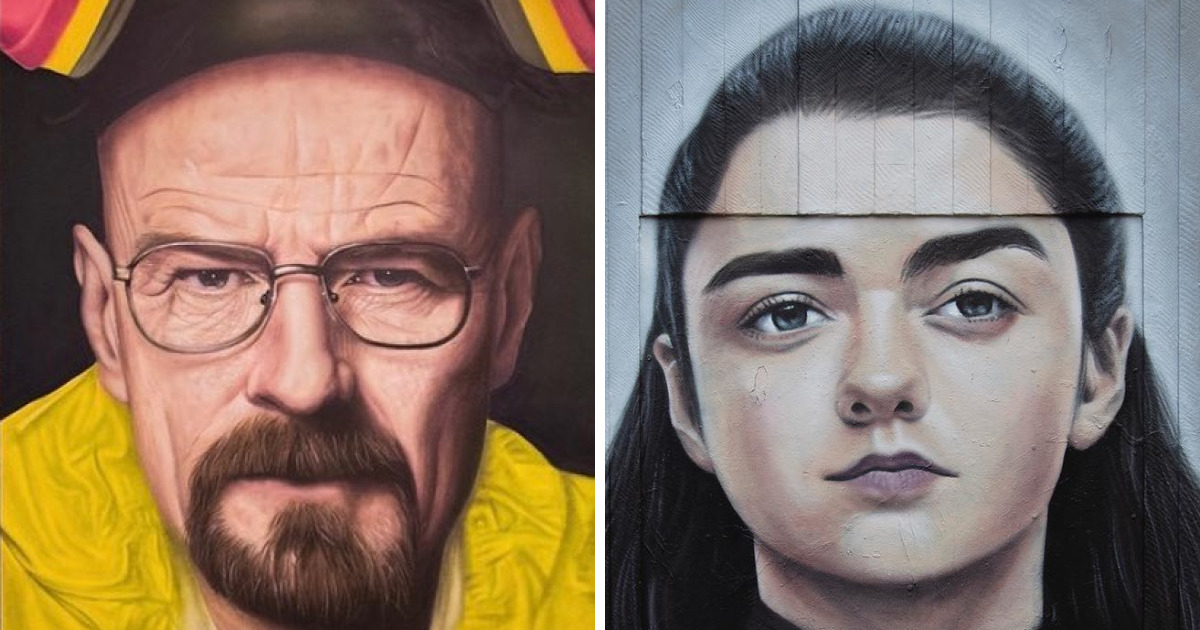

Walk around Manchester long enough and you may find David Bowie watching from a brick wall, Walter White looking suspiciously comfortable near a coffee shop, or Arya Stark staring down pedestrians as if she has quietly added them to her list. These are not oversized advertisements or evidence that television has escaped from the living room. They are the work of Akse P19, a Manchester-based street artist celebrated for his enormous, photorealistic portraits.
Akse has been painting walls since 1992. During that time, he has transformed ordinary building surfaces into public portraits of musicians, actors, athletes, artists, activists, scientists, and fictional characters. His subjects have included Prince, Frida Kahlo, Muhammad Ali, Mahatma Gandhi, Carrie Fisher, Stephen Hawking, Amy Winehouse, and numerous characters from popular films and television shows.
Although recognizable faces provide the immediate attraction, these giant murals are more than celebrity fan art with a ladder. They explore memory, identity, community, and the curious power of seeing a familiar face in an unexpected place.
Who Is Akse P19?
Akse P19 is a French-born artist of Vietnamese heritage who has lived in Manchester since 1997. He began as a traditional graffiti writer in the suburbs of Paris, entering the culture through hip-hop and joining the P19 crew in the early 1990s. His artist name is pronounced like “axe,” although his portraits are considerably more precise than that sharp-edged nickname suggests.
His career did not follow the conventional route from art school to gallery opening. Akse studied science, earned advanced qualifications, and worked for years as a project manager while continuing to paint. His scientific background feels surprisingly appropriate when examining his murals. Every highlight, shadow, color transition, and facial proportion appears carefully observed. The results have the emotional impact of portrait painting and the technical discipline of a controlled experimentonly the laboratory is outdoors and occasionally being rained on.
Over time, Akse shifted from lettering toward freehand, high-definition portraiture. He now has more than three decades of experience creating large-scale murals, with roughly two decades focused on photorealistic faces. His work appears throughout Manchester and in other locations across the United Kingdom.
Why Pop Icons Look So Powerful on City Walls
A portrait changes when it grows from a framed image into a face several stories high. Details that might seem minor in a photograph become dramatic architectural features. A raised eyebrow can occupy an entire row of bricks. A wrinkle becomes a winding road. A musician’s stare can stop someone halfway through checking a text message, which may be the closest modern society gets to a miracle.
Scale is only part of the effect. Pop icons arrive with stories already attached to them. Viewers recognize their songs, performances, public achievements, personal struggles, or cultural influence. That shared knowledge allows a mural to communicate before anyone reads a plaque or opens a search engine.
Musicians Become Part of the City’s Soundtrack
Music plays an especially important role in Akse’s work. His portraits of David Bowie, Prince, Jimi Hendrix, Amy Winehouse, Marvin Gaye, Mark E. Smith, Liam Gallagher, and Tony Wilson connect individual artists with the places and communities that remember them.
Manchester is an ideal setting for these tributes. The city has a deep musical identity shaped by clubs, record labels, bands, independent venues, and fiercely loyal fans. A mural of a musician does not simply decorate a neighborhood; it can function like a visual track on the city’s permanent playlist.
Akse’s David Bowie portrait became one of his most widely recognized tributes. The mural captured Bowie’s unmistakable visual identity while giving admirers a public place to remember him. The response reached Bowie’s family: Iman shared the tribute, while Bowie’s son, filmmaker Duncan Jones, also acknowledged it. For a street artist, that kind of recognition carries a different weight from online applause. It confirms that the portrait reached people personally connected to its subject.
Prince offers another ideal mural subject. His expressive face, dramatic styling, and association with purple make him instantly recognizable. Yet a successful portrait must do more than reproduce famous features. It must suggest the charisma that made those features culturally meaningful in the first place.
Film and Television Characters Step Off the Screen
Akse is also fascinated by cinema and television. His murals have portrayed Bryan Cranston as Walter White, Samuel L. Jackson as Jules Winnfield, Maisie Williams as Arya Stark, Peter Dinklage as Tyrion Lannister, Heath Ledger as the Joker, James Gandolfini as Tony Soprano, and Bob Odenkirk as Jimmy McGill.
These portraits play an entertaining trick on the viewer. The person is real, but the identity being celebrated is often fictional. A mural of Bryan Cranston dressed as Walter White does not merely depict an actor; it recalls an entire television narrative about ambition, morality, chemistry, and catastrophically poor life choices.
Akse has a particularly natural connection to Breaking Bad. His background in chemistry made painting Walter White especially satisfying, and the series has supplied him with a remarkably mural-friendly collection of faces. Walter White, Jesse Pinkman, Gus Fring, Hank Schrader, Mike Ehrmantraut, and Jimmy McGill have all appeared in his body of work. Few television dramas have inspired such an impressive outdoor family album, although calling these characters a “family” may require very generous legal wording.
His Game of Thrones portraits also demonstrate how street art can respond quickly to popular culture. A portrait of Arya Stark appeared as excitement around the series surged, while Tyrion Lannister was painted in London’s Shoreditch district. Passersby photographed and shared the works, extending their lives from physical walls into digital culture.
More Than Celebrity Portraits
The phrase “pop icon” can imply fame without substance, but Akse’s selection of subjects is broader and more thoughtful. His walls have honored Frida Kahlo and Salvador Dalí alongside Stephen Hawking, Nelson Mandela, Gandhi, Bruce Lee, and Muhammad Ali. These figures represent art, science, activism, sport, philosophy, and cultural resistance.
Frida Kahlo is particularly suited to public portraiture. Her direct gaze, distinctive eyebrows, floral styling, and complex legacy make her immediately identifiable. A giant Frida mural can be visually beautiful while also inviting viewers to consider disability, identity, pain, creative independence, and the way an artist’s image can become almost as famous as the art itself.
Muhammad Ali carries a similarly layered cultural meaning. He was an extraordinary athlete, but his public importance extends into civil rights, religious freedom, political dissent, and personal conviction. A mural can hold those associations without spelling them out in giant bullet points across the bricks.
That range explains why Akse’s portraits appeal to people who might never voluntarily enter a contemporary art gallery. Someone may stop because they recognize Princess Leia, then remain to study the technique. Another viewer may be drawn to Mandela or Gandhi because of personal or political meaning. Public art creates multiple entrances into the same conversation, and none of them requires an admission ticket.
How Photorealistic Giant Murals Are Created
Turning a photograph into a large mural involves far more than making the image bigger. The artist must translate facial proportions onto an irregular surface while accounting for windows, mortar lines, pipes, doors, street furniture, and viewing distance.
Choosing the Face and Reference Image
A strong reference photograph needs clear lighting, expressive features, and enough detail to remain effective at scale. The best source image is not always the most famous one. A quieter expression can produce a more intimate mural, while dramatic lighting may help a portrait command attention from across a street.
The location matters just as much as the face. A musician connected to Manchester may have greater emotional force there than on an unrelated wall. A television character near an entertainment venue can create playful context. Good mural placement turns the building into part of the composition instead of treating it as a very large, inconvenient sheet of paper.
Building Form With Spray Paint
Akse’s portraits are painted freehand using aerosol techniques refined through decades of practice. Spray paint can create sharp edges, soft gradients, transparent layers, and broad blocks of color, but controlling it at portrait scale requires exceptional coordination.
The artist first establishes the major proportions and tonal areas. Smaller details are added through layers of shading, color, and highlights. From close range, the image may appear as a field of sprayed marks. Step backward, and the fragments suddenly organize themselves into skin, hair, fabric, and expression.
This viewing-distance effect is essential. A mural must work for someone standing beside it and for someone approaching from the opposite side of the street. Too much detail can become visual static; too little can flatten the face. The artist continually moves between the wall and a distant viewpoint to judge whether the portrait still holds together.
Weather, Walls, and Other Uncooperative Colleagues
Outdoor art comes with environmental complications. Wind can redirect paint, rain can stop work, cold can affect materials, and textured brick can interrupt delicate transitions. Lifts or scaffolding may be necessary for tall surfaces, while pedestrian traffic and nearby businesses require careful planning.
Then there is the wall itself. Brick absorbs paint differently from smooth concrete. Old surfaces may crack or shed. Previous coatings can fade unevenly. A muralist must understand the architecture before creating the illusion that a face has always belonged there.
The Beauty of Temporary Public Art
Many street murals are temporary. Buildings are renovated, walls are demolished, new commissions replace older paintings, and weather slowly edits every image without asking permission. Akse has seen several of his works disappear, including pieces that were painted over or lost when a structure changed.
That impermanence can feel disappointing, but it is central to street art. A mural belongs to a specific moment. People discover it, photograph it, discuss it, and remember where they were when they first saw it. The work may vanish physically while continuing to circulate through personal photographs and social media.
Temporary art also keeps a neighborhood visually alive. A wall can honor a musician one year, respond to a television phenomenon the next, and later become a platform for a local social issue. The city behaves like a continuously revised cultural notebookone with extremely large pages and very limited eraser control.
How Giant Murals Strengthen Communities
Akse describes his portrait practice as a way to inspire and uplift communities. That purpose became especially visible in later works honoring local heroes and socially significant figures. His portraits are not limited to distant celebrities; they also reflect the people, history, and values associated with a neighborhood.
A well-placed mural can turn an overlooked building into a landmark. Residents use it as a meeting point. Visitors photograph it. Nearby businesses gain foot traffic. Local guides add it to walking routes, and the surrounding area develops a stronger visual identity.
Public reaction can also transform a mural into a community gathering place. When artworks are damaged or threatened, residents often respond with messages, repairs, photographs, or calls for preservation. The wall stops being a passive surface and becomes a place where people express whatand whomthey value.
However, responsible mural making requires permission, planning, and respect for local context. Public art should not treat a neighborhood as empty visual real estate. The strongest murals emerge through conversation among artists, property owners, organizers, and residents.
What Makes Akse P19’s Pop Icon Murals Memorable?
Technical realism attracts attention, but emotional recognition makes the work memorable. Akse paints faces people already know, then changes the conditions under which they encounter them. A portrait previously confined to a screen, record sleeve, or magazine suddenly occupies part of daily life.
His work also balances intimacy with spectacle. The mural may be enormous, yet the emphasis remains on subtle human details: the tension around a mouth, the direction of a gaze, the softness of a shadow, or the expression that separates a generic likeness from a recognizable personality.
Most importantly, the paintings invite participation. Viewers do not need specialized art vocabulary to respond. They can recognize, remember, photograph, disagree, laugh, or tell a companion why the subject mattered to them. That accessibility is one of street art’s greatest strengths.
A Street-Level Experience With Pop Culture Murals
Seeing a giant mural online is enjoyable, but meeting one in person is a different experience. On a screen, the portrait is neatly cropped and perfectly still. On the street, it competes with buses, bicycles, store signs, construction noise, and a determined pigeon that has absolutely no respect for composition.
The first surprise is usually scale. From the far end of a block, the face appears almost photographic. As you walk closer, the illusion begins to separate into individual decisions. Areas that looked like smooth skin reveal layered clouds of aerosol paint. Highlights become quick bursts of pale color. Dark eyelashes stretch across rough mortar lines.
That shift between realism and abstraction encourages viewers to move. You step back to see the whole portrait, approach to inspect the technique, and then retreat again when you realize you are standing directly in someone’s doorway. Unlike a gallery painting, a street mural choreographs the body through public space.
Recognition Creates Instant Conversation
Pop icon murals often produce spontaneous conversations among strangers. One person recognizes Bowie immediately. Another debates which era the portrait represents. A child identifies Arya Stark but has no idea why the adults are excited about Prince. Someone else confidently names the wrong actor and continues walking before anyone can convene a fact-checking committee.
These small exchanges reveal why familiar subjects are so effective. Recognition removes the initial barrier between the viewer and the artwork. People arrive with their own memories: a song played at a wedding, a film watched with a parent, or a television series consumed during an impressively unproductive weekend.
A mural does not dictate which memory is correct. It gathers private associations around one public image. Two people can look at the same portrait and experience entirely different versions of it.
Photographing the Mural Changes the Experience
Most visitors instinctively reach for a phone. Photography preserves a temporary artwork and helps others discover it, but it can also reduce a neighborhood to a backdrop. The better experience involves looking before photographing.
Notice how the portrait interacts with brick color, doorways, shadows, and nearby businesses. Observe the distance at which the face becomes most convincing. If people are working or living near the mural, avoid blocking entrances and ask before including them prominently in a photograph.
Changing the camera angle can reveal how carefully the mural has been designed. A straight-on image documents the portrait, while a wider composition shows its relationship with the street. Details of the sprayed surface help explain the technique. Together, those views tell a more complete story than the standard “look, I am pretending to hold a celebrity’s enormous chin” posealthough there is room in the world for that photograph too.
The Lasting Feeling Is Bigger Than Celebrity
After spending time with several pop culture murals, the faces begin to feel like chapters in a public archive. Some celebrate collective joy. Others become memorials. A few capture the fever surrounding a television series, while portraits of activists and local heroes connect popular recognition with civic values.
The most affecting moment often comes when a resident explains what a mural means locally. That account may not appear in an official description, yet it becomes part of the artwork’s living history. Public art succeeds when people feel some ownership of the story without claiming ownership of the artist’s labor.
Eventually, the mural may fade or disappear. Returning to find a blank wall can be strangely emotional, like discovering that a familiar neighbor moved away without leaving a forwarding address. Yet the absence confirms that the work mattered. People remember it because it changed an ordinary route into a cultural encounter.
Conclusion
Akse P19’s giant murals demonstrate how street art can turn familiar faces into fresh experiences. His photorealistic portraits honor figures from music, film, television, art, science, sport, and public life while giving neighborhoods new visual landmarks.
Their power comes from a combination of technical skill and shared memory. Viewers recognize a face, but they also encounter the wall, the neighborhood, and one another. Bowie, Prince, Frida Kahlo, Walter White, and Arya Stark may provide the introductions; the real subject is the connection created in public space.
Note: Street murals are often temporary, and individual works may be altered, covered, relocated, or removed as buildings and public spaces change.