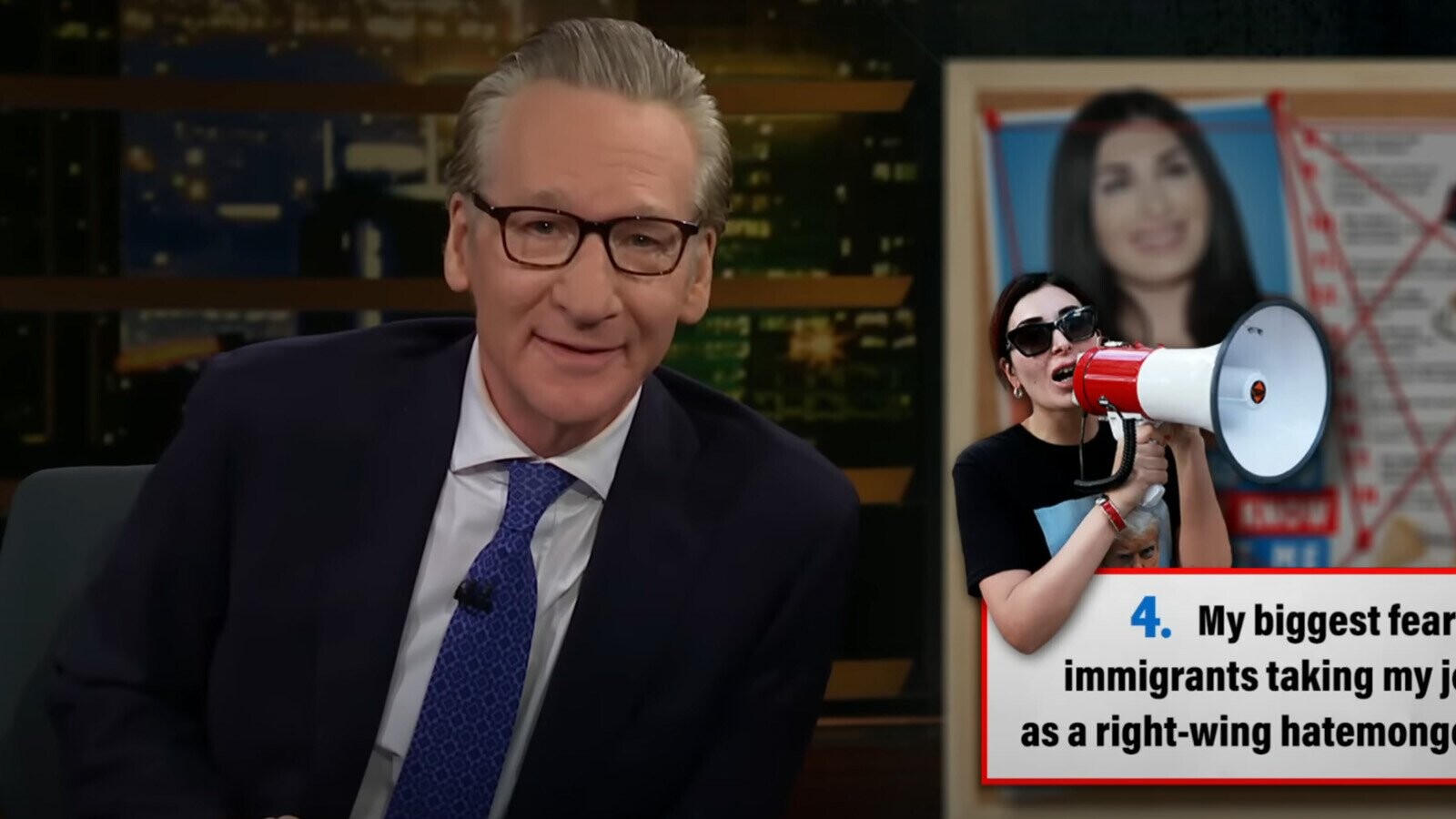

A throwaway Bill Maher joke somehow became a lawsuit, a viral deposition, and a backstage tour of one of MAGA’s ugliest internal feuds. If American politics were a normal workplace, human resources would have disconnected the Wi-Fi and scheduled an emergency seminar titled “Please Stop Posting.”
The story began with Maher joking about far-right activist Laura Loomer’s closeness to Donald Trump. Loomer sued Maher and HBO for defamation. That litigation opened the door to questions about her public statements, including vicious attacks on Representative Marjorie Taylor Greene. What emerged was more consequential than the original joke: a fight over influence, ideological purity, Israel, loyalty to Trump, and who gets to define “America First.”
The insults are sensational, but the underlying MAGA civil war is real. Loomer and Greene are not political opposites. Both built national profiles through aggressive pro-Trump politics, conspiratorial rhetoric, and relentless online confrontation. Their feud demonstrates what happens when a movement organized around personal loyalty lacks a reliable mechanism for resolving disputes. Every disagreement becomes a loyalty test, and every loyalty test becomes content.
The Bill Maher Joke That Started the Legal Chain Reaction
On the September 13, 2024, episode of Real Time with Bill Maher, Maher discussed Loomer’s presence around Trump during the presidential campaign. She had traveled with Trump to the Philadelphia debate and appeared with his entourage at September 11 memorial events, despite previously promoting a conspiracy theory about the attacks.
Maher riffed on Loomer’s own claim that Taylor Swift and Travis Kelce were in an “arranged relationship” designed to influence the election. Turning the premise back on Loomer, he joked that perhaps she was in an arranged relationship with Trump. He then suggested she might be the answer to a crude question about Trump’s romantic life.
It was not Maher’s finest comedic hour. The joke had all the sophistication of a middle-school rumor wearing an HBO badge. Nevertheless, Loomer treated it as a defamatory factual accusation rather than political satire. She filed a lawsuit against Maher and HBO in October 2024, initially seeking $150 million.
The litigation eventually produced a straightforward judicial conclusion. In April 2026, a federal judge dismissed Loomer’s case, finding that a reasonable viewer would have understood Maher’s remarks as a joke. The court also concluded that Loomer had not established the required elements of falsity, actual malice, and damages. The contextMaher’s reputation as a comedian, the satirical program, and the audience’s laughter and groansmattered enormously. TheWrap reported on the dismissal, while the published court analysis was examined by Reason’s Volokh Conspiracy.
Loomer appealed. As of July 23, 2026, the Eleventh Circuit docket showed that the case remained pending, with her opening brief due July 31. The latest filings can be followed through the public appellate docket.
Discovery Turned a Bad Joke Into Political Archaeology
Had the dispute remained limited to Maher’s joke, it might have disappeared into the vast landfill of forgotten television controversies. Discovery changed that. During her deposition, Loomer was questioned about statements she had made publicly, including attacks on Greene and others.
One exchange concerned Loomer’s bizarre “Arby’s in your pants” post about Greene. The questioning became so unruly that a later court order described the testimony surrounding that phrase as “objectively ridiculous.” The same order criticized the behavior of Loomer, her attorney, and opposing counsel, describing a breakdown in professional decorum. Politics had entered a federal deposition and immediately tracked mud across the carpet.
Other exchanges addressed unsupported sexual and corruption allegations Loomer had directed at Greene. Those accusations should not be mistaken for established facts. Their importance lies in what they reveal about the language used inside the pro-Trump ecosystem: allies are not merely accused of being mistaken. They are portrayed as corrupt, sexually immoral, secretly controlled, disloyal, or fraudulent.
The deposition became public entertainment because it captured political trolling under oath. On social media, a person can dodge questions, delete posts, or launch a fresh accusation. A deposition requires the speaker to explain what a statement meant and identify its factual basis. Suddenly, the fog machine is off and the fluorescent courtroom lights are on.
The episode was explored by Esquire, while a later judicial order documented the misconduct and disputes surrounding the depositions. The spectacle was funny in the way that watching someone bring a leaf blower into a library is funny: briefly, until everyone remembers where they are.
Laura Loomer and Marjorie Taylor Greene Were Once Allies
The Loomer–Greene feud did not begin with Israel or Bill Maher. Greene has said she was once friendly with Loomer and supported her unsuccessful 2020 congressional campaign in Florida. Their relationship deteriorated when Loomer launched another campaign in 2022, this time challenging Republican Representative Daniel Webster.
According to Greene’s later account, she advised Loomer to run in an open district instead of challenging an incumbent conservative Republican. Greene declined to endorse Loomer against Webster, and Loomer reportedly viewed the decision as a betrayal. From there, the political friendship began transforming into an online demolition derby.
By September 2024, their disagreements were fully public. Loomer posted a racist attack targeting Kamala Harris’s Indian heritage. Greene condemned the post and said it did not represent Republicans or MAGA. Loomer responded by attacking Greene. CNN’s contemporaneous coverage described the clash as a growing feud exposing tensions among Trump’s allies, while Axios reported that Republicans were alarmed by Loomer’s access to Trump.
That moment established the feud’s recurring pattern. Greene would attempt to draw a boundary around acceptable MAGA behavior. Loomer would accuse her of hypocrisy, weakness, or insufficient loyalty. Both would then insist that theynot the other personrepresented the authentic movement.
The Real Prize Is Access to Donald Trump
The fight matters because Loomer is not merely another anonymous account collecting outrage clicks. She has demonstrated access to Trump and an ability to influence discussions about personnel.
In April 2025, Loomer met with Trump in the Oval Office and urged him to remove national security officials she considered insufficiently loyal. Multiple officials were dismissed soon afterward. Trump downplayed her role but publicly described her as a patriot. The Associated Press, The Washington Post, and Reuters connected the personnel purge to her meeting and loyalty complaints.
This influence changes the stakes of the Loomer–Greene conflict. It is not simply two personalities fighting over followers. It is a contest over proximity to the president, control of the loyalty police, and the ability to label other conservatives unacceptable.
Greene held elected office and possessed a formal political platform. Loomer built power through direct access, social-media amplification, and public campaigns targeting officials. One model depends on votes and committee assignments; the other depends on gaining the attention of a leader who values personal loyalty. The second model can be astonishingly effective in a political movement where a viral accusation may travel faster than a background investigation.
Israel and Gaza Deepened the MAGA Civil War
The feud grew more ideologically significant as Greene and Loomer diverged over Israel and the war in Gaza. Loomer has been an outspoken supporter of Israel. Greene increasingly embraced a noninterventionist “America First” position and criticized continued U.S. involvement abroad.
In July 2025, Greene became the first Republican member of Congress to call the situation in Gaza a “genocide,” while also condemning the October 7 Hamas attack and calling for the hostages’ return. Her declaration reflected a broader debate among Republicans over humanitarian conditions, military assistance, and whether unwavering support for Israel is compatible with America First politics. Time documented the expanding Republican divide.
Greene later used the label “MIGA”“Make Israel Great Again”against Loomer, suggesting that her priorities favored Israel over the United States. Loomer responded by accusing Greene of antisemitism and questioning her character. The exchange showed how quickly a foreign-policy disagreement can become a battle over identity and belonging.
The argument is larger than these two figures. One MAGA faction combines nationalism with strong support for Israel, viewing the country as a strategic and civilizational ally. Another faction interprets America First as opposition to foreign military commitments, overseas aid, and pressure from lobbying groups. Still others slide from policy criticism into antisemitic conspiracy theories, making honest debate more difficult and dangerous.
That tension cannot be settled with another meme. It concerns what America First actually means when U.S. alliances require money, weapons, diplomatic commitments, or military risk.
A Movement Built on Purity Tests Eventually Tests Everyone
MAGA has always contained competing groups: traditional Republicans, populist nationalists, religious conservatives, libertarians, isolationists, aggressive foreign-policy hawks, online influencers, and people who simply enjoy watching institutions shake. Trump’s personality and electoral power held these factions together.
That unity becomes fragile when the coalition must answer specific policy questions. How much should the United States spend abroad? Who qualifies as loyal? Does winning require expanding the coalition or purging doubters? Is MAGA an ideology, a governing program, or allegiance to Trump personally?
Loomer’s method supplies easy answers: loyalty is proven by attacking whoever has just been declared disloyal. Greene has often participated in similar political combat, but she objects when that weapon is pointed at her. This does not make the two figures interchangeable. It does reveal the central weakness of purity-test politics: nobody receives permanent certification.
Yesterday’s gatekeeper can become tomorrow’s traitor. The movement’s internal arguments therefore escalate rapidly because losing a dispute may mean losing access, status, audience trust, or Trump’s approval.
Why the Personal Cruelty Is Politically Useful
The graphic insults are not merely evidence that everyone involved should put down the phone and drink some water. They perform several political functions.
They Overwhelm the Policy Debate
An argument about Gaza, foreign aid, or national security requires facts and trade-offs. A personal accusation requires only a screenshot. The accusation wins the attention contest before the policy discussion has located its reading glasses.
They Turn Followers Into Combatants
Influencers do not simply disagree; they mobilize audiences. Followers search for embarrassing clips, repeat allegations, and pressure allies to choose a side. Political discussion becomes participatory fandom with subpoenas.
They Establish Dominance
In an outrage-based media environment, restraint can look like weakness. The person willing to say the cruelest thing may appear more fearless and therefore more authentic. That incentive rewards escalation even when the claims are unsupported.
They Keep the Feud Profitable
Every response produces another post, interview, fundraising email, podcast segment, or television appearance. The fight becomes a self-replenishing content mine. Nobody needs to resolve the dispute because resolution is terrible for engagement.
When Greene discussed the feud with Megyn Kelly in August 2025, Loomer demanded an opportunity to respond, extending the conflict into another media cycle. The Daily Beast chronicled the resulting exchange. The argument was no longer just happening in public; publicity had become one of its primary objectives.
The First Amendment Irony at the Center of the Lawsuit
Loomer has cultivated an image as a defender of free speech and a critic of censorship. Yet she pursued a massive defamation claim over a television joke while defending her own ability to publish harsh opinions and personal attacks.
Free speech does not mean freedom from criticism, and it does not prevent legitimate defamation lawsuits. False statements presented as facts can cause real harm. Courts must distinguish such claims from protected opinion, rhetorical exaggeration, and satire.
That distinction was central to the Maher ruling. The judge did not declare that every sexual rumor is harmless or that comedians possess magical immunity. The decision depended on context and on what a reasonable viewer would understand Maher to be doing. A joke delivered by a famous comedian during a satirical political program is not automatically a factual news report.
The irony is sharper because discovery required Loomer to defend the meaning and basis of her own inflammatory statements. A lawsuit intended to punish Maher instead subjected her public rhetoric to legal scrutiny and helped expose a broader MAGA power struggle.
What This MAGA Feud Reveals
Maher’s joke did not create the conflict. It functioned like a clumsy stagehand accidentally pulling open the curtain before the actors were ready. Behind it stood years of resentment, rivalry, and ideological disagreement.
The Loomer–Greene battle reveals at least three fault lines. First is the competition for Trump’s approval and the power that accompanies proximity to him. Second is the argument over foreign policy, particularly Israel, Gaza, and the meaning of America First. Third is a struggle over who can police MAGA’s boundaries despite having crossed those boundaries repeatedly themselves.
The nastiness may entertain opponents of the movement, but treating the feud only as comedy misses its consequences. Loomer’s advocacy has been associated with actual government personnel decisions. Greene’s policy shifts reflected genuine changes occurring within parts of the Republican base. The people involved may communicate through insults, but the conflict touches national security, diplomacy, and the composition of the governing coalition.
Experience Section: What It Is Like to Follow a Political Feud Like This
Following the Bill Maher, Laura Loomer, and Marjorie Taylor Greene story offers a familiar modern political experience. It begins with a ridiculous headline. You click because the situation sounds too strange to be real. Five minutes later, you are reading a federal court order about an Arby’s reference and wondering whether representative democracy was supposed to include this much processed meat.
The first lesson is that the funniest detail is rarely the most important one. Maher’s joke created the legal hook, while the deposition supplied viral excerpts. The lasting story, however, concerns political influence. A reader who stops at the insult misses the personnel purges, loyalty campaigns, and foreign-policy divisions underneath it.
The second lesson is to separate allegations from verified events. Online feuds deliberately blur that boundary. A dramatic claim may be repeated thousands of times without gaining a single gram of evidence. When following such a story, look for court records, direct video, official statements, and reporting that identifies its sources. “Someone posted it confidently” is not an evidentiary standard, although the internet keeps submitting it for consideration.
The third lesson is that outrage can distort your sense of scale. A viral political personality may dominate social media while remaining unfamiliar to most voters. At the same time, an unelected influencer can still gain meaningful access to powerful officials. Audience size, public recognition, and institutional influence are related, but they are not the same thing.
The fourth lesson is emotional. Political feuds are designed to recruit spectators. Each side wants the audience to feel disgusted, amused, frightened, or personally betrayed. That emotional energy encourages immediate sharing before verification. Waiting ten minutes, reading the complete exchange, and checking a second source can feel painfully old-fashioned. It is also remarkably effective.
Finally, following the dispute demonstrates how movements change after gaining power. Opposition creates unity because everyone shares an enemy. Governing forces allies to make choices about budgets, wars, appointments, and alliances. Those decisions expose differences that slogans previously concealed.
A useful reading experience therefore moves through three questions. What happened? What has actually been proven? Why does the event matter beyond the personalities involved? Applied here, the answers are clear. Maher made a crude joke. Loomer filed an unsuccessful defamation lawsuit and appealed. Discovery spotlighted her attacks on Greene. The resulting spectacle exposed a battle over Trump’s ear, MAGA’s ideological boundaries, and American foreign policy.
That method will not make political media less absurd. It will make the absurdity more understandableand may prevent the loudest person in the room from choosing your conclusions for you.
Conclusion
Bill Maher’s joke was crude, forgettable, and ultimately more powerful than its punchline deserved. Loomer’s lawsuit preserved it, discovery transformed it, and the courts treated it as protected comedy rather than a factual accusation.
The larger result was an unusually clear view of MAGA’s internal machinery. Loomer and Greene are fighting over personal history, political influence, Israel, loyalty, and ownership of the America First label. Their dispute demonstrates how a movement fueled by suspicion and purity tests can eventually turn those instincts inward.
The joke may fade. The underlying MAGA civil war will not disappear so easily, because it asks a question no insult can settle: Is the movement held together by a coherent governing philosophy, or only by loyalty to one man?
Note: This article distinguishes documented events and court findings from unverified personal allegations raised in political posts or litigation. Such allegations are discussed only to explain the feud and are not presented as facts.