
Note: Some of Ed Harrington’s illustrations intentionally borrow the tone of old medical journals, natural-history plates, and folklore. The disturbing “facts” in several captions are part of the creative fiction, while other details are inspired by real animals, parasites, fears, and scientific oddities.
There are two kinds of scary art. The first kind yells at you from across the room with blood, fangs, and enough shadows to make a flashlight feel underqualified. The second kind smiles politely, hands you a neat little scientific explanation, and waits for your brain to notice that something is deeply, magnificently wrong.
Ed Harrington’s unsettling drawings belong firmly in the second category. His creepy illustrations look as though they were torn from a lost encyclopedia, a cracked Victorian anatomy guide, or the staff bulletin board at a hospital that absolutely should not still be open after midnight. They are elegant, detailed, strange, and often funny in the way only horror can be funny: the kind of funny that makes you laugh first and then inspect your own tongue in the bathroom mirror.
Harrington, who also creates under the name nothinghappenedtoday, is known for blending horror, satire, pop-culture references, comics, and precise linework. In interviews, he has described a longtime love of horror, especially practical effects and the creeping sense of dread that lingers after a good scare. His portfolio moves between illustration, cartoons, design work, and darkly comic visual experiments, making him especially good at giving bizarre ideas a polished, believable finish.
The collection often described as 13 Unsettling Drawings With Creepy Stories By Ed Harrington is memorable because it does not simply show monsters. It gives each disturbing image a backstory. A parasite has a fake Latin name. A bodily abnormality has a dubious historical origin. A bizarre animal has an extinction tale, a medical consequence, and the kind of footnote that makes you wonder whether you should have paid more attention in biology class.
Why Ed Harrington’s Creepy Drawings Work So Well
The secret is not just gore, although some of these pieces certainly make anatomy feel like it has betrayed us personally. Harrington’s strongest creepy drawings combine three ingredients: beautiful craftsmanship, familiar visual language, and one impossible detail.
The craftsmanship makes the image inviting. The familiar language makes it believable. Then the impossible detail sneaks in wearing a lab coat.
This approach has a long artistic history. Medical illustration has often depended on careful drawing to communicate complex information, while historical anatomy books used detailed images to make observations feel authoritative and memorable. Harrington borrows that visual authority, then twists it into horror. It is the artistic equivalent of receiving a formal letter that begins, “Dear resident, congratulations on your new internal organs.”
His work also taps into the uneasy pull of the uncanny: the moment when something looks almost normal but not quite. Surrealist artists have long used familiar objects and settings to make ordinary life feel strange, unstable, or slightly haunted. Harrington’s drawings use that same tension, except his version may include teeth where teeth do not belong, creatures living where creatures should never be allowed rent-free, and giant snails that would make gardening feel like a tactical operation.
The 13 Creepy Drawings and the Stories Behind Them
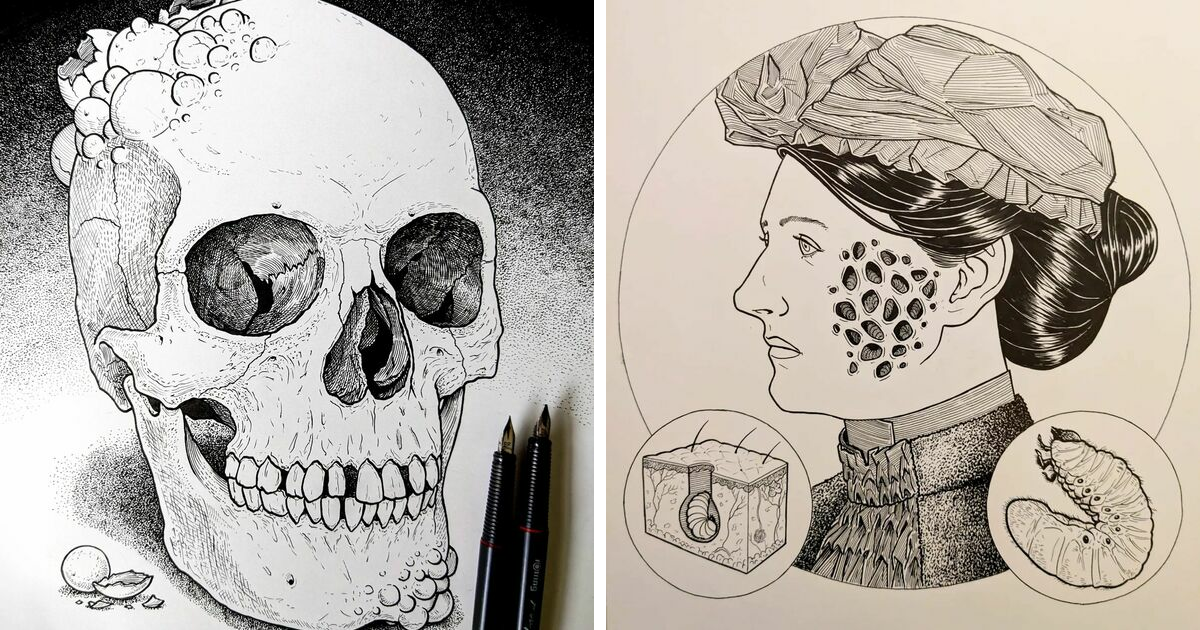
1. Cranial Osteocystis: When Knowledge Literally Goes to Your Head
Cranial Osteocystis, also nicknamed “bone blisters,” presents a skull afflicted with hollow, egg-like growths. The accompanying story reads like a historical medical mystery, complete with references to old graves, strange dietary theories, and “pearls of wisdom” supposedly formed from accumulated knowledge.
That last phrase is especially effective because it turns a pleasant metaphor into body horror. Normally, wisdom is something you gain from experience. In Harrington’s universe, it might detach from your skull and end up in a memorial object. This drawing works because it begins with the language of medicine and ends with the language of nightmares.
2. The Crag Barnacle: A Reason to Respect Dry Socks
The Crag Barnacle imagines a land-dwelling parasite that infects people through damp socks in the woods. The drawing takes a creature associated with ocean rocks and docks, then relocates it to the human foot. Suddenly, a harmless walk through a forest feels like a terrible lifestyle choice.
The story is convincing because it uses practical, unpleasant details: wet socks, larvae, oil, pain, and desperate workers. Harrington understands that the best fictional monsters are not always gigantic. Sometimes they are small, sticky, and waiting near your ankle.
3. The Dream of Teeth Growing From Hands
One of the most unsettling drawings in the collection was inspired by Harrington’s dream of a schoolgirl with teeth growing from both hands. Her classmates call her “Chompers,” turning the image into a nightmare about bullying as much as body horror.
Teeth are already emotionally powerful. They are connected to pain, childhood, embarrassment, health, speech, eating, and the universal anxiety of waking up from a dream where one has become loose. Put teeth on hands, and suddenly every handshake becomes a high-stakes negotiation.
4. Dapper Cephalopod: The Gentleman From the Deep
Dapper Cephalopod is a wonderfully strange example of Harrington mixing genuine science with playful menace. The drawing references the nautilus, a real cephalopod with a comparatively simple pinhole-style eye that lacks a lens. Nautiluses also have numerous arms without suckers, relying instead on sticky grooves to help grip food and surfaces.
Those real facts are weird enough to sound invented. Harrington’s gift is recognizing that nature frequently outperforms horror fiction. Add a formal outfit, sharp linework, and a solemn expression, and suddenly the nautilus looks less like a marine animal and more like an ancient lawyer preparing to read your will.
5. Linguadontia: The Tongue Has Filed a Complaint
Linguadontia imagines a rare condition in which extra teeth grow from the tongue. The fake clinical language is what makes the piece land so hard. It sounds just plausible enough to inspire a few seconds of frantic internet searching, followed by relief, then suspicion, then more searching.
Real supernumerary teeth do exist, meaning a person can develop more teeth than the standard dental formula. But Harrington’s tongue-teeth scenario pushes the idea into fictional anatomical horror. The result is grotesque, clever, and exceptionally effective at making readers appreciate every normal sentence they have ever spoken.
6. A Woman With Her Giant Isopod
Not every disturbing idea in this series is entirely imaginary. The drawing of a woman with a giant isopod draws inspiration from the real tongue-eating louse, a parasitic isopod known for attaching to a fish’s tongue, feeding on blood, and effectively replacing the tongue after it atrophies.
That sounds like it was invented by someone who lost an argument with the ocean. Yet it is real biology. Harrington exaggerates the scale and turns the creature into an eerie companion, proving that nature occasionally writes horror stories without asking permission from a screenwriter.
7. Ossifixion: A Fake Historical Punishment That Feels Too Possible
Ossifixion imagines an ancient punishment in which two people are physically joined through exposed arm bones. The piece is not frightening merely because it is violent. It is frightening because the caption is structured like disputed history: incomplete records, old tapestries, uncertainty, and an “educated guess” about what the remains might have looked like.
That is a smart horror device. History is full of strange punishments, partial records, legends, and exaggerated retellings. Harrington uses the gaps between documented fact and folklore as a playground. The image feels like it belongs in a museum exhibit that has been closed for “renovation” since 1987.
8. The Portuguese Goliath Snail: Cute Until It Is the Size of Furniture
The giant snail drawing is particularly memorable because snails are usually considered harmless, slow, and mildly annoyed by salt. Harrington’s fictional Portuguese Goliath Snail is massive enough to serve as a child’s mount, rare enough to inspire collectors, and dangerous enough to turn a whimsical ride into a cautionary tale.
The idea is even funnier because giant snails already appear in medieval art. Manuscripts from the Middle Ages often featured knights battling snails in their margins, though the exact meaning of these scenes remains uncertain. They may have involved satire, parody, symbolism, or simply the medieval equivalent of doodling something bizarre during a long meeting.
Harrington’s snail feels like the logical next step: what if the marginal joke escaped the manuscript and began demanding snacks?
9. Tetracaudates: The Horror of Seeing Something That Is Inside Your Eye
Tetracaudates, also called “Feowerwogs,” invents a parasite that lives within the eye and casts shadows on the retina. The fictional sufferers believe they are seeing dark phantoms or sky serpents, when the terror is actually moving inside their own vision.
This one is especially disturbing because it weaponizes a familiar experience. Most people have seen floaters, flickering spots, or visual oddities at some point. Harrington transforms that harmless uncertainty into cosmic body horror. The monster is not in the attic. The monster is in your eyeball, and it apparently has excellent timing.
10. Taking the Pufferfish Out for a Stroll
This drawing is amusing on the surface: a cheerful pufferfish being treated like a pet. The sweetness lasts until you remember that some pufferfish contain tetrodotoxin, a potent neurotoxin associated with severe poisoning.
The image captures Harrington’s particular style perfectly. It is cute, ridiculous, and slightly threatening. The pufferfish looks happy. You look happy. Nobody is technically attacking anyone. Yet every sensible part of your brain is quietly whispering, “Maybe do not put that on a leash.”
11. Trypophobia: When a Pattern Feels Like a Threat
Trypophobia draws power from clustered holes, bumps, or circular forms. The word is often used to describe intense discomfort or disgust toward such patterns. Research has found that clusters of holes can trigger strong aversive reactions in some people, with certain spatial patterns appearing especially uncomfortable.
Harrington does not need a complicated monster here. He only needs repetition. A field of tiny openings can make the body react before the mind has time to explain why. It is proof that horror sometimes arrives through design rather than narrative.
12. Osseous Boletationis: The Body as a Fungus Garden
Osseous Boletationis leans into fungal body horror, suggesting a condition where the skeletal system and mushroom-like growths become terrifyingly intertwined. Even without a long caption, the title does a lot of work. “Osseous” sounds clinical. “Boletationis” sounds botanical. Together, they sound like the diagnosis you receive after a doctor pauses for too long before speaking.
Fungi are ideal horror material because they are both beautiful and quietly invasive. They thrive underground, recycle decay, form vast networks, and make the natural world feel much stranger than a backyard lawn suggests. Harrington turns that biological unease into an image that is difficult to forget and even harder to enjoy while eating pizza.
13. The Final Untitled Unease
The final piece in a collection like this often works because it leaves room for the audience to finish the story. Harrington understands that viewers are remarkably good at frightening themselves. Give people an unfamiliar anatomy, a mysterious creature, or a person behaving too calmly around something impossible, and their imagination will write the rest.
That is why these creepy drawings stick. They are not merely illustrations of monsters. They are prompts. Each image asks a dangerous little question: “What if this were real?” Then it smiles and lets your brain do unpaid overtime.
What Is Real, What Is Fictional, and Why That Matters
The best way to enjoy Ed Harrington’s unsettling art is with a sense of curiosity and a modest amount of skepticism. Several drawings in the series use invented illnesses, extinct animals, cryptid parasites, and pseudo-historical punishments. Their captions mimic the rhythms of medical writing, museum labels, and natural-history accounts, but they should be read as creative storytelling rather than health advice.
At the same time, Harrington often anchors his fiction in real details. Nautilus eyes really are unusual. Tongue-eating isopods really exist. Pufferfish toxicity is real. Rat lungworm is also real, though it is caused by Angiostrongylus cantonensis, not the fictional creature names in the artwork. The CDC notes that people can become infected through raw or undercooked infected snails or slugs, or contaminated produce.
That blend of fact and invention is the point. Real nature provides the creepy foundation; Harrington builds a crooked little haunted house on top of it.
Why We Cannot Look Away From Creepy Art
Horror fans know the feeling. You cover your eyes, then immediately peek through your fingers because you need to know what happened. Psychologists often discuss horror enjoyment through concepts such as curiosity, arousal, tension, and the satisfaction of experiencing fear in a controlled setting.
Ed Harrington’s drawings offer a compact version of that experience. They are safe because they are drawings. They are unsettling because they feel specific. The monster has a name. The condition has a history. The creature has an apparent habitat. The caption provides just enough detail to make the impossible feel organized.
And organized horror is often scarier than chaotic horror. A random monster is alarming. A monster with taxonomy, symptoms, and a centuries-old treatment protocol is the kind of thing that makes you cancel your camping trip.
Experiences Inspired by Ed Harrington’s Unsettling Drawings
Looking at Ed Harrington’s creepy illustrations can feel strangely personal because the images pull from ordinary human experiences: visiting a doctor, walking through the woods, staring at a strange insect, getting a toothache, seeing a shadow move in the corner of your eye, or wondering whether that lump is probably nothing. Usually, it is nothing. But horror art lives in the tiny space between “probably nothing” and “I should not have looked that up.”
One common experience is the late-night scroll. You are comfortably in bed, phone brightness set low, minding your business, when you see an illustration of a parasite or an anatomical oddity. The drawing is excellent. You admire the linework. You appreciate the creative caption. Then you make the strategic mistake of reading the comments, where someone says, “I have a weird feeling in my foot now.” Suddenly, your foot has become the main character in a medical thriller.
Another experience is the post-artwork reality check. After seeing Linguadontia, you may run your tongue across your teeth just to confirm that everyone is still located in the proper department. After seeing Tetracaudates, you may notice every floating speck in your vision with the concentration of a detective in a crime drama. After seeing the giant snail, you may look at a garden slug and think, “You are lucky you are small.”
There is also a shared social experience. Creepy drawings are often more fun with friends because one person will confidently declare, “That is definitely fake,” while another quietly opens a search engine. Within minutes, the group has learned that a real parasite can replace a fish’s tongue, pufferfish toxins are no joke, and nature has been writing absurd horror for millions of years. The conversation usually ends with everyone agreeing that the ocean should be monitored more closely.
For artists, Harrington’s work can inspire a different kind of experience: the urge to create a believable falsehood. A fictional field guide, imaginary medical diagram, invented cryptid, haunted museum label, or fake historical artifact can be more unsettling than a traditional monster because it invites the audience to participate. The viewer fills in the missing information. They imagine the smell, the sound, the treatment, the warning signs, and the poor intern who had to catalog the specimen.
For writers, these drawings are a reminder that specificity is powerful. “A monster in the woods” is broad. “A parasite that enters through wet socks and calcifies beneath the skin” is memorable. The more precise the strange detail, the more the audience wants to believe it. Horror becomes effective when it feels documented, categorized, and just one footnote away from being true.
Most of all, Harrington’s creepy stories remind us that discomfort can be entertaining when it is handled with imagination. His illustrations are gross, clever, playful, and beautifully designed. They do not just frighten viewers. They make viewers curious. They make people ask questions. They make people laugh nervously. And, on occasion, they make people avoid looking directly at their own hands for the rest of the afternoon.
Final Thoughts on Ed Harrington’s Creepy Illustration Style
Ed Harrington’s unsettling drawings succeed because they understand a basic truth about horror: the scariest things are often the ones that almost make sense. A strange parasite is frightening. A strange parasite with a scientific name, a treatment method, and a suspiciously detailed historical record is unforgettable.
Across these 13 creepy illustrations, Harrington turns anatomy, marine life, medieval absurdity, medical language, dreams, and dark humor into a strange little universe. It is a place where pufferfish go for walks, isopods become tongues, snails become transportation, and knowledge might physically escape your skull.
It is creepy. It is clever. It is occasionally disgusting. And it is proof that a good drawing does not need to jump out at you to haunt you. Sometimes it only needs to sit quietly on the page, look official, and wait for you to wonder whether you should call a doctor.