Inside the Incredible Pilot That Almost Landed Trey Parker and Matt Stone A Kids’ Show Pre-‘South Park’

Before Trey Parker and Matt Stone built a Colorado town populated by foul-mouthed children, anxious parents, incompetent officials, and one unusually ambitious piece of Christmas feces, they nearly took a very different route into television. That route involved biblical brothers, dancing prehistoric humans, bargain-bin costumes, educational history, and enough cheerful singing to make a network executive wonder whether the creators of South Park had briefly been replaced by extremely strange camp counselors.
The project was called Time Warped, a live-action musical comedy designed to turn famous stories from history into fast, silly television adventures. Two pilots were produced during the mid-1990s, when Parker and Stone were still struggling filmmakers rather than internationally recognized comedy creators. Fox considered the concept, and a reworked version was developed for younger viewers, but the series never reached television.
Today, the surviving pilots offer more than an amusing piece of forgotten entertainment. They reveal the creative machinery that would later power South Park, Team America: World Police, and The Book of Mormon. The animation is missing, but the ingredients are already bubbling: musical storytelling, historical irreverence, innocent characters, fake sincerity, and the firm belief that no sacred subject is too important to receive a ridiculous song.
Before South Park, There Was Cannibalism With Show Tunes
Parker and Stone met while studying at the University of Colorado Boulder. Their early collaborations included short films, crude construction-paper animation, odd character voices, and a shared enthusiasm for comedy that treated good taste as more of a suggestion than a law.
One of their most important early projects began as Alferd Packer: The Musical, a student production inspired by the real Colorado prospector accused of cannibalism after a disastrous winter expedition. The film was later released as Cannibal! The Musical. Instead of presenting Packer’s story as a grim historical drama, the group filled it with romantic melodrama, fake optimism, violent slapstick, and original songs.
The production also established a creative circle that included performers and collaborators such as Dian Bachar, Toddy Walters, Jason McHugh, and Ian Hardin. Several members of that group would return for Time Warped, giving the pilots the feeling of a repertory theater company that had discovered a time machine behind a community-center curtain.
A Formula Hidden Inside the Chaos
Cannibal! The Musical was deliberately rough, but its underlying formula was remarkably durable. Parker and Stone used upbeat music to tell stories about unpleasant events. Characters expressed absurd beliefs with complete sincerity. Historical facts were rearranged for comic effect, while familiar musical conventions made the strangest material feel oddly accessible.
That formula would eventually appear throughout their careers. Before that happened, however, someone at Fox noticed that the concept might work on television.
How Time Warped Became a Possible Television Series
Fox executive Pam Brady encountered Parker, Stone, and their collaborators while working with Brian Graden. Brady reportedly encouraged the group to develop a weekly project that captured the historical musical style of Cannibal! The Musical. Rather than extending the Alferd Packer story indefinitelythere are only so many verses one can write about freezing minersthe creators proposed an anthology that could jump to a different period in every episode.
The result was Time Warped, introduced as a “musical romp through time.” Parker, Stone, and their regular collaborators appeared as members of a fictional performing troupe called the Time Warped Players. The performers adopted joke stage names, including wonderfully suspicious identities such as Imon Welfare, Peeny Bunslinger, and Ichabod Jones.
The format was flexible. One week could feature a biblical story, another could visit prehistory, and a hypothetical third episode might have transformed the French Revolution into a tap number about cake. History supplied the plot; the ensemble supplied songs, costumes, exaggerated acting, and intentional nonsense.
The 1950s Educational Style Was Part of the Joke
Parker reportedly envisioned the show with the visual language of a wholesome mid-century educational program. That choice was not merely inexpensive decoration. The stiff narration, theatrical staging, obvious sets, and relentlessly enthusiastic performances created a comic contrast with the material.
The audience was invited to recognize the artificiality. These were not historical figures magically captured on film. They were energetic performers wearing costumes and behaving as though a plywood desert were the grandest location ever constructed. The limitations became part of the humor.
The First Time Warped Pilot: Aaron and Moses Get a Rewrite
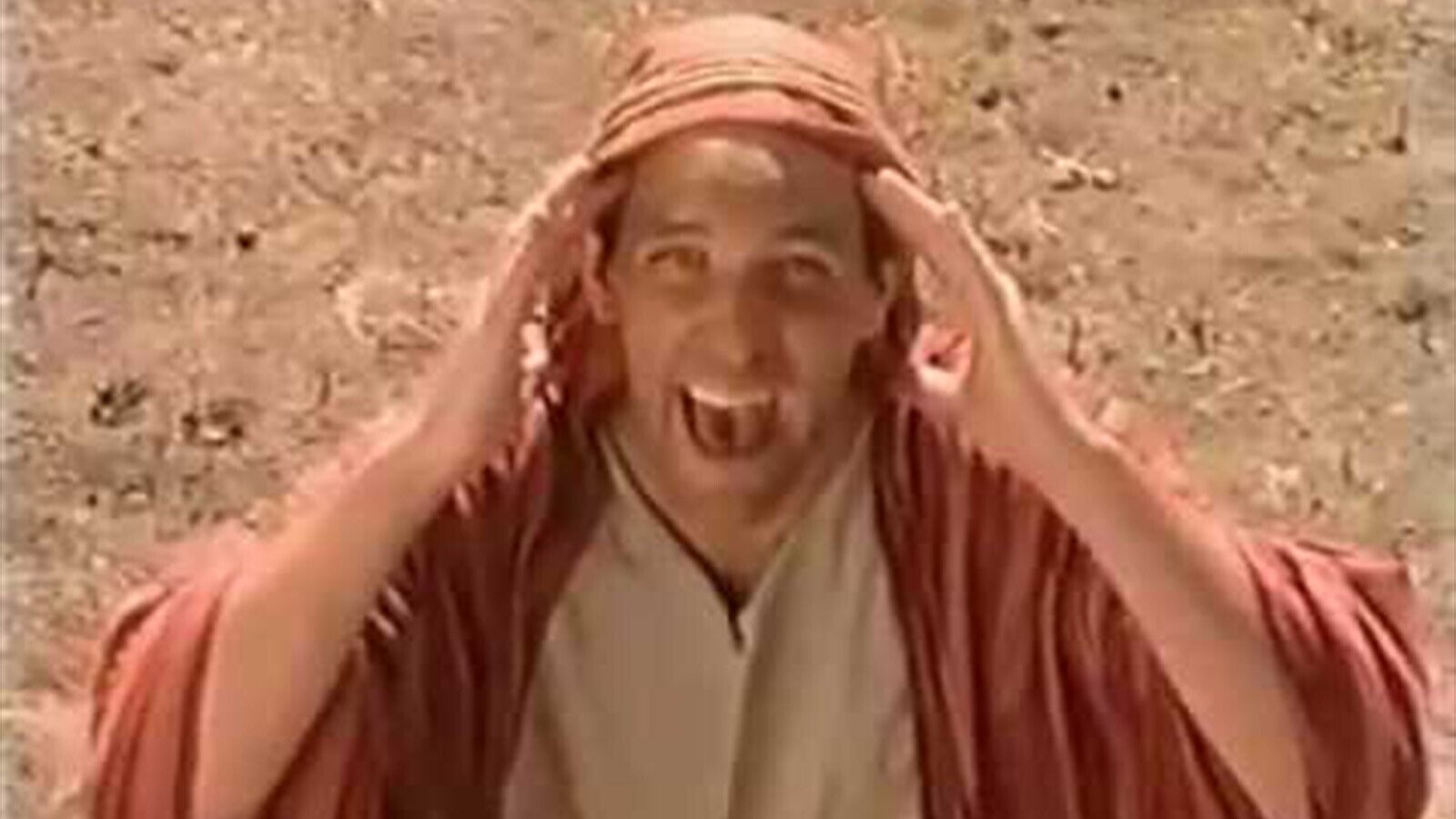
The first pilot, usually identified as “Aaron,” reworked the story of Moses, Aaron, Pharaoh, and the liberation of the Hebrews. Instead of treating Moses as the unquestioned central hero, the episode shifted attention toward his brother Aaron, played by Parker.
That change is pure Parker-and-Stone logic. Take a familiar narrative, locate the person standing slightly outside the spotlight, and ask what the story looks like from that character’s frustrated perspective. The result turns a solemn biblical epic into an ensemble comedy involving sibling rivalry, divine instructions, political authority, and songs that refuse to behave with appropriate reverence.
“Aaron” resembles an early blueprint for the creators’ later treatment of religion. The comedy does not depend solely on declaring a belief ridiculous. It emerges from the human behavior surrounding belief: people misunderstand instructions, compete for credit, overstate their importance, and attempt to explain enormous mysteries through painfully confident dialogue.
The pilot also uses music as an efficient storytelling device. Songs establish relationships, compress exposition, repeat jokes, and keep the narrative moving. That technique later became central to South Park musical episodes and eventually to Parker and Stone’s work on Broadway.
Fox showed interest, but the original pilot was not considered an ideal fit for children’s programming. Instead of abandoning the idea immediately, the creators returned with a substantially reworked second attempt.
Rom and Jul: Romeo and Juliet Meet Human Evolution
The second pilot, “Rom and Jul,” was designed more directly as children’s entertainment. It transplanted the basic structure of Romeo and Juliet into prehistoric Africa and turned the lovers into members of different early human groups. Rom was associated with Homo erectus, while Jul belonged to an Australopithecus community.
In other words, Parker and Stone combined Shakespeare, evolutionary science, musical theater, caveman costumes, and children’s television. Most creators would consider two of those ingredients sufficient. Parker and Stone apparently looked at the entire pantry and pushed it down the stairs.
The educational intention was clearer than it had been in “Aaron.” The prehistoric romance offered opportunities to explain differences between early hominids while parodying forbidden-love stories. The episode reportedly tested favorably with children younger than 10, but Fox Kids did not move forward with a series.
Accounts of the decision emphasize a mixture of network caution, shifting development priorities, and uncertainty about where the show belonged. Fox Kids already had recognizable, merchandise-friendly programming associated with action and established franchises. A live-action evolutionary musical starring adult comedians in primitive costumes was a more difficult product to schedule, advertise, and explain at a meeting without drawing diagrams.
Whatever the precise internal calculation, two pilots were produced and neither became a weekly show. Jason McHugh later preserved the episodes by uploading them online, allowing fans to see a project that could easily have disappeared into a studio archive.
Why Fox May Have Found the Show Difficult to Sell
It Was Educational, but Not Comfortably Educational
Successful educational children’s television usually makes its purpose obvious. A host asks a question, characters discover an answer, and the lesson arrives wearing a bright name tag. Time Warped treated education as raw material for parody.
A child might learn something about Moses or human evolution, but the lesson competed with fake theatricality, character jokes, strange musical numbers, and humor aimed at adults. The show was not too intelligent for children, but it was tonally difficult to classify. It existed somewhere between classroom television, sketch comedy, historical satire, and the kind of musical performed by teachers after someone accidentally serves espresso at a faculty meeting.
The Parker-Stone Voice Was Still Forming
The pilots contain recognizable elements of the duo’s style, but they do not yet possess the ruthless clarity of South Park. Live action made every costume and set visible, while animation would later allow Parker and Stone to build entire worlds without pretending a painted wall was ancient Egypt.
More importantly, South Park gave them recurring characters with strong personalities. Cartman, Stan, Kyle, Kenny, Randy, and the town’s adults became dependable engines for conflict. An anthology like Time Warped would have required the audience to meet new historical characters nearly every week.
It Was Hard to Know Who Should Be Watching
The first pilot leaned toward adult historical comedy. The second was reshaped for children. That transition created a familiar development problem: when a network tries to broaden a strange concept, it can accidentally blur the quality that made the concept interesting.
For adults, the children’s educational framing could seem overly simple. For parents, the creators’ irreverent instincts might seem unpredictable. For children, some of the historical and theatrical jokes required context. The program wanted to entertain everyone, which is admirable, but television history is full of pilots that attempted to serve the entire family and ended up sitting alone at the dinner table.
The Creative DNA That Survived
Although Time Warped failed as a television proposal, its central ideas did not vanish. Parker and Stone continued combining cheerful music with subjects that traditional entertainment approached solemnly.
South Park repeatedly used songs not as decorative interruptions but as storytelling tools. Music could explain a character’s motivation, summarize a complicated belief system, parody a genre, or make an offensive idea sound alarmingly catchy. Stone has discussed how the strongest songs in their work function within the story rather than merely sitting beside it.
The 1999 film South Park: Bigger, Longer & Uncut expanded that approach into a full movie musical. Team America: World Police used songs to parody nationalism, Hollywood storytelling, romantic montages, and Broadway itself. Finally, The Book of Mormon transformed religious history and missionary culture into a traditional stage musical with highly untraditional material, winning major theatrical awards and becoming a long-running Broadway success.
Seen from that perspective, Time Warped was not a meaningless detour. It was an early laboratory. Its creators were experimenting with the same question they would explore for decades: How can a song make controversial comedy sharper rather than softer?
The later success of The Book of Mormon makes the lost pilot especially fascinating. Parker and Stone eventually mastered the kind of musical historical satire they had attempted years earlier with cardboard scenery and prehistoric costumes. The scale changed. The theatrical instinct did not.
How the Failure Helped Clear the Road to South Park
At approximately the same point in their careers, Parker and Stone were developing another peculiar project built around crude construction-paper characters. Their two shorts known as The Spirit of Christmas circulated through Hollywood on copied videotapes, becoming a viral sensation before online video sharing existed in any familiar form.
Executives were not immediately convinced that the shorts could become a television series. The language was offensive, the animation looked homemade, and the central characters were children in a small Colorado town. Those supposed weaknesses, however, gave the project a clear identity that Time Warped lacked.
South Park did not need to become a family program, a history lesson, or a showcase for recognizable merchandise. It could be sold as a disruptive adult comedy. Comedy Central was willing to take the risk, even after the pilot performed poorly with test audiences.
The network’s decision allowed Parker and Stone to preserve their comic instincts rather than continually adjusting them for younger viewers. The series debuted in 1997 and rapidly became a defining Comedy Central program. Its success also gave the creators enough authority to return to films, musicals, puppetry, political satire, and nearly every other format that would have terrified a cautious children’s programming department.
Why Time Warped Still Matters
Lost and rejected pilots are often discussed as alternate-history curiosities. Viewers imagine the careers that might have followed if a network had made a different decision. In the case of Time Warped, the alternate timeline is especially entertaining.
Perhaps Parker and Stone would have become respected producers of unconventional educational television. Perhaps they would have spent several seasons singing about the Roman Empire, medieval medicine, and Andrew Jackson’s banking policies. Perhaps a generation of children would now remember the Louisiana Purchase through a chorus line.
More likely, the pair would eventually have collided with the restrictions of children’s programming. Their comedy thrives on pushing an idea beyond the point of comfort. A weekly Fox Kids production would have required careful limits, predictable standards, and constant consideration of parents, advertisers, and educational expectations.
The rejection may therefore have been less a tragedy than an accidental course correction. Time Warped demonstrated that Parker and Stone could create songs, organize an ensemble, reinterpret history, and finish a television pilot. Its failure encouraged them to pursue a concept that better matched their voices.
Creative careers rarely advance through a neat series of victories. Sometimes an unsuccessful project teaches its creators what they should keep, what they should abandon, and which network conference rooms should never be trusted with a singing Australopithecus.
The Experience of Watching Time Warped Today
For a modern viewer, watching Time Warped feels less like streaming a conventional television episode and more like opening an unlabeled videotape discovered in the back room of a very eccentric theater company. The image quality, inexpensive staging, theatrical costumes, and broad performances immediately reveal the project’s age and limited resources.
That roughness is part of its appeal. Contemporary television pilots are often polished enough to disguise uncertainty. Time Warped cannot hide anything. Every ambitious choice is visible, along with every budgetary compromise. When a location is supposed to represent a distant historical world, viewers can practically feel the crew standing two feet outside the frame holding a light.
The first pleasure comes from recognition. Parker’s musical instincts are unmistakable. Melodies are used to accelerate jokes and deliver exposition. Characters sing with absurd commitment, even when their surroundings resemble a school production mounted after the drama department spent most of its budget on snacks.
Fans of South Park can also recognize the emerging rhythm of the comedy. A serious premise is introduced, a character responds with misplaced confidence, and the scene escalates through repetition. The humor is not yet as precise as it would become, but the pattern is there. It is like hearing a famous band’s early demo and realizing the guitarist already knew the riff, even though the drummer appeared to be recording inside a laundry basket.
The second viewing experience is discomfort, especially during “Rom and Jul.” The attempt to combine evolutionary education, prehistoric caricature, romance, and children’s comedy creates moments that feel awkward by modern standards. Some jokes are products of their era, while others are simply examples of young creators trying every possible idea before discovering which ones deserved to survive.
That awkwardness should not be erased from the project’s history. It demonstrates how creative voices develop through trial rather than revelation. Parker and Stone did not suddenly emerge with a perfect understanding of television. They experimented with tone, audience, structure, performance, and format. Some combinations worked. Others marched onstage wearing fake fur and began singing about human evolution.
There is also an unexpected warmth in seeing the recurring group of collaborators together. Time Warped resembles a project made by friends who genuinely believed they might be one enthusiastic executive away from a television career. The performers commit fully because the opportunity matters to them. Their energy gives the pilots charm even when the jokes miss.
Most of all, the experience creates suspense despite the outcome already being known. Viewers know that Fox will pass and South Park will eventually succeed, yet it is easy to imagine how uncertain the future felt during production. Parker and Stone were not established creators completing a quirky side project. They were young filmmakers trying to prove that the strange things they found funny could support a career.
Watching the pilots now turns that uncertainty into creative archaeology. Every cheap prop and awkward transition points toward a later achievement. The historical songs anticipate The Book of Mormon. The cheerful blasphemy anticipates South Park. The handmade attitude anticipates a production culture in which speed and invention would matter more than conventional polish.
Time Warped may not be a forgotten masterpiece, but it is something more revealing: a visible draft of an artistic identity. It captures Parker and Stone before success protected their ideas, before audiences understood their style, and before network executives knew that two Colorado filmmakers could turn sacrilege, sincerity, and show tunes into an entertainment empire.
Conclusion
Time Warped almost placed Trey Parker and Matt Stone on an entirely different television path. Its two pilots transformed biblical history and human evolution into live-action musical comedy, using many of the collaborators who had helped create Cannibal! The Musical. Fox declined to order the series, but the project preserved ideas that would later flourish in South Park, Team America, and The Book of Mormon.
The story is a reminder that failed pilots are not necessarily wasted work. Sometimes they are rehearsal rooms for better projects. Parker and Stone did not become the kings of children’s historical television, but they discovered that songs, satire, and aggressively inappropriate sincerity could take them somewhere much more interesting.
SEO Metadata
Note: This original article synthesizes publicly available interviews, archival reporting, production records, and commentary about Time Warped and the early careers of Trey Parker and Matt Stone.