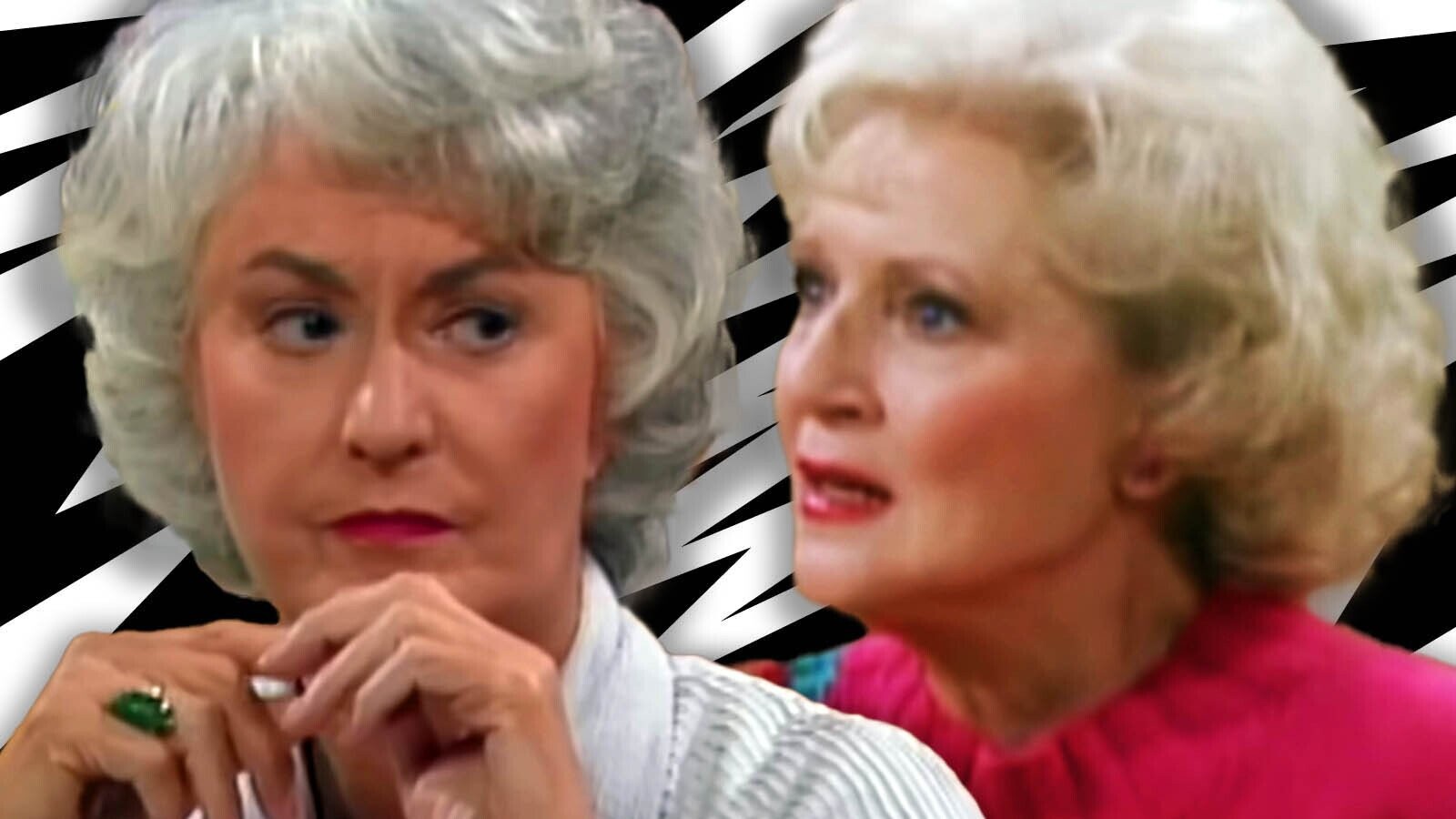

Note: This article is based on public interviews, cast recollections, and retrospective reporting. Because Bea Arthur and Betty White are no longer here to clarify every r and avoids treating backstage stories as courtroom evidence.
For decades, The Golden Girls has felt like the television equivalent of a warm blanket, a cheesecake slice, and a perfectly timed Sophia Petrillo insult. Dorothy, Rose, Blanche, and Sophia made friendship look durable, hilarious, and occasionally fueled by passive-aggressive kitchen conversations.
That is why fans are always surprised to hear that Bea Arthur and Betty White, who played Dorothy Zbornak and Rose Nylund, were not especially close off camera. They were brilliant together. Their timing was sharp. Their scenes had the rhythm of a two-person tennis match played with sarcasm and Minnesota stories.
But the truth behind the reported Bea Arthur and Betty White tension appears to be more complicated than a single feud, a single fight, or one actress secretly hiding the last cheesecake. A former Golden Girls actor, Lyn Greene, offered one of the most thoughtful explanations: Arthur may have struggled with what she perceived as Betty White’s overly agreeable public persona. Other people connected to the series later pointed to different work styles, live-audience habits, and two very different personalities.
In other words, the Bea Arthur–Betty White “beef” was likely less about one giant betrayal and more about a long-running mismatch in temperament. That does not make it less interesting. It makes it more human.
The Short Answer: It Was Probably About Personality, Not One Scandal
Fans searching for a dramatic smoking gun may be disappointed. There is no reliable public account of one huge incident that permanently shattered the relationship between Bea Arthur and Betty White. The available stories instead suggest repeated small frictions: one actor liked focus and privacy before a performance, while the other could be playful, social, and charming with an audience even between takes.
Arthur was known for her directness. She had a formidable stage presence, a dry wit, and very little patience for what she considered artificial behavior. White, meanwhile, had spent decades mastering television’s social side: game shows, live appearances, panel programs, interviews, and audiences who adored her before she even delivered a line.
Neither approach was wrong. They were simply different. One person’s cheerful professionalism can look like performative sweetness to someone who values bluntness. One person’s serious concentration can look chilly to someone who thrives on warmth and spontaneity. Put those two approaches in the same dressing-room hallway for seven seasons, and you have the recipe for a very polite, very talented storm cloud.
What Lyn Greene Said About Bea Arthur and Betty White
Lyn Greene, credited as Lynnie Greene, played the younger version of Dorothy Zbornak in several Golden Girls flashback episodes. Her role put her close enough to observe Arthur’s personality and understand why Arthur’s approval mattered. Greene later described Arthur as someone who valued authenticity and had little patience for people she believed were putting on an act.
Greene’s explanation was not that Betty White was secretly malicious or insincere. Instead, she suggested that Arthur may have sometimes seen traces of Sue Ann Nivens in White. Sue Ann, of course, was White’s famously sugary, sharp-edged character from The Mary Tyler Moore Show: a woman who could smile sweetly while metaphorically sharpening a butter knife behind her back.
That comparison matters because Rose Nylund and Sue Ann Nivens were almost opposites. Rose was innocent, dreamy, and capable of turning a simple anecdote about St. Olaf into a story with seventeen cousins, three cows, and a missing accordion. Sue Ann was a polished television personality whose charm came with hidden claws.
Greene’s point was essentially that Arthur may have wondered whether White’s real-life sweetness was always as uncomplicated as it appeared. In Greene’s view, someone who is relentlessly pleasant can accidentally make a more reserved person look harsh by comparison. It is the classic workplace dynamic where one colleague says “Have a beautiful day!” at 7:02 a.m., while another is still negotiating with coffee and basic consciousness.
Still, this should be treated as Greene’s interpretation, not a final verdict from Bea Arthur herself. Public memories are valuable, but they are still memories. They can explain how people experienced a relationship without proving every private motive inside it.
Betty White’s Own Explanation Was Surprisingly Simple
Betty White did not deny that Arthur had reservations about her. In a 2011 interview, White said Arthur was “not that fond” of her and described herself as someone Arthur could find irritating. White suggested that her own upbeat disposition may have gotten under Arthur’s skin.
That explanation fits the larger pattern described by people who worked around the show. White had a famously sunny public image, but she was not naïve about comedy or show business. She was a veteran performer who knew how to connect with a room, improvise when necessary, and keep an audience engaged.
Arthur’s comedy came from a different engine. Dorothy’s humor often arrived through deadpan exasperation, raised eyebrows, controlled disbelief, and the emotional exhaustion of a woman who had apparently been assigned to supervise three adult chaos generators. Arthur’s style was precise. Her funniest moments often worked because she did not look as if she was trying to be funny.
White’s comedy could be light, nimble, and openly playful. Arthur’s could be dry, grounded, and built on resistance. On screen, those styles fit together beautifully. Off screen, they may have created a gap that never fully closed.
Different Work Styles May Have Made the Tension Worse
Bea Arthur Treated the Set Like a Place to Focus
Several producers, writers, and people close to the show later described Arthur as intensely focused during taping. Her background included theater, where actors often protect their concentration before stepping onstage. For someone working in that mode, the minutes between scenes are not necessarily social time. They can be preparation time.
Arthur reportedly preferred to stay mentally inside the work. That does not make her humorless. In fact, she was famously funny. It simply means she may have viewed the set as a professional space first and a social event second.
Betty White Connected With the Live Audience
White, on the other hand, was known for interacting with the live studio audience during breaks or moments when production paused. To fans, that sounds delightful. Betty White chatting with an audience is basically a public-service announcement for happiness.
But that habit reportedly annoyed Arthur. From Arthur’s perspective, it may have interrupted concentration and changed the rhythm of a carefully built live performance. From White’s perspective, it was likely a natural extension of the kind of television she had been doing for years.
This is a reminder that conflict does not always require a villain. Sometimes one person is trying to preserve focus, while another is trying to preserve energy. Both believe they are helping the show. Both can still drive each other slightly nuts.
Was There Jealousy Over Applause or Awards?
Some later accounts have floated the idea that audience applause or awards recognition may have contributed to the Bea Arthur and Betty White friction. White’s popularity was enormous, and she won an Emmy for playing Rose in the first season of The Golden Girls. In an ensemble full of powerhouse performers, attention can become a delicate subject even when nobody says it aloud.
However, the jealousy theory should be handled carefully. It is speculation, not a confirmed explanation. Arthur was already an acclaimed performer with a remarkable career, including major success in theater and television. Reducing her feelings to simple envy would flatten a much more complicated personality.
It is more reasonable to say that audience response may have made existing differences more visible. If White received a huge reaction during introductions or made the audience laugh between scenes, Arthur may have found the atmosphere distracting. That is not necessarily jealousy. It may have been irritation with the machinery around fame.
Hollywood is full of people who enjoy applause in theory but dislike everything that happens while waiting for it. Arthur may simply have been one of them.
The Backstage Argument That Ended With a Very Strange Calendar
One of the most memorable stories about the alleged tension came from later recollections about a 1986 Christmas episode of The Golden Girls. During production, Bea Arthur and Betty White reportedly had a rare backstage argument intense enough that crew members noticed the yelling.
According to people involved with the show, the mood the next day was still awkward. Then the stagehands decided to intervene in the most television-crew way imaginable: with a prank involving nude photos of themselves inserted into a prop calendar.
The calendar was connected to the episode’s plot, and the unexpected images made the cast laugh. Reports from the anniversary special describe the moment as a tension-breaker. What had been a strained atmosphere turned into laughter, and the two actresses reportedly hugged afterward.
It is almost too perfect for The Golden Girls. A serious dispute gets defused not by a corporate retreat, a mediation workshop, or a color-coded communication chart, but by a prop full of naked crew members. Somewhere, Sophia Petrillo would have approved the efficiency.
The episode also highlights something important: even when personal tension existed, it did not prevent Arthur and White from doing exceptional work. The cameras came on, the performances landed, and viewers got the friendship they loved.
Why Their On-Screen Chemistry Still Worked So Well
The greatest irony is that the differences between Bea Arthur and Betty White may have strengthened the Dorothy-and-Rose relationship. Dorothy was practical, skeptical, and rarely impressed. Rose was sincere, optimistic, and capable of saying something so innocent that Dorothy needed a full five seconds to recover.
That contrast created comedy. Rose’s sweetness gave Dorothy something to react to. Dorothy’s impatience gave Rose’s innocence a sharper outline. Their scenes worked because neither woman played the same note.
Professional acting often requires people to create intimacy, loyalty, or affection with coworkers they may not choose as friends in ordinary life. Arthur and White were both skilled enough to make the audience believe Dorothy and Rose cared deeply for each other. That is not fake. It is craft.
And craft matters. A friendship on television does not need to be a documentary of the actors’ private lives to feel emotionally true. Sometimes the best ensemble work comes from performers who understand exactly how different they are.
Why the Bea Arthur–Betty White Story Should Not Be Turned Into a Villain Narrative
Modern celebrity culture loves clean categories: hero, villain, victim, queen, diva, secret monster. Real people rarely cooperate with that kind of filing system.
Betty White was beloved by generations of viewers and colleagues. Bea Arthur was adored for her intelligence, toughness, and fearless comic style. Both women could be generous, difficult, funny, sensitive, and deeply committed to their work. Those qualities can exist in the same person without cancelling each other out.
It is also worth remembering that The Golden Girls was made under pressure. It was a live-audience sitcom with tight schedules, demanding dialogue, physical comedy, emotional scenes, and the expectations that come with a hit show. Small annoyances can become bigger when people are tired, watched, and expected to be funny on command.
The most responsible conclusion is not that Bea Arthur “hated” Betty White for one definitive reason. It is that several people who knew the production remembered a complicated relationship shaped by personality, work habits, and contrasting ideas about sincerity, focus, and performance.
Experiences Related to the Bea Arthur and Betty White Story: What Workplace Friction Can Teach Us
The Bea Arthur and Betty White dynamic feels familiar because most people have worked with a version of it. Not the Emmy-winning sitcom version, hopefully. Most offices do not have a live studio audience, and the break room rarely contains a cheesecake large enough to solve a conflict. But the underlying tension is recognizable.
There is often one person who processes work quietly. They want to prepare, think, and avoid unnecessary chatter before an important meeting. Then there is another person who gets energy from conversation. They greet everyone, joke with strangers, and somehow know the names of every delivery driver before lunch.
Neither person is automatically difficult. The problem starts when each assumes the other person’s style is a judgment. The quiet colleague may think, “Why are they always performing?” The social colleague may think, “Why are they always annoyed with me?” Suddenly, two normal work styles become personal stories.
That is where the Bea Arthur and Betty White story offers a useful lesson. Personality differences become more manageable when people stop trying to decode every behavior as a secret message. A cheerful person may simply be cheerful. A reserved person may simply be concentrating. The gap between those interpretations can be enormous.
Another lesson is that professionalism does not require friendship. Arthur and White reportedly delivered when it mattered. They understood the assignment, hit the timing, and protected the quality of the show. In many workplaces, that is enough. You do not have to vacation together, share every opinion, or become best friends to build something excellent.
There is also value in humor. The famous calendar prank may sound ridiculous, but laughter can interrupt tension when used carefully. It reminds people that a disagreement does not have to become their entire identity. The goal is not to avoid conflict forever. It is to keep conflict from swallowing the work, the team, and everyone’s Tuesday.
Finally, the story shows why it is dangerous to rely on assumptions. We often see the polished colleague as fake or the blunt colleague as rude. Sometimes those impressions are accurate. Often they are incomplete. People carry different histories, insecurities, habits, and ways of staying functional under pressure.
That is what makes the Golden Girls story more interesting than ordinary celebrity gossip. It is not only about who liked whom. It is about how talented people with different emotional operating systems can still make something unforgettable together.
Conclusion
The reported Bea Arthur and Betty White tension was likely real, but it was also more nuanced than the word “feud” suggests. Lyn Greene’s explanation points to Arthur’s discomfort with what she may have perceived as overly polished friendliness. Betty White’s own comments suggest that her positivity could irritate Arthur. Producers and writers added another layer: Arthur’s serious, focused approach to work did not always mesh with White’s audience-friendly spontaneity.
Yet the lasting legacy of The Golden Girls is not conflict. It is the astonishing quality of the work. Bea Arthur and Betty White created two of television’s most beloved characters, and their differences helped produce a comic contrast that remains funny decades later.
That may be the most Golden Girls lesson of all: you do not need perfect harmony to build something great. Sometimes you just need talent, discipline, a good script, and perhaps a strategically placed cheesecake.