
A Petite Moravian Star Pendant is proof that a light fixture does not need to be enormous, covered in crystals, or visible from the next county to make a room memorable. With its pointed geometric silhouette, glass panels, and jewel-like metal frame, this compact pendant brings architectural character to spaces that might overwhelm under a traditional chandelier.
It can brighten a breakfast nook, add a little drama above a kitchen sink, or transform a plain hallway into a surprisingly polished passage. During the day, the pendant behaves like a suspended sculpture. At night, light moves through its many angled panes and creates a warm, dimensional glow. In other words, it is both lighting and decorationwithout demanding the floor space of another “essential” side table.
Although the form is rooted in a meaningful historic tradition, today’s petite Moravian star lights work with interiors ranging from colonial and traditional to modern farmhouse, eclectic, transitional, and contemporary. The key is choosing the right size, finish, glass, bulb, and hanging height for the room.
What Is a Petite Moravian Star Pendant?
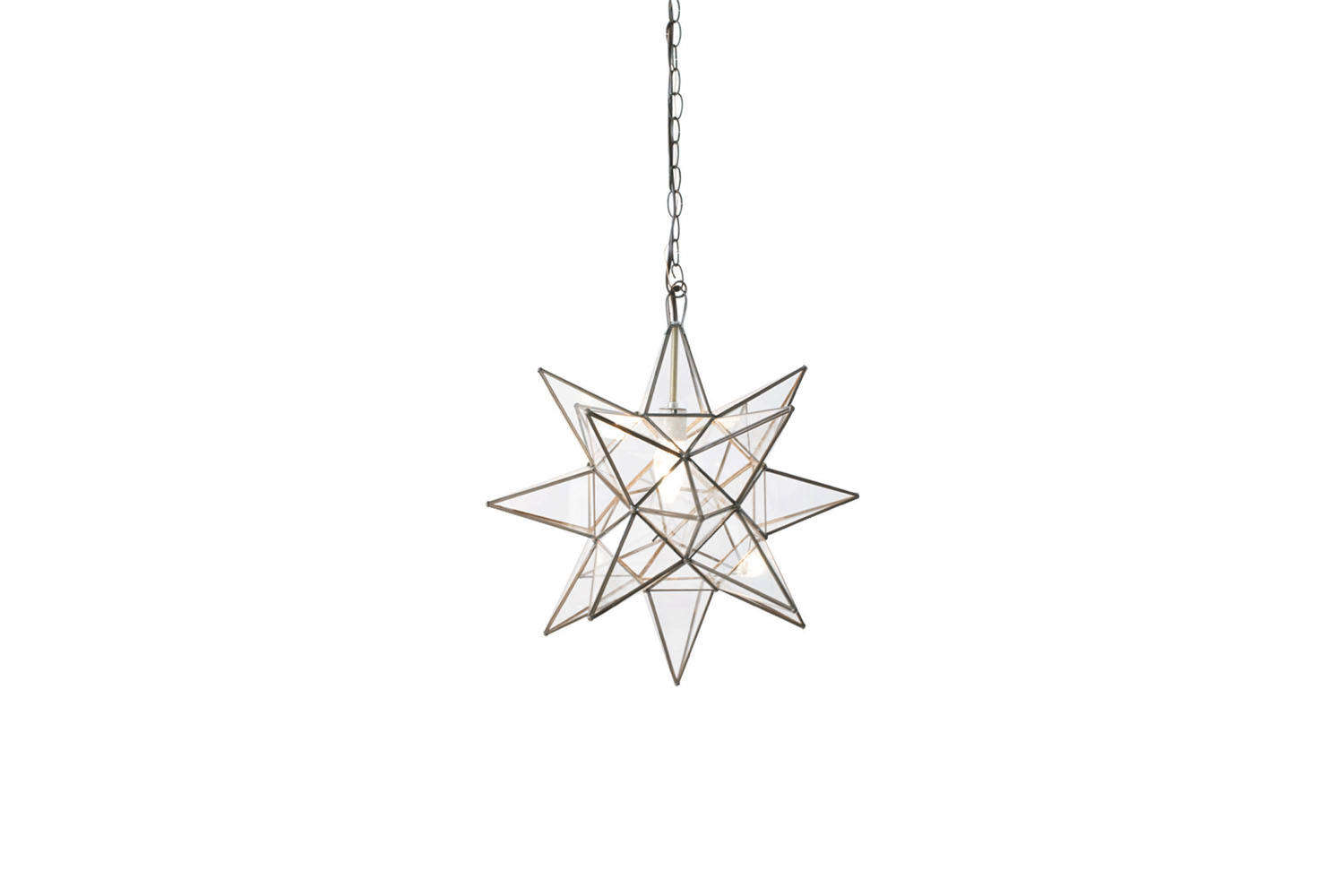
A petite Moravian star pendant is a compact ceiling fixture shaped like a three-dimensional star. Most decorative lighting versions feature a metal framework fitted with clear, seeded, frosted, amber, or colored glass panels. A bulb sits inside the star and shines through the geometric shade.
The word petite generally describes the fixture’s smaller scale rather than one standardized measurement. Many compact models are approximately 8 to 14 inches wide, although manufacturers define “small” differently. Some are true hanging pendants with chains or rods, while others are semi-flush fixtures designed for lower ceilings.
Unlike a flat five-point star, the Moravian-inspired form is dimensional, symmetrical, and covered with projecting points. Traditional Moravian stars are associated with Advent, Christmas, and Epiphany, but metal-and-glass pendant versions are commonly used throughout the year as permanent architectural lighting.
The History Behind the Moravian Star
The Moravian star originated in nineteenth-century Germany, where students at Moravian schools used complex star forms while studying geometry. The design was later adopted as a religious and seasonal symbol representing the Star of Bethlehem. It became particularly connected with Advent traditions in Moravian communities.
The best-known traditional form has 26 points, although decorative stars now appear in many configurations. Modern pendant lights do not always reproduce the historic construction exactly. Instead, they borrow its recognizable geometry and reinterpret it in materials suitable for permanent interior lighting.
This background gives the fixture more substance than the average fashionable pendant. You can appreciate it as a symbol of faith and hope, as a piece of geometric design history, or simply as a handsome light that makes the ceiling considerably less boring.
Why the Petite Version Works So Well
It Adds Drama Without Consuming the Room
A full-size star chandelier can become the dominant feature in a foyer or dining room. That is wonderful when the room can support it. In a narrow hall, powder room, compact kitchen, or low-ceilinged entry, however, a large fixture can feel less like a design statement and more like an approaching spacecraft.
A petite star pendant preserves the pointed silhouette and glittering glass while maintaining more visual breathing room. It catches attention without blocking important sightlines or making the ceiling appear crowded.
It Looks Interesting From Every Direction
Many pendant shades have a clear front and back. A Moravian star does not. Its dimensional shape offers an engaging view from nearly every angle, which makes it especially effective in open layouts, stairwells, passageways, and rooms where the fixture can be seen from several locations.
It Can Function Alone or in a Group
A single petite pendant can define a small zone such as a sink, desk, reading corner, or breakfast table. Multiple stars can be arranged above a long island or suspended at staggered heights in a tall entry. Small pendants are commonly grouped when a broader surface needs even light coverage.
Materials and Finishes to Consider
Clear Glass
Clear glass reveals the bulb and allows the greatest amount of light to escape. It keeps the fixture visually light, making it a strong choice for small rooms. Because everything inside is visible, the socket, wiring, and bulb shape become part of the design.
A clear-glass star looks particularly sharp with a simple filament-style LED bulb. Avoid an oversized or unusually long bulb unless the fixture provides sufficient interior clearance.
Seeded or Textured Glass
Seeded glass contains tiny bubbles and irregularities that soften the view of the bulb. It adds vintage character and disguises dust more generously than perfectly clear glassa quality that deserves more applause than it usually receives.
The textured surface also breaks up glare and produces subtle highlights across the individual panes. This style works beautifully in farmhouse, cottage, traditional, and transitional interiors.
Frosted, Opal, or Colored Glass
Frosted glass produces a gentler glow and partially conceals the bulb. Amber panels warm the light, while smoky, blue, or green glass creates a more decorative effect. Keep in mind that darker or more opaque glass can reduce usable brightness, so the fixture may work better as accent lighting than as the room’s only source of illumination.
Black or Oil-Rubbed Bronze Frames
Dark metal outlines every point and emphasizes the star’s geometry. Matte black feels crisp and modern, while oil-rubbed bronze leans warmer and more traditional. Both finishes provide attractive contrast against pale walls and ceilings.
Antique Brass and Aged Gold
Brass brings warmth and a slightly glamorous quality to the pendant. An aged or unlacquered finish feels collected rather than flashy, while polished gold creates a more formal result. Brass also pairs naturally with walnut, oak, marble, dark green cabinetry, and warm white walls.
Nickel, Chrome, and Silver-Tone Metals
Cool metallic finishes can make the historic star form feel more contemporary. They coordinate well with stainless-steel appliances, gray stone, mirrored surfaces, and blue-based color palettes. Because the star itself is visually detailed, a simple finish often prevents the fixture from looking overly ornate.
Where to Hang a Petite Moravian Star Pendant
In a Small Entryway
An entryway establishes the personality of a home before guests have time to notice the basket of shoes you hoped they would ignore. A petite star pendant introduces shape and sparkle overhead without occupying valuable floor area.
Statement lighting can also draw the eye upward and help a modest entry feel more intentional. Designers frequently use distinctive ceiling fixtures to give small entrances a stronger sense of scale and identity.
Above a Kitchen Sink
The area above a sink is an ideal location for one small pendant. It supplies focused light, fills an otherwise empty ceiling zone, and creates a visual moment without competing with island lighting.
Choose clear or lightly textured glass for better task illumination. A dimmable bulb is useful because midnight water-glass missions do not require the brightness of an operating room.
Over a Kitchen Island
Two or three petite Moravian star pendants can create a rhythmic arrangement over an island. The number depends on the island’s length, fixture width, and desired spacing. The composition should feel balanced rather than squeezed together merely because a product photo showed three.
Start with the island’s centerline, mark the proposed fixture positions, and view them from adjoining rooms before installation. Pendant recommendations are useful starting points, but proportion and clear sightlines matter more than rigid formulas.
Over a Breakfast Table
A single star suspended above a small round table creates an intimate focal point. The angular fixture provides a pleasing contrast to the table’s curved edge. For a rectangular table, consider a pair of petite pendants or one slightly larger star.
In a Hallway
A row of compact star pendants can turn a long corridor into a deliberate design feature. Repetition works particularly well when the fixtures are aligned with doors, arches, or architectural bays. Designers often use playful pendants in series to give hallways greater character.
In a Powder Room
A powder room is one of the best places to experiment with expressive lighting. Because the space is small, a petite fixture can feel luxurious without requiring a major renovation. Confirm that the model carries the appropriate location rating if it will be exposed to moisture or condensation.
On a Covered Porch
A Moravian star can create a welcoming porch glow, but an indoor fixture should never be installed outside merely because the porch has a roof and an optimistic personality. Use a model specifically marked for damp or wet locations as required by its exposure. UL guidance distinguishes dry-, damp-, and wet-location luminaires according to the moisture conditions they are designed to withstand.
How to Choose the Right Size
Begin by measuring the fixture’s total width, body height, canopy, and maximum hanging length. A star’s pointed profile can make it feel larger than a globe or cylinder with the same listed diameter, so compare its measurements with the surrounding space rather than shopping by label alone.
For a small sink, desk, or compact entry, one fixture around 8 to 12 inches may be sufficient. A 12- to 14-inch model can have more presence over a small table or in a taller foyer. Product listings commonly offer Moravian-style fixtures around 12 inches wide, demonstrating how the form can deliver detail at a relatively compact scale.
Before ordering, create a paper or cardboard outline matching the pendant’s width. Hold or suspend it at the proposed location. This low-tech test quickly reveals whether the fixture will look charmingly petite or suspiciously similar to a ceiling-mounted sea urchin.
Hanging Height and Spacing
Over a kitchen island or dining surface, a common starting point is to place the bottom of a pendant roughly 30 inches above the countertop or tabletop. Adjust the height for the ceiling, fixture proportions, users’ eye levels, and the activity taking place below.
For open walkways, maintain comfortable head clearance. In rooms with taller ceilings, additional chain or downrod length may create better visual balance. In lower rooms, a semi-flush version may be safer and more proportional.
When using multiple fixtures, distribute them evenly across the work surface rather than across the entire room. Some retail guides suggest spacing pendants approximately two feet apart, but the appropriate distance changes with fixture width and island length.
Choosing the Bulb and Light Quality
Shop by Lumens, Not Just Watts
Watts measure energy use, while lumens describe brightness. Check the fixture’s maximum bulb rating and select an LED that provides the desired lumens without exceeding the manufacturer’s limits. ENERGY STAR recommends using lumen output when comparing modern bulbs with older incandescent options.
A petite pendant used for atmosphere may need only moderate brightness. A fixture above a sink or work surface may require a brighter bulb, supported by other layers of room lighting.
Select a Comfortable Color Temperature
Warm white light around 2700K to 3000K generally complements brass, bronze, wood, and traditional interiors. Cooler light can feel cleaner in modern rooms but may make clear glass and exposed metal appear harsher. Lower Kelvin values look warmer and more yellow, while higher values appear cooler and bluer.
Consider Color Rendering
Color rendering index, or CRI, indicates how accurately a light source reveals colors. A bulb with a CRI of at least 80 is generally appropriate for residential use, while a rating of 90 or higher can make food, finishes, artwork, and skin tones look more natural.
Use a Dimmer When Compatible
A dimmer allows one pendant to support bright morning tasks, relaxed dinners, and soft evening ambience. Confirm that the fixture, bulb, and dimmer are mutually compatible. Otherwise, the result may include buzzing, flickering, or the lighting equivalent of a tiny indoor thunderstorm.
Interior Styles That Suit a Moravian Star Light
Traditional and Colonial
Choose clear glass with antique brass, dark bronze, or black metal. Pair the pendant with paneled walls, classic millwork, warm wood, and historically influenced furniture.
Modern Farmhouse
A black frame and seeded glass connect easily with white cabinetry, wood beams, apron-front sinks, and simple hardware. The star provides a more distinctive alternative to the familiar dome-shaped farmhouse pendant.
Transitional
A transitional room blends traditional shapes with cleaner finishes. Try a geometric star in aged brass or polished nickel, then repeat the finish sparingly through cabinet pulls, frames, or a faucet.
Contemporary
For a modern look, choose a sharply outlined black or silver frame with clear glass. Surround it with uncomplicated surfaces and restrained colors. The elaborate geometry becomes more noticeable when it is not competing with a dozen other decorative patterns.
Eclectic and Bohemian
Colored glass, mixed metals, vintage rugs, patterned wallpaper, and collected art can make the pendant feel worldly and expressive. Because the star already carries visual energy, repeat one of its colors or finishes elsewhere to keep the room connected.
Buying Checklist
- Dimensions: Verify the width, height, canopy size, and total adjustable drop.
- Bulb access: Check whether a hinged panel makes bulb replacement easy.
- Socket type: Confirm the required base and maximum wattage.
- Location rating: Choose dry-, damp-, or wet-rated construction for the intended setting.
- Ceiling compatibility: Look for sloped-ceiling compatibility when needed.
- Adjustability: Determine whether the chain, cord, or rods can be shortened.
- Safety certification: Look for a recognized product-safety listing appropriate for the U.S. market.
- Replacement parts: Ask whether glass panels, mounting hardware, or extension rods are available.
- Cleaning access: Intricate fixtures are much friendlier when at least one panel opens.
Installation and Electrical Safety
A hardwired pendant must be securely supported by an appropriate electrical box and installed according to the fixture instructions and applicable local codes. The National Electrical Code is a principal U.S. benchmark for safe electrical design and installation, but local requirements and adopted editions can vary.
Never install a bulb that exceeds the fixture’s marked maximum wattage. Excess heat can damage the fixture, wiring, or nearby materials. The U.S. Consumer Product Safety Commission specifically advises using bulbs with the correct wattage for their fixtures.
Because glass-and-metal star fixtures can be heavier than they appear, the mounting hardware must carry the complete fixture safely. If the existing box is loose, the wiring is old or damaged, the ceiling is unusually high, or the installation requirements are unclear, hire a qualified electrician.
Cleaning and Maintenance
Turn off the light and allow the bulb to cool before cleaning. Use a soft microfiber cloth or duster for routine maintenance. Support each panel gently rather than pressing against the pointed frame.
For clear or seeded glass, apply a small amount of glass cleaner to the cloth instead of spraying the fixture directly. This reduces the chance of liquid entering the socket or collecting along metal seams. Dry the panels to prevent streaks.
Inspect the canopy, chain, rods, and visible fasteners periodically. Replace damaged glass through the manufacturer when possible. Do not improvise a replacement pane from ordinary picture-frame glass, which may differ in thickness, edge treatment, and heat resistance.
Common Decorating Mistakes
Choosing a Fixture That Is Too Small
Petite should look intentional, not apologetic. A tiny pendant suspended in the middle of a large foyer can appear lost. Increase the size, lower the fixture, or use a group when the surrounding architecture demands more visual weight.
Relying on One Small Pendant for All the Light
A decorative star may produce beautiful ambience without adequately lighting an entire kitchen or hallway. Combine it with recessed lights, sconces, lamps, or under-cabinet lighting.
Using a Distracting Bulb
Clear glass puts the bulb on display. A bulb that is too bright, too cool, oddly shaped, or covered in printed markings can become the first thing people notice. Choose one that supports the design rather than looking as though it wandered in from the garage.
Ignoring the Daytime Appearance
A pendant is visible even when it is switched off. Consider how the metal finish and glass color interact with daylight, wall paint, cabinetry, and nearby hardware.
Installing an Indoor Fixture in a Moist Area
A beautiful light is not automatically suitable for a bathroom, porch, or humid location. Always follow the marked environmental rating instead of guessing from the fixture’s materials.
Real-World Experience: What Living With a Petite Moravian Star Pendant Feels Like
The most noticeable part of the experience is how quickly the pendant gives a small space an identity. A plain ceiling light often disappears into the background. A Moravian star does the opposite. Even a compact model creates a focal point, especially in an entry, hallway, or breakfast nook where there may not be room for large furniture or elaborate wall decor.
During daylight hours, the fixture behaves almost like a piece of geometric jewelry. Clear panes reflect windows and surrounding finishes, while the dark or brass framework outlines the star. The effect changes as you walk beneath it, because different points overlap from different angles. That sense of movement is one reason the design feels more dynamic than a simple globe pendant.
At night, the bulb choice becomes crucial. A warm, dimmable LED usually creates the most inviting result. At full brightness, clear glass can produce crisp highlights and defined shadows. Lowering the dimmer softens those effects and lets the star glow more like a lantern. Seeded glass creates an especially pleasant evening atmosphere because the tiny bubbles scatter the light and make the fixture sparkle without actual glitter invading the house.
The pointed shape also influences how large the pendant feels. A 10-inch star can have more visual presence than a 10-inch round shade because its silhouette extends in several directions. People shopping online sometimes underestimate this effect. Making a paper template before purchasing is surprisingly helpful and can prevent an awkward return involving a box filled with sharp corners and packing foam.
In a kitchen, one petite pendant works best when it has a clearly defined job. Above a sink, it creates focused illumination and gives the sink wall a finished appearance. Above a large island, one small star may feel insufficient, but two or three can form an attractive sequence. The fixtures should not be packed so tightly that the points appear to be arguing with one another.
Maintenance is manageable, although the geometric frame collects more dust than a smooth dome. Clear glass reveals fingerprints and kitchen residue quickly. Seeded or lightly textured glass is more forgiving. A hinged access panel makes a significant difference when changing the bulb or cleaning the inside. Without one, maintenance can become a miniature puzzle performed on a ladder.
The pendant also tends to attract comments. Guests may recognize the Moravian tradition, associate the shape with Christmas, or simply ask where the light came from. In a neutral room, it supplies a story and a focal point without requiring bold paint or patterned wallpaper. That makes it particularly useful for homeowners who want personality but prefer a restrained color palette.
There is also flexibility in how seasonal the fixture feels. Styled with evergreen branches, candles, and red accents, it naturally supports holiday decor. Surrounded by simple wood, linen, stone, and black metal, it reads as year-round geometric lighting. The design does not need to retire to the attic in January.
Overall, living with a petite Moravian star pendant is a balance of decorative impact and practical scale. It brings craftsmanship, history, and a little celestial charm into spaces that cannot accommodate a grand chandelier. The fixture asks for thoughtful placement and occasional dusting, but in return it makes an ordinary ceiling considerably more interesting.
Conclusion
A Petite Moravian Star Pendant combines meaningful history with versatile contemporary lighting. Its compact scale suits entries, halls, breakfast areas, powder rooms, kitchen sinks, and grouped island arrangements. The geometric profile creates architectural interest, while the choice of glass, metal finish, bulb brightness, and color temperature determines whether the final effect feels rustic, traditional, glamorous, or modern.
Measure carefully, consider the star’s visual reach, and match the fixture’s location rating to the installation environment. Use layered lighting when one small pendant cannot provide sufficient illumination, and prioritize secure mounting, correct bulb wattage, and code-compliant electrical work. Do those things, and this little star will earn its place in the spotlightquite literally.
Research note: This article synthesizes historical, design, product, energy-efficiency, and safety guidance from the Moravian Church in America, Associated Press, Monroe Historical Society, Better Homes & Gardens, Architectural Digest, Lowe’s, The Home Depot, Rejuvenation, Schoolhouse, ENERGY STAR, UL Solutions, the National Fire Protection Association, and the U.S. Consumer Product Safety Commission. Product dimensions and installation requirements vary, so always consult the specifications supplied with the individual fixture.
SEO Tags