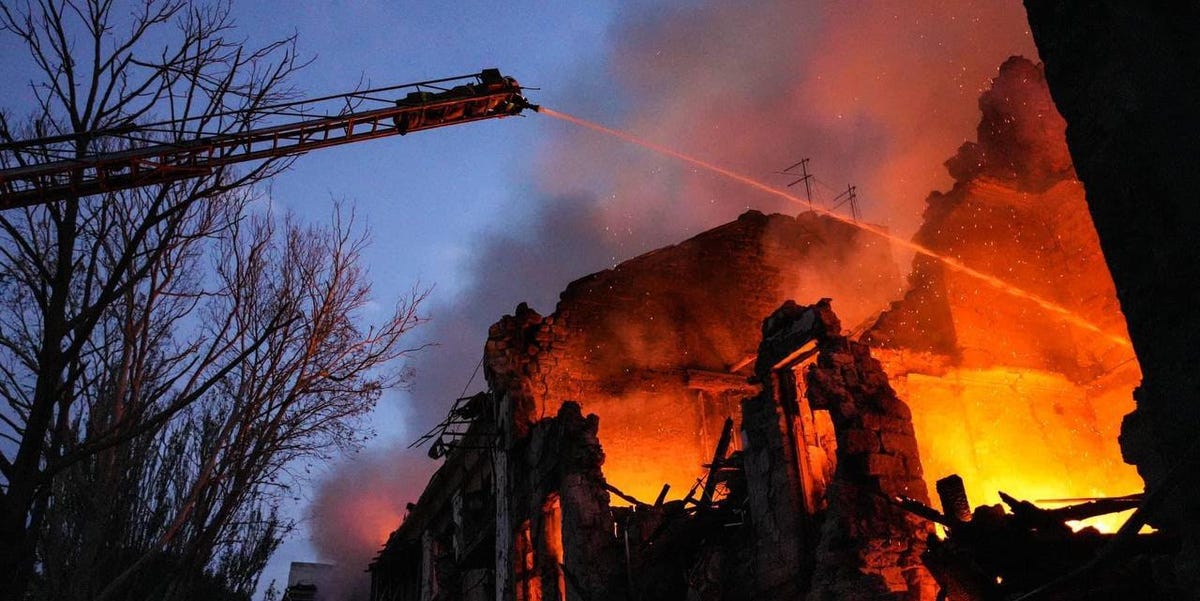

When a missile strike turns a cathedral into a crime scene, the story is no longer only about weapons. It becomes a story about memory, identity, faith, food security, and the strange modern habit of making 19th-century architecture negotiate with 21st-century explosives. Spoiler alert: marble, icons, and stained glass are not great negotiators.
On July 23, 2023, Russian forces launched a heavy overnight attack on Odesa, Ukraine’s Black Sea port city. The strike damaged the historic Transfiguration Cathedral, also known as the Spaso-Preobrazhenskyi Cathedral, in Odesa’s UNESCO-protected historic center. Ukrainian officials said the attack included 19 missiles of several types, including Oniks cruise missiles fired from Russian-controlled Crimea, Kh-22 missiles launched by aircraft, Kalibr sea-launched missiles, and Iskander systems. The phrase “Russia’s ramjet missiles” points especially to the P-800 Oniks, a supersonic anti-ship missile powered in flight by a ramjet engine. But the cathedral story needs one important footnote: Ukrainian and church sources reported that an X-22, also written as Kh-22, struck the cathedral’s altar area directly. In other words, this was not a single-missile mystery novel. It was a mixed Russian barrage with several villains in the cast.
The result was devastating. The cathedral’s central altar was destroyed, parts of the building were damaged down through lower levels, icons and interior features were harmed, and volunteers, clergy, firefighters, and residents rushed to rescue what they could. At least one person was reported killed in the wider Odesa attack, with more than 20 wounded, including children. The building was wounded; the city was shaken; and cultural heritage once again learned that war does not politely knock before entering.
What Happened in Odesa on July 23, 2023?
The attack came in the early hours of Sunday, July 23, after several days of Russian strikes on Odesa and nearby port infrastructure. Ukrainian officials described the barrage as one of the most intense attacks on the city since Russia’s full-scale invasion began in February 2022. Odesa, long known for its port, literature, architecture, humor, courtyards, and seaside swagger, suddenly found itself under another storm of missiles.
Ukraine’s Air Force reported that Russia launched 19 missiles of different types toward Odesa Oblast. The list included five Oniks cruise missiles from the Bastion coastal missile system in Crimea, three Kh-22 air-launched cruise missiles from Tu-22M3 aircraft over the Black Sea, four Kalibr sea-launched cruise missiles, five Iskander-K land-launched cruise missiles, and two Iskander-M ballistic missiles. Ukrainian air defenses reported downing nine of the incoming weapons, including Kalibr and Iskander-K missiles. Several others got through.
One of the worst impacts landed in the heart of the city: the Transfiguration Cathedral. Images from the aftermath showed debris scattered across the nave, damaged religious objects, broken interior surfaces, and workers moving through dust and rubble. The Odesa Diocese of the Ukrainian Orthodox Church condemned the attack, saying the cathedral had no connection to military facilities. That point mattered because the building was not just another structure on a map. It was a spiritual and historical landmark in a densely built urban center.
Why the Transfiguration Cathedral Matters
The Transfiguration Cathedral is not simply “an old church,” the way a violin is not simply “a wooden squeaky box.” Founded in the late 18th century and consecrated in the early 19th century, the cathedral became one of Odesa’s defining religious and architectural landmarks. It stood at the center of a city famous for mixing cultures, languages, trade routes, and artistic traditions.
The cathedral had already lived through destruction once. In 1936, during Joseph Stalin’s Soviet campaign against religion, the original structure was demolished. After Ukraine gained independence, the cathedral was rebuilt, with restoration work taking place around the turn of the 21st century. That history made the 2023 strike feel especially cruel to many Ukrainians: a cathedral destroyed under Stalin, rebuilt under independent Ukraine, and then damaged again during Russia’s war.
In January 2023, Odesa’s historic center was added to UNESCO’s World Heritage List and immediately placed on the List of World Heritage in Danger. That designation recognized both the city’s cultural importance and the risks created by Russia’s invasion. The July strike proved how real those risks were. UNESCO condemned the damage to cultural sites in Odesa, and international attention quickly focused on the cathedral as a symbol of Ukraine’s endangered heritage.
There is also an uncomfortable religious irony. The cathedral belonged to the Ukrainian Orthodox Church historically linked to the Moscow Patriarchate. The rebuilt cathedral had been consecrated in 2010 by Patriarch Kirill of the Russian Orthodox Church, a religious leader later known for supporting Russia’s war. So, yes, a Russian strike badly damaged a cathedral tied to a church tradition historically connected to Moscow. If irony were a building material, Odesa would need a second cleanup crew.
The Missile Details: Ramjet-Powered Oniks and the Mixed Barrage
The headline phrase “ramjet missiles” refers to the P-800 Oniks, also known by NATO as SS-N-26 “Strobile.” The Oniks is a Russian supersonic anti-ship cruise missile designed to threaten naval targets. Unlike a basic rocket that burns fuel and then coasts, the Oniks uses a rocket booster to get moving and then relies on a ramjet engine during flight. A ramjet compresses incoming air at high speed and burns fuel in that airflow, allowing the missile to maintain very fast movement without carrying all the oxidizer a conventional rocket would need.
For readers who do not spend their weekends reading missile manualsand congratulations on having healthier hobbiesthe simple version is this: ramjet-powered missiles are built for speed, range, and difficult interception. Russia adapted weapons designed for ships and military targets into land-attack roles, including attacks around Odesa. This is one reason the July 2023 barrage was so alarming. Odesa was not facing one predictable type of weapon. It was hit by a layered attack using different missiles with different flight profiles.
However, accuracy matters. Ukrainian sources said the cathedral altar was struck by a Kh-22 anti-ship missile, not necessarily by an Oniks. The Oniks missiles were part of the same Russian attack wave against the Odesa region. That distinction does not reduce the seriousness of the strike. It makes the event clearer: Russia used a broad set of high-speed and long-range weapons in an urban region containing civilians, port infrastructure, residential buildings, and protected cultural sites.
Why Odesa Was Under Heavy Attack
The timing of the Odesa attacks was not random. They followed Russia’s withdrawal from the Black Sea Grain Initiative in July 2023. That agreement had helped allow Ukrainian grain exports to move through Black Sea routes despite the war. After leaving the deal, Russia intensified strikes on Odesa and nearby grain and port facilities.
Odesa is not only a beautiful coastal city where architecture seems to have dressed nicely for dinner. It is also a major gateway for Ukrainian agricultural exports. Grain shipments from Ukrainian ports have mattered to global food supply, especially for countries vulnerable to price spikes. When Russia attacked port infrastructure and grain storage, the consequences were not limited to Ukraine. The shock traveled through global markets, humanitarian planning, and dinner tables far from the Black Sea.
That is why the cathedral strike and the grain attacks belong in the same conversation. They show how Russia’s campaign against Odesa combined military pressure, economic coercion, psychological intimidation, and cultural destruction. The missiles did not just damage roofs and walls. They sent a message: ports, churches, neighborhoods, and heritage sites could all be treated as pressure points.
Russia’s Denial and Ukraine’s Response
Russia denied responsibility for the cathedral damage and claimed Ukrainian air defense may have caused it. Ukrainian officials, church representatives, witnesses, and international reporting challenged that claim. The Odesa Diocese said a Russian rocket hit the central altar. Ukrainian President Volodymyr Zelenskyy condemned the attack and promised the cathedral would be restored.
In modern war, missiles are followed by narratives almost as quickly as smoke is followed by sirens. One side launches weapons; then come statements, counterstatements, blame shifting, videos, satellite images, expert analysis, and the internet’s traditional contribution: people arguing confidently after watching three seconds of blurry footage. For readers, the responsible approach is to follow multiple credible sources, compare official claims with physical evidence, and avoid turning uncertainty into a hobby.
In this case, the broader picture is clear. Russia launched a large missile attack on Odesa. The Transfiguration Cathedral was severely damaged during that attack. International organizations and governments condemned the damage to cultural heritage. Italy and UNESCO later moved to support restoration of the cathedral roof. Whatever Moscow claimed, Odesa residents were left sweeping glass and plaster from a sacred space.
Cultural Heritage as a Battlefield
War damages people first. That should never be forgotten. But it also damages the places where people understand who they are. Cathedrals, museums, libraries, theaters, archives, cemeteries, and old streets carry memory. They are the hard drive of a community, except made of stone, wood, paint, paper, and stubborn human affection.
Ukraine’s cultural heritage has been repeatedly threatened during Russia’s invasion. UNESCO and other cultural organizations have tracked damage to hundreds of sites across the country. Odesa’s historic center, Kyiv’s religious landmarks, Lviv’s historic neighborhoods, and many smaller local monuments have all faced danger from missiles, drones, shelling, fire, and neglect caused by war.
The Transfiguration Cathedral became a powerful example because it sits at the intersection of so many meanings. It is religious, architectural, Ukrainian, Orthodox, historically connected to Russian imperial and Soviet history, and located in a city long celebrated for cosmopolitan culture. Damaging such a place does not erase history. It often has the opposite effect: it makes people remember harder.
What Restoration Means After the Strike
Restoring a cathedral is not the same as replacing a broken window in the garage, though both can involve someone saying, “Who is paying for this?” Restoration requires structural assessment, documentation, conservation expertise, funding, careful handling of artifacts, and decisions about what to rebuild exactly as it was and what to preserve as evidence of damage.
After the Odesa strike, volunteers and clergy began the immediate work: clearing rubble, saving icons, protecting surviving objects, and making the building safe enough for specialists. Later, international support followed. Italy and UNESCO signed an agreement to fund restoration work on the cathedral roof, showing that cultural recovery can become a diplomatic act as well as a construction project.
Rebuilding does not undo the strike. It does not bring back lost lives, erase fear, or make the cracked plaster forget what happened. But restoration tells a different story from destruction. It says: this place matters enough to repair. It says the city has not surrendered its memory. It also says that even when missiles arrive with engines screaming, history can answer with scaffolding, brushes, stonework, and patience.
What the Strike Reveals About Modern War
The Odesa cathedral strike reveals three uncomfortable truths about modern conflict.
1. Advanced weapons do not guarantee precise outcomes
Missiles can be fast, expensive, and technologically sophisticated while still causing catastrophic damage in civilian areas. The use of anti-ship missiles and mixed barrages against cities increases the risk to buildings that were never designed to be targets or shields.
2. Infrastructure and identity are often attacked together
Odesa’s port facilities, grain storage, residential buildings, and cathedral were not isolated symbols. Together, they represented Ukraine’s economy, civilian life, and cultural identity. Striking them placed pressure on both the body and spirit of the city.
3. Information battles follow physical attacks
After the cathedral was hit, competing claims appeared immediately. That pattern has become familiar in the Russia-Ukraine war. The public must read carefully, avoid propaganda traps, and rely on evidence-based reporting instead of the loudest online microphone.
Related Experiences and Reflections: Standing With a City After the Shatter
Most people will never stand inside a cathedral moments after a missile strike, and that is a very good thing. But many people know the feeling of entering an old sacred or historic building and lowering their voice without being told. The air feels different. The walls seem to ask for manners. Even tourists who came mainly for photos suddenly walk a little slower, as if the floor itself has requested silence.
That is why the damage to Odesa’s Transfiguration Cathedral feels larger than one building. Anyone who has visited a beloved church, synagogue, mosque, temple, library, museum, or historic town square can understand the emotional logic. These places are not only useful. They are containers of time. A child sees candles. A parent sees a family baptism. A historian sees layers of empire, revolution, independence, and war. A local resident sees the background of ordinary life: errands, weddings, funerals, holidays, and the same old stone steps waiting through every season.
The images from Odesa showed people doing what communities often do after disaster: they picked things up. That sounds small until you think about it. Picking up an icon from broken stone is an act of refusal. Sweeping glass from a church floor is not glamorous; nobody writes action-movie trailers about broom technology. Yet it is one of the most human responses possible. It says, “This is damaged, but it is not abandoned.”
There is also a lesson here for readers far from Ukraine. Cultural heritage is easy to admire when it appears on postcards and travel blogs. It is harder to protect when the news cycle moves on, funding is complicated, and experts need years to restore what a missile can damage in seconds. The Odesa cathedral reminds us that preservation is not a decorative hobby for people who own too many tweed jackets. It is part of how societies defend memory.
The strike also changes how we experience headlines about war. “Missile attack damages cathedral” is a short sentence, almost too short for what it contains. Inside that sentence are firefighters, priests, volunteers, frightened neighbors, broken artwork, international law, military technology, grain markets, and a city trying to wake up after a night it did not choose. Good reporting stretches that sentence back into human scale.
For writers, students, travelers, and everyday readers, the responsible experience is to look beyond the explosion. Ask what the building was before the attack. Ask who used it. Ask what was lost, what was saved, and who is doing the quiet work afterward. The story of Russia’s missile attack on Odesa’s Transfiguration Cathedral is not only about destruction. It is also about documentation, rescue, restoration, and the stubborn decision to keep meaning alive when violence tries to reduce everything to rubble.
Conclusion
Russia’s July 2023 attack on Odesa was a military event, a cultural event, and a global warning wrapped into one terrible night. The barrage included advanced weapons such as ramjet-powered Oniks missiles, along with Kh-22, Kalibr, and Iskander missiles. The Transfiguration Cathedral, one of Odesa’s most important Orthodox landmarks, was severely damaged, with its altar area hit and its interior scarred.
The cathedral’s history made the strike even more painful. Founded in the 18th century, destroyed under Stalin, rebuilt in independent Ukraine, and damaged during Russia’s invasion, it has become a symbol of both vulnerability and resilience. Odesa’s responserescue, cleanup, documentation, and restorationshows that heritage can be injured without being erased.
The details matter because they prevent the story from becoming just another headline. This was not only about missiles. It was about a city, a sacred place, a threatened port, a broken grain deal, and the ongoing battle over Ukraine’s future and memory. In the end, the shattered cathedral stands as evidence of destruction, but also as a promise: what is broken can be rebuilt, and what is remembered can resist being buried.