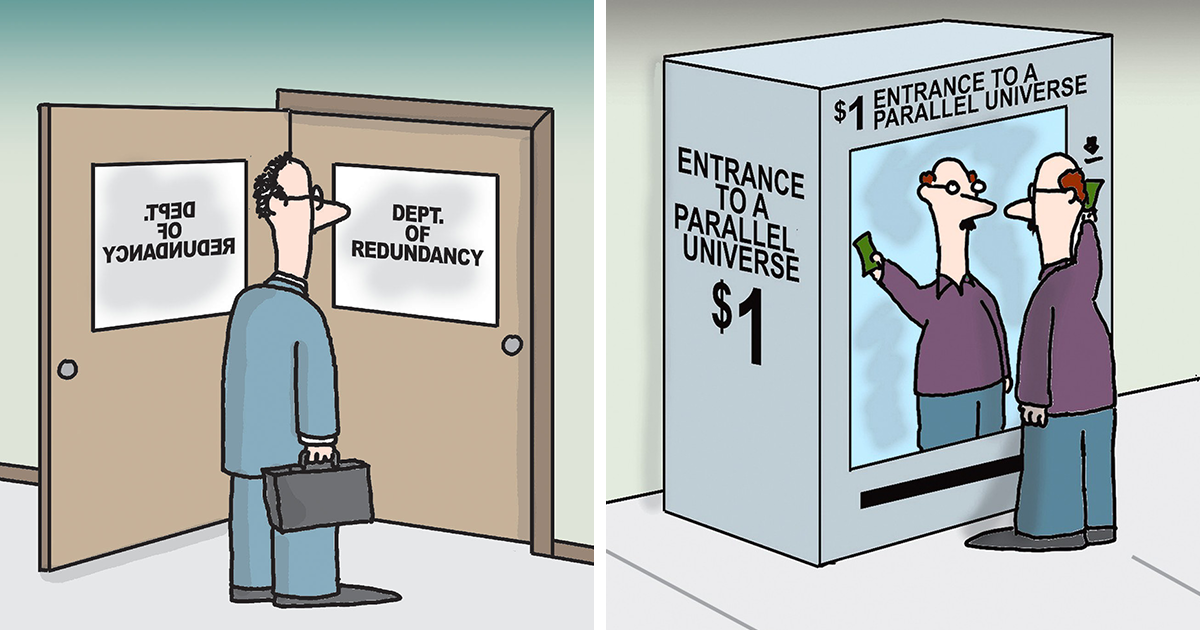

If your sense of humor wears sunglasses indoors, laughs at awkward silence, and thinks a talking toaster having an existential crisis is perfectly reasonable entertainment, Dave Blazek’s Loose Parts may be your natural habitat. The long-running single-panel comic has built a loyal audience by doing something deceptively difficult: taking ordinary situations, twisting them sideways, and letting the punchline walk in wearing a lab coat, a chicken suit, or the emotional expression of a tax auditor.
The title “30 Comics By Dave Blazek For Those With A Darker Sense Of Humor” sounds like a warning label, but it is really an invitation. These are not “dark” in the heavy, gloomy sense. They are dark in the way a perfectly normal sentence becomes suspicious when a cow says it. Blazek’s humor lives in the land of the absurd, the deadpan, the unexpectedly philosophical, and the slightly wrong. It is clever without becoming smug, strange without becoming confusing, and silly enough to keep the whole thing from needing a permission slip.
Dave Blazek is best known as the creator of Loose Parts, a syndicated single-panel comic that debuted in 1998 and has continued to entertain readers with its sharp, oddball perspective. The strip is associated with strange characters, talking animals, visual puns, and punchlines that often arrive from the opposite direction of where your brain was politely waiting. That is the fun. Your expectations line up neatly; then Blazek kicks the chair out from under them.
Why Dave Blazek’s Comics Work So Well
Great one-panel comics are tiny machines. They have almost no room to waste. A cartoonist gets one image, a few words, and one chance to make your brain perform a gymnastic trick. Blazek’s Loose Parts succeeds because it understands timing, economy, and surprise. The drawing gets you comfortable. The caption or dialogue then quietly opens a trapdoor.
Many cartoonists build jokes around exaggeration. Blazek often builds them around displacement. A serious concept shows up in a ridiculous place. A ridiculous character behaves with perfect seriousness. A barnyard animal discusses office politics. A mythological creature has a customer-service problem. A scientist treats nonsense as if it belongs in a peer-reviewed journal. That contrast gives the comic its spark.
His darker humor usually comes from recognition. Readers laugh because the joke points at something familiar: bureaucracy, aging, vanity, anxiety, bad communication, social performance, workplace absurdity, or the weird little humiliations of being alive. Then the comic wraps that truth in a costume so absurd that it becomes safe to laugh at. This is why Loose Parts can feel both silly and surprisingly accurate.
The Beauty of the Single-Panel Setup
Unlike a traditional comic strip, a single-panel cartoon has no runway. There is no first panel for setup, second panel for escalation, and third panel for payoff. Everything must happen at once. The scene and the joke must share the same square of real estate. Blazek uses that limitation as a strength.
A good Loose Parts panel often feels like you have walked into the middle of a conversation you were not supposed to hear. The characters are already committed to the absurdity. Nobody turns to the reader to explain why a fish is discussing career planning or why a grim reaper figure has the energy of a tired office manager. The comic trusts you to catch up. That trust makes the joke sharper.
This is also why Dave Blazek comics are so re-readable. The first laugh comes from the punchline. The second laugh often comes from noticing the background detail, the facial expression, or the way the situation becomes even stranger the longer you stare at it. The best panels do not simply deliver a joke; they leave a small comedic stain on your brain. In a good way. Mostly.
What “Darker Sense of Humor” Really Means Here
Dark humor does not always mean cruelty. In Blazek’s world, it usually means comic honesty with a crooked smile. The jokes may brush against mortality, failure, loneliness, fear, stupidity, or the fact that humans are basically nervous mammals wearing pants. But the tone is rarely mean-spirited. Instead, the humor suggests that life is weird, people are stranger than they admit, and the universe has the comedic timing of a raccoon stealing a sandwich.
For readers with a darker sense of humor, the appeal is clear. These comics do not insist that everything is cheerful. They do not decorate reality with glitter and motivational stickers. They say, “Yes, existence is absurd. Now watch this duck make it worse.” That kind of joke can be oddly comforting. It turns discomfort into a punchline without pretending the discomfort never existed.
30 Reasons These Dave Blazek Comics Hit the Funny Bone
1. They Treat Absurdity Like Normal Business
One of the most enjoyable things about Loose Parts is how calmly everyone behaves inside completely ridiculous circumstances. The stranger the setup, the more ordinary the dialogue often becomes. That deadpan confidence makes the joke land harder.
2. Animals Are Never Just Animals
In Blazek’s comic universe, animals often function like tiny furry philosophers, office workers, customers, critics, or confused relatives. They reflect human behavior back at us, only with better ears.
3. The Jokes Reward Smart Readers
The humor is accessible, but it rarely feels lazy. Many panels ask the reader to make a small mental leap. That little click of understanding is part of the pleasure.
4. The Darkness Is Playful, Not Miserable
Even when a joke leans into gloom, fear, or failure, it keeps a bounce in its step. The result is dark comedy with a rubber chicken hidden in its jacket.
5. Workplace Humor Gets Weird Fast
Offices are already strange little ecosystems. Add Blazek’s imagination, and suddenly meetings, resumes, management language, and professional etiquette become playgrounds for absurdity.
6. The Panels Love Miscommunication
Many jokes rely on characters misunderstanding each other in ways that feel both impossible and deeply human. Anyone who has ever survived a family dinner or a staff meeting will understand.
7. The Visual Style Supports the Joke
The art does not fight for attention. It guides the eye, sets the mood, and lets the punchline breathe. In one-panel comedy, clarity is not boring; it is essential.
8. The Humor Feels Slightly Unhinged
There is a wonderful “wait, what?” quality to many Loose Parts comics. The joke makes sense, but only after your brain agrees to loosen its tie.
9. Blazek Finds Comedy in Everyday Anxiety
Fear of failure, fear of embarrassment, fear of being misunderstoodthese are ordinary human themes. Blazek makes them ridiculous enough to laugh at.
10. The Punchlines Often Arrive Sideways
The best jokes are not always the loudest. Sometimes they are the ones that sneak in through the window, sit at your breakfast table, and ask why you look surprised.
11. It Has Newspaper Comic DNA
Loose Parts has the discipline of classic newspaper cartooning: quick setup, clean delivery, broad readability, and a joke that works in seconds.
12. It Also Feels Modern
The themesabsurd systems, social awkwardness, identity, productivity, and cultural weirdnessfeel right at home in today’s internet-shaped attention span.
13. It Makes Smart Use of Silence
Some comics are funny because of what is said. Others are funny because of the expression after it is said. Blazek understands both.
14. The Humor Is Compact
No long explanation. No comedy traffic jam. Just a scene, a twist, and a laugh that sometimes arrives one second after you think you are done reading.
15. The Characters Look Like They Believe the Nonsense
The best absurd comedy depends on commitment. In Loose Parts, the characters rarely seem aware they are in a joke. That is exactly why they are funny.
16. It Plays With Language
Puns, literal interpretations, idioms, and unexpected word choices often become the engine of the joke. Language itself becomes a banana peel.
17. It Has a Taste for the Morbidly Silly
Death, danger, and disaster can appear, but usually through a filter of cartoon logic. The result is a wink, not a wallop.
18. It Understands Human Vanity
People want to look smart, important, attractive, and in control. Blazek’s comics enjoy gently removing that costume and revealing the confused mammal underneath.
19. It Makes the Ordinary Suspicious
A kitchen, a doctor’s office, a classroom, or a sidewalk can become strange with one perfectly placed line. Suddenly, normal life looks guilty.
20. It Has a Strong “Far Side Neighbor” Energy
Fans of surreal single-panel cartoons often appreciate Loose Parts because it shares that love of animals, science jokes, strange premises, and reality bending just enough to squeak.
21. It Lets the Reader Feel Clever
A great comic does not over-explain. Blazek often leaves just enough space for the reader to connect the final wire. That makes the laugh more satisfying.
22. The Humor Ages Well
Because the jokes often focus on human behavior rather than short-lived trends, many panels remain funny long after the day they were published.
23. It Turns Logic Against Itself
A lot of Loose Parts humor begins with a logical idea and then follows it to an illogical conclusion. That is where the comedy catches fire.
24. It Is Strange Without Being Random
Randomness alone is not comedy. Blazek’s panels usually have structure beneath the weirdness. The joke may be absurd, but it is not accidental.
25. It Makes Small Things Feel Dramatic
A minor inconvenience can become an epic crisis. A tiny misunderstanding can become a philosophical event. That scale mismatch is comedy gold.
26. It Is Perfect for Quick Reading
These comics work beautifully in short bursts. You can read one with coffee, another while pretending not to check your phone, and another while avoiding a task with the elegance of a professional procrastinator.
27. It Has a Strong Voice
You can often recognize the Blazek style: sharp, odd, compact, and quietly mischievous. A strong comic voice makes even a tiny panel feel like a complete world.
28. It Respects the Reader’s Weirdness
Some comics try to be universally pleasant. Loose Parts seems to wink at people who enjoy the stranger corner of the buffet.
29. It Turns Darkness Into Distance
By filtering uncomfortable ideas through absurd scenarios, the comic creates emotional distance. You laugh because the scary thing has been made ridiculous.
30. It Is Simply Funny
Analysis is useful, but at the end of the day, the joke either works or it does not. Dave Blazek’s best comics work because they surprise, amuse, and linger.
Why Readers Keep Coming Back to Loose Parts
There is a specific joy in opening a comic and having no idea where it will go. With many gag panels, the basic rhythm becomes predictable after a while. Loose Parts stays lively because it can jump from animals to office life, from medical absurdity to social satire, from literal wordplay to full-on cartoon logic. The variety keeps readers alert.
That unpredictability is especially important for people who enjoy darker humor. A darker comic sensibility usually dislikes obvious punchlines. It wants irony. It wants tension. It wants the joke to reveal something faintly uncomfortable about life, then let everyone laugh before the lights flicker. Blazek’s work often delivers exactly that balance.
The strip also benefits from its single-panel format in the digital age. A strong panel can travel easily across websites, social media feeds, newsletters, and group chats. It asks for only a few seconds, but it can stay with readers all day. That is efficient comedy. If laughter had a productivity dashboard, Loose Parts would be dangerously well-optimized.
Experiences Related to Reading 30 Dave Blazek Comics With a Darker Sense of Humor
Reading a batch of 30 Dave Blazek comics is a different experience from reading one panel in isolation. One comic is a quick laugh. Thirty comics become a tour through a particular comic intelligence. You start to notice the patterns: the deadpan tone, the love of visual contradiction, the way animals and people seem equally confused by existence, and the quiet confidence with which ridiculous ideas are presented as if they were completely normal.
The first experience is usually surprise. A panel begins with something familiar, maybe a domestic situation, a public place, or a professional setting. Then the joke adds one impossible element, and the whole scene changes. The reader’s brain has to adjust quickly. That adjustment is the laugh. It feels like stepping onto what you thought was solid ground and discovering it is actually a trampoline.
The second experience is recognition. Even when the characters are not human, the behavior often is. A bird might act insecure. A monster might sound like middle management. A skeleton might have better timing than your uncle at Thanksgiving. Behind the absurdity, the comic is usually pointing at recognizable habits: overthinking, pretending to know what we are doing, making systems more complicated than they need to be, or using impressive language to hide very ordinary foolishness.
The third experience is a kind of permission. Darker humor gives readers permission to laugh at things that are usually annoying, embarrassing, or uncomfortable. Not in a cruel way, but in a relieving way. Life contains awkward conversations, strange fears, bad decisions, and moments when everyone involved should probably stop talking. Blazek’s comics take that emotional clutter and compress it into one clean joke. The result feels like opening a window in a room full of weirdness.
Reading 30 of these comics can also remind you how much craft hides inside a “simple” cartoon. It is easy to underestimate a single panel because it looks quick. But the best panels are built with precision. The setup must be clear immediately. The drawing must not confuse the joke. The wording must be short enough to land but specific enough to sparkle. The punchline must surprise without feeling random. That is a narrow bridge, and Blazek crosses it with the relaxed confidence of someone who has been doing this for decades.
Another enjoyable part of the experience is sharing the comics with other people. Darker, absurd humor often reveals personality. One person laughs hardest at the animal jokes. Another loves the bleak little observations about work. Someone else enjoys the wordplay. And there is always one person who stares silently for five seconds, then laughs too loudly because the joke finally detonated. That delayed reaction is one of the great pleasures of smart comics.
There is also a comforting rhythm to the collection. A group of 30 comics gives you variety without exhaustion. You can move from one strange premise to another, almost like flipping through tiny windows into alternate realities. None of them demands too much time, yet each offers a complete comic moment. In a world where entertainment often arrives as a three-hour streaming commitment, a sharp one-panel joke feels refreshingly humane.
Most importantly, the experience proves that dark humor does not have to be harsh. It can be warm, clever, odd, and deeply silly. It can look at the absurdity of life and respond not with despair, but with a raised eyebrow and a punchline. That is why Dave Blazek’s Loose Parts continues to connect with readers who like their comedy a little bent, a little brainy, and just suspicious enough to make the furniture nervous.
Conclusion: A Little Dark, A Lot Clever
30 Comics By Dave Blazek For Those With A Darker Sense Of Humor is more than a collection idea; it is a perfect description of why Loose Parts has remained so appealing. Dave Blazek’s comics understand that humor does not need to be loud to be powerful. Sometimes the funniest joke is the one delivered with a straight face by a character who should not exist, in a situation that should not happen, saying something that somehow makes perfect sense.
For fans of absurd comics, single-panel cartoons, newspaper humor, clever wordplay, and darker comedy that still feels playful, Blazek’s work offers a satisfying mix. It is weird, witty, compact, and surprisingly human. The world of Loose Parts may be full of talking animals, impossible logic, and deeply questionable decisions, but that is exactly why it feels so familiar. After all, real life is also full of impossible logic and deeply questionable decisions. It just has fewer cows with punchlines.
Note: This article is written as original SEO content based on publicly available factual information about Dave Blazek and Loose Parts. It does not reproduce copyrighted comic panels or captions.