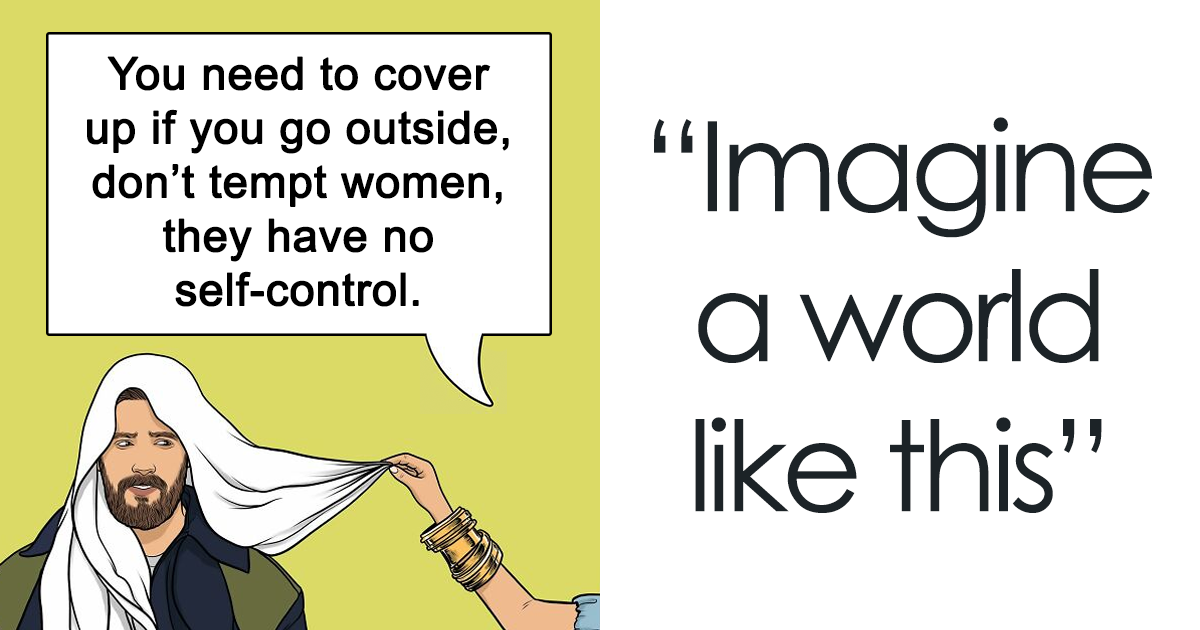

Everyday sexism is sneaky. It does not always arrive wearing a villain cape, twirling a mustache, and announcing, “Hello, I am here to ruin equality before lunch.” More often, it shows up as a raised eyebrow, a “joke,” a double standard, a dress-code comment, a workplace assumption, or a casual piece of advice that nobody asked for. That is exactly why artist Lainey Molnar’s gender-role reversal series, Imagine a World Like This, hits so hard.
In the series, Molnar places men in situations that women are often expected to accept as normal. The result is sharp, funny in a “wait, why are we laughing and wincing at the same time?” way, and surprisingly difficult to dismiss. By switching the genders, the illustrations expose how absurd many social expectations look when they are no longer aimed at women.
The title “Artist Points Out Everyday Sexism By Placing Men In The Shoes Of Women (8 Pics)” may sound like a light internet gallery, but the message underneath is anything but light. These images are not just clever role-reversal jokes. They are tiny social experiments. They ask one question over and over: Would this still seem normal if it happened to men?
Who Is Lainey Molnar?
Lainey Molnar is a Hungarian-born, Amsterdam-based illustrator known for creating bold, relatable comics about womanhood, feminism, relationships, body image, social pressure, and gender double standards. She began sharing personal experiences through art around the time of the 2020 lockdown, and her work quickly grew into a global conversation about how women are treated in public, private, professional, and romantic spaces.
Her style is simple but direct. She does not bury the message under layers of complicated symbolism. Instead, she draws recognizable people in recognizable situations. A viewer does not need an art history degree, a museum audio guide, or a tiny glass of gallery wine to understand what is going on. The point lands fast.
That accessibility is part of her power. Molnar’s illustrations feel like a friend saying, “You know that thing that keeps happening but everyone tells you is not a big deal? Yes. It is a big deal.” Her comics often turn private frustration into public language, and that is why so many people see themselves in her work.
What Makes “Imagine a World Like This” So Effective?
The genius of the series is not that it invents bizarre new scenarios. It is that it flips familiar ones. Women are often told to smile more, dress differently, avoid seeming too ambitious, be careful at night, tolerate inappropriate remarks, carry the emotional weight of relationships, and still somehow remain cheerful enough to qualify as “pleasant.” Molnar reverses those expectations and places men inside them.
Suddenly, the logic looks ridiculous. A man being judged for what he wears, blamed for attracting attention, treated as naturally responsible for housework, or shamed for aging does not read as “normal.” It reads as intrusive, unfair, and exhausting. And that is the point. When the same behavior looks absurd after a gender swap, the problem was never the person receiving it. The problem was the rule.
Everyday Sexism: The Small Stuff That Is Not Actually Small
Everyday sexism refers to ordinary interactions, assumptions, jokes, policies, and social habits that reinforce unequal treatment between genders. It can be obvious, but it can also be quiet. Sometimes it hides inside compliments. Sometimes it dresses up as “tradition.” Sometimes it enters a room as “just common sense,” which is usually when we should check its pockets.
Common examples include assuming a woman will take meeting notes, expecting mothers to be less committed at work while praising fathers for “helping,” commenting on women’s bodies in professional settings, treating assertive women as aggressive, or questioning women’s safety choices instead of questioning the behavior that makes those choices necessary.
Molnar’s illustrations work because they turn these familiar moments into a mirror. The viewer is invited to notice not only what is happening in the picture, but also their own reaction to it. If a man being treated that way looks unfair, then perhaps women have been asked to swallow unfairness with a smile for far too long.
The Power of Reversal in Feminist Art
Role reversal has long been used in feminist art, satire, film, and social commentary because it interrupts automatic thinking. People often defend old norms simply because they have seen them repeated for years. Reversal breaks the pattern. It takes a familiar situation and makes it unfamiliar enough to examine.
That is why Molnar’s work does not need a long lecture to make its point. The images do the arguing. They create a quick emotional jolt: confusion, laughter, discomfort, recognition. In that order, usually. The humor opens the door, and the discomfort walks in carrying receipts.
For many viewers, the series is not about “men versus women.” It is about systems of expectation. Men can also be harmed by rigid gender norms, especially when they are told not to be vulnerable, nurturing, cautious, emotional, or dependent. But Molnar’s specific focus is the burden placed on women: the constant monitoring, judging, doubting, blaming, and correcting that can follow women through daily life like a pop-up ad nobody can close.
Why the “8 Pics” Format Works So Well Online
Digital culture loves quick visuals. People scroll fast, skim faster, and sometimes treat reading a full paragraph like they are being asked to assemble furniture without instructions. An eight-image series fits perfectly into that environment. It is short enough to consume quickly but strong enough to stay in the mind afterward.
Each illustration acts like a standalone argument. One picture might highlight clothing double standards. Another may address domestic expectations. Another may point to the way sexuality is judged differently depending on gender. Together, the series becomes a compact gallery of gender bias, showing how sexism is not one isolated problem but a pattern across many parts of life.
The format also encourages sharing. People tag friends, start discussions, argue in comment sections, and say, “This happened to me.” That response is important because everyday sexism often survives through isolation. When people realize their experiences are not random or personal failures, the conversation changes.
Specific Double Standards the Series Brings Into Focus
1. Clothing and Respectability
Women are frequently judged by what they wear. Too short, too tight, too plain, too revealing, too modest, too old-fashioned, too attention-seeking, too boring. Somehow, the outfit is always on trial. Molnar’s gender swap exposes how strange it is to make a person’s clothing responsible for other people’s behavior.
2. Body Image and Aging
Women are often expected to age naturally, but not visibly; stay youthful, but not try too hard; be fit, but not vain; be attractive, but not aware of it. This is not a beauty standard. It is a circus act with bad lighting. By putting men into similar judgment zones, the series shows how exhausting constant appearance policing can be.
3. Household Labor
Even in modern families, women are often expected to manage the invisible work: remembering birthdays, planning meals, tracking school forms, scheduling appointments, noticing when the shampoo is nearly empty, and somehow knowing where everyone’s socks have migrated. When men are drawn as the ones automatically responsible for domestic order, the imbalance becomes easier to spot.
4. Career Ambition
An ambitious man is often seen as focused. An ambitious woman may be called cold, bossy, difficult, selfish, or “a lot.” That last phrase deserves retirement and maybe a quiet cabin in the woods. Molnar’s work challenges the idea that confidence becomes threatening when it belongs to a woman.
5. Sexual Double Standards
Women are often judged more harshly for sexual choices, dating history, desire, or even rumors about desire. The same behavior that may be framed as normal or admirable for men can become shameful when attached to women. Gender reversal makes that hypocrisy especially visible because the unfairness is almost comically obvious.
6. Safety and Blame
Women are regularly taught to modify their lives around potential danger: do not walk alone, do not wear that, do not drink too much, text when you get home, hold your keys, watch your surroundings. Safety advice can be practical, but it becomes unfair when it shifts responsibility away from harmful behavior and onto the people trying to avoid it.
Why Some People React Defensively
Art about sexism often receives a predictable response: “Why are you so negative?” “Not all men.” “Can’t anyone take a joke?” “This is exaggerated.” “I have never seen this happen.” These reactions are common because the work asks people to notice patterns they may benefit from, ignore, or simply never experience.
But discomfort is not the same as unfairness. In fact, discomfort can be useful. It may signal that an old assumption is being challenged. Molnar’s illustrations do not accuse every individual man of behaving badly. They point to cultural scripts that many people absorb without realizing it. The point is not guilt for sport. The point is awareness that leads to better behavior.
Everyday Sexism in the Workplace
The workplace remains one of the clearest places where everyday sexism shows up. Women may be interrupted more often, assigned support tasks that do not lead to promotion, judged more harshly for tone, or expected to be warm and competent at the same time. That combination can feel like being asked to run a marathon while holding a tray of cupcakes and maintaining a “positive attitude.”
U.S. research continues to show gender gaps in pay, promotion, and workplace experience. Women make up a major share of the labor force, yet they still face barriers in leadership, sponsorship, pay equity, and career advancement. Reports on corporate America have also noted that women often receive less career support and fewer opportunities to rise, even when they are just as committed to their work as men.
This is where Molnar’s visual approach becomes especially relevant. A chart can show inequality, but an illustration can make people feel the absurdity of it. Both matter. Data explains the scale of the problem; art explains why the problem feels personal.
The Emotional Labor Nobody Applauds
One of the most relatable themes connected to everyday sexism is emotional labor. Women are often expected to smooth tension, remember feelings, organize social life, soften criticism, comfort others, and communicate gently even when they are exhausted. If a woman is upset, she may be called dramatic. If she is calm, she may be called cold. If she is direct, she may be called rude. Apparently, the acceptable emotional setting is “pleasant decorative lamp.”
Molnar’s work helps name this pressure. By showing men placed under similar expectations, she makes the invisible visible. That matters because people cannot fairly divide labor they refuse to recognize.
Why Humor Helps the Message Travel
Humor is one of the reasons the series travels so well online. A serious topic becomes easier to approach when the first reaction is a laugh. But the humor is not there to soften the issue into harmless entertainment. It is there to lower defenses long enough for the truth to land.
The best social satire works like a banana peel placed in front of a bad idea. The idea slips, falls, and suddenly everyone can see how silly it looked standing there. Molnar’s illustrations do that with sexist assumptions. They do not shout. They flip the scene and let the hypocrisy trip over itself.
What Men Can Learn From These Illustrations
For male viewers, the series offers an opportunity to practice empathy without making themselves the center of the story. The useful question is not, “Would I personally do this?” The better question is, “Have I noticed this happening, and what do I do when I see it?”
Men can help by listening without immediately debating, sharing domestic and emotional labor fairly, challenging sexist jokes, crediting women’s ideas at work, respecting boundaries, and noticing when women are being held to standards that men are not. None of these require a superhero cape. In fact, please do not wear one to the office unless it is a very casual Friday.
What Women Often Recognize Immediately
Many women recognize the situations in Molnar’s work instantly because they have lived versions of them. They know what it feels like to calculate safety before leaving a building, to dress for the weather and then worry about being judged, to have expertise questioned, to be told to smile, to be labeled difficult for setting a boundary, or to carry the invisible checklist that keeps homes and relationships functioning.
That recognition can be validating. It tells viewers, “You are not imagining it.” Sometimes that sentence alone is powerful. Everyday sexism often works by making people feel overly sensitive for noticing it. Art can interrupt that by turning individual experiences into shared evidence.
Experiences Related to the Topic: Why These Pictures Feel So Familiar
One reason “Artist Points Out Everyday Sexism By Placing Men In The Shoes Of Women (8 Pics)” resonates is that the situations feel less like fiction and more like someone has been quietly taking notes from everyday life. Many people have seen a woman at work suggest an idea, receive silence, and then watch a man repeat the same idea five minutes later to applause. The room does not always notice. The woman does. The coffee machine probably does too, and it has seen things.
Another familiar experience is the public safety routine many women learn early. Before going out, they think about shoes they can walk quickly in, whether the route is well lit, whether their phone is charged, whether a friend knows where they are, and how to exit a conversation without angering someone. These calculations are so common that they become background noise. Molnar’s gender reversal makes that background noise loud enough for everyone else to hear.
There is also the strange social theater of appearance. A woman may be told she looks tired when she skips makeup, vain when she wears too much, brave when she gains weight, suspicious when she loses it, youthful when she hides aging, and desperate when she tries to look youthful. The rules contradict each other so often that the only winning move is to stop letting the game define your worth. Molnar’s drawings capture that contradiction by making it visible from the outside.
In family settings, everyday sexism often appears as “natural” responsibility. A mother may be expected to know the pediatrician’s number, the teacher’s name, the snack preference, the birthday schedule, the laundry status, and the emotional weather report of every person in the house. A father who remembers one appointment may be praised like he has successfully landed a spacecraft. This is not because men cannot care. It is because society often trains everyone to treat women’s care as automatic and men’s care as exceptional.
In dating, the double standards can be equally tiring. Women are told to be attractive but not intimidating, interested but not eager, independent but not unavailable, selective but not “picky,” fun but not careless, confident but not too confident. That is not romance; that is a password-protected obstacle course. When a man is drawn under those same rules, the absurdity becomes easier to laugh atand harder to defend.
Perhaps the most meaningful experience connected to Molnar’s series is the moment of recognition shared between viewers. Someone sees an illustration, sends it to a friend, and says, “This.” No essay. No explanation. Just “this.” That tiny exchange matters because it transforms private frustration into public understanding. The pictures become conversation starters at kitchen tables, in group chats, in classrooms, and sometimes in uncomfortable workplace discussions that should have happened years earlier.
That is the lasting strength of the series. It does not claim that every woman has the same life or that every man is free from hardship. Instead, it shows how gendered expectations shape ordinary experiences in ways people often overlook. By placing men in women’s shoes, Molnar does more than reverse roles. She asks viewers to walk around in the logic of sexism until the shoes start to pinch.
Conclusion: A Mirror With a Sense of Humor
Lainey Molnar’s Imagine a World Like This series succeeds because it makes everyday sexism impossible to shrug off. By placing men in situations commonly faced by women, the illustrations reveal how many “normal” expectations are actually unfair, invasive, or absurd. The images are simple, but their message is layered: gender bias is not always dramatic, but it is persistent; it is not always intentional, but it is still harmful; and it does not disappear just because someone says, “Relax, it was a joke.”
The series also reminds us that awareness is only the first step. The next step is changing the habits, policies, comments, assumptions, and social scripts that keep these double standards alive. That work belongs to everyone. Women should not have to explain sexism forever, and men should not have to experience a role-reversal cartoon before believing it exists. But if a cartoon opens the door, let the conversation walk in.
Note: This article is written as original web content and synthesizes publicly available information about Lainey Molnar’s gender-role reversal illustrations, everyday sexism, gender stereotypes, workplace bias, and common social double standards. No source links are inserted, as requested.