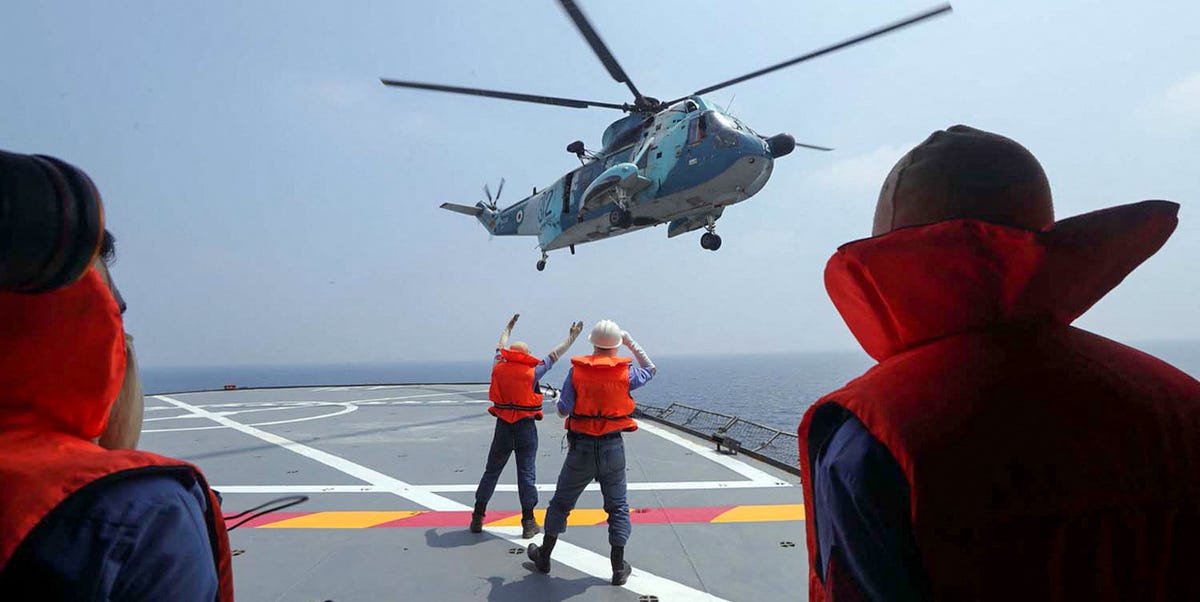

Iran has never been known for building glossy, nuclear-powered aircraft carriers with coffee shops, catapults, and a price tag large enough to make a finance minister faint. Instead, Tehran is doing what it often does in military technology: taking something ordinary, stretching it beyond its original job description, and turning it into a tool of asymmetric warfare. In this case, the ordinary thing is a cargo ship. The new job description? A floating base for drones, helicopters, missiles, commandos, and maritime surveillance.
The idea sounds almost like a garage project that wandered into a shipyard: remove enough commercial hardware, add a flight deck, install military communications, park drones on top, and present the finished product as a naval power-projection platform. Yet behind the odd appearance of Iran’s converted cargo ships is a serious strategic calculation. Iran is trying to extend its reach beyond the Persian Gulf without building a traditional blue-water navy. It wants platforms that are cheaper than aircraft carriers, more flexible than small patrol craft, and useful for the drone-heavy style of conflict that has reshaped modern warfare.
These ships are not aircraft carriers in the American sense. Nobody should mistake the Shahid Bagheri or Shahid Mahdavi for the USS Gerald R. Ford. Iran’s converted ships do not launch manned fighter jets, dominate oceans, or carry an air wing capable of sustained high-tempo operations. But they do not need to. Their value is different. They are floating launch pads, intelligence hubs, intimidation tools, and symbols of a navy learning to combine commercial hulls with drones, missiles, and propaganda. In other words, they are awkward-looking ships with a surprisingly clear purpose.
Why Iran Wants Cargo-Ship Aircraft Carriers
The simplest answer is cost. Building a real aircraft carrier requires advanced shipbuilding capacity, naval aviation expertise, massive budgets, trained crews, escorts, maintenance yards, and decades of institutional experience. Iran lacks most of those ingredients. What it does have is experience modifying commercial vessels, a growing domestic drone industry, a large missile arsenal, and a strategic need to threaten adversaries at sea without matching them ship for ship.
Iran’s military strategy has long leaned on asymmetric methods. Instead of trying to defeat the U.S. Navy in a classic fleet battle, Iran invests in mines, fast attack craft, anti-ship missiles, armed drones, small boats, coastal launchers, and proxy networks. Converted cargo ships fit neatly into that playbook. They give Iran mobile sea bases that can support drones and helicopters, carry missiles, host special forces, and operate farther from Iranian shores than the small boats that have traditionally defined the Islamic Revolutionary Guard Corps Navy.
This matters because geography gives Iran both opportunity and anxiety. The Strait of Hormuz is one of the world’s most important energy chokepoints. The Gulf of Oman, the Arabian Sea, the Red Sea, and the Indian Ocean all connect to areas where Iran wants influence. A converted merchant ship can linger, observe, launch drones, support small craft, and complicate the calculations of better-equipped navies. It may not win a war by itself, but it can make a crisis messier, and in geopolitics, “messier” is often a feature, not a bug.
The Shahid Bagheri: From Container Ship to Drone Carrier
The most eye-catching example is the Shahid Bagheri, a former container ship converted into what Iranian media has called a drone-carrier warship. Open-source imagery showed major modifications, including an angled flight deck and ski-jump-style ramp. The ship was eventually unveiled as a platform intended to carry drones, helicopters, and cruise missiles. Iran claimed it could operate far from home waters and travel long distances without refueling, presenting it as a symbol of deterrence and self-reliance.
The design is visually strange because it is a compromise. A container ship was never meant to be an aircraft carrier. Its superstructure, stability profile, internal layout, and deck arrangement were built around cargo, not aircraft operations. So Iran’s engineers had to work around the original hull. The result looks less like a polished naval aviation platform and more like someone grafted a runway onto a commercial ship and told physics to be polite.
Still, the Shahid Bagheri shows real ambition. A long deck can support unmanned aircraft operations more easily than manned fighter operations. Drones need less runway, less life-support infrastructure, and less risk tolerance than piloted aircraft. A ship that cannot support F/A-18s or F-35Cs may still be useful for reconnaissance drones, loitering munitions, vertical takeoff drones, and light helicopter missions. For Iran, that is enough to create a floating node in a wider surveillance-and-strike network.
The Shahid Mahdavi and Iran’s Floating Base Concept
The Shahid Mahdavi is another important part of the story. This converted merchant vessel has been described as an expeditionary sea base or multipurpose support ship. It has reportedly carried helicopters, drones, missiles, radars, and small craft. In 2024, Iranian sources publicized ballistic missile launches from the vessel, a move designed to send a strategic message: Iran wants adversaries to believe its missiles can come not only from land, but also from mobile platforms at sea.
That does not mean every claim should be swallowed whole. Iranian military announcements often mix real capability, selective demonstration, and theatrical messaging. But the broader trend is visible. Iran is experimenting with ways to turn large commercial hulls into floating military utility platforms. Some may support drones. Others may serve as intelligence ships, command posts, missile launch platforms, or motherships for small boats. Together, they expand Iran’s menu of options.
The older Shahid Roudaki pointed in the same direction. It was introduced as an intelligence and support ship for the IRGC Navy, with deck space for drones, small boats, helicopters, and missile systems. It was not a graceful warship, but it represented a shift: the IRGC, historically strongest in coastal and littoral warfare, wanted vessels that could travel farther and stay on station longer. The Shahid Bagheri and Shahid Mahdavi are more ambitious descendants of that idea.
What These Ships Can Actually Do
The biggest mistake is to ask whether Iran’s converted cargo ships can compete with U.S. aircraft carriers. They cannot. The better question is what problems they can create in a regional crisis. The answer is: quite a few, especially if they are used as part of a larger network.
1. Launch and Recover Drones
Drones are the main reason these conversions make sense. Iran has invested heavily in unmanned systems, including reconnaissance drones, attack drones, and one-way strike drones. A sea-based platform can extend the range of those systems, position them closer to targets, and make launch points harder to predict. Even if the drones are not highly advanced, they can provide surveillance, targeting data, harassment, and saturation pressure.
2. Support Helicopters and Small Craft
Deck space allows helicopters to land, refuel, or operate in limited roles. The ships can also support small boats, commandos, and boarding teams. That matters in the kind of gray-zone maritime operations Iran has often used: harassment, seizures, surveillance, and pressure against commercial shipping. A floating base gives small units more endurance and reach.
3. Carry Missiles and Sensors
Large cargo-derived hulls have room for radars, communications gear, missile launchers, and electronic intelligence equipment. The ship itself may be vulnerable, but it can contribute to a wider targeting network. If paired with coastal radars, drones, satellites, or other ships, it becomes one more node in Iran’s attempt to watch, track, and threaten movement through key waters.
4. Serve as Strategic Theater
These ships are also floating billboards. When Iran unveils a drone carrier, sails it into distant waters, or shows missiles launching from deck containers, the audience is not only military planners. It is domestic viewers, regional rivals, proxy groups, oil markets, and foreign governments. The message is: “We may be sanctioned, but we can still improvise.” For a regime that values symbolism, that message is not accidental.
The Weaknesses Are Obvious, and That Matters
Iran’s converted cargo ships are clever, but clever does not mean invincible. Their weaknesses are substantial. A commercial hull is not designed with the survivability of a purpose-built warship. It lacks the layered defenses, compartmentalization, aviation fuel systems, damage-control architecture, and escort doctrine that serious carrier operations require. If a real shooting war begins, these ships are large, visible, slow targets.
Air defense is another problem. A ship launching drones must also survive drones, missiles, aircraft, submarines, and long-range precision weapons fired by opponents with better sensors. Unless protected by escorts and shore-based defenses, a converted carrier can become a very expensive bonfire. In naval warfare, looking intimidating on television is useful; surviving a coordinated strike is harder.
Then there is the aviation problem. Operating aircraft at sea is one of the most difficult tasks in military life. Saltwater corrodes equipment. Deck motion complicates launches and recoveries. Weather turns simple operations into comedy sketches with consequences. Drones reduce some of the risk, but they do not eliminate it. Launching, recovering, maintaining, fueling, arming, and controlling unmanned aircraft from a modified cargo ship still requires skill, discipline, and reliable systems.
Why the U.S. and Its Allies Still Pay Attention
It is easy to mock the idea of a cargo ship aircraft carrier. The nickname writes itself: “Temu carrier,” “flat-top freighter,” “aircraft-ish carrier.” But militaries do not dismiss threats just because they look odd. The history of warfare is full of cheap, improvised systems that forced expensive adaptations. Mines are cheap; mine countermeasures are not. Drones are cheap; air defense interceptors are not. Small boats are cheap; protecting shipping lanes is not.
Iran’s converted vessels matter because they fit into a larger challenge: how to defend ships, ports, bases, and energy infrastructure against low-cost, widely distributed strike systems. A drone launched from shore is already a problem. A drone launched from a vessel hundreds or thousands of miles away adds uncertainty. A ship that can carry drones, missiles, command teams, and small craft becomes a mobile complication.
For the United States, Gulf Arab states, Israel, and commercial shipping companies, the issue is not whether Iran has built a peer competitor to a U.S. carrier strike group. It has not. The issue is whether Iran can create enough risk to raise insurance costs, slow shipping, force naval deployments, and increase the chance of miscalculation. On that score, even a strange-looking converted cargo ship can have strategic weight.
How Drones Changed the Aircraft Carrier Conversation
Traditional aircraft carriers were built around manned aircraft. They needed long decks, catapults or ramps, arresting gear, aviation fuel, repair crews, pilots, and enormous logistics chains. Drones change some of those requirements. They can be smaller, cheaper, more expendable, and more tolerant of unconventional launch methods. They do not need a pilot ready room, a rescue helicopter orbit, or a human being risking a bad day in the cockpit.
This is why Iran’s experiment is part of a global trend. Countries are exploring drone carriers, amphibious assault ships with unmanned aircraft, smaller aviation ships, and modular launch systems. The question is no longer only “Who has aircraft carriers?” It is becoming “Who can put useful airpower at sea without building a traditional carrier?” Iran’s answer is crude but practical: start with a big merchant hull and make it useful enough.
That approach may not impress naval purists, but it reflects the direction of modern conflict. Future sea battles may involve fewer dramatic carrier-versus-carrier duels and more contests between sensors, drones, missiles, electronic warfare, and distributed launch platforms. In that world, a converted cargo ship is not a joke. It is a clue.
Specific Examples: Shahid Bagheri, Shahid Mahdavi, and Shahid Roudaki
The Shahid Bagheri is the most carrier-like example, with its long flight deck and drone-focused configuration. It represents Iran’s clearest attempt to build a ship that can operate unmanned aircraft in a way that resembles a miniature carrier concept. Its public unveiling emphasized drones, helicopters, cruise missiles, and long-range endurance.
The Shahid Mahdavi is better understood as a sea base. It may not look like a classic carrier, but it supports the broader mission: carry weapons, sensors, drones, helicopters, and small craft into waters beyond Iran’s coast. Its reported missile launches from sea were especially important because they suggested Iran wants to blur the line between naval platform and missile battery.
The Shahid Roudaki was an earlier signal of the same doctrine. It was smaller and less ambitious, but it showed the IRGC Navy’s interest in ships that could support drones, boats, missiles, and intelligence operations far from home. Taken together, these vessels show Iran moving from coastal harassment toward mobile maritime disruption.
The Bigger Strategic Picture
Iran’s cargo-ship conversions are not isolated engineering projects. They sit at the intersection of sanctions, geography, drones, missiles, and regional rivalry. Sanctions limit Iran’s access to modern aircraft and major warship technology. Geography gives Iran proximity to major shipping chokepoints. Drones and missiles allow it to threaten targets without matching Western airpower. Converted ships tie those elements together.
In a crisis, these vessels could support surveillance of shipping lanes, act as decoys, provide launch points for drones, or force adversaries to spend resources tracking and targeting them. Even if they are destroyed early in a conflict, they may still serve Iran’s messaging: “We are innovative, we are present, and we can threaten beyond our coastline.” That is the strange logic of asymmetric naval power. A ship does not need to survive forever to have strategic effect. Sometimes it only needs to change the enemy’s planning.
Experience and Lessons: What This Topic Teaches About Modern Warfare
Looking at Iran’s converted cargo ships is a little like looking at the future through a scratched window. The image is not clean, but you can still see the shape of what is coming. The first lesson is that military innovation does not always arrive polished. Sometimes it arrives welded onto the side of a merchant ship. Analysts, journalists, and casual readers often expect new weapons to look sleek and futuristic. Iran’s drone carriers look improvised because they are improvised, but that does not make them irrelevant.
One useful way to understand these ships is to imagine a workshop problem. Suppose you cannot afford a luxury tool, but you still need to do the job. You take a cheaper tool, modify it, accept its flaws, and focus on the specific task it can perform. Iran is not trying to build the best aircraft carrier in the world. It is trying to build a “good enough” sea platform for drones, missiles, and intimidation. In asymmetric warfare, “good enough” can be extremely annoying for the other side.
The second lesson is that drones reward creativity. A navy that lacks carrier pilots can still operate unmanned aircraft. A state that lacks modern fighter jets can still produce loitering munitions. A country that cannot build a Ford-class carrier can still place a runway-like deck on a container ship. This does not erase the gap between Iran and the U.S. Navy, but it narrows certain tactical options. It gives Iran a way to reach farther, watch longer, and complicate defense planning.
The third lesson is about perception. A converted cargo ship may be militarily limited, but it can be politically powerful. Images of a giant vessel carrying drones and helicopters create headlines. They reassure domestic supporters. They warn rivals. They travel quickly on social media. In modern conflict, perception is not separate from power. It is part of the operating environment. Iran understands that a dramatic-looking ship can serve as both a weapon and a message.
The fourth lesson is that commercial infrastructure is becoming part of military imagination. Cargo ships, trucks, containers, satellites, civilian drones, and commercial electronics are increasingly tied to conflict. The line between civilian platform and military platform is thinner than it used to be. That creates opportunities for weaker states and non-state actors, but it also creates dangers for global trade. If more militaries see commercial ships as adaptable launch platforms, navies will have to rethink surveillance, identification, and escalation control.
Finally, Iran’s makeshift aircraft carriers show that the future of naval warfare may be less elegant and more crowded. The next maritime crisis may involve drones launched from shore, drones launched from ships, missiles hidden in containers, small boats operating from motherships, spoofed signals, electronic warfare, and propaganda videos released before the smoke clears. It will not always look like the clean diagrams in naval textbooks. It may look messy, improvised, and uncomfortableexactly like a cargo ship trying to become an aircraft carrier.
Conclusion
Iran’s effort to turn cargo ships into makeshift aircraft carriers is not a sign that Tehran is about to challenge the U.S. Navy on equal terms. It is a sign that the rules of maritime power are changing. Drones, missiles, commercial hulls, and asymmetric doctrine allow countries with limited resources to build platforms that create real operational headaches. The Shahid Bagheri, Shahid Mahdavi, and Shahid Roudaki are not beautiful ships, and they are not invulnerable ships. But they are meaningful ships.
They show how Iran thinks: improvise, disperse, threaten, signal, and force stronger opponents to spend time and money solving problems Iran created at lower cost. That is why these cargo-ship carriers deserve attention. Not because they are the future of aircraft carriers in the traditional sense, but because they represent a future where almost anything large enough to float can become part of the drone war at sea. The age of the perfect carrier is not over. But the age of the weird carrier has definitely arrived.
Note: This article is written for web publication in standard American English and summarizes publicly reported information and defense analysis available as of May 27, 2026.