
Note: This article is for educational purposes only and should not be treated as personalized financial advice. Markets are moody creatures. Please consult a qualified financial professional before making major investment decisions.
Every investor loves high returns. Of course we do. High returns make portfolios look intelligent, retirement calculators look friendly, and dinner conversations sound slightly more sophisticated than “I bought it because a guy on YouTube had dramatic lighting.” But here is the uncomfortable truth: low returns are not a market malfunction. They are not a software glitch in capitalism. They are not proof that Wall Street forgot to plug in the money machine. Low returns are a feature of the markets, not a bug.
That idea may sound gloomy at first, especially after long stretches when U.S. stocks delivered returns that made patience look like genius. But market history tells a different story. Long-term wealth is built not because markets always go up quickly, but because investors are rewarded over time for accepting uncertainty, volatility, and the occasional decade that feels like watching paint dry while wearing uncomfortable shoes.
The phrase “low return environment” gets tossed around whenever valuations are high, bond yields are modest, or investors become nervous that yesterday’s gains borrowed too much from tomorrow. The concern is reasonable. Major investment firms have recently projected more muted future returns for U.S. stocks than many investors became used to during the roaring years of mega-cap technology dominance. But lower expected returns do not mean investing is broken. They mean price still matters, risk still exists, and markets still work the way they always have: unevenly, stubbornly, and with a sense of humor that borders on rude.
Why Low Returns Happen in Healthy Markets
Markets move in cycles because human expectations move in cycles. When investors feel optimistic, they are willing to pay more for each dollar of earnings. When they feel fearful, they demand a discount. This emotional tug-of-war creates the market’s rhythm: boom, disappointment, recovery, enthusiasm, and then another reminder that trees do not grow to the moon, even if a brokerage app uses green confetti.
High Prices Pull Future Returns Forward
One of the simplest explanations for low future returns is also the most ignored: when investors pay a high price today, they often reduce their likely return tomorrow. A stock is not just a ticker symbol with feelings. It represents a claim on future cash flows. If the price of that claim rises faster than the underlying earnings, the future return math becomes less generous.
Think of it like buying a rental property. If the rent is $2,000 a month and you pay a reasonable price, your expected return may be attractive. If you pay twice as much for the same rent because everyone suddenly wants “passive income” and a rustic mailbox, your future return is probably lower. The building did not become worse. The price simply became more demanding.
Stocks work in a similar way. When valuations expand, investors enjoy strong current returns. But those strong returns can leave less opportunity ahead unless earnings growth accelerates enough to justify the higher price. This is why a great company can be a mediocre investment if purchased at an extreme valuation. The company may be wonderful. The stock may still need to digest its own popularity.
Expected Returns Are Not Promises
Expected returns are estimates, not prophecies carved into a marble tablet by the finance gods. Vanguard, Schwab, BlackRock, Morningstar, AQR, Capital Group, and other firms publish capital market assumptions to help investors plan, but none of them can predict the future with perfect precision. If they could, they would not publish PDFs. They would own private islands shaped like candlestick charts.
Still, expected returns are useful because they force investors to think realistically. If U.S. large-cap stocks have become expensive relative to earnings, it is sensible to expect lower forward returns than after a bear market when fear has pushed prices down. If bonds offer higher starting yields than they did several years ago, fixed income may have a better return foundation. None of this guarantees a specific outcome, but it improves the quality of planning.
The Market Is a Discounting Machine, Not a Vending Machine
Many investors secretly treat the stock market like a vending machine: insert money, press “S&P 500,” receive 10% annually, enjoy snacks. Unfortunately, the market is not required to deliver average returns on your preferred schedule. Long-term averages are made from very unaverage years.
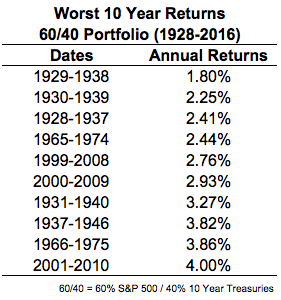
The S&P 500 has historically produced strong long-term returns, especially when dividends are included. But those returns came with wars, recessions, inflation scares, crashes, bubbles, banking crises, pandemics, and enough headlines to make a calm investor consider taking up birdwatching. The average return is real, but the path toward it is lumpy. Sometimes investors receive several years of high returns in a row. Sometimes they receive a decade of disappointment and a complimentary lesson in humility.
This is why low returns are a feature. They are part of the mechanism that resets expectations, lowers excess enthusiasm, and creates better opportunities for future investors. A market that only delivered high returns forever would eventually become absurdly expensive. A market that occasionally delivers low or negative returns is a market that still prices risk.
Low Returns Are the Price of Admission
There is no free lunch in investing, although there are many expensive lunches at investor conferences. The reason stocks have historically outperformed safer assets over long periods is that they are risky. They can fall sharply. They can underperform cash for uncomfortable stretches. They can make intelligent people say things like, “Maybe I should sell everything and buy commemorative silver coins from a late-night commercial.”
The reward for owning stocks is not a steady paycheck. It is a long-term risk premium. Investors demand higher expected returns from equities because equities are uncertain. But that premium is not constant. It changes with valuations, interest rates, inflation expectations, profit margins, and investor sentiment.
When everyone wants to own stocks, the equity risk premium can shrink. When nobody wants to own them, the premium can rise. This is one of the great ironies of investing: future returns often look most attractive when investors feel least interested in taking risk. Bargains rarely arrive wearing a tuxedo and holding a sign that says, “Safe and obvious opportunity here.” They usually arrive during stress, confusion, and widespread bad vibes.
The Role of Bonds in a Low-Return World
Bonds also deserve a realistic discussion. For years, investors complained that bond yields were too low. Then interest rates rose, bond prices fell, and everyone suddenly remembered that “safe” does not always mean “never uncomfortable.” Bonds can lose value, especially when interest rates rise quickly. However, higher yields can also improve the forward-looking return potential of fixed income.
In a balanced portfolio, bonds are not supposed to be the exciting friend who starts a business from a garage and becomes a billionaire. Bonds are more like the reliable friend who brings a charger, checks the weather, and reminds everyone that leaving at 6:30 avoids traffic. Their job is usually income, diversification, and stability. They may not always offset stock declines perfectly, but they can still help manage portfolio risk and provide liquidity when investors need it most.
Low returns across both stocks and bonds can feel frustrating, but it also forces investors to focus on what they can control: costs, taxes, savings rate, diversification, time horizon, and behavior. Those variables may not sound glamorous, but they are often more dependable than trying to guess next quarter’s market mood.
What Investors Can Actually Control
Investors cannot control whether the next decade delivers 4%, 6%, or 10% annualized stock returns. They cannot control inflation, Federal Reserve policy, oil prices, artificial intelligence spending, election cycles, or whether a famous CEO posts something chaotic before breakfast. But they can control several powerful inputs.
1. Savings Rate
When expected returns are lower, saving more becomes more important. This is not the most exciting sentence in financial writing, but it is one of the most useful. A higher savings rate can reduce the pressure on a portfolio to perform miracles. If your plan only works when markets deliver heroic returns every year, your plan may need fewer capes and more math.
2. Diversification
Diversification is not designed to make you rich overnight. It is designed to keep one bad idea, one overpriced sector, or one unlucky market cycle from ruining the whole party. A diversified portfolio may include U.S. stocks, international stocks, bonds, cash, and other assets depending on the investor’s goals and risk tolerance.
The key is understanding that diversification often feels disappointing in the short run. Something in your portfolio will almost always look foolish. That is normal. If every asset you own is going up at the same time, you may not be diversified; you may simply own the same risk in different outfits.
3. Costs and Taxes
In a high-return environment, fees can hide in the couch cushions. In a low-return environment, they stand in the living room wearing tap shoes. If gross returns are modest, every percentage point lost to high fees, unnecessary trading, or poor tax management matters more.
Low-cost funds, tax-efficient strategies, and disciplined rebalancing can help investors keep more of what the market provides. None of these tools can turn a 4% market into a 14% market, but they can prevent avoidable leakage. In investing, avoiding self-inflicted wounds is a surprisingly strong strategy.
4. Time Horizon
Low returns are hardest for investors who need quick results. A person investing for a home down payment in two years should think differently from a person investing for retirement in 30 years. Time horizon determines how much volatility you can reasonably accept.
The longer your horizon, the more important it becomes to stay invested through dull periods. Markets often deliver returns in bursts. Missing a handful of powerful recovery periods can damage long-term results. The frustrating part is that those bursts frequently occur when the news still looks terrible. The market does not wait for everyone to feel emotionally prepared.
Why “Average Returns” Can Mislead Investors
Average returns are useful for history, but dangerous as expectations. If stocks have averaged around 10% annually over long periods, that does not mean investors should expect 10% every year. In fact, a year that lands neatly on the long-term average is surprisingly rare. Markets prefer drama.
A better way to think about returns is in ranges. Over one year, almost anything can happen. Over five years, valuations and earnings matter more. Over ten years, starting price becomes a powerful influence. Over 20 or 30 years, patience, compounding, and behavior become increasingly important.
This is why market planning should include conservative assumptions. If your retirement plan survives lower returns, higher inflation, and a few unpleasant bear markets, it is probably sturdier than a plan built on permanent sunshine. Optimism is wonderful. Optimism with a spreadsheet is better.
The Hidden Benefit of Low Returns
Low returns can actually help disciplined investors. That sounds strange, like saying a flat tire is a chance to appreciate rubber. But lower prices and muted performance can improve future expected returns for new contributions. Young investors, regular savers, and retirement plan participants may benefit when markets go sideways because they can buy more shares at less demanding prices.
This is the beauty of dollar-cost averaging. When markets are expensive, your fixed contribution buys fewer shares. When markets fall or stagnate, it buys more. Over time, this habit turns volatility from an enemy into raw material. It does not eliminate risk, but it gives the investor a process that does not depend on perfect timing.
For retirees, low returns are more complicated. Withdrawal rates, sequence-of-returns risk, inflation, and portfolio allocation all matter. A retiree facing low early retirement returns may need more flexibility than someone enjoying strong markets right after leaving work. That flexibility could mean holding cash reserves, adjusting spending, rebalancing carefully, or using a more conservative withdrawal strategy.
Specific Example: The Investor Who Expects Too Much
Imagine an investor named Alex. Alex is 35, earns a solid income, and assumes the stock market will return 10% every year because that number appears in many historical charts. Alex saves $500 a month and expects compounding to do the heavy lifting.
Now imagine the next decade produces only 5% annualized returns. Alex may feel disappointed, but the plan is not broken. If Alex keeps saving, avoids panic selling, increases contributions as income rises, and stays diversified, the lower-return decade can still become a foundation for future wealth. The real danger is not the 5% return. The danger is Alex abandoning the plan because reality failed to match a rounded historical average.
Now consider another investor, Jordan, who is 62 and plans to retire soon. Jordan assumes an 8% annual return while withdrawing aggressively. If returns arrive lower than expected, the plan may become fragile. Jordan may need to reduce risk, adjust spending, build a cash buffer, or delay retirement slightly. Same market, different life stage, different solution.
This is why low returns are not universally good or bad. They are context. The investor’s response matters as much as the market’s behavior.
Experience Notes: Lessons From Real Investor Behavior
One of the clearest experiences related to low-return markets is that investors rarely struggle with math alone. They struggle with expectations. When a portfolio rises 18% one year, many investors quickly treat that result as normal. When the next year delivers 2%, they feel punished. Nothing terrible may have happened. The portfolio simply stopped sprinting. But emotionally, a normal slowdown can feel like betrayal.
In real investing conversations, this is where behavior becomes more important than spreadsheets. People often say they are long-term investors until the market gives them a long-term experience in real time. A flat market for three years can feel more annoying than a sharp crash because it lacks drama. At least a crash gives investors something to talk about. A low-return stretch just sits there, eating snacks, refusing to leave.
A useful personal rule is to separate market performance from personal progress. Your portfolio may be flat, but you can still be making progress if you are saving consistently, reducing debt, improving your income, lowering fees, and building a better allocation. The market is only one employee in your financial life. Do not let it act like the entire company.
Another lesson is that low returns reveal who had a plan and who had a vibe. During strong bull markets, almost every strategy looks brilliant. Concentrated tech portfolio? Genius. Random stock tips? Visionary. Buying after three cups of coffee and a headline? Bold. But when returns fall, weak plans become visible. Investors suddenly discover whether they understand their risk tolerance, whether they can rebalance, and whether their portfolio matches their actual goals.
Low-return periods also teach humility. A person can read every market outlook, follow every strategist, and still be surprised. That does not mean research is useless. It means research should create better preparation, not false certainty. Good investors do not need to know exactly what will happen next. They need a plan that can survive several outcomes.
For younger investors, the experience of low returns can be strangely valuable. It builds patience early. It teaches that wealth accumulation is not a highlight reel. It is repetition: save, invest, rebalance, learn, continue. The boring parts are not separate from success. They are the machinery of success.
For older investors, low returns can encourage better conversations. Instead of asking, “How do I beat the market?” the better question may be, “What return do I actually need?” If the required return is modest, the portfolio may not need heroic risk. If the required return is unrealistic, the answer may involve saving more, spending less, working longer, or changing goals. None of these choices are as thrilling as discovering the next superstar stock, but they are often more reliable.
The most practical experience is this: low returns feel less frightening when they are expected in advance. A realistic investor is not shocked when markets become boring. They do not assume every dull period is a disaster. They understand that compounding includes pauses, setbacks, and long stretches where the best action is simply not doing something foolish. In markets, boredom is not always a warning sign. Sometimes boredom is the bill you pay before the next round of opportunity arrives.
Conclusion: The Market Is Working, Even When It Disappoints You
Low returns are not evidence that markets are broken. They are evidence that markets are cyclical, competitive, and tied to valuation reality. Strong past returns can reduce future opportunities. Weak periods can improve them. Expensive assets can stay expensive longer than expected, and cheap assets can remain unpopular long enough to test everyone’s patience.
The best response is not to predict every twist. It is to build a resilient investment process. Save consistently. Diversify intelligently. Keep costs low. Rebalance when needed. Match your portfolio to your actual time horizon. Most importantly, avoid turning every market forecast into an emotional emergency.
Investing is not supposed to feel wonderful all the time. If it did, the returns would probably be lower because everyone would want in at any price. The discomfort is part of the deal. Low returns remind investors that risk is real, prices matter, and patience is not just a virtue. It is an asset class with no ticker symbol.