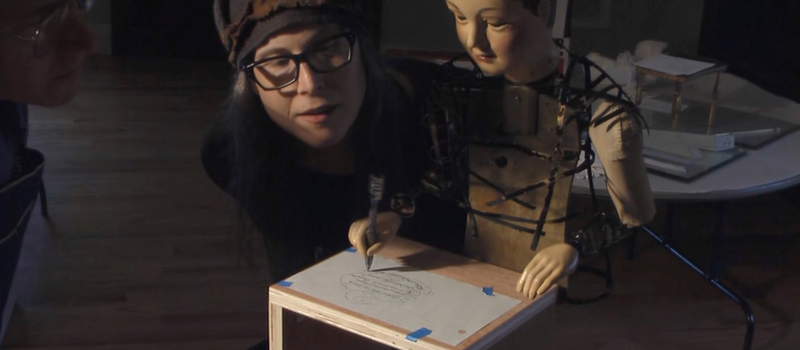

Some machines do one job. A toaster toasts. A blender turns fruit into breakfast chaos. The Maillardet Automaton, on the other hand, sits quietly like a tiny mechanical gentleman and then proceeds to write poetry, draw pictures, move its head, and make modern engineers question their weekend plans. When Fran Blanche went in-depth with the Maillardet Automaton, the story became more than a museum curiosity. It became a detective case about lost technology, pressure-sensitive pens, clockwork memory, and the strangely emotional power of a machine that was never supposed to have a microchip.
The Maillardet Automaton is one of the most astonishing examples of early mechanical engineering still known today. Built around 1800 by Swiss mechanician Henri Maillardet, it is often called the “Draughtsman-Writer” because it can create four drawings and three poems, all through a sophisticated system of springs, cams, levers, rods, and carefully translated motion. In plain English: it is a robot artist from the age of candlelight. No batteries. No software updates. No “please reconnect to Wi-Fi.” Just brass, steel, genius, and a little bit of theatrical magic.
Why Fran Blanche’s Deep Dive Matters
Fran Blanche is known for hands-on technical curiosity, the kind that does not stop at “wow, that’s neat.” Her exploration of the Maillardet Automaton focused on one of the machine’s most intriguing mysteries: the missing original writing instrument. The automaton’s hand does not merely drag a pen across paper. It moves in three dimensions, pressing down with different force during different strokes. That matters because the original pen likely affected the character of the drawings and writing.
A modern ballpoint can make lines, but it cannot easily reproduce the full personality of a historical writing tool. A quill, brush, or pressure-sensitive ink device can vary line width depending on pressure and direction. That variation may be the difference between “a machine drew this” and “wait, did a tiny ghost artist just sign my notebook?” Fran’s investigation treated the pen not as an accessory but as a core part of the machine’s programming. The automaton’s cams may store the motion, but the writing instrument translates that motion into visible art.
The Maillardet Automaton: A Clockwork Artist With a Memory
The Maillardet Automaton belongs to a golden age of automata, when master clockmakers and mechanicians built machines that imitated life. Some automata played instruments, some moved like animals, and some performed theatrical tricks for fascinated audiences. Maillardet’s creation stood apart because of its unusually large mechanical memory. It could produce seven separate renderings: four drawings and three poems, including verses in French and English.
That “memory” is not digital. It lives in brass cams, which are shaped disks that guide mechanical fingers as they rotate. As the cams turn, followers trace their irregular edges. Those tiny changes are converted through levers and rods into front-and-back, side-to-side, and up-and-down movements of the writing hand. Today, we might compare the cams to read-only memory because they store fixed instructions. The automaton cannot improvise a new poem about coffee, taxes, or why your printer is angry. But it can replay its stored program with stunning grace.
How the Cams Control the Hand
Imagine trying to draw a ship by controlling someone’s wrist with invisible strings. One string moves the hand left and right. Another moves it forward and backward. A third lifts or lowers the pen. Now replace those strings with metal rods and those instructions with carefully shaped brass disks. That is the basic miracle inside the Maillardet Automaton.
The cams do not simply make random motion. They encode exact paths. The machine’s base contains the driving machinery because the program is too large to fit inside the figure’s body. This design choice helped Maillardet give the automaton its extraordinary repertoire. Instead of hiding everything inside the doll, he used the desk-like chest as a mechanical brain. It is a beautiful engineering trade-off: less mystery in the body, more memory in the base.
A Museum Mystery Delivered in Pieces
The automaton’s modern history is almost as dramatic as its performance. In 1928, The Franklin Institute in Philadelphia received a badly damaged brass machine donated from the estate of John Penn Brock. It had been through a fire and was not in working condition. At the time, the family believed it had been made by Johann Maelzel, a famous showman associated with mechanical exhibitions. The true maker was unknown.
After restoration work, the automaton began to draw and write again. Then came the moment every historian dreams of: the machine identified its own creator. Around the border of its final poem, it wrote in French that it had been written by the Automaton of Maillardet. That signature revealed Henri Maillardet’s connection to the machine. It is difficult to imagine a better plot twist. Most old machines come with a label. This one wrote its own.
Who Was Henri Maillardet?
Henri Maillardet was a Swiss mechanician active in the late 18th and early 19th centuries. He worked in London producing clocks and other mechanisms and had links to the world of Pierre Jaquet-Droz, whose famous automata helped define the era. Maillardet’s work sits at the intersection of horology, entertainment, robotics, art, and theatrical showmanship.
Automata were not just engineering experiments. They were public spectacles. Audiences paid to see machines imitate life at fairs, exhibitions, salons, and museums. A writing automaton was especially powerful because writing felt deeply human. A machine that could trace letters and draw charming images seemed to blur the line between mechanism and mind. Today, with artificial intelligence writing emails and software generating images, that old sense of wonder feels surprisingly familiar. The Maillardet Automaton was not AI, but it was absolutely part of the long human dream of making tools that appear to think.
The Missing Pen: Small Part, Huge Question
Fran Blanche’s deep dive is fascinating because it zooms in on a deceptively small question: what was the original pen like? The original writing instrument was lost, and modern demonstrations have used substitutes, including a fine ballpoint. But the movement of the automaton’s hand suggests the pen was more than a simple point touching paper. The machine varies pressure during strokes, which hints that the tool may have been designed to respond to that pressure.
A pressure-sensitive instrument could explain why historical examples of the automaton’s work show more nuance than a rigid modern pen might produce. If the original pen widened its line when pressed harder and narrowed it on lighter strokes, the machine’s three-dimensional hand motion would become visually meaningful. Instead of merely plotting coordinates, the automaton would be controlling line weight, texture, and expression.
Why a Ballpoint Is Not Enough
A ballpoint pen is convenient, reliable, and very good at surviving inside a kitchen drawer for eleven years. But it is not necessarily the right partner for a centuries-old automaton. Ballpoints usually produce a fairly consistent line. They do not naturally give the rich variation of a brush, quill, or valve-based ink tool. Fran’s experiments explored how a weighted or pressure-reactive writing instrument might better match the machine’s original behavior.
This is where the topic becomes wonderfully nerdy. If the automaton presses harder on a downstroke, that force could open a valve, flex a nib, or spread a brush. If it lifts on the return stroke, the line could become thinner or stop entirely. The pen is therefore not passive. It is part of the interface between stored mechanical data and visible art. In modern terms, the cams are the file, the linkage is the processor, and the pen is the output device. A bad output device can make brilliant programming look ordinary.
What the Automaton Draws and Writes
The Maillardet Automaton’s known repertoire includes drawings such as a ship, a Chinese temple, and Cupid-themed images, along with poems in French and English. These works are not rough mechanical scribbles. They are carefully composed performances, combining visual charm with technical control. The automaton lowers its head, positions the pen, and works across the paper like a miniature artist concentrating very hard on not messing up the margins.
Its output also reveals why early audiences were so captivated by automata. The machine does not merely move. It behaves. It appears to look down at its work. It creates recognizable images. It signs a message. Even when you know every movement is pre-programmed in metal, the illusion of intention is hard to resist. That illusion is the emotional engine of the Maillardet Automaton.
Mechanical Memory Before Computers
One reason the Maillardet Automaton remains so important is its connection to the history of computing. The machine stores instructions physically. Each cam’s shape represents information. When read by mechanical followers, that information becomes motion. This is not computing in the electronic sense, but it is a powerful reminder that “programming” existed long before laptops, smartphones, or that one app that updates every time you are in a hurry.
The automaton shows that data can be stored in wood, brass, holes, grooves, pins, teeth, punched cards, magnetic fields, silicon, or cloud servers. The medium changes; the core idea remains. Store instructions. Retrieve them. Convert them into action. The Maillardet Automaton did this with theatrical elegance more than two centuries ago.
Restoration as Reverse Engineering
Restoring a machine like this is not the same as replacing a broken phone screen. There are no factory manuals waiting in a drawer. Restorers must study wear marks, surviving parts, historical drawings, old descriptions, and the logic of the mechanism itself. The Franklin Institute’s restoration history includes major work by skilled mechanics and later restoration efforts that helped bring the automaton back into reliable operation.
Fran Blanche’s work belongs to that broader culture of reverse engineering. She looked at what the machine does, what it appears designed to do, and what missing component could complete the system. That kind of analysis is valuable because restoration is not only about making an object move again. It is about understanding how it was meant to perform.
Why This Story Still Feels Modern
The Maillardet Automaton feels old and futuristic at the same time. It is old because it comes from a world of hand-cut parts, exhibition halls, and clockwork spectacle. It is futuristic because it asks questions we still care about. What counts as creativity? Can a machine produce art? Is a tool less impressive because it follows instructions? How much of expression lives in the mechanism, and how much lives in the viewer’s imagination?
Modern robots and AI systems are more flexible, but they often feel invisible. Their workings are hidden behind chips, servers, and code. The Maillardet Automaton is different. Its intelligence is physical. You can look at the cams and understand, at least in principle, where the instructions live. That visibility gives the machine a special charm. It is not a black box. It is a brass box with excellent stage presence.
Fran Blanche’s Contribution to the Conversation
Fran Blanche’s investigation helped make the Maillardet Automaton feel alive as an engineering problem, not merely as an artifact behind glass. By focusing on the missing writing instrument, she highlighted how subtle the original design may have been. The machine’s beauty is not only in the big obvious partsthe cams, the rods, the figure, the basebut also in the tiny final contact point between pen and paper.
That lesson applies far beyond automata. In engineering, the last inch often matters most. A speaker depends on its cone. A camera depends on its lens. A robot hand depends on its gripper. The Maillardet Automaton depends on the writing tool that turns hidden mechanical memory into visible expression. Fran’s deep dive reminds us that solving historical technology often requires imagination, experiment, and respect for details that might look minor until they explain everything.
Lessons for Makers, Engineers, and Curious Humans
1. Old Technology Can Still Teach New Tricks
The Maillardet Automaton proves that innovation did not begin with circuit boards. Its cam-based memory, motion translation, and output control are still excellent teaching examples for robotics, mechanical design, and systems thinking.
2. The Interface Changes the Art
The missing pen is a perfect example of interface design. The same stored motion can produce different results depending on the tool at the end of the hand. In digital design, we might say the user interface shapes the experience. In this case, the pen interface shapes the art.
3. Reverse Engineering Requires Humility
It is tempting to assume modern tools are always better. But with historical machines, the original solution may have been more elegant than expected. A quill, brush, or pressure-sensitive ink mechanism could solve problems that a modern pen introduces.
4. Wonder Is a Serious Engineering Force
The automaton was built to amaze people, and it still does. That matters. Wonder attracts attention, attention encourages learning, and learning keeps old machines from becoming silent furniture.
Experiences Related to the Maillardet Automaton
Experiencing the Maillardet Automaton, even through video, feels different from reading a normal technology article. At first, you notice the obvious magic: a small figure moves, lowers its head, and begins to write. Then your brain catches up and starts asking rude but useful questions. How does it know where to move? Why does the hand lift at exactly the right moment? Why does the line look more alive than expected? And why, after two hundred years, does this machine have better handwriting than half the people in a meeting room?
One of the most rewarding ways to approach Fran Blanche’s deep dive is to watch it like a maker rather than a casual viewer. Do not simply look at the finished drawing. Watch the pressure, timing, hesitation, and return strokes. Pay attention to how the arm travels through space. The magic is not just that the automaton draws; it is that its movements contain hidden decisions. The cams are not thinking in real time, but they preserve the decisions of the maker who shaped them.
For anyone who builds, repairs, sketches, programs, or tinkers, the missing pen mystery is especially relatable. Many projects fail not because the main idea is wrong but because the final contact point is wrong. A 3D printer can have good software and still fail because the nozzle clogs. A camera can have a great sensor and still disappoint because the lens is poor. A robot can have clever code and still drop the object because the gripper is badly designed. The Maillardet Automaton turns that everyday engineering truth into a historical drama.
Another experience worth noting is the emotional shift that happens when you learn the automaton identified its own maker. Before that moment, it is an anonymous marvel. After that, it becomes a messenger from Henri Maillardet’s workshop. The signature does not make the machine conscious, of course, but it does make the past feel strangely present. A dead craftsman’s design, stored in metal, writes across time. That is more romantic than most software release notes.
Fran Blanche’s investigation also encourages a slower kind of curiosity. In a world where technology is often judged by speed, novelty, and screen size, the Maillardet Automaton rewards patience. You have to think about force, friction, ink flow, weight, and mechanical memory. You have to accept that some answers may require prototypes. You have to let the machine teach you what questions to ask. That is a refreshing experience for anyone tired of disposable gadgets and mysterious sealed devices.
The best takeaway is that old machines are not dead machines. They are conversations waiting to be restarted. The Maillardet Automaton speaks through cams, levers, and ink. Fran Blanche listened closely enough to hear a missing part of that conversation. That is why her deep dive remains compelling: it is not only about restoring a pen. It is about restoring nuance, intention, and the full expressive range of a mechanical artist that still has something to say.
Conclusion
[Fran Blanche] Goes In-Depth With The Maillardet Automaton is more than a clever headline for fans of antique machines. It is a reminder that great engineering often hides in details most people overlook. The Maillardet Automaton is a clockwork masterpiece with cam-based memory, a mysterious journey through history, and a performance that still feels magical. Fran Blanche’s focus on the missing writing instrument adds a fresh layer to the story by asking how the machine originally translated pressure, motion, and ink into art.
The result is a topic that connects robotics, restoration, computing history, horology, museum preservation, and creative curiosity. The Maillardet Automaton may be more than two centuries old, but it still feels modern because it raises questions we have not outgrown. Machines can store instructions. Machines can imitate expression. Machines can surprise us. And sometimes, if we are lucky, a machine can even sign its own name and solve part of its own mystery.