#705 When You’re Sitting in the Backseat of a Packed Car and the Driver Takes a Turn Really Fast – 1000 Awesome Things

There is a particular kind of road-trip comedy that cannot be scheduled, rehearsed, or recreated with expensive equipment. It requires one ordinary car, one full backseat, several people who have agreed to surrender all personal space, and a driver who reaches a corner with slightly more enthusiasm than expected.
The steering wheel turns. The car changes direction. The passengers do not receive the memo in time.
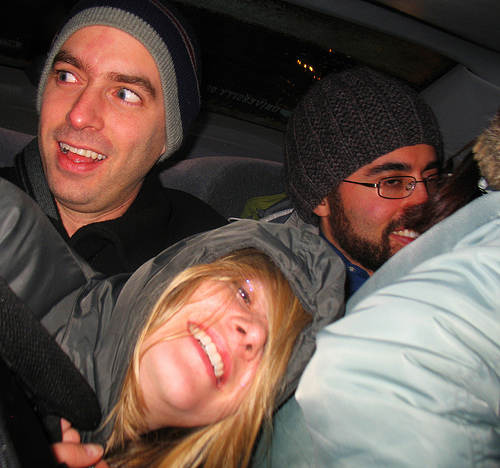
For half a second, everyone in the backseat becomes part of the same badly organized science experiment. Shoulders collide. Someone’s head lands against someone else’s upper arm. A bag of chips makes a heroic attempt to escape. The person beside the door becomes temporary human padding, while the person in the middle discovers that “middle seat” is less a location than a legal classification for suffering.
Then comes the laughter. Not polite laughter, either. This is the breathless, helpless kind produced when several adults are suddenly stacked like laundry and nobody can pretend to be dignified. That tiny burst of harmless chaos is why the packed-car fast turn belongs on any list of life’s overlooked pleasures. It combines surprise, physics, friendship, and the universal joy of blaming the driver.
The Split Second When the Whole Backseat Becomes One Person
A packed backseat has no neutral territory. In an empty car, a passenger can lean, brace, slide a little, and recover without witnesses. In a full car, every movement is immediately transferred to another human being. One person tilts, the next person gets pushed, and the third person receives the entire chain reaction like the final domino in a very soft, very noisy experiment.
That is the magic of the moment: individual passengers briefly stop behaving like separate people. They become a single, loosely connected passenger organism with six knees, four elbows, three competing playlists, and one shared opinion that the driver took the corner too fast.
The original “1000 Awesome Things” idea celebrates exactly this kind of microscopic delight: an everyday event so familiar that most people never pause to give it credit. The packed-car turn is not a major life achievement. Nobody frames a certificate for surviving it. Yet it can become the funniest ten seconds of an otherwise forgettable drive.
Why a Fast Turn Feels So Dramatic
Your Body Wants to Continue Straight
The sensation begins with inertia. Before the turn, the car and everyone inside it are moving in roughly the same direction. When the driver steers into a curve, the tires use friction against the road to redirect the vehicle. Your body, meanwhile, naturally tends to continue along its previous path until the seat, door, seat belt, or neighboring passenger applies the force needed to redirect you with the car.
From inside the vehicle, it feels as though an invisible hand throws everyone toward the outside of the turn. In a road-based frame of reference, however, the car is turning inward while your body briefly resists that change in direction. Physics educators describe the inward acceleration of circular motion as centripetal acceleration, and its magnitude increases with the square of speed while decreasing as the turn radius grows. Translation: a little extra speed can make a tight corner feel much more dramatic.
The Middle Passenger Has Nowhere to Go
The window-seat passengers at least have doors to catch them. The middle passenger has only people. During a left turn, the group shifts right; during a right turn, the group shifts left. The center rider becomes either the projectile or the cushion, sometimes both before the corner is finished.
This is why the event feels larger in a packed car than in an empty one. The force is not necessarily extraordinary, but the available room is extraordinarily small. A few inches of sideways movement is enough to trigger a full social pileup. Add slippery jackets, a vinyl seat, a backpack under somebody’s feet, or a takeout cup being guarded like a newborn, and the backseat becomes a live-action puzzle.
Surprise Adds the Exclamation Point
A smooth turn that everyone sees coming may produce a synchronized lean. An unexpected turn produces comedy. Research on motion sickness and passenger comfort suggests that predictability matters: occupants often feel better when they can anticipate upcoming vehicle movement, and looking outside can help the brain match visual information with signals from the inner ear and body. Drivers usually know when they are about to steer, while passengers may be reading, talking, or staring at a phone.
That difference explains the classic driver response: “What? That wasn’t even fast.” Of course it did not feel dramatic to the person holding the steering wheel, looking through the windshield, and initiating the turn. The driver had a preview. The backseat got a surprise exam.
The Soundtrack of a Packed-Car Corner
Every fast turn has its own audio sequence. First comes the intake of breath: a collective “whoa” from people who have suddenly realized gravity has submitted a change request. Next comes impact noisethe soft thump of shoulders, the squeak of upholstery, the rattle of something in the cup holder. Then comes the accusation.
“Dude!”
“Watch it!”
“My drink!”
“Why are you driving like this?”
Finally, everyone laughs, including the driver, who may offer the traditional defense: “I barely touched the wheel.” This statement is never accepted into evidence.
The comedy works because all passengers experience the same event at the same time. Shared laughter is not merely background noise; studies have linked laughter with social bonding and increased feelings of connection. A ridiculous group collision can therefore become a tiny friendship ritualone that is remembered and retold long after the destination, traffic, and exact route have been forgotten.
Why These Tiny Car Moments Become Big Memories
Road trips create memory through compression. People sit unusually close together for unusually long periods, sharing snacks, music, navigation mistakes, gas-station opinions, and increasingly questionable jokes. The car becomes a temporary room moving through the world. Because nobody can simply walk away, small events gain surprising importance.
A quick turn can become an inside joke before the vehicle reaches the next stoplight. The friend who spilled three french fries is now known as “the casualty.” The person crushed against the door becomes “the airbag.” The driver is placed on probation. By the end of the trip, the story has already been exaggerated into a corner taken at race-car speed, although the vehicle was probably traveling through a suburban intersection at a pace that would not impress a determined cyclist.
Nostalgia often thrives on ordinary shared details rather than only major milestones. Communities form around revisiting familiar cultural and personal memories because remembering together can create a sense of connection. The packed-backseat turn fits perfectly into that pattern: it is funny in the moment, but even better years later when one person says, “Remember that turn?” and everybody immediately does.
The Important Difference Between Funny and Reckless
The awesomeness is the accidental group leannot dangerous driving. A normal corner can feel dramatic when the backseat is full and passengers are distracted. Speeding, aggressive steering, overloading a vehicle, or intentionally throwing passengers around is not part of the joke.
Every person should have an actual seating position and a properly fitted seat belt. A packed car must never mean more occupants than available seats and restraints. Federal safety guidance emphasizes buckling up on every trip and in every seating position, including the rear. NHTSA reports that nearly 60% of backseat passengers killed in crashes in 2024 were unbuckled, based on cases with known restraint use. The Insurance Institute for Highway Safety likewise treats seat belts as essential safety equipment, while the National Safety Council warns that an unrestrained rear passenger can endanger other occupants as well.
Seat-belt laws differ by state, but physics does not check local statutes before acting. The Governors Highway Safety Association reported in its June 2026 overview that most states and the District of Columbia had some form of rear-seat belt enforcement, while several states still did not. Legal minimums vary; the sensible habit does not: everyone buckles up before the car moves.
Keep the Cabin Ready for an Ordinary Turn
Loose objects add unnecessary drama. Phones, water bottles, cameras, and takeout containers can slide or become hazards during sudden movement. Store what you can, keep drinks in cup holders, and avoid balancing an open container on your knee as though the laws of motion signed a personal exemption for your iced coffee.
Passengers who are prone to carsickness may also benefit from facing forward, looking toward the horizon, putting down reading material or screens, and asking for smoother driving. Motion sickness commonly involves conflicting information from the eyes, inner ear, muscles, and joints; fresh air and a distant visual reference may help some travelers.
How to Preserve the Fun Without Creating a Problem
The driver should enter turns at a safe speed, steer progressively, leave generous space, and remember that passengers cannot always predict the next move. The passengers should buckle up, keep the floor clear, secure loose belongings, and save elaborate backseat gymnastics for a stationary vehicle.
That does not eliminate the classic group lean. Cars still turn. People still get surprised. Friends still bump shoulders and laugh. Safety does not ruin the moment; it keeps the moment in the category where it belongs: harmless, ridiculous, and repeatable as a story.
The best version lasts only a second. Nobody is hurt. Nothing breaks. The driver is mildly insulted. The snack survives. Everyone regains an upright position and continues the conversation as though the backseat did not just perform a low-budget stunt sequence.
Backseat Turn Experiences: The Extra of Chaos
Experience One: The Airport Run
Picture four friends leaving for the airport before sunrise. The trunk is packed with luggage arranged according to a system nobody understands. The backseat contains three adults wearing winter coats, which means the vehicle is technically carrying six adults by volume. One passenger is holding coffee. Another is guarding a paper bag of breakfast sandwiches. The middle passenger has accepted that both armrests are fictional.
Everyone is sleepy until the driver turns into the airport access road with brisk confidence. The entire back row shifts at once. Coffee tilts but does not spill. The breakfast bag rises into the air like it has briefly achieved flight. The outside passenger makes contact with the door and announces, with courtroom seriousness, “I would like to change drivers.”
Now everyone is awake. The near-spill becomes the defining victory of the morning. For the rest of the trip, each curve is met with exaggerated preparation. Passengers plant their feet. The coffee holder uses two hands. The middle rider calls directions like a ship captain: “Turn approaching! Brace to port!” By the time they reach the terminal, the group has developed procedures more detailed than the airline’s boarding process.
Experience Two: The After-Dinner Squeeze
Five relatives leave a restaurant after a large family dinner. Nobody wants to take a second car, so everyone carefully fits into the available seats. The backseat passengers are full, warm, and carrying leftovers. A container of pie sits on one lap with the solemn importance of a national treasure.
The driver makes an entirely legal right turn. The backseat shifts left. One cousin leans into another, who leans into an aunt, who protects the pie by lifting it overhead. For one glorious second, she resembles a championship athlete holding a trophy above a collapsing crowd.
The pie remains level. This is treated as a miracle. Nobody discusses the fact that the aunt’s purse has emptied onto the floor. Priorities are clear. The story told later is not about the dinner, the restaurant, or what anybody ordered. It is about the Save. Capital S. Years later, someone may bring pie to a holiday gathering and hear, “Careful on the turns,” causing the entire table to laugh while newcomers stare in confusion.
Experience Three: The Teenage Road Trip
A group of teenagers is heading to a movie in a friend’s aging sedan. The speakers are working harder than the engine. Everybody is talking over the music, and the middle passenger is trying to send a text while holding a jacket, a snack, and a level of optimism unsupported by available space.
The driver takes a roundabout. Not recklessly, just quickly enough to surprise people who are paying attention to everything except the road. The backseat slides in unison. The text becomes gibberish. A handful of popcorn transfers ownership without permission. Someone shouts, “We’re all going to die,” in the cheerful tone of a person who clearly believes the opposite.
At the next red light, everyone is still laughing. The driver turns down the music and insists the roundabout was “perfectly normal.” The passengers replay the incident with instant slow-motion commentary. Each person claims to have been hit by at least three others, which is mathematically ambitious in a three-person backseat.
That night, the movie may be good or bad. It almost does not matter. The ride becomes part of the event. Years later, the car will be gone, the theater may be renovated, and nobody will remember the plot. But they may remember the turn, the flying popcorn, and the message that accidentally read, “we arrrrrr here.”
Why the Experience Works Every Time
These stories share the same ingredients: close friends or family, a confined space, an unexpected change in motion, and a safe ending. The physical movement creates surprise; the crowd creates contact; the lack of serious consequences creates permission to laugh. It is slapstick comedy produced by everyday transportation.
More importantly, the moment belongs equally to everyone in the car. Nobody has to explain why it was funny. The passengers felt it together. That shared understanding transforms a minor inconvenience into a group memoryand proves that some of life’s most durable stories are not planned adventures. They are ordinary corners taken while the backseat is full.
Conclusion: A Tiny Turn Worth Remembering
When you are sitting in the backseat of a packed car and the driver takes a turn faster than expected, the world briefly becomes simple. Your body follows inertia, your friends become cushions, somebody protects the snacks, and the driver denies all wrongdoing. Then everyone laughs.
It is not the speed that makes the moment awesome. It is the synchronization. Several people experience the same harmless surprise, collide with the same ridiculous lack of elegance, and immediately gain a story that can be retold for years. In a life filled with scheduled entertainment, optimized experiences, and carefully edited photos, there is something refreshing about joy that arrives uninvited at an ordinary intersection.
Note: Enjoy the memory, not risky driving. Every occupant should have a proper seat, wear a correctly positioned seat belt, and ride with a driver who follows traffic laws and takes turns safely.