A Mysterious Rock Sat in a School for 20 Years. Nobody Realized It Was Hiding 66 Dinosaur Footprints.

For more than two decades, students at Biloela State High School in Queensland, Australia, walked past a large, pale slab of rock as if it were just another piece of campus decoration. It sat there in the school foyer, quiet as a locked filing cabinet and about a thousand times older. Teachers passed it. Parents passed it. Students probably leaned near it, ignored it, and hurried by it on the way to class. Nobody realized that this ordinary-looking rock was carrying a prehistoric secret: 66 fossilized dinosaur footprints.
The discovery sounds like the beginning of a movie where the school janitor says, “That rock always gave me a weird feeling,” but the real story is even better. The boulder had been recovered from the Callide Mine near Biloela in the early 2000s and donated to the school. People knew it had some unusual marks, but its full scientific value remained hidden in plain sight until paleontologist Dr. Anthony Romilio from the University of Queensland examined it in detail. What he found was not just a cute dinosaur souvenir. It was one of the densest collections of dinosaur footprints ever documented in Australia.
In other words, the school had been casually displaying a 200-million-year-old Jurassic traffic report. No bell rang. No dramatic music played. The rock simply waited until someone looked closely enough.
The School Rock That Was Much More Than a Rock
The boulder’s journey began at Callide Mine, a coal mining area in Central Queensland. Workers had found the slab during mining activity, and it was eventually saved and brought to Biloela State High School. The school displayed it in a public area, where it became part of everyday scenery. Like a trophy cabinet, a noticeboard, or that one classroom clock that seems personally committed to moving slowly, the rock blended into school life.
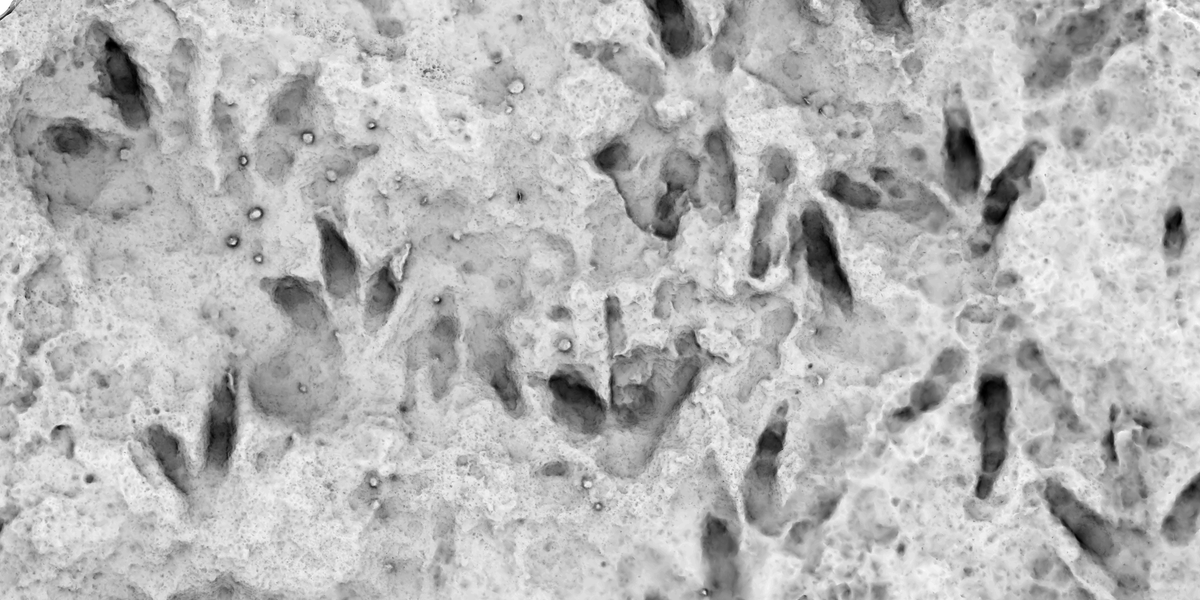
But unlike most school decorations, this one had been walked on by dinosaurs during the Early Jurassic period, around 200 million years ago. The fossil surface preserved dozens of tiny three-toed impressions, many of which were difficult to see without proper techniques. Some marks were visible, but the full pattern needed scientific investigation.
That is one reason the story is so fascinating. The fossil was not buried deep underground when scientists recognized it. It was not locked in a museum vault. It was not discovered by a dramatic expedition involving helicopters, desert camps, and somebody shouting, “We found it!” It was sitting in a school, waiting for curiosity to catch up.
What Scientists Found on the Boulder
When Dr. Romilio studied the rock, he identified 66 fossilized footprints on a surface of roughly one square meter. Researchers concluded that the tracks were made by 47 individual dinosaurs. That number matters because fossil footprints are not just isolated marks. They can reveal movement, behavior, body size, speed, and even how animals used an ancient landscape.
The footprints are three-toed impressions linked to the ichnospecies Anomoepus scambus. An ichnospecies is not the name of the animal itself in the usual bone-based sense. Instead, it is a scientific classification for trace fossils, such as footprints. Think of it like identifying a visitor by their shoeprint rather than by seeing their face. Paleontology is basically the world’s oldest detective show, except the suspects left town 200 million years ago.
The trackmakers were likely small, two-legged, plant-eating dinosaurs. Based on the size and spacing of the footprints, researchers estimate that their legs ranged from about 15 to 50 centimeters in length. They were probably moving slowly, at less than 6 kilometers per hour, across wet clay that may have formed near a waterway. In modern terms, they were not sprinting like movie monsters. They were strolling, crossing, browsing, or moving through a muddy area at a relaxed pace.
Why 66 Dinosaur Footprints Are a Big Deal
Dinosaur bones often get the spotlight. A giant skull in a museum can stop people in their tracks faster than a “free pizza” sign. But footprints are incredibly valuable because they record behavior. Bones show what an animal was. Tracks show what it did.
A footprint can suggest whether a dinosaur walked on two legs or four, whether it moved quickly or slowly, whether several animals traveled through the same place, and whether the ground was wet, dry, soft, or covered by shallow water. In the case of the Biloela boulder, the concentration of footprints gives scientists a rare glimpse into dinosaur activity in the Callide Basin during a period when Australia has no known fossilized dinosaur bones from that time.
That makes the rock especially important. It is not just a collection of cute little dino toes. It is evidence from a missing chapter of Australia’s dinosaur story. The tracks help researchers understand which kinds of dinosaurs were present, how common they may have been, and how they moved through the environment.
The Early Jurassic World Behind the Footprints
To appreciate the discovery, imagine Central Queensland 200 million years ago. Forget modern classrooms, roads, school uniforms, and lunchboxes. The environment was part of a changing Jurassic world filled with waterways, sediment, and small dinosaurs moving across soft ground. The Callide Basin preserved traces of these animals when conditions were just right.
For footprints to become fossils, the process has to be almost suspiciously perfect. First, an animal steps into soft sediment, such as mud or wet clay. The ground must be firm enough to hold the print but soft enough to record detail. Then the impression has to be covered by more sediment before rain, wind, water, or other animals destroy it. Over millions of years, those layers harden into rock. Eventually, erosion, mining, or excavation brings the surface back into the light.
That means each fossil footprint is a tiny miracle of timing. A dinosaur took a step. Mud accepted the impression. Sediment protected it. Rock preserved it. A miner noticed the slab. A school kept it safe. A scientist finally studied it. If any part of that chain had broken, the footprints could have disappeared forever.
How 3D Imaging Revealed the Hidden Details
The Biloela rock did not give up all its secrets at first glance. Some impressions were subtle, and years of public display had not exactly turned the slab into a laboratory-perfect specimen. Researchers used tools such as photography, silicone molding, 3D imaging, and light filters to bring out details that the human eye could easily miss.
This is where modern paleontology becomes surprisingly high-tech. Gone are the days when fossil study meant only a brush, a notebook, and a wide-brimmed hat. Today, scientists can use digital modeling to measure depth, spacing, shape, and track orientation. Light filters can make faint impressions stand out. Three-dimensional models allow researchers and the public to examine surfaces without handling the original fossil.
In this case, those tools helped reveal the scale of the discovery. What looked like a curious school rock became a data-rich fossil surface. The tracks were not random scratches. They were organized evidence left by dozens of animals moving through the same prehistoric environment.
Meet Anomoepus scambus, the Footprint Name With a Big Story
The footprints were classified as Anomoepus scambus, a name used for a particular type of fossil track. It is important to be precise here: Anomoepus scambus refers to the track type, not necessarily a confirmed dinosaur species known from bones. Scientists infer the likely trackmaker by comparing the footprint shape with known dinosaur anatomy.
The trackmakers were likely ornithischian dinosaurs, a major group of mostly plant-eating dinosaurs. The animals that made these prints were probably small, bipedal herbivores with long legs, short arms, compact bodies, and beak-like mouths. If your mental image of dinosaurs is limited to giant roaring predators, this discovery offers a useful correction. Not every dinosaur was a skyscraper with teeth. Some were modest little plant eaters walking through mud like ancient chickens with better public relations.
The three-toed shape of the footprints helped researchers identify the track type. The size and stride helped estimate the animals’ movement. Together, these clues turn a stone surface into a prehistoric scene: many small dinosaurs crossing wet clay, possibly near a river or shallow waterway, leaving tracks that would outlast mountains, forests, and every homework assignment ever written.
Why the Discovery Was Easy to Miss
One of the funniest and most humbling parts of the story is how obvious the rock seems after the fact. Once you know it contains 66 dinosaur footprints, it is tempting to wonder how anyone missed it. But that reaction is unfair. Many fossil tracks are not dramatic at first glance. They can look like dents, cracks, bumps, stains, or natural weathering. Without the right lighting, angle, training, or curiosity, they may not stand out at all.
There is also a human factor. When something sits in a familiar place for years, people stop seeing it. The brain labels it “background” and moves on. That is why you can misplace your phone while it is sitting directly in front of you, or walk past a historic fossil every day because you are thinking about math class, lunch, or whether you remembered your assignment.
The Biloela boulder is a perfect example of hidden significance. It was not invisible. It was simply underestimated.
The Role of Everyday People in Fossil Discoveries
Paleontology is not only done by scientists in remote deserts. Many important fossil discoveries begin with ordinary people noticing something unusual. Farmers, miners, hikers, students, teachers, construction workers, and local community members often play a key role. They are the ones who spend time on the land, see fresh rock surfaces, and notice odd shapes after rain, erosion, or excavation.
The Biloela rock was saved because someone recognized that it might matter. Later, community interest helped bring it to the attention of experts. That partnership between local observation and professional science is exactly how many fossil stories begin.
There is a practical lesson here: if you find a strange rock, fossil-like mark, or track-shaped impression, do not chip it out, sell it, or turn it into a doorstop with delusions of grandeur. Photograph it, record where it was found, avoid damaging it, and contact a museum, university, or local geological authority. Context is everything in paleontology. A fossil without location data is like a mystery novel with the last chapter missing.
Another Surprise Was Hiding Nearby
The school boulder was not the only fossil-bearing rock hiding in ordinary surroundings. During the investigation, another rock from the Callide Mine area was found being used as a car park boundary marker. That larger boulder contained two distinct dinosaur footprints made by a slightly larger two-legged dinosaur. A third sample, encased in resin and used as a bookend, also contributed to the research.
This detail makes the story even more delightful. Apparently, Central Queensland had been storing Jurassic clues in the most casual possible ways: school display, car park marker, bookend. Somewhere, a paleontologist’s blood pressure probably rose and fell at the same time.
These additional finds suggest that the Callide Basin may hold more dinosaur track evidence than previously recognized. They also show how industrial sites, especially mines that expose ancient rock layers, can reveal fossils that would otherwise remain buried. Mining can be destructive, but when fossils are noticed and preserved, it can also expose scientifically valuable surfaces.
What This Means for Australian Dinosaur Research
Australia’s dinosaur fossil record is patchy compared with some other regions. Body fossils are rare in many time periods, and the Early Jurassic is especially challenging. That is why trace fossils such as footprints are so important. They can preserve evidence of dinosaurs even when bones are absent.
The Biloela discovery adds to a growing picture of small ornithischian dinosaurs living in what is now Queensland during the Early Jurassic. Similar track types have been reported from other Australian sites, including areas such as Mount Morgan and Carnarvon Gorge. Together, these discoveries suggest that small plant-eating dinosaurs may have been widespread across the region.
Footprints also allow researchers to study behavior at a moment-by-moment scale. A bone may tell you that an animal existed. A trackway can tell you that it walked across wet clay, turned, slowed down, traveled with others, or crossed a waterway. That is why a single slab with dozens of prints can become a scientific treasure.
Lessons From a Rock That Waited 20 Years
The story of the Biloela boulder is not just about dinosaurs. It is about attention. It reminds us that discovery often begins when someone takes a second look at something familiar. A rock in a foyer. A mark in a driveway. A pattern on a beach. A fossil in a drawer. The world is full of objects that seem ordinary until the right question is asked.
It also shows why schools are powerful places for science. Imagine being a student and learning that the object you walked past every day was older than flowering plants, older than most familiar dinosaur giants, and older than the Atlantic Ocean in its current form. That kind of discovery can make science feel less like a textbook and more like a door suddenly swinging open.
The Biloela students did not need a time machine. The Jurassic had been sitting in their foyer.
Experiences Related to This Topic: What the Biloela Dinosaur Footprint Story Teaches Us
Stories like this feel exciting because they connect ancient history with everyday life. Most people imagine fossil discoveries happening in dramatic places: desert cliffs, remote badlands, windswept quarries, or museum storage rooms guarded by serious people with clipboards. But the Biloela rock changes that picture. It shows that a major discovery can sit in a school hallway, quietly collecting dust, memories, and probably the occasional student glance of mild confusion.
For students, this kind of story can make science feel personal. A dinosaur footprint is not just a fact to memorize. It is physical evidence that a living animal once passed through a real place. When young people learn that 47 small dinosaurs crossed wet clay and left 66 footprints behind, the past becomes easier to imagine. The dinosaurs stop being cartoon monsters and become animals with bodies, habits, paths, and environments. They walked, paused, crossed muddy ground, and moved through their world one step at a time.
For teachers, the discovery is a dream classroom example. It can introduce geology, biology, evolution, sedimentary rock, fossilization, measurement, mapping, and scientific skepticism. Students can ask questions such as: How do scientists know the tracks are dinosaur footprints? How can stride length estimate speed? Why do trace fossils matter when bones are missing? What conditions preserve footprints? Those questions build critical thinking because they require evidence, not guesswork.
For communities, the story is a reminder that local places can hold global importance. Biloela is not a giant capital city or a famous fossil tourism hub, yet a school there preserved a rare window into Early Jurassic life. That should make every community a little more curious about its own landscapes, museums, schools, mines, farms, creek beds, and old collections. Sometimes heritage is not announced with a plaque. Sometimes it is waiting beside the office.
There is also a useful lesson about patience in science. The rock did not become important only when it was studied. It was important the whole time. The difference was recognition. Many discoveries work that way. A specimen may sit in a drawer, a field, a classroom, or a storage shed for years before someone has the expertise, technology, or curiosity to understand it. Scientific knowledge often grows not because the world suddenly changes, but because our ability to notice improves.
On a more practical level, the Biloela discovery encourages careful observation. You do not need to be a paleontologist to notice something unusual, but you do need to be respectful. Fossils should not be damaged, removed illegally, or treated as personal trophies. The best first steps are simple: take clear photos, note the location, leave the object in place when possible, and contact professionals who can assess it properly. A fossil’s scientific value often depends on where it was found and how it relates to surrounding rock layers.
Finally, the story is just plain fun. It has everything: dinosaurs, a school, a mysterious rock, hidden clues, advanced imaging, and the wonderful fact that a fossil jackpot spent 20 years pretending to be lobby decor. It is the kind of science news that makes people look twice at ordinary things. And honestly, that might be its greatest gift. The next time someone walks past an odd rock, a strange print, or a pattern that seems too interesting to ignore, they may pause and wonder: what if this is not just a rock?
Conclusion
The mysterious rock at Biloela State High School proves that extraordinary discoveries do not always arrive with dramatic entrances. Sometimes they sit quietly in a foyer for 20 years, waiting for someone to ask the right question. With 66 fossilized dinosaur footprints made by 47 individual dinosaurs, the boulder offers one of Australia’s most remarkable dinosaur track discoveries and a rare glimpse into Early Jurassic life.
Its story blends science, luck, community awareness, and modern technology. It also reminds us that fossils are not just ancient objects; they are records of behavior, movement, and vanished worlds. A small dinosaur’s muddy step became a message across 200 million years. And for a long time, that message was waiting in a school hallway.
Editorial Note: This article is written for web publication and is based on publicly reported scientific information about the Biloela State High School dinosaur footprint discovery, the University of Queensland research, and related paleontological reporting. It does not include source links in the article body to keep the publishing format clean.