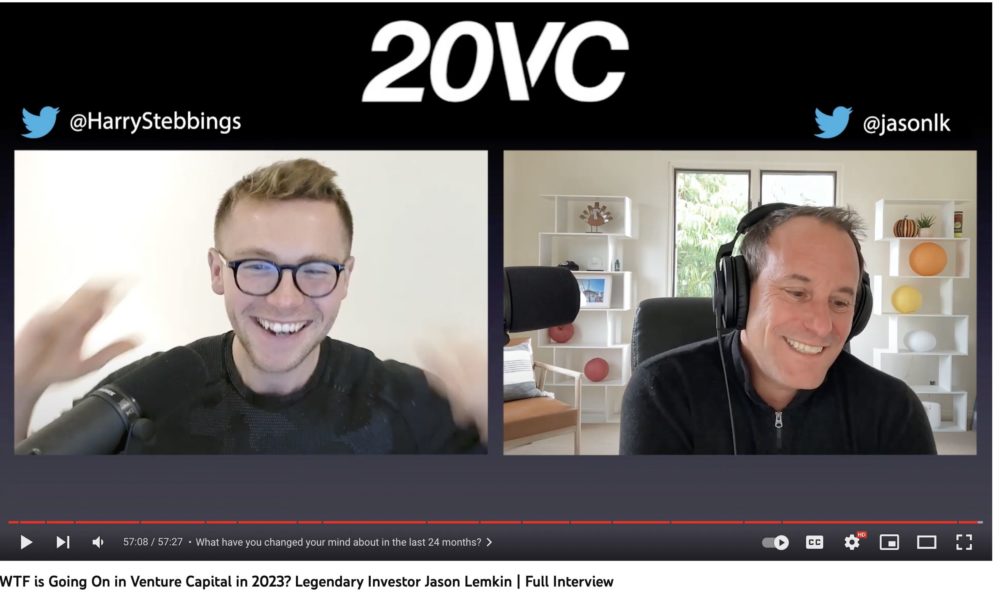
Almost Every Great Founder … Almost Ran Out of Money. And Much More. Jason + Harry Are Back!

There is a strange little myth floating around startup land: great founders are calm, well-funded, elegantly dressed people who raise money with one eyebrow, sip sparkling water with investors, and glide from idea to IPO like a swan wearing a Patagonia vest. Lovely image. Almost entirely fake.
The real founder story is usually messier. It includes payroll anxiety, awkward investor calls, budget cuts, delayed hires, a spouse asking very reasonable questions, and a bank balance that looks less like a runway and more like a sidewalk. That is why the topic “Almost Every Great Founder … Almost Ran Out of Money” hits so hard. It is not just a dramatic headline. It is practically a chapter title in the unofficial founder handbook.
Jason Lemkin, founder of SaaStr, and Harry Stebbings, host of 20VC, have built audiences around exactly this kind of direct, sometimes uncomfortable startup truth. When Jason and Harry get together, the conversation is rarely about polished slogans. It is about what founders, operators, and venture capitalists actually face: tighter fundraising markets, changing SaaS buying behavior, fraud risk, valuation resets, capital efficiency, and the brutal math of cash burn.
And yes, almost every great founder has, at some point, stared at the numbers and thought: “Well, this is either the comeback story or the final episode.”
Why Running Out of Money Is a Founder’s Oldest Enemy
Startups do not usually die because the logo was ugly, the pitch deck had too many gradients, or the founder forgot to post a “building in public” thread. They die because they run out of cash before they reach enough customer demand, revenue, product-market fit, or investor conviction to keep going.
Cash is not just money. For a startup, cash is time. It buys product iterations, customer discovery, engineering sprints, sales calls, marketing tests, and the occasional office snack that prevents the team from becoming feral. When cash disappears, optionality disappears with it.
That is why startup runway is one of the most important metrics a founder can track. Runway is the number of months a company can operate before it runs out of money. If a startup has $1 million in the bank and burns $100,000 per month, it has roughly 10 months of runway. That sounds simple, but founders often make the math dangerously optimistic. They assume sales will accelerate, investors will appear, churn will behave, and hiring plans will magically become cheaper. The spreadsheet becomes a fairy tale with formulas.
Jason Lemkin has repeatedly warned founders not to confuse hope with runway. In a strong venture market, a startup might survive sloppy spending because the next round arrives quickly. In a tighter market, the next round is no longer guaranteed. Suddenly, “we will raise in six months” becomes “we should have started six months ago.”
Jason Lemkin and Harry Stebbings: Why This Conversation Matters
Jason Lemkin is best known as the founder of SaaStr, one of the most influential communities for SaaS founders, executives, and investors. Before SaaStr, he co-founded EchoSign, which was acquired by Adobe, and later became an active SaaS investor. Harry Stebbings built 20VC from a podcast into a major venture platform, interviewing founders, investors, and operators across the technology ecosystem.
That pairing works because they represent two sides of the startup table. Jason brings the operator-investor perspective: What does it really take to build a durable SaaS company? Harry brings the interviewer-investor perspective: What are the patterns behind winners, losers, and the funding machine itself?
When they discuss venture capital, they do not treat it like a magical fountain where founders show up with a slide deck and leave with millions. They talk about the machinery: limited partners, fund cycles, diligence, public market multiples, growth expectations, late-stage valuations, buyer behavior, and the uncomfortable truth that many startups are not as fundable as they believe.
That is what makes the “founders almost ran out of money” theme more than a motivational quote. It is a lens for understanding how great companies are built. The founders who survive are not always the ones with the most elegant plans. Often, they are the ones who confront reality faster than everyone else.
The Venture Capital Reset: From Growth at All Costs to Grow Up, Please
For several years, especially during the 2020 and 2021 funding boom, many startups were rewarded for growth at almost any cost. Hire fast. Spend fast. Expand fast. Raise again before anyone notices the unit economics are wearing a fake mustache.
Then the market changed. Public technology valuations compressed. Interest rates rose. Late-stage funding slowed. Growth investors became more selective. Founders who had built their plans around easy follow-on financing suddenly had to operate in a world where capital efficiency mattered again.
This is the environment Jason and Harry have often dissected: a venture market where investors still write checks, but the bar is higher. Founders need stronger metrics, cleaner stories, better retention, more realistic sales forecasts, and a clearer path to profitability. “We are growing fast” is no longer enough if growth is powered by a flamethrower pointed directly at the cash balance.
In SaaS, this shift has been especially important. The classic SaaS model is beautiful when it works: recurring revenue, high gross margins, expansion revenue, sticky customers, and predictable growth. But when churn is high, customer acquisition costs are inflated, and sales cycles stretch, SaaS can become an expensive treadmill. You keep running faster, but the bank account keeps moving backward.
How SaaS Buying Changed
One of the major points in the Jason and Harry conversation is that SaaS buying has changed. During the boom, many software purchases moved quickly. Department heads could sign tools. Teams could add apps. The attitude was often: “If it helps growth, buy it.”
After the market reset, CFOs and procurement teams became more involved. Buyers started asking harder questions: Do we already have a tool that does this? Can we consolidate vendors? Is this software essential or merely nice to have? What is the measurable return on investment? Why is this renewal 30% more expensive than last year? And who approved all these dashboards nobody opens?
For SaaS founders, this changed the game. A product could no longer rely only on enthusiastic users. It also had to survive economic scrutiny. The champion might love the tool, but the CFO might ask, “Does this save money, make money, reduce risk, or simply create another login?”
That means founders must sell value, not vibes. They need clear ROI, stronger onboarding, better customer success, and pricing that matches the buyer’s reality. In tighter markets, software companies must become more disciplined because their customers have become more disciplined.
Famous Founders Who Nearly Hit the Wall
The idea that great founders almost run out of money is not theoretical. Some of the most famous companies in business history came dangerously close to collapse.
Airbnb: From Credit Card Debt to Cereal Boxes
Airbnb’s early story is now startup folklore. Brian Chesky, Joe Gebbia, and Nathan Blecharczyk struggled to convince investors that strangers would pay to sleep in other strangers’ homes. The idea sounded weird, and in fairness, it was weird. It was also brilliant.
When money became tight, the founders created election-themed cereal boxes during the 2008 U.S. presidential campaign. They sold boxes such as “Obama O’s” and “Cap’n McCain’s” to raise cash and keep the company alive. It was not a scalable hospitality strategy. Nobody was pitching “cereal-as-a-service.” But it showed creativity, persistence, and survival instinct. That hustle helped them get attention and eventually enter Y Combinator.
The lesson is not that every founder should sell novelty breakfast food. Please do not launch “Series A Flakes” unless you have a very understanding accountant. The lesson is that great founders find ways to extend the game.
FedEx: The Blackjack Legend
FedEx founder Fred Smith faced one of the most dramatic cash crunches in business history. In the company’s early days, Federal Express was reportedly down to its last few thousand dollars and could not cover critical fuel expenses. Smith famously went to Las Vegas, played blackjack, and won enough money to keep the company alive a little longer.
This is not recommended treasury management. No CFO wants to hear, “Our cash strategy is table 12 at Caesars.” But the story survives because it captures the desperation and risk tolerance often present in early-stage companies. FedEx did not become great because of blackjack. It became great because the underlying logistics vision was strong, and the team found a way to survive long enough to prove it.
Tesla and SpaceX: The 2008 Cliff
Elon Musk’s companies Tesla and SpaceX both faced severe financial stress during the 2008 financial crisis. SpaceX had suffered multiple launch failures, Tesla was struggling to finance production, and Musk had to decide how to allocate his remaining resources. Both companies came close to failure before securing critical lifelines.
Whatever one thinks of Musk today, the 2008 chapter is a classic example of founder risk. The companies did not look inevitable at the time. They looked fragile, expensive, and possibly doomed. Survival required capital, timing, technical progress, and an extraordinary tolerance for pressure.
Amazon: The Dot-Com Crash Survival Test
Amazon is now one of the most powerful companies in the world, but during the dot-com crash, critics questioned whether it could survive. The company carried heavy losses, faced investor skepticism, and operated in a market where many internet companies disappeared. Amazon’s ability to secure financing before the worst of the crash and later drive operational discipline helped it endure.
The Amazon story shows that even great companies can look financially terrifying before they look obvious. In hindsight, people say, “Of course Amazon survived.” At the time, it was not “of course.” It was “please hold while Wall Street screams.”
The Founder Skill Nobody Brags About: Cash Discipline
Founders love to discuss vision, product, culture, and category creation. Those things matter. But one of the least glamorous founder skills is cash discipline. It is the ability to say no before the bank account forces the conversation.
Cash discipline means knowing your burn rate, understanding your gross margin, tracking customer acquisition costs, reviewing retention, and modeling conservative scenarios. It means building a plan for what happens if fundraising takes twice as long as expected. It means knowing which hires are essential and which are just “it would be nice if we had someone for this” hires.
It also means facing uncomfortable truths. If the sales team is missing quota, do not pretend the next quarter will magically fix it. If churn is too high, do not spend more on acquisition until the product and customer fit are healthier. If the market has shifted, update the plan. Reality does not care that the board deck looked gorgeous.
What Investors Want Now
In the current venture environment, investors still want ambition. They still want companies that can become large, defensible, and valuable. But they are much less patient with sloppy fundamentals.
Founders need to show several things clearly:
- A large and specific market opportunity
- Evidence of real customer pain
- Strong retention or early signs of repeat usage
- A believable go-to-market motion
- Capital efficiency, not just revenue growth
- A team that can operate under pressure
- A plan that does not depend entirely on perfect fundraising conditions
That last point is crucial. A startup plan that only works if the next round arrives on time is not a plan; it is a weather forecast. Founders need a survival route, not just an upside case.
Why Almost Running Out of Money Can Make Founders Better
Running low on cash is awful. It creates stress, damages morale, and forces painful decisions. But it can also sharpen a company. Scarcity reveals what matters.
When money is abundant, teams can hide weak priorities behind headcount and tools. When money is tight, every project must justify itself. Every hire must matter. Every customer conversation becomes more valuable. Every product feature has to earn its place.
This is why many great companies emerge stronger after a near-death experience. They learn to focus. They learn to sell. They learn to listen to customers. They learn that revenue is not a vanity metric when it arrives with healthy margins and durable retention. Most importantly, they learn that survival is a strategy.
The Fraud and Diligence Problem
Jason and Harry have also discussed a more uncomfortable part of venture: fraud and weak diligence. During hot markets, investors can move too quickly. Deals become competitive. Funds fear missing out. Founders with impressive numbers get less scrutiny than they should. Then, when the market slows, problems surface.
This does not mean most founders are dishonest. Most are not. But it does mean pressure can create bad behavior. A founder who is desperate to raise may overstate metrics. An investor who is desperate to win a deal may skip diligence. A board that wants to believe the story may ignore warning signs.
The healthier approach is simple but not easy: verify the numbers, understand the customer base, inspect revenue quality, and ask whether growth is durable. In venture capital, trust matters. But trust without verification is how expensive surprises are born.
The Practical Playbook for Founders Facing a Cash Crunch
If you are a founder and the runway is getting short, panic is understandable but not useful. The first step is to get brutally clear on the numbers. How much cash is in the bank? What is the true monthly burn? Which expenses are fixed? Which can be reduced quickly? How much revenue is contracted, not merely hoped for?
Second, create multiple scenarios. A base case is not enough. Build a conservative case where fundraising takes longer, sales cycles stretch, and revenue lands slower than expected. Then build a survival plan around that case.
Third, communicate early. Investors do not like surprises, especially surprises that arrive wearing a flaming hat. If you need bridge financing, strategic help, customer introductions, or cost-cutting advice, ask before the company is cornered.
Fourth, protect the core. Do not cut the muscle that creates customer value. Cut distractions, underperforming programs, unnecessary software, unfocused experiments, and hiring plans that belonged to a different market.
Finally, sell. Revenue solves many problems. Not all problems, but many. A founder who can personally sell, close early customers, and learn from objections has a better chance of survival than a founder waiting for the market to admire the pitch deck.
What “Jason + Harry Are Back” Really Signals
The excitement around Jason Lemkin and Harry Stebbings is not just about two well-known startup voices having another conversation. It signals that founders are hungry for direct analysis. They want less theater and more truth. They want to understand what is actually happening in venture capital, SaaS, AI, buying behavior, and fundraising.
That kind of conversation matters because startup culture can easily become performative. Everyone is “crushing it” until the bridge round fails. Everyone is “capital efficient” until the finance model reveals otherwise. Everyone has “strong customer love” until renewals come due.
Jason and Harry’s best discussions cut through that fog. They remind founders that great companies are not built by pretending hard things are easy. They are built by confronting hard things early enough to do something about them.
Final Analysis: The Great Founder Is a Realist With a Wild Dream
The best founders are not merely optimists. Pure optimism is dangerous. If you believe everything will work out because you are special, the market will eventually send you a very stern email.
The best founders combine ambition with realism. They can imagine a huge future while staring directly at the ugly present. They know the company could become massive, but they also know payroll is due Friday. They believe in the mission, but they still check the bank account. They inspire the team, but they do not hide from the burn rate.
Almost every great founder almost ran out of money because building something new is inherently unstable. Customers are uncertain. Investors are emotional. Markets change. Products break. Hiring is hard. Competitors wake up. Procurement teams appear out of nowhere holding spreadsheets. The miracle is not that startups struggle. The miracle is that any of them survive.
But some do. They survive because the founders adapt faster, sell harder, spend smarter, and refuse to confuse denial with courage. They use cash as time, time as learning, and learning as leverage. That is the real story behind many legendary companies: not a smooth rise, but a series of near-disasters handled just well enough to keep going.
Additional Founder Experiences and Lessons From the Edge
One of the most useful experiences related to this topic is the founder’s first serious runway meeting. It is rarely cinematic. Nobody turns dramatically toward a rain-soaked window while a violin plays. More often, it is a tired team in a conference room, staring at a spreadsheet that has suddenly become the most honest person in the company.
That meeting changes people. Before it, the startup may still feel like an idea with momentum. After it, the company becomes a machine that must produce results before time runs out. Founders begin asking sharper questions. Which customers are most likely to close? Which features actually influence buying decisions? Which marketing channels produce pipeline rather than applause? Which team members are essential to the next milestone?
In many startups, the first cash crunch reveals that the company has been trying to do too much. The team is building three products, chasing four customer segments, testing five channels, and attending every conference with free coffee. Scarcity forces focus. Suddenly, the founder realizes that the company does not need more activity. It needs more progress.
Another common experience is the awkward investor update. When everything is going well, updates are easy. Charts go up, milestones sparkle, and the founder writes with the confidence of a person who has recently discovered bullet points. But when cash is tight, the update becomes a leadership test. A strong founder does not hide the problem. They explain the situation, show the plan, ask for specific help, and make it clear what has already changed.
The best investors usually prefer truth early over panic late. They may not always provide more money, but they can offer introductions, advice, bridge options, acquisition conversations, or hiring discipline. A vague “things are challenging” update helps nobody. A precise “we have nine months of runway, three cost actions underway, two enterprise deals in legal review, and a bridge plan if those slip” creates confidence.
Founders also learn that morale and honesty must travel together. If the team senses trouble but leadership pretends everything is perfect, trust erodes. If leadership shares every fear without a plan, panic spreads. The balance is to be clear without being chaotic: “The market is harder, so we are narrowing focus. These are the priorities. This is what we will stop doing. This is how we win.”
Another lesson from near-death startup moments is that revenue quality matters more than revenue theater. A desperate company may chase bad-fit customers, discount too heavily, or promise features it cannot support. That may bring cash in the door, but it can create future churn, support burdens, and product confusion. Survival revenue is good. Poisoned revenue is expensive.
The healthiest founders use the cash crunch as a forcing function. They revisit pricing. They improve onboarding. They call customers personally. They reduce sales friction. They stop measuring vanity metrics and start measuring behavior that predicts renewal, expansion, and referrals.
Finally, almost running out of money teaches humility. A founder can be smart, hardworking, persuasive, and still be wrong about timing. The market does not owe anyone adoption. Investors do not owe anyone a round. Customers do not owe anyone urgency. That humility can become a superpower because it pushes the founder closer to reality.
The founder who survives the edge often becomes calmer, tougher, and more useful. They no longer worship the fundraising announcement. They respect the customer invoice. They no longer confuse headcount with progress. They respect leverage. They no longer believe every problem can be solved by hiring faster. They learn that discipline is not the enemy of ambition. Discipline is what keeps ambition alive long enough to matter.
Conclusion
“Almost Every Great Founder … Almost Ran Out of Money. And Much More. Jason + Harry Are Back!” is more than a catchy startup headline. It captures one of the deepest truths in entrepreneurship: great companies are often built frighteningly close to the edge.
Jason Lemkin and Harry Stebbings keep returning to the topics founders need most: cash burn, fundraising reality, SaaS buying behavior, venture discipline, and the difference between hype and durable company building. Their conversations matter because the startup world does not need more fairy tales. It needs better maps.
Running low on money is not a badge of honor by itself. Plenty of companies run out of money and simply disappear. The lesson is not to glorify chaos. The lesson is to respect the math, move quickly, communicate clearly, sell real value, and build a company that can survive when the market stops clapping.
The best founders dream big, but they count cash carefully. They chase massive outcomes, but they know exactly how many months of runway remain. They understand that survival is not separate from strategy. Sometimes, survival is the strategy that makes everything else possible.
Note: This article is based on publicly available startup history, SaaStr and 20VC discussion themes, venture market reporting, and widely reported founder examples. Source links are intentionally omitted for clean web publishing.