
Some discoveries arrive with fireworks. Others arrive as a spreadsheet quietly whispering, “Hey, you may want to look at these 56 weird galaxies.” That second kind is exactly what happened when astronomers used artificial intelligence to search for gravitational lens galaxiesrare cosmic alignments where gravity turns space into a natural magnifying glass.
The story sounds like science fiction, but it is very real: a convolutional neural network, a type of AI especially good at recognizing image patterns, scanned thousands of galaxy images from the Kilo-Degree Survey and flagged possible strong gravitational lenses. After human experts reviewed the results, the team identified 56 strong lens candidates. In astronomy terms, that is not a small “nice job, robot” moment. It is a major step toward changing how we search the universe.
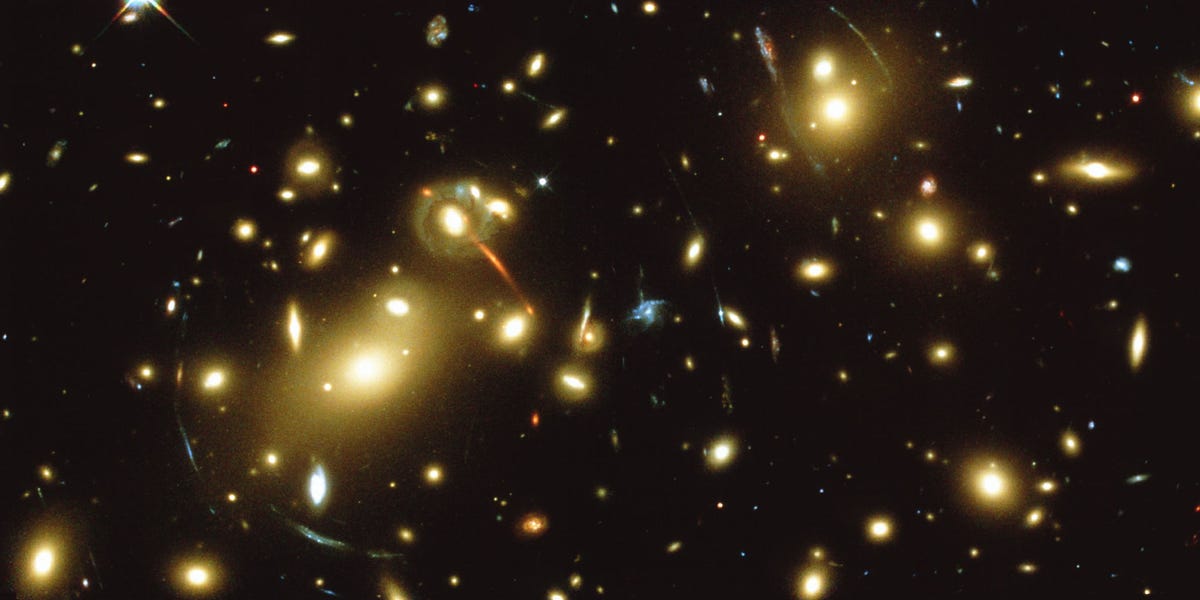
Gravitational lenses are among the most beautiful and useful optical tricks in the cosmos. They can appear as arcs, partial rings, multiple copies of the same distant galaxy, or nearly perfect Einstein rings. They are also extremely hard to find because the geometry has to be almost ridiculously precise. A massive foreground galaxy must sit in just the right line of sight between Earth and a more distant background galaxy. When it works, gravity bends the background light, magnifies it, and gives astronomers a better look at objects that would otherwise be too faint or too far away.
In other words, the universe has its own zoom lens. It just has terrible appointment availability.
What Is a Gravitational Lens Galaxy?
A gravitational lens galaxy is usually a massive foreground galaxy whose gravity bends the light of another galaxy behind it. Einstein’s general theory of relativity explains why this happens: mass curves spacetime, and light follows that curve. When the alignment is strong enough, the foreground object acts like a lens, warping and enlarging the image of the distant source.
The result can look surreal. A background galaxy may appear as a stretched blue arc around a red foreground galaxy. In a near-perfect alignment, the light may form a circular halo called an Einstein ring. If the alignment is slightly off, astronomers may see two, four, or even more copies of the same background object. It is not the galaxy cloning itself for attention; it is gravity bending the path of light along multiple routes.
Why These Lenses Matter
Gravitational lenses are not just pretty space jewelry. They are scientific tools. By studying how light is bent, astronomers can measure the mass of the foreground galaxy, including invisible dark matter. That matters because dark matter does not emit, absorb, or reflect light in any normal way. We know it is there because of its gravitational effects. Lensing gives researchers a direct way to map those effects.
Strong lenses can also magnify galaxies from the early universe, helping scientists study how galaxies formed, grew, and changed over billions of years. In some cases, lensing even helps measure the expansion rate of the universe by comparing the arrival times of light that has traveled along different paths.
How AI Found Dozens of Gravitational Lens Candidates
The breakthrough behind the headline came from a team using data from the Kilo-Degree Survey, often shortened to KiDS. This survey mapped large areas of the sky with high-quality imaging, creating exactly the kind of enormous data set that makes astronomers both excited and slightly nervous. There is treasure in the data, but there is also a mountain of it.
The researchers trained a convolutional neural network to recognize the visual signatures of strong gravitational lenses. CNNs are particularly useful for image classification because they can learn shapes, edges, patterns, and repeated structures. In this case, the AI was trained to look for lens-like features around luminous red galaxiesmassive galaxies that are good candidates for bending the light of more distant background objects.
The numbers tell the story. The AI analyzed a sample of 21,789 luminous red galaxies. It retrieved 761 strong-lens candidates. Human astronomers then visually inspected the strongest candidates and narrowed the list to 56 of the most reliable gravitational lens candidates.
That human review step matters. AI is fast, but astronomy is not a “click accept and publish” profession. A strange-looking galaxy can be a real gravitational lens, but it can also be a merger, a spiral arm, a nearby artifact, a chance overlap, or an image-processing oddity. The best results come from pairing machine speed with expert skepticism. The AI says, “Look here.” The astronomer says, “Let’s not embarrass ourselves.”
Why Finding Gravitational Lenses Is So Difficult
Strong gravitational lensing is rare because it depends on alignment. Imagine trying to line up a flashlight, a wine glass, and your eye from across a football field while the football field is expanding and everyone involved is moving. That is the general flavor of the challenge.
Even when a lens exists, it may be faint, small, or hidden in the glare of the foreground galaxy. Ground-based telescope images also have limits created by atmospheric seeing. In the KiDS study, the neural network was optimized for lenses with Einstein radii larger than about 1.4 arcseconds, meaning it was better at finding wider, more visible lensing patterns than tiny compact ones.
This limitation is not a failure; it is how careful science works. AI models are only as good as their training data, target definitions, and observational conditions. A model trained to find big blue arcs may miss smaller image separations. A model trained on simulated lenses may struggle with messy real galaxies. A model that is too sensitive may flood scientists with false positives. The goal is not magic. The goal is a smarter filter.
AI as a Cosmic Search Assistant
The real power of AI in astronomy is not that it replaces scientists. It changes where scientists spend their attention. Instead of manually searching tens of thousands or millions of galaxy images one by one, astronomers can use machine learning to prioritize the most promising targets.
That shift is crucial because modern astronomy is entering a data-rich era. Surveys from instruments such as the Dark Energy Spectroscopic Instrument Legacy Imaging Surveys, the Vera C. Rubin Observatory, Euclid, Roman, Hubble archives, and other major projects are producing or preparing to produce image catalogs so large that manual inspection alone is no longer realistic.
Later lens searches have already shown how quickly the field is moving. AI-based methods have helped identify more than 1,200 possible gravitational lenses in DESI Legacy Imaging Survey data. Another machine-learning effort connected to the AGEL survey identified thousands of potential lenses, with follow-up spectroscopy confirming many of them as real strong gravitational lenses. Meanwhile, newer archival projects are using AI tools to search through Hubble images for rare cosmic anomalies, including previously unnoticed lens-like structures.
The trend is clear: the universe has not suddenly become more lensy. Our tools have become better at noticing.
What Astronomers Learn From These Lens Galaxies
1. The Distribution of Dark Matter
Every gravitational lens is a mass detector. The visible stars in the foreground galaxy contribute to the bending of light, but dark matter contributes too. By modeling the lensing pattern, astronomers can infer how mass is distributed in and around the lens galaxy. This helps test models of dark matter and galaxy formation.
2. The Structure of Distant Galaxies
Because gravitational lenses magnify background galaxies, they allow astronomers to study objects that would otherwise be too dim or too small to examine in detail. A lensed galaxy from billions of years ago may reveal information about star formation, gas, dust, and galaxy evolution in the early universe.
3. The Expansion of the Universe
Some strong lenses create multiple images of the same variable source, such as a quasar or supernova. Since each image follows a different path through curved spacetime, the light can arrive at different times. Measuring those time delays can help constrain cosmological parameters, including the Hubble constant.
4. Rare Cosmic Events
Lensing can magnify supernovae, quasars, and other transient events. When a lensed supernova appears multiple times, astronomers can sometimes predict when another image will appear. That is like getting a cosmic rerun, except the universe controls the schedule and refuses to use a streaming app.
Why the 56 AI-Found Candidates Were Important
The discovery of 56 gravitational lens candidates was important not only because of the number, but because of the method. It demonstrated that convolutional neural networks could search large sky surveys for strong lenses with meaningful efficiency. The project also showed a practical workflow: train the model, scan the data, rank the candidates, and let experts inspect the best results.
That workflow became a template for later searches. As survey sizes grew, the basic idea scaled with them. Instead of asking whether AI can help, the field began asking how to improve AI lens finding: better simulations, better training sets, better uncertainty estimates, better ranking systems, and better ways to combine machine learning with human review.
The 56 candidates were therefore more than a list of interesting galaxies. They were a proof of concept for astronomy in the big-data age.
The Human Side of Machine Learning in Astronomy
There is a charming irony in all this. Astronomers built machines to find patterns humans might miss, but the final step still requires human judgment. A gravitational lens candidate can look convincing to an algorithm and suspicious to an expert. Or the opposite can happen: the AI may score an object modestly, while a trained astronomer notices a faint arc that deserves follow-up.
This is why the best future for AI in astronomy is collaborative. AI is not the astronomer. It is the tireless assistant that never complains about looking at 100,000 nearly identical galaxy thumbnails. Human researchers bring physical understanding, caution, creativity, and the ability to ask better questions.
In that sense, AI is not making astronomy less human. It is freeing humans from the most repetitive parts of discovery so they can focus on interpretation, theory, and follow-up observations.
What Comes Next for AI and Gravitational Lens Discovery?
The next generation of sky surveys will make the KiDS search look almost quaint by comparison. The Vera C. Rubin Observatory’s Legacy Survey of Space and Time is expected to image billions of galaxies over a 10-year survey. Its enormous camera and repeated observations will help scientists find strong lenses, weak lensing signals, lensed supernovae, and other rare events.
Space-based missions will add another layer. Euclid is designed to map the large-scale structure of the universe and study dark matter and dark energy. NASA’s Nancy Grace Roman Space Telescope will also contribute deep, wide-field imaging that could uncover many more lensing systems. These surveys will not merely add data; they will multiply the discovery problem.
That means AI will become less of a novelty and more of an essential part of the astronomical toolkit. The bottleneck will no longer be whether we can collect enough images. It will be whether we can identify the rare, meaningful signals hiding inside them.
Common Misunderstandings About AI-Found Lens Galaxies
AI Did Not “See” the Universe Like a Human
The AI did not look through a telescope and feel wonder. It processed image data and learned statistical patterns associated with lensing. That is powerful, but it is not consciousness. The wonder is still our department.
Not Every Candidate Is Confirmed
A candidate is not the same as a confirmed gravitational lens. Confirmation often requires detailed modeling, higher-resolution imaging, spectroscopy, or follow-up observations. The 56 candidates were strong possibilities, not a final cosmic census.
AI Does Not Make the Discovery Less Scientific
Using machine learning does not make the result less rigorous. The key is transparency: researchers must explain training data, model performance, false positives, limitations, and validation methods. AI can accelerate discovery, but evidence still has to survive scientific review.
Experience Section: What It Feels Like to Explore an AI-Discovered Universe
Thinking about an AI finding dozens of gravitational lens galaxies gives the experience of astronomy a surprisingly modern emotional texture. It is no longer only the image of a lone astronomer staring through an eyepiece on a cold mountaintop. That romantic picture still has its place, but today’s cosmic exploration often looks more like a collaboration between telescopes, servers, algorithms, and people drinking coffee near dangerously large monitors.
The experience begins with scale. Looking at one galaxy image can feel manageable. Looking at a thousand feels like work. Looking at millions feels like trying to count grains of sand while the beach is still being delivered by truck. That is where AI becomes not just useful, but almost necessary. It turns the overwhelming into the searchable. It does not remove the mystery; it gives researchers a map to the parts of the mystery most worth investigating.
There is also a strange kind of suspense. A machine-learning model may output a ranked list of objects, but each candidate still has to be opened, inspected, questioned, and compared. Is that blue smear an arc? Is that red galaxy massive enough to act as a lens? Is the image clean? Is the shape a cosmic clue or just a messy spiral arm pretending to be important? The process feels a little like detective work, except the suspects are galaxies and the crime scene is billions of light-years wide.
For writers, educators, and science communicators, this topic is especially satisfying because it combines two public fascinations: artificial intelligence and deep space. AI can sometimes feel abstract, technical, or even intimidating. Gravitational lensing, on the other hand, gives AI a visual mission. The algorithm is not just sorting ads or recommending another video. It is helping find places where gravity has bent light into rings and arcs. That is a much better use of machine learning than reminding someone to buy socks they already bought.
The most meaningful experience, though, is humility. The AI found dozens of gravitational lens candidates because humans built the surveys, designed the models, trained the systems, and knew what kind of rare pattern to search for. But the universe supplied the phenomenon. Gravity did the bending. Galaxies did the aligning. Ancient light traveled for billions of years before landing in a detector and becoming data. The discovery is technological, but it is also deeply cosmic.
There is a lesson here for anyone watching the future of science unfold. AI is not making the universe smaller or more predictable. It is revealing that our existing archives and surveys contain more hidden structure than we could manually uncover. The night sky has always been full of secrets. Now, we have a faster way to notice when one of them is waving.
Conclusion
The headline “An AI Found Dozens of Gravitational Lens Galaxies” captures a turning point in astronomy. A convolutional neural network searched KiDS galaxy images, identified hundreds of possible strong lenses, and helped astronomers narrow them to 56 promising candidates. That achievement showed how machine learning can accelerate one of the most difficult searches in observational cosmology.
Gravitational lens galaxies are rare, beautiful, and scientifically powerful. They help researchers map dark matter, study distant galaxies, test general relativity, and probe the structure of the universe. As new surveys collect more data than humans can inspect by hand, AI will become a crucial partner in finding these cosmic magnifying glasses.
The most exciting part is not that machines are replacing astronomers. It is that machines are helping astronomers ask bigger questions. Somewhere in a future data release, another faint arc, ring, or duplicated galaxy is waiting to be found. The universe has left the clues. AI is helping us read the handwriting.