
Pluto has never been interested in behaving like a simple ball of frozen rock. It has a heart-shaped glacier, mountains made of water ice, nitrogen snow, moving glaciers, a blue atmospheric haze, five moons, and a complicated relationship with the word “planet.” Now add another item to the cosmic oddities list: possible clouds.
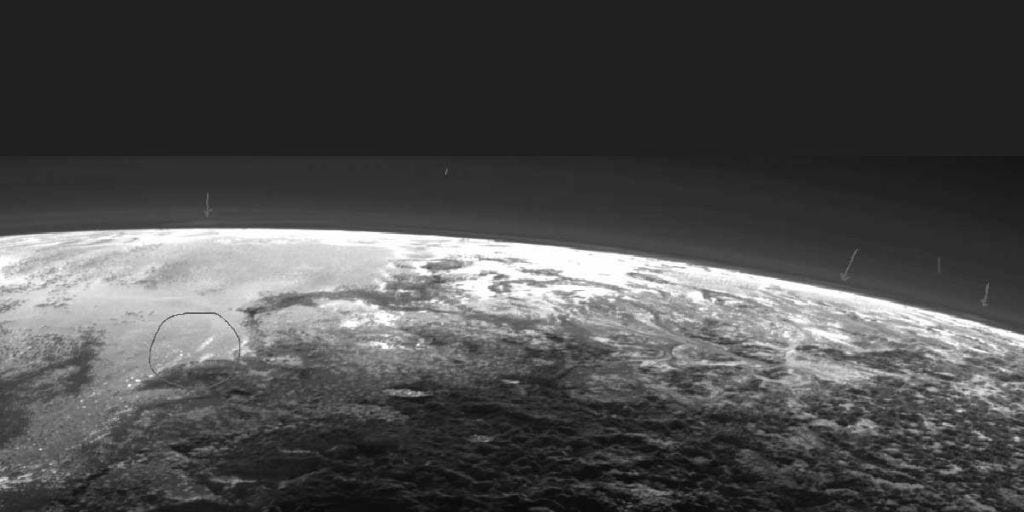
Images returned by NASA’s New Horizons spacecraft revealed several bright, localized features that may be rare condensation clouds hanging low over Pluto’s surface. The wording matters. Scientists have not declared them confirmed clouds, but the candidates suggest that Pluto may produce localized weather in an atmosphere that is extraordinarily cold and thin.
The finding is more than entertaining space trivia. Possible Pluto clouds could reveal how nitrogen, methane, sunlight, ice, haze, winds, and seasonal change interact in one of the strangest climates in the solar system.
Pluto’s Clouds Come With an Important Scientific Asterisk
New Horizons flew past Pluto on July 14, 2015, becoming the first spacecraft to examine the dwarf planet at close range. Among the mission’s images were views taken near Pluto’s dawn and dusk boundaries. There, sunlight skimmed through the atmosphere at a shallow angle, making faint particles and atmospheric structures easier to see.
Researchers eventually identified seven small, bright features that looked plausibly cloud-like. They were isolated, low-lying, and observed while Pluto was strongly backlit. One intriguing wisp appeared to stretch tens of miles across. Because atmospheric models had already suggested that methane could occasionally condense in Pluto’s lower atmosphere, the bright patches had a reasonable physical explanation.
However, a 2017 analysis published in The Astronomical Journal found that more than 99 percent of the observed area appeared free of discrete clouds. No broad cloud decks were detected, and the seven candidates could not be verified using stereo images or repeated observations.
Pluto was therefore not experiencing an overcast afternoon with a chance of frozen methane showers. At most, it may have been producing a few delicate clouds near sunrise or sunset.
Why the Evidence Is Difficult to Confirm
Clouds normally reveal themselves by changing shape and moving over time. New Horizons, however, performed a rapid flyby rather than entering orbit. Scientists did not have days or weeks of footage showing a suspected cloud drifting, expanding, or disappearing.
Bright surface patches, reflected sunlight, concentrations of haze, topographic features, and image-processing effects can also imitate atmospheric wisps. A single image may be suggestive, but a moving sequence would provide much stronger evidence. That is why the responsible description remains “possible clouds.” The headline may wear a party hat, but the science still has its lab coat buttoned.
Pluto Has a Surprisingly Complicated Atmosphere
Before New Horizons arrived, Pluto was often imagined as a mostly inactive ice world with a temporary atmosphere. The flyby demolished that tidy picture.
Pluto’s atmosphere is dominated by nitrogen, with smaller amounts of methane and carbon monoxide. Its surface pressure is around 10 microbars, approximately 100,000 times lower than atmospheric pressure at sea level on Earth. Despite being incredibly thin, the atmosphere extends far above Pluto’s surface and contains numerous layers of suspended particles.
New Horizons also measured an unexpectedly cold upper atmosphere, with temperatures near 65 to 68 kelvins, or roughly minus 340 degrees Fahrenheit. Under these conditions, substances that remain gases on Earth can freeze, condense, sublime, and migrate across Pluto’s landscape.
On Pluto, weather is not driven by liquid water. It is driven by volatile materials that treat the solid and gaseous states as interchangeable career options.
Pluto’s Clouds and Blue Haze Are Different Phenomena
Pluto’s blue haze is confirmed, widespread, and spectacular. The suspected clouds are localized, rare, and uncertain. Although both involve tiny particles suspended in the atmosphere, they form through different processes.
The haze begins when ultraviolet sunlight interacts with methane and nitrogen. The resulting chemistry produces hydrocarbons such as acetylene and ethylene, which develop into microscopic particles. As these particles settle, they create numerous horizontal layers extending more than 120 miles above the surface.
The particles scatter blue light efficiently, producing a blue glow around Pluto’s edge. The visual effect resembles a blue sky, although Pluto’s atmosphere is far too thin to create an Earth-like daytime dome overhead.
A cloud would form when an atmospheric gas cooled enough to condense into tiny ice particles. Unlike the global haze, a cloud would be temporary, localized, and sensitive to regional temperatures and winds. Think of haze as Pluto’s atmospheric filter and a cloud as a brief weather event that wandered into the photograph.
What Could Pluto’s Clouds Be Made Of?
Methane ice is the leading candidate. Atmospheric models indicate that methane can occasionally reach saturation in Pluto’s lower atmosphere, especially where local cooling creates favorable conditions for condensation.
The suspected clouds were observed near the terminator, the moving boundary between daylight and darkness. This may simply be where low-angle sunlight makes thin clouds visible. It may also indicate that temperature changes near dawn and dusk help methane condense.
Other trace compounds in Pluto’s atmosphere could theoretically freeze under the right conditions, but their low abundance makes them less obvious cloud-building materials. Without a spectrum measured directly from one of the features, scientists cannot determine its composition with confidence.
These clouds would not resemble Earth’s towering formations. They would probably be thin patches or faint streaks of frozen hydrocarbons. An umbrella would be unnecessary, although a pressure suit, industrial heating system, and several billion dollars in transportation would be useful.
Pluto Already Has Weather Without Confirmed Clouds
Clouds would be exciting, but Pluto’s atmosphere is dynamic even without them. The dwarf planet’s famous heart-shaped region, Tombaugh Regio, contains Sputnik Planitia, a vast basin covered mainly with nitrogen ice.
When sunlight warms the surface, some nitrogen ice sublimates directly into gas. In colder regions, nitrogen gas condenses and freezes onto the ground again. This exchange between the surface and atmosphere helps drive circulation around Pluto.
Climate models suggest that winds above the surface can blow westward, opposite Pluto’s direction of rotation, in a pattern called retro-rotation. A strong current may also develop along the western edge of Sputnik Planitia, influenced by the basin’s cliffs and trapped cold air.
Although Pluto’s atmosphere is extremely thin, it can still transport heat, haze particles, and grains of ice. Those movements may contribute to dark plains, wind streaks, frost deposits, and other surface features.
A world does not need rain, oceans, or breathable air to have weather. It needs an atmosphere, differences in energy, materials capable of changing state, and enough time for physics to become creative.
JWST Revealed That Pluto’s Haze Helps Control Its Climate
The James Webb Space Telescope has not confirmed Pluto’s cloud candidates, but it has added an important chapter to the atmospheric story.
In 2025, researchers reported mid-infrared observations showing that Pluto’s haze emits thermal radiation and plays a major role in regulating atmospheric temperature. The results confirmed an earlier prediction that haze particles could absorb solar energy and release it at infrared wavelengths, cooling the atmosphere more effectively than gas molecules alone.
JWST’s Mid-Infrared Instrument was sensitive enough to separate Pluto’s thermal signal from that of Charon, its largest moon. Earlier telescopes often measured the two worlds together, making their individual properties difficult to untangle.
The observations indicated that Pluto’s haze contains Titan-like organic particles along with hydrocarbon and nitrile ices. The haze is therefore not merely attractive background scenery. It influences atmospheric temperature, circulation, seasonal ice movement, and potentially the conditions under which methane clouds can form.
If haze controls how quickly Pluto’s atmosphere heats and cools, it may help determine when methane reaches its condensation point. The same blue layers that make Pluto look beautiful could decide whether a tiny cloud appears at twilight.
Why Possible Clouds on Pluto Matter
They Could Reveal Local Weather
Confirmed clouds would demonstrate that Pluto’s thin atmosphere supports regional variations in temperature and vapor concentration. Scientists could use their locations, altitudes, and movement to test atmospheric circulation models.
They May Connect the Atmosphere to Surface Ice
Nitrogen and methane continually migrate between Pluto’s surface and atmosphere. Clouds could represent a visible stage in that cycle, connecting atmospheric cooling with frost formation and deposition.
They Help Explain Pluto’s Long Seasons
Pluto requires approximately 248 Earth years to orbit the Sun. Changes in sunlight over that orbit affect the distribution of volatile ice, atmospheric pressure, and circulation. Understanding cloud formation could improve models of how Pluto’s climate evolves over decades and centuries.
They Provide Comparisons With Other Icy Worlds
Neptune’s moon Triton has a thin nitrogen atmosphere and active volatile transport. Saturn’s moon Titan has thick organic haze and methane weather. Pluto occupies a peculiar middle ground: colder and thinner than Titan, yet chemically connected to both worlds.
Studying Pluto’s clouds and haze helps researchers determine which atmospheric processes are universal and which depend on a world’s gravity, temperature, chemistry, and distance from the Sun.
They Improve the Study of Exoplanets
Clouds and hazes can hide or alter the atmospheric signatures of planets orbiting other stars. Pluto gives scientists a relatively nearby laboratory for studying aerosols, condensation, volatile chemistry, and thermal balance under extreme conditions. “Nearby,” naturally, is doing heroic work in that sentence.
What Would Confirm Clouds on Pluto?
The strongest solution would be a future Pluto orbiter. Unlike a flyby spacecraft, an orbiter could repeatedly photograph the same regions at different times of day and during different seasons.
Researchers could watch suspected clouds move with the wind, measure how long they survive, calculate their altitude, and use spectroscopy to identify their chemical composition. Observations from future space telescopes may also help, especially if they can separate faint atmospheric features from Pluto’s bright surface.
The critical evidence would be change. A feature that appears, moves, evolves, and disappears in a physically consistent way would be difficult to dismiss as reflected light or surface terrain.
Until then, Pluto’s forecast remains scientifically cautious: overwhelmingly clear, globally hazy, and perhaps occasionally cloudy around twilight.
Conclusion: Pluto Keeps Refusing to Be Boring
Possible clouds fit a larger pattern established by the New Horizons mission. Every closer look at Pluto reveals a world more active and interconnected than scientists once expected.
Nitrogen ice moves through Sputnik Planitia. Methane and carbon monoxide migrate between the surface and atmosphere. Winds carry particles across the landscape. Organic haze rises in layered blue bands and helps regulate the climate. Somewhere within that system, rare methane clouds may briefly gather near dawn or dusk.
The honest conclusion is more nuanced than a simple “clouds discovered” announcement. New Horizons identified seven plausible cloud candidates, not definitive proof. Yet the possibility alone shows how much weather can occur in an atmosphere that is barely there.
Pluto may be small, cold, distant, and officially classified as a dwarf planet, but it has the meteorological instincts of a much larger worldand the showmanship of one that knows we are watching.
A Related Experience: Imagining a Twilight Weather Watch on Pluto
No human has stood on Pluto, so any firsthand travel story would require either fiction or a deeply suspicious expense report. However, New Horizons images allow a scientifically grounded thought experiment: what might it feel like to conduct a weather watch from the edge of Sputnik Planitia?
You would begin beneath a sky that looked almost black overhead. Pluto’s atmosphere is far too thin to produce the bright daytime sky familiar on Earth. Near the horizon, however, sunlight passing through long paths of atmospheric haze could create a faint blue glow. Translucent layers might appear stacked above distant mountains as the tiny Sun hung in the darkness.
The cold would be beyond ordinary human experience. At temperatures near minus 380 degrees Fahrenheit at the surface, exposed equipment would require extraordinary thermal engineering. Nitrogen, methane, and carbon monoxide would exist as surface ices. Water ice would behave less like snow and more like solid rock.
A mountain made of water ice sounds temporary to an Earthling. On Pluto, it is strong enough to support entire ranges because the temperature is far below water’s melting point.
Your weather instruments would not record a breeze pushing against a jacket. The atmosphere is so thin that even moving gas would transfer little force compared with wind on Earth. Sensitive equipment could still measure circulation, however. Haze particles might settle slowly onto the ground, tinting older terrain reddish-brown. Tiny grains of ice could migrate across the plain.
Then the terminator would approach. Shadows from the mountains would stretch across the nitrogen ice. Low-angle sunlight would make suspended particles easier to see, just as dust suddenly becomes visible in a beam of light entering a dark room.
A small bright patch might appear above the horizonthin, isolated, and frustratingly subtle. Is it a methane cloud, a denser knot of haze, light reflecting from an icy slope, or an instrument artifact?
From a surface station, repeated observations could answer the question that New Horizons could not. You could track the feature against background stars, measure its spectrum, compare it with wind predictions, and watch whether it changed shape. A feature moving independently of the landscape would provide powerful evidence that Pluto truly has clouds.
The most surprising part of the experience would not be the cold or darkness. It would be the realization that Pluto is active. The landscape would not feel like a museum exhibit frozen since the birth of the solar system. It would feel slow, seasonal, and alive with physical processes.
Ice would migrate. Molecules would escape into space. Haze would descend through the atmosphere. Nitrogen would sublime from sunlit surfaces and freeze again in colder regions. Pluto’s heart-shaped basin would help drive a faint atmospheric pulse around the world.
A Pluto cloud, if confirmed, would probably not be visually dramatic. It would not tower overhead, rumble with thunder, or flash with lightning. Its significance would come from context: a delicate patch of condensed methane surviving in one of the coldest and thinnest atmospheres ever explored.
On Earth, a cloud is usually background scenery. On Pluto, one small wisp could prove that even the remote frontier of the solar system has local weather, regional climate, and a few surprises left in the forecast.
Editorial note: The cloud-like features discussed in this article are scientifically recognized candidates rather than confirmed clouds. The information is based on NASA’s New Horizons observations, peer-reviewed studies of Pluto’s atmosphere and circulation, and James Webb Space Telescope research published in 2025.