
Note: This article is written from scratch and synthesized from real publicly reported research about MIT digital fibers, smart textiles, wearable computing, fabric-based machine learning, and electronic garments.
There was a time when the smartest thing your shirt could do was survive spaghetti sauce. Then MIT walked into the closet, looked at ordinary fabric, and apparently thought, “Cute. But what if this could store data, run analysis, and quietly judge your posture?” That is the delightful, slightly spooky idea behind MIT’s programmable clothing fiber: a thread-like technology designed to sense, store, analyze, and help infer what the wearer is doing.
The title “At MIT, Clothing Fiber Watches You” sounds like a science-fiction warning label stitched into a hoodie. But the real story is less about creepy surveillance and more about a major step in smart textiles, wearable computing, and digital fabric. MIT researchers, including Professor Yoel Fink and collaborators, developed a fiber containing microscopic digital devices that can be sewn into clothing. Unlike a smartwatch strapped to one small spot on your wrist, this technology points toward clothing that can sense information from broad areas of the body.
In other words, the future of wearables may not be something you put on after you get dressed. It may be the thing you are already wearing. Your shirt could become the device. Your sleeve could become the sensor. Your workout top could become the world’s most polite personal trainer, except it never needs coffee and it has no patience for fake lunges.
What Is MIT’s Programmable Clothing Fiber?
MIT’s programmable fiber is a smart textile component built by embedding hundreds of tiny silicon digital chips into a polymer fiber. The result is thin and flexible enough to pass through a needle, be sewn into fabric, and survive multiple wash cycles in testing. That last part matters because nobody wants a “revolutionary” shirt that dies the first time it meets laundry detergent.
The key innovation is that this fiber is not just carrying a continuous analog signal. It has digital capabilities. That means it can encode, store, and process information using discrete data, the same basic language that makes modern computers useful. Traditional electronic fibers have often been closer to passive wires or sensors. MIT’s version pushes closer to a fabric-based digital system.
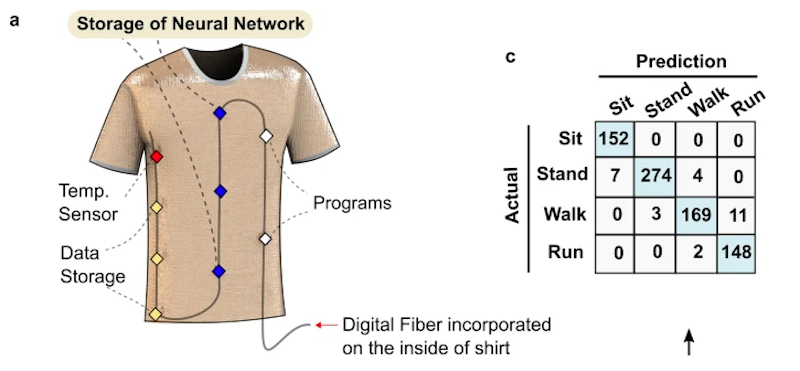
In the research, the fiber included memory, temperature sensors, and a neural network program. When sewn into a shirt near the armpit, it collected surface body temperature data and used that information to infer the wearer’s activity. In reported testing, the system reached high accuracy in identifying activity from the collected data.
That does not mean your T-shirt is peeking at you through tiny cartoon eyeballs. “Watches” here means sensing patterns: temperature shifts, movement clues, physiological signals, and context. It is less like a camera in your closet and more like a thread that can notice, remember, and help interpret what is happening around it.
Why Digital Fiber Is a Big Deal
Wearable technology is already popular. Smartwatches count steps, rings track sleep, earbuds monitor workouts, and phones behave like tiny bosses in our pockets. But most wearables share the same limitation: they sit in one place. A watch knows a lot about your wrist. It knows much less about your back, shoulders, chest, legs, and overall body movement.
Clothing, however, touches large areas of the body. A shirt, base layer, sock, sleeve, or pair of leggings sits close to the skin and moves naturally with the wearer. If those garments can sense and process data, they could provide a much richer view of health and activity than a single device on a wrist.
This is where fabric-based machine learning becomes exciting. The MIT fiber demonstrated that digital components inside a thread can support sensing, memory, and inference. Instead of collecting data and immediately shipping everything to a phone or cloud server, future fabric systems may process some information locally. That could reduce delays, improve privacy, and make smart clothing more useful in real-time situations.
Imagine a runner wearing a shirt that detects early signs of overheating. Picture a physical therapy sleeve that helps track motion quality after an injury. Think of a base layer for firefighters, soldiers, or Arctic researchers that monitors physiological stress in harsh environments. The same basic idea could apply to athletes, patients, workers, and everyday people who just want better health feedback without dressing like a cyborg who lost a bet.
How the Fiber Works Without Turning Clothes Into Gadgets
The magic begins with a preform, which is essentially a larger version of the fiber’s structure. Researchers place microscopic electronic chips into this preform, then draw it down into a long polymer fiber while maintaining electrical connections among the devices. This thermal drawing approach allows complex materials and components to be integrated into something thread-like.
The result is not a bulky circuit board taped to a shirt. It is a flexible strand that can be integrated into textiles. In MIT’s work, the fiber was thin enough to be passed through a needle and sewn into a garment. That detail sounds small, but it is huge. The difference between “wearable” and “wearable without feeling ridiculous” is comfort.
Good smart clothing has to behave like clothing first. It must bend, stretch, wash, breathe, and avoid scratching the wearer like a haunted sweater. If it feels like wearing a charging cable, consumers will politely decline and return to cotton.
MIT’s research also introduced the idea of addressing individual components inside the fiber. Think of the fiber as a hallway with many rooms, and each room has its own digital address. Instead of powering or reading everything at once, the system can communicate with specific elements. That kind of control is important for making smart fabrics scalable, efficient, and programmable.
The Fiber Can Store Data, Too
One of the most charming details from the MIT programmable fiber story is that it could store digital files. Researchers reported writing, storing, and reading data from the fiber, including a short color movie file and a music file. The data could remain stored without power for a period of time.
This is where the imagination starts sprinting. A wedding dress could store the couple’s first dance song. A museum textile could carry its own preservation history. A sports jersey could store performance records. A medical garment could preserve a limited local record of body signals for later review.
Is anyone urgently asking for pants that remember a video clip? Not exactly. But as a proof of concept, it is powerful. Storage inside a fiber shows that textiles can carry more than style, warmth, and the mysterious crumb that always appears in hoodie pockets. They can carry information.
That information dimension changes how designers, engineers, doctors, and manufacturers may think about fabric. A garment could become a platform. Threads could become infrastructure. Clothing could become an interface between the body and the digital world.
Smart Fabrics Are Not New, But MIT’s Approach Moves the Needle
Smart textiles have been developing for years. Researchers have explored fibers that detect light, fabrics that hear sound, textile sensors that measure strain, and garments that monitor breathing or body movement. Some projects use conductive yarns. Others print electronics onto fabric. Still others attach small devices to garments.
What makes MIT’s digital fiber stand out is the integration of digital electronics directly inside the fiber. Earlier smart textiles often depended on external electronics, analog signals, or bulky attachments. MIT’s work suggests a path toward fibers that are not just connected to electronics but are themselves part of the computing system.
That distinction matters. A shirt with a sensor clipped to it is still mostly a shirt plus a gadget. A shirt made from fibers that sense and compute begins to become something else entirely: a textile computer. The garment is not simply holding the technology. The garment is the technology.
Possible Uses: From Fitness to Healthcare
The most obvious application is health monitoring. A digital fiber garment could one day track temperature, heart rate, respiratory changes, motion, muscle activity, or signs of physical stress. This could help doctors monitor patients outside hospitals, support early detection of health changes, or give athletes more detailed training feedback.
For example, a smart shirt could notice patterns that suggest fatigue during a workout. A recovery garment could help measure whether a patient is moving correctly after surgery. A base layer used in extreme cold could provide warnings before dangerous physiological stress builds up. A work uniform could help monitor heat exposure for people in demanding environments.
These examples are especially compelling because clothing is already part of daily life. People may forget to wear a special device, but they rarely forget to wear clothes. Society generally appreciates that. Turning ordinary garments into unobtrusive monitoring systems could make health tracking feel less like a medical appointment and more like getting dressed.
The Privacy Question: When Your Shirt Knows Too Much
Of course, the phrase “clothing fiber watches you” raises an important question: who gets to see the data? Smart clothing could be helpful, but it could also become uncomfortable if privacy is handled poorly.
Body data is personal. Temperature, movement, sleep, stress signals, and activity patterns can reveal sensitive information about a person’s habits and health. If smart garments become common, they must be designed with clear rules around consent, storage, encryption, ownership, and deletion.
A useful smart shirt should not become a tattletale. It should not send unnecessary data to employers, insurers, advertisers, or random apps with suspiciously cheerful logos. Users need control. They should know what is being collected, where it is processed, how long it is stored, and whether it can be shared.
One promising idea is local processing. If a fabric can analyze some information on the garment itself, it may not need to transmit raw data constantly. That could make smart textiles safer and more practical. A shirt that says “your body temperature pattern looks unusual” is very different from a shirt that uploads every second of raw physiological data to a server farm named something like CloudBuddy.
Challenges Before Smart Clothing Goes Mainstream
MIT’s programmable fiber is impressive, but smart clothing still faces real-world challenges. Durability is one. Clothing is abused daily. It is stretched, folded, sweated into, washed, dried, forgotten in gym bags, and occasionally attacked by pets. Electronics must survive all of that.
Power is another challenge. Some fiber systems still require external power or control devices. Future versions need better integrated batteries, lower energy consumption, and safe charging methods. Nobody wants to ask, “Did I charge my socks?” before leaving the house.
Manufacturing is also difficult. For smart textiles to become common, they must be produced at scale without becoming wildly expensive. They need to work with knitting, weaving, sewing, cutting, washing, sizing, and fashion design. A brilliant fiber that cannot be manufactured affordably will remain a lab celebrity rather than a wardrobe staple.
There is also the issue of standards. Smart garments will need reliable ways to communicate with phones, medical systems, fitness platforms, and each other. They will need safety testing, repair options, recycling plans, and user-friendly controls. The future of clothing cannot depend on a 96-page instruction manual written by someone who thinks “simple setup” means “compile firmware.”
Why This Technology Feels So Strangeand So Logical
The idea of intelligent clothing feels strange because clothing has always been personal, familiar, and mostly passive. We choose clothes for comfort, appearance, weather, culture, identity, and occasionally because everything else is in the laundry. Turning fabric into a sensing platform changes the emotional meaning of garments.
At the same time, it is completely logical. Clothes are the objects most consistently in contact with our bodies. They move when we move. They sit close to vital signs. They cover more area than watches or phones. If engineers want better body data, fabric is an obvious frontier.
The best future version of this technology will not feel like wearing electronics. It will feel like wearing normal clothing that happens to be smarter. The technology should disappear into the textile, leaving the wearer with useful insights rather than visible wires and awkward blinking lights.
What “Clothing Fiber Watches You” Really Means
The phrase sounds dramatic, but the most accurate interpretation is that MIT’s fiber gives fabric a new kind of awareness. It can sense physical signals, store data, and support machine-learning inference. That is not the same as human vision, and it is not the same as a camera watching someone. It is closer to a textile nervous system.
In biological terms, skin is full of sensors. It detects heat, pressure, pain, and movement. Smart textiles could give clothing a similar role, acting as an artificial sensing layer around the body. That could help people understand performance, wellness, safety, and health in new ways.
In practical terms, the technology is still developing. It is not about replacing doctors, coaches, or common sense. It is about creating garments that gather better signals and help interpret them. The shirt of the future may not diagnose you at breakfast, but it might notice that your body is working harder than usual during a run, or that your recovery pattern has changed.
Experience Section: Living With the Idea of Clothing That Watches You
The first time you hear about clothing that can sense and analyze data, your brain may do a tiny backflip. Mine certainly did. A smart watch feels normal now because it has a screen, buttons, apps, and the personality of a tiny wrist computer. But a smart shirt? That feels different. Shirts are supposed to be soft, silent, and loyal. They are not supposed to have opinions about your squat form.
Still, the more you think about it, the more natural the idea becomes. During exercise, for example, people already rely on clothing for performance. Runners buy moisture-wicking shirts. Cyclists wear padded shorts. Hikers choose base layers that manage heat. Athletes already trust fabric to interact with the body. MIT’s digital fiber simply extends that relationship from comfort to information.
Imagine doing a home workout while wearing a smart training shirt. Instead of guessing whether you are moving evenly, the garment could detect patterns from multiple body zones. It might notice that one shoulder is rotating differently from the other, or that your temperature is climbing faster than usual. The feedback could be subtle: a phone notification, a coach dashboard, or a gentle vibration. Ideally, it would not shout, “Congratulations, your plank has emotionally collapsed.”
For healthcare, the experience could be even more meaningful. Many people dislike bulky medical monitors. They can feel clinical, inconvenient, and annoying to wear for long periods. A soft garment that quietly tracks relevant signals could make long-term monitoring easier. A patient recovering at home might wear a comfortable shirt that helps track breathing patterns or activity levels. A doctor could review trends instead of relying only on short clinic visits.
There is also a strong safety angle. Workers in hot environments, rescue teams, military personnel, and cold-weather explorers could benefit from clothing that notices stress before the person feels obvious symptoms. In dangerous conditions, early warnings matter. A base layer that monitors physical strain could act like a silent teammate. It would not replace training or judgment, but it could add another layer of protection.
Everyday consumers may adopt smart clothing slowly. People are practical. They will ask normal questions: Is it comfortable? Can I wash it? Is it expensive? Does it need charging? Will it share my data? Does it look like actual clothing or like I escaped from a prototype lab? These questions will decide whether smart textiles become mainstream or stay in research demonstrations.
The privacy experience will be just as important as the technical one. A smart garment should make the wearer feel empowered, not monitored. Clear controls, local processing, and transparent data policies will be essential. People may accept a shirt that helps them understand their health. They will be far less excited about a shirt that quietly feeds personal data into a mysterious corporate blender.
The most exciting version of MIT’s clothing fiber is not a creepy shirt that spies on you. It is a helpful fabric that works with you. It could make health monitoring less awkward, sports training more precise, and safety gear more intelligent. The technology still needs refinement, but the direction is fascinating. For centuries, clothing has protected us from the outside world. Now, it may also help us understand what is happening inside our own bodies.
Conclusion
MIT’s programmable clothing fiber shows how far smart textiles have come. By embedding digital devices, memory, sensors, and machine-learning capability into a flexible fiber, researchers have opened the door to garments that can sense, store, analyze, and infer. The technology is still developing, and challenges remain in power, durability, cost, privacy, and mass production. But the core idea is powerful: fabric can become more than fabric.
Clothing has always reflected who we are. In the future, it may also help reveal how we move, how we recover, how we perform, and how our bodies respond to the world. That future will need careful design and serious privacy protection. But if done well, smart clothing could become one of the most natural forms of wearable technology ever made. After all, the best wearable is the one you were already planning to wear.