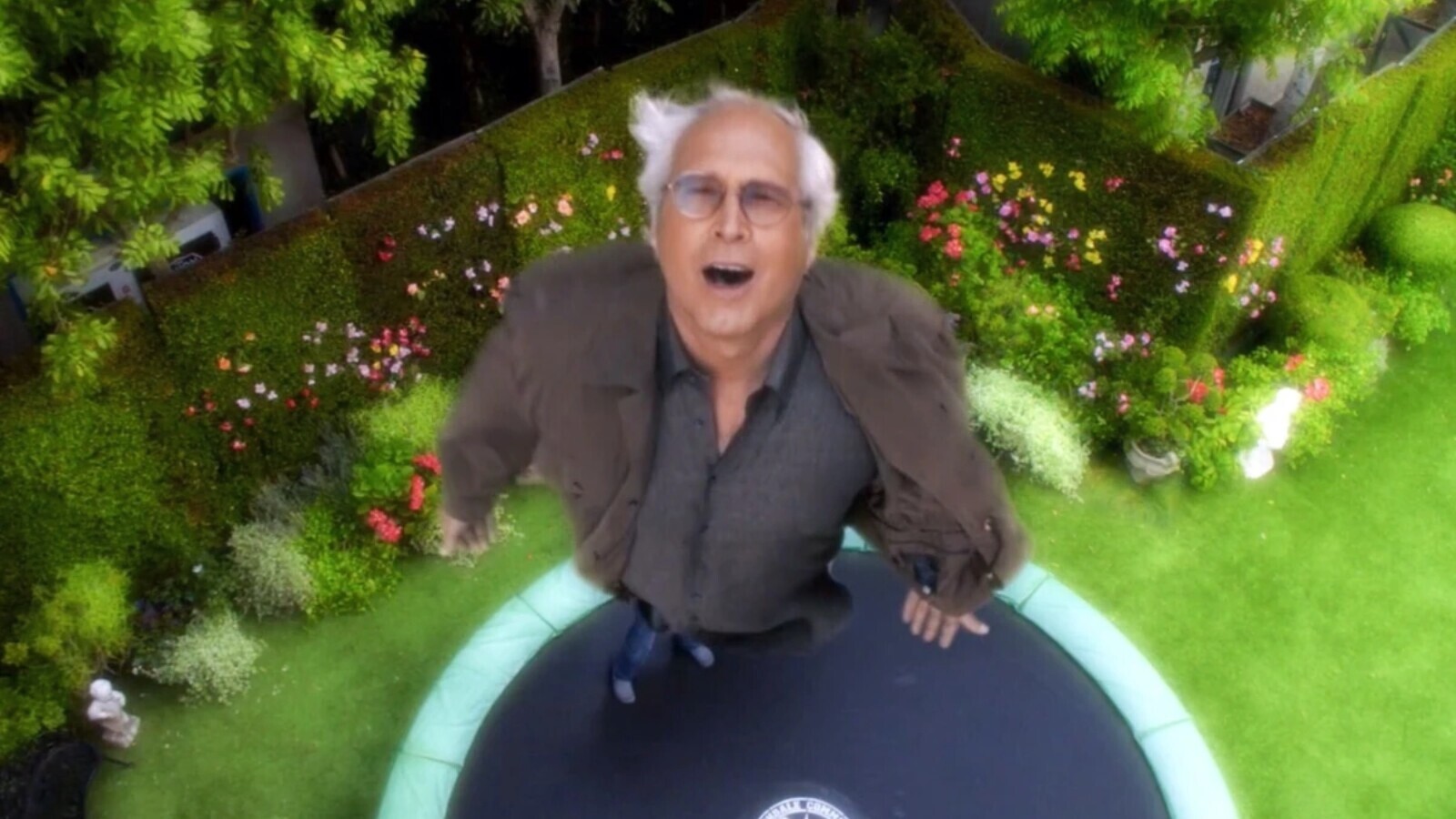

Some celebrity stories involve red carpets, private jets, and a publicist who somehow knows the exact percentage of sparkling water left in the room. Chris O’Connor’s story about Chevy Chase involves something much more relatable: a backyard trampoline, a teenager with too much confidence, and a comedy legend who apparently did not believe the sky was big enough for everyone.
During an appearance on Pardon My Take, comedian Chris O’Connor shared a wonderfully awkward memory from his younger years. O’Connor said he ended up at Chevy Chase’s home while attending an event connected to Chase’s daughter. Like many teenagers placed near a trampoline, O’Connor saw a large spring-loaded circle and made the only logical decision available to a high school freshman: he started jumping.
Then Chevy Chase noticed.
According to O’Connor’s retelling, Chase told him to get off the trampoline because it was dangerous. O’Connor complied. But the moment took an especially funny turn when Chase then got on the trampoline himself with O’Connor’s friend. The safety warning suddenly had a very specific target audience: not necessarily everyone, but definitely Chris.
That is why the story has stuck with audiences. It is not simply a tale about a famous actor and a trampoline. It is a miniature comedy sketch about celebrity encounters, teenage expectations, backyard etiquette, and the universal feeling of realizing that you are not the main character in someone else’s yard.
The Chevy Chase Trampoline Story, Explained
To be clear, the phrase “Chevy Chase kicked Chris O’Connor off a trampoline” is comic shorthand. O’Connor was not describing a physical kick or an injury. In his version of the story, Chase told him to stop jumping because it was unsafe. O’Connor got off, only to watch Chase take his place on the trampoline shortly afterward.
That twist is the engine of the whole anecdote. If Chase had simply said, “Please don’t jump on the trampoline,” the story would have been a normal adult-versus-teenager moment. Every neighborhood has one. But Chase getting on the trampoline afterward transforms the scene into something much stranger and funnier.
It becomes a story about access. Chris O’Connor could admire the trampoline from the sidelines, but Chevy Chase apparently held the keys to the aerial kingdom.
A Teenager Meets a Comedy Legend
O’Connor has explained that he was a high school freshman at the time. For a young person interested in comedy, meeting Chevy Chase would have felt like bumping into a living piece of television history. Chase became famous through Saturday Night Live and later starred in comedy staples such as Caddyshack, National Lampoon’s Vacation, and Fletch. To plenty of comedy fans, he represents the era when a raised eyebrow, a pratfall, or a smug grin could carry an entire scene.
That kind of celebrity meeting creates a special form of pressure. A teenager does not walk into the home of a famous comedian and calmly think, “I will behave with excellent social awareness today.” A teenager thinks, “There is a trampoline. This may be my moment.”
In O’Connor’s story, the trampoline becomes more than backyard equipment. It becomes a stage. He is not just jumping. He is trying to be memorable in front of someone whose career was built on physical comedy, timing, and making ordinary situations look ridiculous.
Unfortunately, every great stage needs a director. And in this case, the director apparently decided that O’Connor’s scene was over.
Why Chris O’Connor’s Story Is So Funny
The funniest stories are often built on a mismatch between expectation and reality. O’Connor likely expected a celebrity encounter to feel glamorous, encouraging, or at least mildly cinematic. Instead, he got a backyard safety lecture followed by the kind of reversal that makes a comedian remember the moment for years.
The humor comes from several layers working at once.
The Idol-and-Reality Collision
Meeting a celebrity can be strange because the person standing in front of you is both an ordinary human being and a giant collection of movies, sketches, quotes, magazine covers, and family arguments about which Vacation sequel was best. The brain struggles to process both versions at once.
O’Connor was not meeting a random adult named Chevy. He was meeting Chevy Chase, the man audiences associate with Clark Griswold’s chaos, Ty Webb’s effortless cool, and an entire generation of comedy. That makes a small interaction feel bigger than it really is.
And yet, in the moment, Chase was simply a homeowner looking at a teenager bouncing around in his yard. Celebrity mythology tends to collapse quickly when someone is worried about a trampoline.
The Timing Could Not Be Better
A good comedy story needs a turn. O’Connor gets one almost immediately. Chase says the trampoline is dangerous. O’Connor steps down. Then Chase starts using it himself.
That is classic comic contrast. The rule exists, but the rule has exceptions. The exception is the person making the rule. It is less “trampoline safety policy” and more “trampoline zoning law.”
Anyone who has ever been told, “You can’t do that,” only to watch another person do exactly that five minutes later understands the emotional shape of the joke. It is mildly unfair, deeply familiar, and funny once enough time has passed.
It Is a Story About Being a Kid Again
The story also works because it brings listeners back to childhood and adolescence. Most people remember a moment when they tried too hard to impress an adult, a coach, a friend’s parent, or someone they admired. Sometimes that attempt went well. Sometimes it ended with a sentence like, “Please stop doing that in my yard.”
O’Connor’s celebrity version is bigger than the average awkward memory, but the emotional core is universal. He wanted to have fun, make an impression, and maybe show a little personality. Instead, he became the person who had to get off the trampoline while everyone else watched.
That is not tragedy. That is content.
The Community Connection Makes the Story Even Stranger
Fans of Community may hear O’Connor’s story and immediately think of the show’s famous trampoline episode, “Aerodynamics of Gender.” Chevy Chase played Pierce Hawthorne on the series, and the episode features an elaborate secret trampoline plot involving Pierce and fellow student Jeff Winger.
The resemblance is amusing: Chevy Chase, a trampoline, unusual rules about who gets to jump, and a dose of competitive energy. It would be easy to imagine that the fictional trampoline chaos came from a real-life backyard story.
But there is no reason to treat that as fact. The connection is best enjoyed as a pop-culture coincidence. Sometimes life mirrors television. Sometimes television mirrors life. And sometimes a trampoline is simply a very efficient machine for generating bad decisions and excellent stories.
What makes the parallel fun is that Community often treated ordinary places as if they were epic worlds with their own rules. A backyard trampoline can become a secret society. A community college study group can become an action-movie crew. In O’Connor’s real-life version, the trampoline became a tiny kingdom with one very famous gatekeeper.
Who Is Chris O’Connor?
Chris O’Connor is a comedian, writer, actor, and podcaster originally from Philadelphia who later became part of the Austin comedy scene. He is known as one half of the comedy podcast Stuff Island, which he hosts with Tommy Pope. The show’s conversational format is well suited to stories like the Chevy Chase trampoline anecdote: odd memories are allowed to breathe, become funnier, and occasionally gain the dramatic structure of a minor Greek myth.
O’Connor has also appeared in the Netflix comedy Tires, where he plays Cal. The series centers on the chaotic world of an auto repair shop and leans into the kind of blunt, awkward humor that fits O’Connor’s storytelling style.
His trampoline story feels especially on-brand because it does not present him as the flawless hero of his own memory. He is not the teenager who impressed Chevy Chase with incredible athleticism. He is the teenager who got asked to stop, stepped aside, and watched the celebrity take over.
That willingness to be the butt of the joke is one reason stories like this travel so well online. People trust a storyteller who is willing to admit that, on at least one occasion, he lost a backyard power struggle to Chevy Chase.
Celebrity Encounters Are Better When They Are Weird
People often imagine celebrity encounters as neat little packages: a photo, a handshake, a compliment, maybe a signed napkin that later becomes a treasured family artifact. The memorable stories are usually messier.
A celebrity encounter becomes interesting when it includes an unexpected rule, a social misunderstanding, an awkward silence, or an object that should not matter as much as it does. In this case, the object is a trampoline. Not a yacht. Not an award show. Not a movie set. A trampoline.
That ordinary detail gives the anecdote its power. A trampoline belongs in the world of birthday parties, scraped knees, summer afternoons, and neighbors pretending not to notice that someone has been bouncing for two straight hours. Putting Chevy Chase into that setting makes him feel both more human and more surreal.
It is also a reminder that famous people still have houses, families, schedules, and personal boundaries. A celebrity may be associated with iconic fictional characters, but at home they are still allowed to make rules about the backyard equipment.
Of course, the story is much funnier when the rule appears to change the moment the celebrity wants a turn.
Trampoline Safety Is the One Part Nobody Should Ignore
There is a practical point hiding inside the comedy. Trampolines can cause serious injuries, especially when multiple people are jumping at once or when someone attempts tricks beyond their ability. Public health and pediatric safety organizations have long warned families to take trampoline risks seriously.
So, while the Chevy Chase trampoline story is funny as a tale of awkward celebrity hierarchy, the basic warning about safety was not absurd. The funny part is the timing and the apparent double standard in O’Connor’s memory, not the idea that trampolines require caution.
The sensible takeaway is not to recreate the scene. It is to enjoy the story from the comfort of solid ground, where the only thing likely to bounce unexpectedly is a group-chat notification.
Why the Story Keeps Resurfacing
Chris O’Connor’s Chevy Chase trampoline story has circulated because it checks several internet-friendly boxes at once. It is short, visual, odd, celebrity-adjacent, and easy to summarize in one sentence. Most importantly, it has a clean punchline: the kid gets told the trampoline is too dangerous, then watches Chevy Chase jump on it.
It also feels like a story from another era. There is something delightfully pre-social-media about a teenager visiting a celebrity’s house and experiencing a bizarre moment that is not recorded from six different angles. The memory survives because someone tells it well, not because an algorithm catches it on video.
O’Connor’s account shows why comedians collect awkward moments like baseball cards. A strange encounter may feel embarrassing when it happens, but years later it can become a polished story with rhythm, suspense, and a celebrity standing in the middle of the punchline.
In the end, the tale is not really about a trampoline. It is about the risk of meeting a hero, trying to be cool, and discovering that your big moment may end with you standing in the grass while Chevy Chase gets the better bounce.
Related Experiences: What the Trampoline Story Says About Awkward Memories
Every person has a smaller version of Chris O’Connor’s Chevy Chase moment. Maybe you tried to impress a teacher with a joke that landed like a dropped textbook. Maybe you volunteered for something before understanding what it involved. Maybe you walked into a friend’s house, sat in the wrong chair, and learned that the family dog, grandmother, or oddly territorial cat had a permanent claim on it.
Those moments can feel huge at the time because embarrassment has excellent sound design. It adds thunder, violins, and a dramatic close-up of your face while everyone else is probably thinking about snacks. Years later, though, the same moment becomes useful. It becomes a story.
That is one of the quiet lessons inside O’Connor’s anecdote. The teenager on the trampoline may have felt sidelined, but the adult comedian got a memorable bit. He turned a weird personal memory into a story that audiences could immediately picture: a young comedy fan, a famous comedian, a backyard trampoline, a warning about danger, and a final reversal.
The details matter because they make the memory believable. A generic story about meeting a celebrity might disappear from your mind before the next sentence. A story about being told to get off Chevy Chase’s trampoline is impossible to ignore. The trampoline gives the memory shape. The celebrity gives it scale. The awkwardness gives it heart.
There is also something reassuring about stories in which famous people are not presented as flawless movie characters. Chase is not described as Clark Griswold, Ty Webb, or Pierce Hawthorne. He is a person in his own yard making a decision about a trampoline. O’Connor is not presented as a future comedy star with perfect timing. He is a freshman who wanted to jump higher.
That contrast makes the moment feel real. Celebrity culture often makes people seem distant, polished, and impossible to understand. An odd backyard interaction brings everything back to earth, even if the story technically begins several feet above it.
The best personal stories are not always the impressive ones. Sometimes the best story is the time you lost an argument with a vending machine, got locked out of a hotel room in pajamas, waved enthusiastically at someone who was not waving at you, or got politely removed from a celebrity’s trampoline. These are the moments that reveal personality because they are not carefully planned.
They also remind us to give our awkward memories time. Not every embarrassing experience needs to become a life lesson immediately. Sometimes it just needs to sit in the memory bank for a few years until the right audience appears. Then, with good timing and enough self-awareness, it becomes the story everyone remembers.
Chris O’Connor’s story works because he does not try to win the old moment. He lets the moment stay strange. He accepts that Chevy Chase got the trampoline, and he got the punchline. In comedy, that can be an even better prize.
Conclusion
The story of Chris O’Connor and Chevy Chase’s trampoline is funny because it turns a tiny awkward interaction into a full comedy scene. O’Connor’s younger self saw a chance to bounce, impress, and maybe have a memorable celebrity encounter. Instead, he learned that the rules of a famous person’s backyard can change faster than a trampoline spring.
There was no dramatic physical confrontation, no Hollywood scandal, and no grand feud. Just a teenager, a celebrity, a safety warning, and one very specific trampoline policy. But that is exactly why the story works. It is small, weird, human, and impossible to forget.