
Note: This article discusses historical torture and punishment in an educational, non-graphic way. It focuses on context, power, myth, law, and human rights rather than sensational detail.
History has a way of reminding us that human creativity is not always something to applaud. For every cathedral, poem, navigation tool, and peach pie recipe that made civilization more delightful, there was also a dungeon, a public square, or a courtroom where punishment became theater. Torture was not merely about pain. It was about control, confession, humiliation, fear, and, very often, a government or ruler saying, “Watch closely; this is what happens when you challenge us.”
The phrase “death by 1,000 cuts” usually refers to lingchi, a form of execution used in imperial China and later remembered in Western writing with a mixture of horror, misunderstanding, and exaggeration. The expression now survives as a metaphor for slow destruction, but its roots are far darker. Across cultures, torture methods reflected legal systems, religious anxieties, class hierarchies, and public ideas of justice. Some devices were real. Some were rare. Some were exaggerated by museums, pamphlets, and popular culture because apparently humans looked at history and thought, “This needs more dramatic lighting.”
Below are 39 torture methods people once endured, explained with historical context and careful restraint. The goal is not to glorify cruelty but to understand how societies justified itand why modern human rights law treats torture as unacceptable under any circumstances.
Why Torture Was Used in the First Place
Before modern legal protections, torture often served three grim purposes. First, it was used to extract confessions, especially in systems where confession carried enormous legal weight. Second, it punished people publicly, turning suffering into a warning sign for everyone else. Third, it reinforced social order by targeting rebels, enslaved people, religious minorities, accused witches, political prisoners, and those considered “disobedient.”
In many places, torture was not hidden away in secret chambers. It was staged. Pillories stood in public markets. Executions drew crowds. A punishment could be as much a civic performance as a legal sentence. That public element matters because it shows torture was not only physical; it was psychological and social. The crowd became part of the punishment.
39 Horrifying Torture Methods People Once Endured
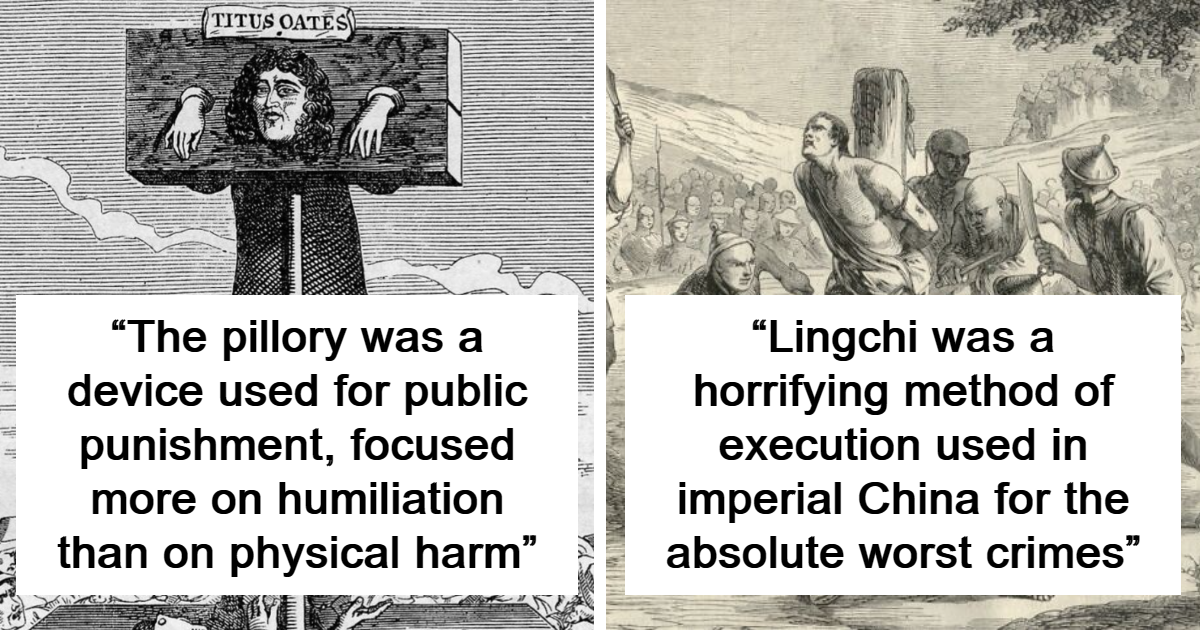
1. Lingchi, or “Death by 1,000 Cuts”
Lingchi was used in imperial China for severe crimes such as treason. Though the phrase “1,000 cuts” is often exaggerated in popular retellings, the punishment became infamous because it represented slow, public, total destruction of the condemned person’s dignity and body.
2. The Rack
The rack was a real torture instrument associated with early modern Europe. Prisoners were restrained on a frame while pressure was applied to force confessions or information. Its reputation became so powerful that “being racked” still suggests extreme strain.
3. Thumbscrews
Thumbscrews were small metal devices used to apply pressure to fingers or thumbs. Their size made them portable, which is probably the least comforting thing one can say about them.
4. The Breaking Wheel
The breaking wheel was used in parts of Europe as a public execution and punishment method. It symbolized how law could become ritualized violence, especially for crimes considered especially serious.
5. Crucifixion
Crucifixion was used by several ancient societies and became strongly associated with Rome. It combined execution, public humiliation, and political warning, particularly for enslaved people, rebels, and enemies of the state.
6. Impalement
Impalement appeared in several ancient and medieval contexts as a terror punishment. Its public display functioned as a message: the ruler’s authority was not merely legal but terrifyingly visible.
7. The Pillory
The pillory held a person’s head and hands in a wooden frame in a public place. It was designed for humiliation, but crowds could make the experience dangerous by throwing objects or insults.
8. Stocks
Stocks restrained the feet, usually in public spaces. They were often used for lesser offenses, but “lesser” did not mean harmless; exposure, shame, and crowd abuse could make the punishment severe.
9. Scold’s Bridle
The scold’s bridle, or branks, was a metal restraint used mainly against women accused of gossiping, arguing, or violating social expectations. It reveals how punishment often enforced gender roles as much as law.
10. Ducking Stool
Ducking stools were used in parts of England and colonial America to punish peopleoften womenaccused of being troublesome or disorderly. In witchcraft accusations, water-based ordeals reflected superstition more than justice.
11. Peine Forte et Dure
This English legal punishment was used against defendants who refused to enter a plea. It is remembered in American history because Giles Corey died under this punishment during the Salem witch trials.
12. The Scavenger’s Daughter
Used in Tudor England, the Scavenger’s Daughter compressed the body rather than stretching it like the rack. Its existence shows that state torture could be bureaucratic, named, stored, and deployed when authorities wanted information.
13. Manacles
Manacles were restraints used in prisons, ships, and interrogation settings. Even when simple, prolonged restraint could become a form of torture through discomfort, fear, and helplessness.
14. Strappado
The strappado involved suspension as punishment or interrogation. It appeared in several European contexts and became associated with coercive questioning.
15. The Judas Cradle
This device appears in torture museum collections and popular lists, though historians debate how commonly it was used. It is a good reminder that not every “medieval torture device” has equal evidence behind it.
16. The Iron Maiden
The iron maiden is one of the most famous examples of a likely myth or later invention. Despite its spooky museum appeal, strong evidence for medieval use is lacking. History, unfortunately, had enough real cruelty without needing this metal closet of doom.
17. The Brazen Bull
The brazen bull is described in ancient sources as a metal execution device linked to Greek legend. Whether every detail is historically reliable is debated, but the story reflects ancient fascination with tyrants and theatrical punishment.
18. Flogging
Flogging was widely used in military, naval, judicial, and slavery contexts. Because it was common, it is sometimes treated as ordinary in historical writing, but for those who endured it, it was a brutal assertion of authority.
19. Whipping Post
Whipping posts turned punishment into public display. They were used in Europe and colonial America, often for crimes that modern readers would not consider worthy of bodily punishment.
20. Branding
Branding marked people as criminals, enslaved individuals, or social outcasts. Its power came not only from immediate pain but from permanent stigma.
21. Mutilation as Punishment
Some legal systems punished theft, rebellion, or perceived dishonor through bodily mutilation. These penalties aimed to make the sentence visible long after the courtroom had emptied.
22. Public Shaming Cages
In some towns, people were confined in cages or suspended baskets for public ridicule. Such punishments blurred the line between legal penalty and community entertainment.
23. The Drunkard’s Cloak
The drunkard’s cloak, sometimes a barrel-like punishment garment, was used to shame people accused of public drunkenness. It shows that punishment often targeted reputation as much as the body.
24. Keelhauling
Keelhauling was a naval punishment associated with dragging a sailor beneath a ship. It became infamous in maritime lore and reflected the harsh discipline of life at sea.
25. Marooning
Marooning left someone isolated, often on an island or remote shore. Pirates and naval crews used it as a punishment that weaponized abandonment.
26. Solitary Confinement
Historical prisoners could be held alone for long periods as a psychological punishment. Unlike dramatic devices, isolation leaves fewer museum artifacts, but its effects could be devastating.
27. Sleep Deprivation
Preventing sleep has long been used to weaken resistance and break morale. It is a reminder that torture does not need elaborate equipment to be harmful.
28. Starvation and Deprivation
Food and water deprivation appeared in prisons, sieges, forced labor systems, and interrogation settings. The method relied on dependency: whoever controlled necessities controlled the person.
29. Exposure to Heat or Cold
Exposure punished people by leaving them vulnerable to weather. It was sometimes combined with public restraint, making nature part of the sentence.
30. Forced Standing
Forced standing appeared in various detention and interrogation settings. It seems simple until one remembers that the body is not built to be used as furniture indefinitely.
31. Stress Positions
Stress positions use posture to create pain and exhaustion. Historically and in modern abuse cases, they have been used because they can leave fewer obvious marks.
32. Water Ordeals
Water ordeals were used in witchcraft accusations and other trials by ordeal. These practices confused superstition with evidence and often placed the accused in impossible situations.
33. Burning at the Stake
Burning was used in parts of Europe for heresy, witchcraft, and other charges. It was not the main method in every witch trialSalem, for example, did not burn witchesbut it remains one of the most feared punishments in European memory.
34. Drawing and Quartering
In England, drawing and quartering was associated with treason. It was a political punishment meant to communicate that attacking the monarch or state would bring total public disgrace.
35. Hanging in Chains
Also called gibbeting, hanging in chains displayed bodies after execution. The point was not only death but a lasting public warning.
36. Forced Labor Under Brutal Conditions
Penal labor, galley slavery, mines, and prison camps could become torture through exhaustion, danger, and deliberate neglect. The punishment was sometimes disguised as productivity.
37. The Cangue
The cangue, used in China and other parts of East Asia, was a heavy wooden collar-like restraint that limited movement and exposed the person to public shame.
38. The Boot
The boot was a European torture device associated with pressure applied to the legs. Like many interrogation tools, it was meant to force speech by overwhelming resistance.
39. Mock Execution
Mock execution threatened death without immediately carrying it out. Its cruelty was psychological: the victim experienced terror, helplessness, and uncertainty as the punishment itself.
Real History vs. Dark Tourism Myths
One of the strangest parts of studying torture history is discovering how often myth and marketing sneak into the dungeon. Medieval torture museums sometimes display objects with dramatic labels, but historians warn that some famous devices were rare, exaggerated, misdated, or invented later. The iron maiden is the celebrity example. It looks like something a horror movie would order from a catalog, yet evidence for its medieval use is weak.
That does not make the real past gentle. The rack, thumbscrews, manacles, public whipping, and legal pressing were real enough. But separating fact from folklore matters. If we turn history into a carnival of fake spikes and spooky props, we miss the more important story: ordinary institutionscourts, monarchies, churches, armies, ships, plantations, prisonscould normalize cruelty when law failed to protect the powerless.
What These Methods Reveal About Power
The most frightening thing about historical torture is not always the device. It is the paperwork. Torture often came with warrants, court orders, officials, witnesses, and rules. A society could convince itself that cruelty was lawful if the right person signed the right document. That is why torture belongs not only in horror history but in legal history.
Many methods also targeted identity. Women were punished for speech. Enslaved people were punished to enforce ownership. Religious minorities were punished to enforce conformity. Political rebels were punished to protect rulers. In that sense, torture was not random violence. It was violence with a message, and the message usually said: “Stay in your place.”
Why Modern Law Rejects Torture
Today, torture is prohibited under international human rights law and humanitarian law. The United Nations Convention Against Torture requires states to criminalize acts of torture, and modern constitutional traditions, including the American ban on cruel and unusual punishment, reflect a long reaction against barbaric penalties. The legal shift did not happen because humans suddenly became perfect. Anyone who has read comment sections knows we are still a work in progress. But the principle matters: no government should have the authority to break a person for convenience, revenge, spectacle, or confession.
History also shows that torture is unreliable. People in extreme fear may say whatever they think will stop the suffering. Confessions extracted under torture can be false, forced, or politically useful rather than truthful. That makes torture not only immoral but bad at producing justice.
Experience-Based Reflections: Reading This History Without Turning It Into Entertainment
Researching a topic like “Death by 1,000 Cuts” is a strange experience. At first, the list format pulls you in because the human brain is nosy. We see a title promising 39 horrifying methods, and some ancient little gremlin in our attention span whispers, “Well, now we have to know.” But the deeper you go, the less it feels like a cabinet of curiosities and the more it feels like standing in front of a mirror held up to civilization.
The most memorable experience is not learning which device looked the scariest. It is realizing how many punishments were public. People gathered to watch. Vendors may have sold food nearby. Children could see what happened. Communities treated suffering as a lesson, a warning, and sometimes a spectacle. That is uncomfortable because it asks a modern reader a hard question: if we had lived then, would we have protested, looked away, or joined the crowd?
Museums and historical sites can make this even more complicated. A torture exhibit may be educational, but it can also slide into haunted-house territory. Dim lights, dramatic music, and overconfident labels can make the past feel like entertainment rather than human tragedy. The best historical experiences do the opposite. They explain who was punished, why the law allowed it, who benefited, and how societies changed. They remind visitors that the victim was not a prop in a scary story. The victim was a person with a name, family, fear, hopes, and a life interrupted by power.
Another powerful experience is noticing how language softens cruelty. Old records may describe torture with calm legal terms: examination, correction, discipline, pressing, restraint. The words sound tidy. The reality was not. That gap between official language and human experience is one reason history matters. It trains us to be suspicious when institutions use neat phrases to hide harm.
For writers, teachers, and curious readers, the challenge is balance. Too little detail can make the past feel abstract. Too much detail can become exploitative. The best approach is to describe enough to understand the method, then shift attention to context: What fear produced this punishment? What authority approved it? Who was most vulnerable? What changed so later generations rejected it?
In the end, the experience of studying historical torture should not leave us merely saying, “Wow, people were awful back then.” That is too easy, and also a little smug. A better conclusion is: societies must build protections because power without limits becomes dangerous. The story of torture is not just about old devices in dusty museums. It is about law, empathy, evidence, human dignity, and the ongoing need to prevent cruelty from dressing itself up as justice.
Conclusion
“Death by 1,000 Cuts” remains a chilling phrase because it captures more than one historical punishment. It describes how cruelty often works: slowly, publicly, and with the approval of people who claim it is necessary. The 39 methods above came from different cultures and centuries, but they share a common thread. They turned human beings into warnings.
Understanding these methods does not mean admiring them. It means recognizing the systems that allowed them to exist. Torture flourished where power faced few limits, where fear mattered more than evidence, and where public humiliation was mistaken for justice. Modern human rights principles grew partly from humanity’s long, painful recognition that punishment must have boundaries. History may be dark, but studying it carefully can make the present a little brighterand far less likely to keep a rack in the basement, which is a very low bar, but an important one.