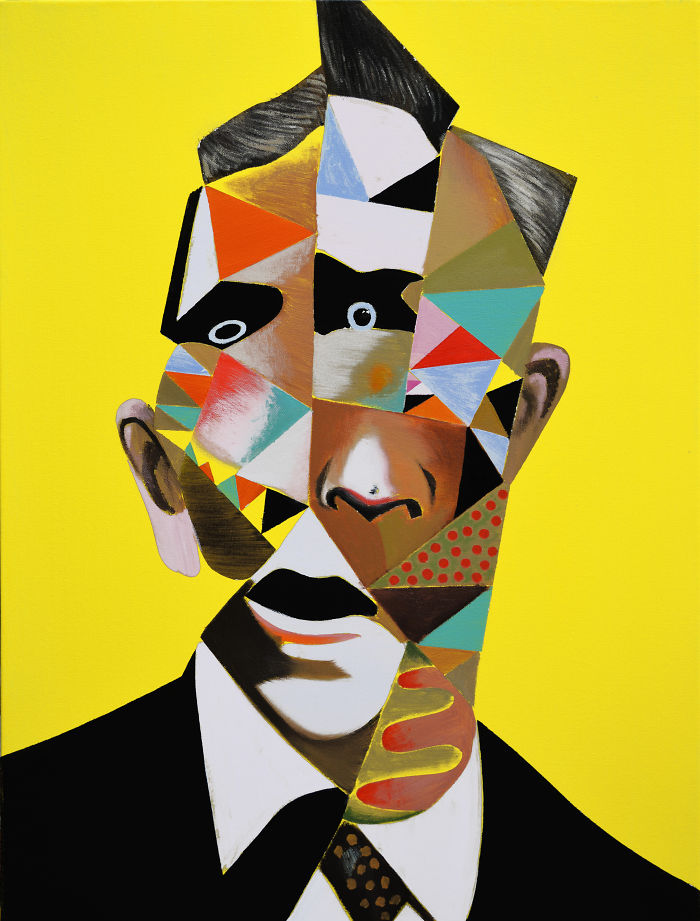

Nicholas Chistiakov, also known as Nicholaas Chiao, is one of those contemporary artists whose work refuses to sit politely in one labeled drawer. Portraiture? Yes. Abstraction? Absolutely. Conceptual art? Please pull up a chair. Deconstructivist painting? That is where things get especially interesting, because Chistiakov’s fractured figures and psychologically charged compositions seem to ask a simple but wonderfully inconvenient question: what if a portrait is not a face, but an argument?
Born in Minsk in 1981 and now associated with Brooklyn, New York, Chistiakov belongs to a generation of artists shaped by migration, cultural overlap, digital visual culture, and the aftershocks of modernism. His paintings often combine recognizable human forms with disrupted planes, broken surfaces, asymmetrical features, and emotional tension. The result is art that feels both intellectual and oddly humanlike a philosophy seminar accidentally wandered into a portrait studio and decided to stay for coffee.
This article explores the visual language of deconstructivist paintings by Nicholas Chistiakov, how his work connects to postmodern art, Cubism, neo-expressionism, and contemporary digital aesthetics, and why his paintings continue to attract viewers who enjoy art that does not hand them the answer on a silver platter.
Who Is Nicholas Chistiakov?
Nicholas Chistiakov is a Belarusian-American contemporary artist whose practice has been documented under several name variations, including Nicholaas Chiao, Nicholas Chistiakov, Nikolay Chistyakov, and Apolianorvs. His biography places him within a transnational creative story: born in Minsk during the Soviet era, later connected to formal art training at the Belarusian State Academy of Arts, and eventually active in New York’s art environment.
Artist profiles describe Chistiakov as a highly versatile painter and conceptual artist. His body of work includes portraits, figurative compositions, abstraction, neo-cubist paintings, photorealistic museum scenes, drawings, sculpture, installation ideas, and digital art. That range matters because his deconstructivist paintings are not isolated experiments. They are part of a wider practice that treats style as a toolbox rather than a prison sentence.
In many Chistiakov works, the subject is not simply painted; it is dismantled, reorganized, and made visually unstable. Faces may appear split into angular regions. Eyes may refuse to align like obedient little soldiers. Color may flatten space while a figure still holds emotional weight. The paintings feel constructed and interrupted at the same time, which is exactly where their energy lives.
What Makes a Painting “Deconstructivist”?
Deconstructivism is most commonly discussed in architecture, especially after the famous 1988 exhibition “Deconstructivist Architecture” at the Museum of Modern Art in New York. In that context, architects challenged clean modernist geometry with warped planes, diagonal tension, fragmentation, and a sense of controlled instability. Buildings seemed to twist, collide, or question their own structure. In other words, the walls had dramaand honestly, some buildings needed a personality.
When applied to painting, deconstructivism is less about literal buildings and more about visual logic. A deconstructivist painting may break the body into parts, disturb traditional perspective, challenge harmony, or make the viewer aware that images are constructed systems rather than neutral windows onto reality. It often asks viewers to look not only at what is represented, but at how representation itself is being pulled apart.
Chistiakov’s deconstructivist paintings fit naturally into this conversation. His work often uses fragmentation not as decoration, but as a way to express psychological complexity. A face becomes a site of collision: identity, social status, desire, anxiety, memory, and cultural performance all seem to crowd into the same frame. The painting does not whisper, “Here is a person.” It says, “Here is a person, but good luck pretending people are simple.”
The Influence of Cubism and Postmodern Art
To understand Chistiakov’s visual language, it helps to look backward. Cubism, developed by artists such as Pablo Picasso and Georges Braque in the early twentieth century, fractured objects and figures into multiple viewpoints. Instead of presenting a single stable perspective, Cubism suggested that reality could be seen from several angles at once. That idea changed the course of modern art and gave later artists permission to treat the picture plane like a stage for analysis.
Chistiakov’s deconstructivist portraits echo that heritage, but they are not simply Cubist throwbacks wearing a contemporary jacket. His paintings often feel more psychological and postmodern. Postmodern art questioned the purity, certainty, and heroic seriousness of modernism. It played with quotation, surface, repetition, cultural signs, and the strange experience of living in a world overloaded with images. Chistiakov’s work appears comfortable in that image-saturated world. It does not try to escape art history; it argues with it, borrows from it, and occasionally rearranges the furniture.
That is why his paintings can feel familiar and unfamiliar at once. A portrait may suggest Cubism, expressionism, digital distortion, and social satire in the same breath. The viewer recognizes the human figure, but the painting refuses to provide a soft landing. It keeps the surface active, unstable, and slightly mischievous.
Key Features of Nicholas Chistiakov’s Deconstructivist Paintings
1. Fragmented Faces and Bodies
One of the clearest characteristics of Chistiakov’s deconstructivist paintings is the fragmentation of the figure. Instead of presenting the face as a smooth, unified surface, he divides it into planes, sections, and visual interruptions. This can make a portrait feel like it is being assembled in real time. The sitter is not frozen; the identity is under construction.
This approach gives his portraits a strangely modern emotional charge. In daily life, people often perform different versions of themselves depending on context: professional self, private self, online self, exhausted self, “I definitely read the terms and conditions” self. Chistiakov’s broken surfaces seem to acknowledge that identity is rarely seamless.
2. Psychological Tension
Chistiakov’s work frequently carries a sense of unease, contemplation, or intensity. Even when the subject is still, the painting can feel mentally active. The disruption of symmetry is important here. Human beings instinctively search for faces and balance, so when a portrait gives us a face that is slightly misaligned, the brain perks up. It is like the painting has tapped the viewer on the shoulder and said, “Something is happening here.”
The tension does not always come from dramatic subject matter. Sometimes it comes from the composition itself: a tilted eye, a sharp color contrast, a flattened background, or a face that seems to look both outward and inward. Chistiakov uses distortion to suggest that interior life is not always tidy.
3. Bold Color and Graphic Impact
Many works associated with Chistiakov’s broader practice show an interest in strong color, graphic clarity, and immediate visual presence. In deconstructivist portraits, color can help separate planes of the face or sharpen the emotional temperature of the image. A saturated background may make a figure appear theatrical. A bright facial zone may feel almost digital. A darker passage can create weight or mystery.
The effect is contemporary without becoming cold. His color choices often create a push-pull between intellectual structure and raw feeling. That balance is one reason the paintings work: they have enough order to be readable and enough disorder to keep the viewer from mentally checking out.
4. A Dialogue Between Painting and Digital Culture
Chistiakov has also been associated with digitally produced art and photo-based painting. That matters because contemporary viewers are surrounded by edited images, filters, glitches, compressed faces, algorithmic feeds, and screen-based distortions. Deconstructivist painting can feel especially relevant in this environment because it mirrors the way images are now processed, fragmented, and redistributed.
In Chistiakov’s hands, deconstruction is not only an art-historical strategy. It also feels like a response to modern perception. We do not encounter people through one pure, uninterrupted view. We see profiles, selfies, thumbnails, search results, memories, rumors, and social signals. His fractured paintings quietly admit that the modern portrait may need a few cracks to be honest.
Important Themes in Chistiakov’s Work
Identity as Construction
At the heart of Chistiakov’s deconstructivist paintings is the idea that identity is built, not simply revealed. His portraits often look assembled from competing parts, as if the person in the painting exists between social role, inner feeling, and visual mask. This makes the work especially relevant in an age when people constantly curate versions of themselves online and offline.
Beauty Under Pressure
Traditional portraiture often aims to flatter, preserve, or idealize. Chistiakov’s deconstructivist paintings are less interested in making the subject behave. Beauty appears, but it is pressured by distortion. The face may be elegant and awkward, attractive and unsettling, composed and fragmented. This combination gives the work its bite. The paintings are not anti-beauty; they simply refuse to let beauty become lazy.
The Artist as Curator of Art History
Chistiakov’s broader project shows a strong awareness of historical styles and artistic categories. Rather than choosing one movement and pledging lifelong loyalty like an art-school knight, he moves across photorealism, neo-cubism, conceptual art, expressionism, and abstraction. His deconstructivist paintings therefore feel like part of a larger curatorial attitude: art history is not a museum hallway one walks through politely; it is raw material to be tested, challenged, and recombined.
How to Read a Deconstructivist Painting by Nicholas Chistiakov
Looking at a deconstructivist painting can be intimidating if you expect art to behave like a clear instruction manual. Chistiakov’s work is better approached as a visual conversation. Start with the figure. Is the person recognizable? Where does the face hold together, and where does it break apart? Notice whether the eyes align, whether the head feels stable, and whether the background supports or isolates the figure.
Next, examine the planes. Many deconstructivist portraits use geometric divisions to create rhythm. These divisions may guide the eye across the face in a nontraditional way. Instead of moving naturally from eyes to nose to mouth, the viewer may bounce between color fields, angles, and interruptions. This is part of the experience. The painting is training the viewer to see identity as layered and unstable.
Finally, consider the emotional result. Does the painting feel comic, anxious, grand, strange, elegant, confrontational, or lonely? Chistiakov’s best deconstructivist works often live in mixed emotional territory. They do not offer one clean mood. They create a space where wit and discomfort can share the same chair, which is brave because discomfort usually hogs the armrest.
Why These Paintings Matter in Contemporary Art
Chistiakov’s deconstructivist paintings matter because they speak to a central problem of contemporary visual culture: how can painting still say something meaningful when the world is flooded with images? One answer is to slow the viewer down. A conventional image can be consumed quickly. A fragmented portrait resists that speed. It demands reconstruction.
His work also shows how older visual strategies can remain alive when filtered through new concerns. Cubist fragmentation, postmodern quotation, expressionist intensity, and digital-age distortion all appear to meet in his paintings. The result is not a nostalgic return to the avant-garde but a contemporary remix of its most useful tools.
For collectors, students, and art lovers, Chistiakov’s paintings offer an accessible entry point into difficult ideas. You do not need a PhD in post-structuralist theory to feel the impact of a broken face staring back at you. The theory helps, but the image does plenty of work on its own.
Specific Examples and Visual Impressions
Works described in connection with Chistiakov’s deconstructivist and neo-cubist practice often focus on portraiture and the transformation of the human figure. Titles such as deconstructivist portraits and neo-cubist portrait works suggest his recurring interest in the face as a formal and psychological site. In these paintings, the face is not destroyed; it is reorganized. That distinction is important. Deconstruction is not vandalism. It is analysis with a paintbrush.
Other parts of Chistiakov’s career, including photorealistic museum interiors and expressive animal paintings such as his well-known cat-themed works, show that he is not confined to one visual mood. This diversity strengthens the deconstructivist pieces because it suggests choice rather than limitation. He can paint with realism, expression, concept, or fragmentation depending on the problem he wants the artwork to solve.
Experience-Based Reflections: Encountering Chistiakov’s Deconstructivist Paintings
Experiencing deconstructivist paintings by Nicholas Chistiakov is not like scrolling past a pretty landscape and thinking, “Nice tree, respectable cloud, ten out of ten would picnic.” These works ask for a slower, more active kind of looking. At first glance, a viewer may notice the figure, the color, or the broken facial structure. The painting seems readable, but only partly. Then the second glance arrives, and that is where the real encounter begins.
The most memorable experience of viewing this kind of painting is the feeling that the image is both open and guarded. A face may appear directly in front of you, yet the fragmentation prevents easy intimacy. You are looking at someone, but you are also looking at the systems that make a person visible: pose, surface, geometry, expression, color, and cultural reference. The painting becomes less like a window and more like a puzzle with emotional weather.
For students of art, Chistiakov’s deconstructivist paintings can be especially useful because they demonstrate how an artist can borrow from art history without becoming trapped by it. The works may remind viewers of Cubism, but they do not feel like classroom exercises. They may suggest postmodern theory, but they still operate visually. This combination makes them good teaching objects. They help explain how contemporary artists transform inherited styles into personal languages.
For casual viewers, the experience can be more immediate. The face looks strange; therefore, we keep looking. The asymmetry creates curiosity. The colors build mood. The broken planes turn recognition into an event rather than a reflex. In a world where images are often designed to be understood in half a second, this resistance feels refreshing. The painting does not chase the viewer. It waits, slightly suspiciously, like a cat near an expensive vase.
Collectors may experience these paintings through a different lens. A deconstructivist portrait can bring intellectual energy into a room without losing human presence. It is abstract enough to feel sophisticated, figurative enough to remain emotionally accessible, and unusual enough to start conversations. Unlike purely decorative art, it does not fade into the wallpaper. It keeps speaking, sometimes politely and sometimes with elbows.
Artists can also learn from Chistiakov’s willingness to move between styles. His practice suggests that consistency does not always mean repetition. A consistent artistic identity can emerge through recurring questions rather than one repeated look. In his case, those questions include: How does identity form? How does art history survive in contemporary culture? How can a painting show both surface and inner pressure? These questions give the work continuity even when the style shifts.
The experience of Chistiakov’s deconstructivist paintings ultimately depends on accepting uncertainty. The viewer does not need to “solve” the painting. Instead, the reward comes from noticing how recognition breaks, reforms, and breaks again. The image becomes a small theater of modern identity: unstable, layered, funny in unexpected places, and not always interested in behaving. That is precisely what makes the work worth returning to.
Conclusion
Deconstructivist paintings by Nicholas Chistiakov stand at the intersection of portraiture, postmodern thought, Cubist inheritance, expressionist mood, and contemporary image culture. They are visually fractured but not careless, intellectual but not lifeless, and emotionally charged without turning into melodrama. Chistiakov uses broken planes, asymmetry, bold color, and psychological tension to make portraits that feel suited to modern identity: layered, performed, interrupted, and constantly under revision.
In a crowded contemporary art world, his deconstructivist works offer something valuable: paintings that make viewers participate. They do not simply show a face; they ask how a face becomes meaningful. They do not merely display style; they question what style can still do. And they prove that fragmentation, when handled with purpose, can reveal more than smoothness ever could.