Hackaday Prize 2023: Explore The Basics Of Neuroscience With This Electronic Neuron

Brains are ridiculous. They let us write poetry, remember where we left the soldering iron, and occasionally walk into a room only to forget why we are there. Yet the basic language of the nervous system is surprisingly approachable: tiny electrical changes, thresholds, pulses, and connections. That is exactly why the Lu.i educational neuron PCB, featured in the Hackaday Prize 2023 ecosystem, is so charming. It turns neuroscience from “please memorize this graph” into “watch these LEDs behave like a tiny thinking potato.”
Lu.i is an electronic neuron designed to demonstrate the core behavior of biological neurons using analog electronics. It is not a medical device, not a replacement for real electrophysiology, and definitely not a pocket-sized brain with opinions about your coffee. Instead, it is a hands-on teaching tool that helps students, makers, and curious adults understand how neurons receive signals, integrate them over time, and fire when a threshold is reached.
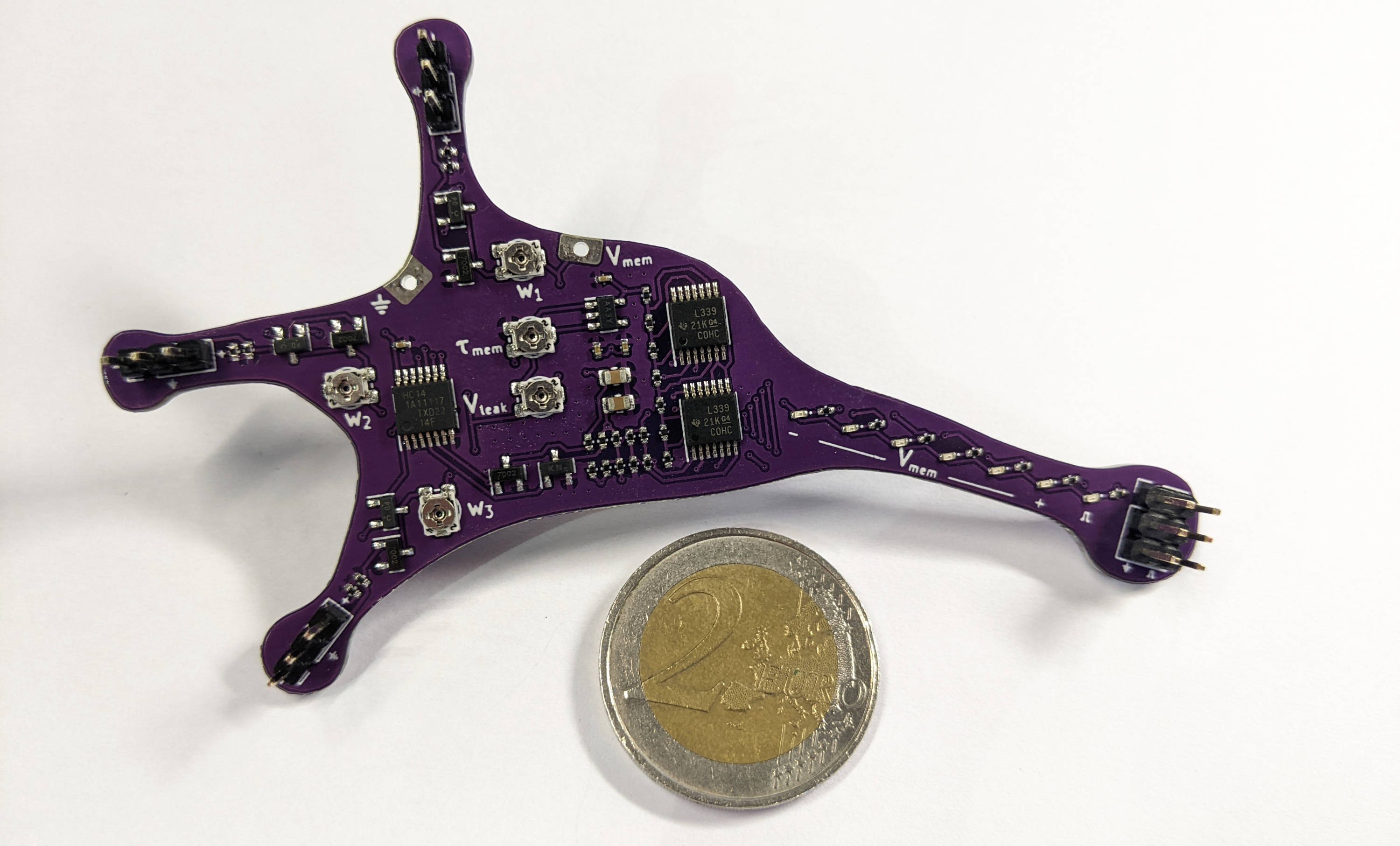
In the world of STEM education, that matters. Neuroscience can become abstract very quickly. Words like “membrane potential,” “synaptic weight,” and “leaky integrate-and-fire model” tend to make beginners stare into the distance as if their own neurons have entered airplane mode. Lu.i solves that problem by giving those ideas a physical shape: a neuron-shaped printed circuit board with visible inputs, outputs, and an LED bar that shows the changing internal state.
What Is Lu.i, the Electronic Neuron?
Lu.i is a small, low-cost, open-hardware electronic neuron PCB created to mimic the basic dynamics of a biological neuron. Its name is an homage to Louis Lapicque, the scientist associated with the leaky integrate-and-fire model, one of the classic mathematical models used to describe neuronal behavior. In plain English, that model says a neuron collects incoming signals, slowly “leaks” charge over time, and fires a spike when its internal voltage crosses a threshold.
That sounds simple, but it captures a powerful idea. A real neuron does not respond to every tiny input as if someone hit the emergency button. Instead, it integrates many incoming signals. Some push it closer to firing. Others pull it away. If the combined effect is strong enough, the neuron generates an action potential, a rapid electrical event that travels along the cell and helps communicate with other cells.
Lu.i recreates this logic using analog electronics. Op-amps, comparators, capacitors, resistors, and transistor-based synapses work together to imitate the timing and threshold behavior of neurons. The board includes excitatory and inhibitory synaptic inputs, which means one signal can raise the neuron’s internal voltage while another can lower it. That alone makes it a tiny classroom drama: one input yells “fire!” while another says “calm down, buddy.”
Why the Hackaday Prize 2023 Connection Matters
The Hackaday Prize has long celebrated open-source hardware projects that do more than blink LEDs for the sake of blinking LEDs, noble though that ancient tradition may be. The 2023 edition included a “Re-engineering Education” challenge, and Lu.i fit beautifully into that theme. It is not simply an electronics project. It is a learning instrument.
Education-focused hardware is especially valuable when it makes invisible systems visible. You cannot see sodium and potassium ions moving across a neuronal membrane with your eyeballs. You cannot easily watch synaptic integration happening inside a brain cell during a normal classroom demo. But with Lu.i, learners can see the analog equivalent of membrane potential rise and fall on an LED display. They can connect multiple boards together and observe how spike-based communication creates network behavior.
This is the heart of great educational hardware: it does not just explain a concept; it lets the learner poke the concept with a jumper wire.
The Neuroscience Behind the Board
Membrane Potential: The Neuron’s Mood Meter
A biological neuron has an electrical difference across its membrane. This is called membrane potential. At rest, the inside of a neuron is usually more negative than the outside. When inputs arrive, ion channels can change that voltage. If the membrane becomes less negative, the neuron moves toward firing. If it becomes more negative, it moves away from firing.
Lu.i represents this changing internal voltage with a VU-meter-style LED chain. Instead of staring at a graph in a textbook, learners can watch the “mood meter” of the neuron climb. The higher the internal voltage, the closer the electronic neuron is to producing a spike. It is a brilliant visual shortcut because it maps an abstract biological process onto something instantly readable.
Action Potentials: The Famous Spike
An action potential is a rapid change in voltage that lets neurons send information. In biological neurons, this involves voltage-gated ion channels, especially sodium and potassium channels. In a simplified educational model, the most important idea is threshold. Below threshold, no spike. At or above threshold, the neuron fires.
This “all-or-nothing” behavior is one reason neurons are so fascinating. A weak input may do nothing. Several weak inputs arriving close together may add up and trigger a spike. A strong input may fire the neuron immediately. Lu.i demonstrates this beautifully because students can adjust inputs and see when the board crosses the firing threshold.
Synapses: Where Neurons Gossip
Neurons communicate through synapses. A synapse can excite the next neuron, making it more likely to fire, or inhibit it, making it less likely to fire. Lu.i includes tunable synapses that can be set as excitatory or inhibitory. That makes it possible to build small networks that demonstrate competition, feedback, rhythm generation, logic-like behavior, and other foundational neuroscience ideas.
In other words, one Lu.i board is a neuron lesson. Several Lu.i boards become a miniature nervous system playground. Add jumper wires and suddenly the lesson has a plot.
How Lu.i Makes Neuroscience Easier to Learn
The problem with teaching neuroscience is not that the subject is boring. The problem is that the interesting parts often happen too fast, too small, or too invisibly for beginners to feel connected to them. Students are commonly shown diagrams, equations, or simulation plots. Those are useful, but they can feel detached from reality.
Lu.i closes that gap. The board lets learners physically connect inputs, tune parameters, and watch signals move through a network. This type of learning matters because the brain loves feedback. When a student turns a knob and sees the LED pattern change, the concept becomes less like vocabulary and more like cause and effect.
It also helps connect neuroscience with electronics. A capacitor can behave like a tiny storage element for charge. A resistor can model leak. A comparator can detect threshold. A transistor can route a signal. Suddenly, the same components used in hobby electronics become metaphors for biological computation. That is deliciously nerdy, like discovering your toaster has been secretly teaching philosophy.
Electronic Neuron vs. Biological Neuron
Of course, Lu.i is a simplified model. A real biological neuron is vastly more complex. It has branching dendrites, ion channels with different kinetics, chemical signaling, gene expression, molecular machinery, and an entire cellular life that no small PCB can fully capture. Real neurons also come in many shapes and types, each with distinct firing patterns and roles.
But simplified models are not a weakness. They are how learning starts. A globe is not Earth, but it is still useful. A circuit diagram is not a thunderstorm, but it can teach electricity. Lu.i is not a neuron in the biological sense, but it captures enough of the firing logic to help beginners understand the basics.
The leaky integrate-and-fire model is especially helpful because it strips the neuron down to a few essential behaviors: incoming signals add up, voltage leaks away, and a spike occurs at threshold. That makes it ideal for education, outreach, and early exploration of neuromorphic engineering.
Why Analog Electronics Are Perfect for This Job
Modern life is full of digital devices, so it is tempting to teach every computational idea with software. But neurons are not little laptops running Python under the skull. Their behavior is physical, continuous, and electrical. Analog electronics offer a natural way to model that behavior because voltages and currents can evolve smoothly over time.
In Lu.i, the gradual rise and decay of membrane potential can be represented directly by circuit behavior. This gives learners a more intuitive sense of time constants, thresholds, and signal integration. Instead of watching numbers update on a screen, they watch a circuit breathe.
Analog also makes the project feel honest. There is no hidden app doing all the thinking behind a glossy interface. The components on the board are part of the lesson. A student can ask, “What does this op-amp do?” or “Why does this capacitor affect timing?” The hardware invites investigation.
What Can You Build With Multiple Electronic Neurons?
A single electronic neuron is useful, but the real fun starts when multiple boards are connected. With several Lu.i units, learners can explore how simple neuron-like elements create more complex behavior. A network can demonstrate oscillation, where activity cycles rhythmically. Another setup can show inhibition, where one neuron suppresses another. More advanced examples can resemble logic operations, proving that spike-based systems can process information in ways that feel both biological and computational.
This is where Lu.i becomes more than a classroom prop. It becomes a bridge between neuroscience and neuromorphic engineering. Neuromorphic systems use brain-inspired principles to process information, often emphasizing spikes, parallelism, low-power operation, and event-driven computation. Lu.i gives learners a friendly entry point into those ideas without requiring a graduate degree, a cleanroom, or a caffeine budget large enough to worry an accountant.
Who Should Care About This Project?
Students
Students can use Lu.i to understand action potentials, thresholds, excitatory inputs, inhibitory inputs, and network behavior. It is especially helpful for learners who understand concepts better when they can touch, test, and modify a system.
Teachers
Teachers can use electronic neurons to turn a lecture into a demonstration. Instead of saying “a neuron integrates inputs,” they can show it. That shift can change the entire energy of a lesson.
Makers and Hardware Hackers
Makers get a satisfying mix of biology, analog electronics, PCB design, and open-source hardware culture. It is the kind of project that makes you say, “I was just going to read one article,” and then three hours later you are pricing op-amps and wondering whether your desk has room for a miniature nervous system.
Neuroscience Communicators
Science communicators often need tools that make complex ideas feel approachable. Lu.i is visually friendly, physically interactive, and conceptually rich. That makes it useful for workshops, outreach events, demonstrations, and informal learning spaces.
Specific Examples of Learning Activities
One simple activity is threshold testing. A student can apply small inputs and observe that the neuron does not fire until enough excitation accumulates. Then the student can increase the input strength or timing and watch the board spike. This illustrates how neurons are selective, not twitchy little drama queens firing at every whisper.
Another activity is inhibition. Connect an inhibitory input and observe how it reduces the chance of firing. This helps explain how nervous systems balance excitation and inhibition. Without inhibition, neural networks can become unstable. Without excitation, nothing happens. A healthy nervous system is not a chorus of everyone shouting; it is more like a well-run group chat with moderators.
A third activity is network construction. Connect several boards so that one neuron’s spike affects another. Students can explore how timing, connection strength, and feedback loops change the network’s behavior. This introduces larger ideas such as pattern generation, signal routing, and distributed computation.
Why Lu.i Feels Like the Right Kind of STEM Tool
The best STEM tools have a certain personality. They invite mistakes. They reward curiosity. They do not hide every mechanism behind software. Lu.i has that quality. It is visible, adjustable, and playful. The neuron-shaped PCB is not just decorative; it helps learners connect the object to the biological concept. The LEDs are not just pretty; they reveal the internal state. The jumper connections are not just convenient; they encourage experimentation.
That combination is powerful because it supports several learning styles at once. Visual learners see the membrane potential. Hands-on learners wire the network. Conceptual learners connect the circuit model to neuroscience. Electronics learners investigate the components. Everyone gets at least one way into the topic.
Limitations: What Lu.i Does Not Teach by Itself
Lu.i is excellent for the basics, but it should not be mistaken for a full model of neural biology. It does not capture every ion channel, neurotransmitter system, dendritic computation, or cellular process involved in real neurons. It also does not replace wet-lab tools, electrophysiology experiments, or computational neuroscience simulations.
That is completely fine. A beginner does not need the entire molecular circus on day one. The value of Lu.i is that it provides a clear starting point. Once learners understand spikes, thresholds, integration, leakage, excitation, and inhibition, they are better prepared for deeper topics such as Hodgkin-Huxley models, synaptic plasticity, brain-computer interfaces, and neuromorphic chips.
Hands-On Experiences Related to This Electronic Neuron
Working with a project like Lu.i feels different from reading about neurons because it turns the learner into a participant. Imagine sitting at a table with a few purple neuron-shaped boards, a handful of jumper wires, and the quiet confidence of someone who has not yet accidentally connected the wrong pin. The first moment of understanding often comes when the LED bar begins to climb. It is a small visual effect, but it carries a big idea: the neuron is accumulating input.
At first, you may treat the board like a mysterious gadget. You trigger an input, watch the LEDs, and wait for the spike indicator to flash. Then you change the input strength. The behavior changes. You adjust timing. The behavior changes again. The lesson sneaks up on you. You are no longer memorizing the phrase “temporal summation.” You are watching it happen in front of you.
One of the most memorable experiences is discovering that weak signals can matter when they arrive together. A single input might fade away before reaching threshold. Two inputs close together might push the neuron over the edge. That is a beautiful teaching moment because it explains why timing is central to neural communication. The nervous system is not only about signal strength; it is also about when signals arrive.
Another satisfying experience is using inhibition. Beginners often imagine neurons as simple “on” switches, but inhibition shows that neural networks depend on restraint as much as activation. When an inhibitory input pulls the membrane potential down, the board becomes less likely to fire. This makes the balance of excitation and inhibition feel concrete. It is the electronics version of a friend saying, “Maybe do not send that email at 1:00 a.m.”
Connecting multiple boards is where the experience becomes delightfully chaotic. One neuron fires and sends a pulse to another. A second board responds, maybe firing immediately, maybe hesitating, maybe staying quiet because another input is holding it back. With only a few connections, the setup begins to feel alive in the educational sense. It is not conscious, of course, but it behaves dynamically enough to make students lean closer.
For teachers, the experience can be refreshing because the project naturally creates questions. Why did this neuron fire faster? Why did the signal fade? Why did adding an inhibitory connection stop the pattern? Why does feedback create rhythm? Those questions are gold. They move the classroom from passive listening to active investigation.
For hobbyists, Lu.i also offers a satisfying electronics lesson. It shows that analog circuits are not dusty relics from the era of beige oscilloscopes. They are elegant tools for modeling real-world systems. A capacitor can become a membrane. A comparator can become a threshold detector. A transistor network can become a synapse. The project reminds us that electronics can explain biology, and biology can inspire electronics.
The biggest experience-related takeaway is this: Lu.i makes neuroscience feel less intimidating. It does not reduce the wonder of the brain. If anything, it increases it. Once you see how much behavior can emerge from a few simple neuron-like circuits, the actual brain seems even more astonishing. Billions of real neurons, trillions of synaptic interactions, chemical signals, plasticity, development, memory, sensation, movement, emotionthe whole glorious thunderstorm begins with electrical events that a small PCB can help us understand.
Conclusion
The Hackaday Prize 2023 project Lu.i is a wonderful example of what educational hardware can do when it respects both science and curiosity. It takes the leaky integrate-and-fire model, one of neuroscience’s foundational simplifications, and turns it into a physical, visual, adjustable electronic neuron. Learners can see membrane potential, trigger spikes, tune synaptic behavior, and connect boards into small networks.
That makes Lu.i more than a clever circuit. It is a bridge between biology and electronics, between textbooks and experiments, between abstract models and hands-on understanding. It shows that neuroscience does not have to begin with a wall of equations. Sometimes it can begin with a purple PCB, a few jumper wires, and the tiny thrill of watching a fake neuron fire for the first time.