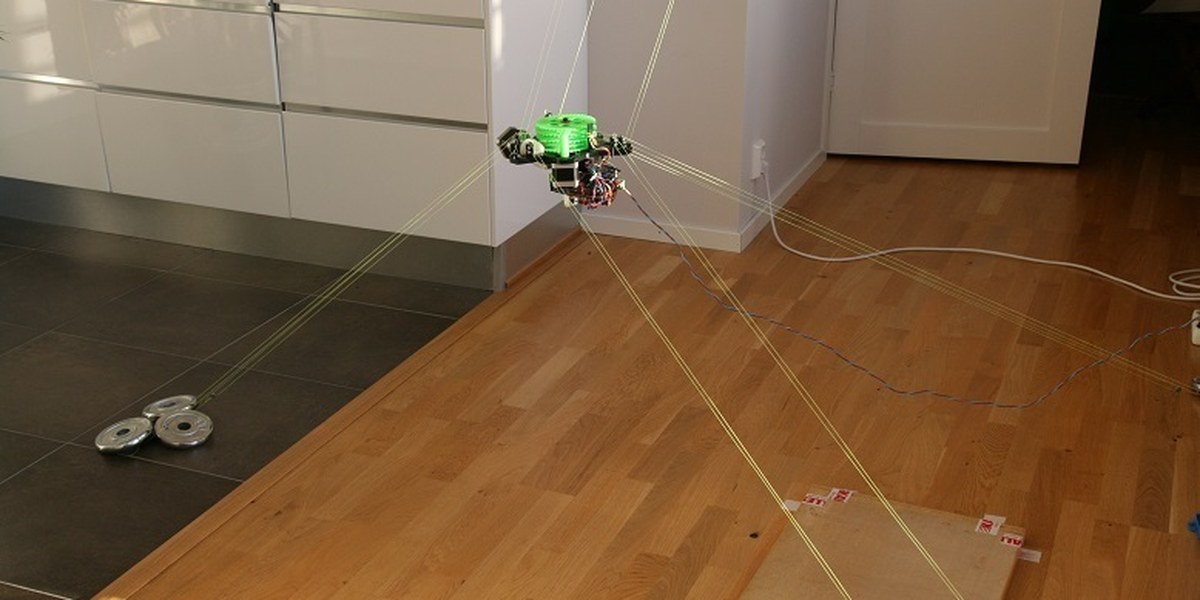

A conventional desktop 3D printer politely occupies a corner of your workshop. The Hangprinter takes a different approach: it looks around, notices the walls and ceiling, and claims the whole room as part of the machine.
Created by Swedish inventor Torbjørn Ludvigsen, this open-source, cable-driven 3D printer replaces the familiar metal frame with strong lines, anchors, pulleys, and synchronized motors. Its printhead hangs in the air like a very precise mechanical spider, moving through a workspace that can be dramatically larger than the build volume of an ordinary printer. The original prototype attracted international attention after producing a roughly five-foot-tall model inspired by the Tower of Babel.
The result is more than a memorable maker project. Hangprinter explores a serious engineering question: Can large-format 3D printing become lighter, cheaper, more portable, and more open by eliminating the giant gantry that normally surrounds the printhead?
What Is the Hangprinter?
The Hangprinter is an open-source, line-driven precision robot based on the RepRap tradition of machines that can reproduce some of their own components. Rather than moving an extruder along rigid rails, it suspends the toolhead from multiple lines attached to anchor points around a room or another supporting structure.
By carefully changing the length of each line, the machine can position the nozzle along the X, Y, and Z axes. In practical terms, the room becomes the printer’s frame. The floor or a separate platform still provides the physical printing surface, so “the entire room is the print bed” is technically an exaggeration. It is, however, an excellent description of how radically the design expands the machine’s usable space.
The active project describes Hangprinter as cheap, light, scalable, and compatible with familiar 3D-printing peripherals. Its current open repository focuses on version 4, while earlier versions documented the long experimental path from a simple two-dimensional plotter to a practical cable-driven fabrication platform.
A Printer Without a Giant Metal Cage
Large-format 3D printers usually require large-format frames. Aluminum extrusion, steel tubing, linear rails, bearings, and motion components become heavier and more expensive as the build area grows. Worse, a frame that is slightly crooked at desktop scale may be annoying; a frame that is slightly crooked across an entire room can become an expensive monument to misalignment.
The Hangprinter avoids much of that structural bulk. Its anchors can be attached to walls, a ceiling, a floor, a lightweight frame, or even larger field equipment. When the printer is not operating, its moving assembly can be retracted upward, returning much of the room to normal use. That is a useful feature for workshops where every square foot already contains three unfinished projects and at least one mysterious box of cables.
How a Hanging 3D Printer Works
Lines Replace Linear Rails
The central component is the moving toolhead, sometimes called the effector or mover. Several low-stretch lines connect that assembly to anchors positioned around the workspace. Motors rotate spools that wind or release the lines. When one line becomes shorter and another becomes longer, the toolhead moves.
This sounds simple until the nozzle must travel in a perfectly straight path. A Cartesian printer can move its X motor a known distance and expect the nozzle to move a corresponding distance. A Hangprinter must calculate how every line length changes for every point in three-dimensional space. The number of motor steps required per millimeter is not constant because the geometry changes as the toolhead moves. RepRapFirmware therefore uses dedicated Hangprinter kinematics to convert ordinary print commands into coordinated spool movements.
Cables Must Remain Under Tension
A rigid rod can push or pull. A line can only pull, which means cable-driven robots need carefully managed tension. If a line becomes slack, the machine loses positional control. If it is excessively tight, it may stretch, overload an anchor, distort the toolhead, or turn a harmless-looking spool into a small mechanical drama.
Hangprinter’s torque-control approach allows the motors to apply a selected pulling force while lines are attached, tightened, released, or stored. Research into cable-driven parallel 3D printers confirms that pretension, cable stiffness, anchor geometry, and toolhead position all influence the stiffness and accuracy of the system.
Material Is Deposited Layer by Layer
Once the toolhead is moving correctly, the printing process is recognizable. A heated extruder deposits material along paths generated by a slicer. The nozzle builds one layer on top of another until the object is complete.
The motion platform is not limited to one particular extruder. It can theoretically carry conventional filament hardware, larger pellet extruders, sensors, probes, or other fabrication tools, provided their mass, power requirements, material delivery system, and reaction forces remain manageable. The official project emphasizes compatibility with common slicers, sensors, print surfaces, and extrusion systems.
From Spare-Room Experiment to Giant Tower
Early coverage of the Hangprinter centered on its affordability and scale. Reports from 2017 placed the parts cost of the prototype at approximately $250, although that historical figure should not be treated as a modern kit price. The machine demonstrated its capabilities by printing a Tower of Babel model approximately five feet tall, an object far beyond the height limit of typical consumer printers.
The tower was an effective demonstration because it made the printer’s main advantage instantly visible. A normal printer would need an enormous rigid frame to produce the object in one piece. The hanging printer needed sufficient anchor spacing, line length, vertical clearance, and a stable surface beneath the nozzle.
Moving the motors away from the suspended carriage in later designs also reduced the moving mass. A lighter toolhead can accelerate more easily and places less force on the cables, although it does not magically eliminate vibration, elasticity, calibration errors, or extrusion challenges. Cable-driven printing remains a careful balancing act between size, speed, tension, and precision.
Why the Room-Scale Design Matters
Large Build Volume Without a Matching Frame
The most obvious benefit is scalability. Increasing the distance between anchors can enlarge the reachable workspace without requiring the builder to construct a comparably large rectangular gantry. Cable-driven systems also offer a high workspace-to-machine-mass ratio and can be reconfigured for different locations.
This does not make the system dimensionless. Ceiling height, anchor placement, line angles, reachable tension, obstructions, material delivery, and floor area still define the practical build volume. Nevertheless, the relationship between machine size and printable-object size is considerably more flexible than it is with a traditional enclosed printer.
Lower Structural Material Requirements
Removing a heavy frame may reduce the amount of metal, shipping volume, and structural hardware needed for large-format printing. The RepRap documentation also highlights the design’s low part count and ability to retract toward the ceiling when idle.
The savings are not automatic. Strong anchors, capable motor drivers, accurate spools, suitable lines, safety equipment, an extrusion system, and calibration tools still cost money. A Hangprinter is best understood as a different distribution of hardware rather than a printer made from four strings and optimism.
Open-Source Development
The Hangprinter’s design files and documentation are openly available, allowing builders to study, modify, repair, and improve the system. That openness helped the project influence research beyond the original prototype and allowed independent groups to experiment with new extruders, control methods, and calibration techniques.
The project has also played a role in discussions about ownership of cable-driven additive-manufacturing ideas. A broad patent associated with Oak Ridge National Laboratory’s SkyBAAM system was challenged after open-source advocates pointed to earlier Hangprinter work. The original claims were later narrowed so they would not cover existing Hangprinter designs.
The Hard Engineering Problems
Calibration Is More Complicated Than Leveling a Bed
A desktop printer may ask its owner to adjust four bed screws or run an automatic mesh. A hanging printer needs accurate anchor coordinates, spool dimensions, line measurements, tension settings, nozzle position, and a mathematical model of the workspace.
RepRapFirmware supports several levels of Hangprinter calibration. A basic calibration can adjust spool zero positions, while more advanced routines can estimate selected anchor coordinates. The documentation warns that some higher-factor calibration can become sensitive to line buildup on the spools. More probing points generally provide better information about errors across the printing area.
Line Stretch Changes Position
Even very stiff line stretches slightly under load. The amount of stretch changes with tension and line length, which means the nozzle can drift away from its calculated position. Flexible anchors, uneven winding, thermal changes, and small measurement errors add further uncertainty.
Hangprinter’s flex-compensation work was developed to account for these effects in firmware. According to project updates, incorporating line flex into calibration improved accuracy by several millimetersan important correction when a large object must remain dimensionally consistent across a room-sized workspace.
Large Prints Magnify Small Mistakes
A one-percent dimensional error on a 20-millimeter part may be barely visible. The same proportional error across two meters becomes 20 millimeters, which is large enough to ruin mating surfaces, distort furniture, or create a sculpture that appears to be leaning away from responsibility.
Large polymer prints also face thermal contraction, weak interlayer bonding, long deposition times, material-flow variation, and accumulated path error. NIST research on polymer additive manufacturing examines how extrusion conditions, rheology, temperature, and process variation affect the geometry and mechanical behavior of printed components.
Physical Safety Becomes More Important
A suspended heated toolhead traveling through an occupied room needs a controlled work zone. Builders must consider anchor pullout, falling hardware, line breakage, hot surfaces, electrical protection, fire risk, unexpected motion, and emergency stopping.
RepRapFirmware includes watchdog and heater-monitoring features intended to respond to processor failures or abnormal heating behavior. Those controls are useful, but software cannot replace properly rated anchors, mechanical inspection, strain relief, physical barriers, ventilation, and responsible supervision.
Potential Uses for a Hanging 3D Printer
Furniture and Full-Scale Prototypes
Furniture-sized shells, molds, sculptures, display pieces, architectural models, and experimental structures are natural candidates. The printer’s tall workspace could be especially helpful for objects that would otherwise need to be divided into many sections and glued together.
Printing a chair does not automatically produce a safe chair, of course. Functional furniture requires suitable materials, toolpaths, wall thickness, load testing, reinforcement, and careful design around the weak direction between printed layers.
Recycled-Plastic Manufacturing
Researchers have paired the Hangprinter concept with fused-particle or pellet extrusion. A 2023 open-hardware study documented a cable-driven system capable of printing directly from processed plastic particles with a machine cost reported below $1,700. The study presented the platform as a foundation for distributed recycling and large-scale additive manufacturing.
Pellets and shredded recycled plastic can be less expensive than commercial filament, particularly at large scale. They also permit higher material-flow rates when used with an appropriate extruder. However, recycled feedstock must be sorted, cleaned, dried, processed, and tested because contamination or inconsistent particle size can disrupt extrusion and weaken the final part.
Construction and Infrastructure Research
The same general principle can be scaled beyond a room. Oak Ridge National Laboratory’s SkyBAAM research uses a cable-driven motion platform to position a concrete-deposition head for infrastructure-scale printing. In a field system, the supporting structure might involve cranes, towers, or portable anchor stations rather than household walls.
Cable-supported systems may be easier to transport than enormous gantries, but construction printing introduces additional challenges: weather, ground movement, pumping pressure, wet-material behavior, structural codes, quality assurance, and worker safety.
Hangprinter Versus a Conventional Large-Format Printer
A rigid gantry offers predictable geometry, enclosed wiring, standardized assembly, and easier commercial packaging. For routine industrial production, those advantages are difficult to beat. A properly engineered frame can also provide excellent stiffness and repeatability.
A hanging 3D printer offers a different set of strengths. It can achieve an unusually large workspace with less permanent structure, retract when not needed, adapt to different environments, and serve as an open platform for experimental tools. Its disadvantages include demanding installation, unusual kinematics, sensitivity to tension and anchor placement, limited consumer support, and a learning curve that begins somewhere beyond “insert filament and press Print.”
Even the project’s creator has acknowledged that versions 0 through 3 were too impractical for widespread general use. Version 4 development has therefore focused on solving setup, calibration, tension control, and usability problems rather than merely making the machine larger.
Who Should Consider Building One?
A Hangprinter is most suitable for experienced makers, robotics researchers, universities, fabrication laboratories, open-hardware developers, artists, and engineers who specifically need a large or unusual workspace. Builders should already understand extrusion systems, firmware configuration, electrical safety, mechanical loads, and dimensional calibration.
Someone purchasing a first 3D printer to make phone stands and replacement knobs will probably be happier with a conventional machine. Someone who looks at a four-meter ceiling and thinks, “That empty vertical space could manufacture a dragon,” may be exactly the intended audience.
Experiences Related to Using a Room as a 3D Printer
The following section is a research-based description of the practical maker experience rather than a claim of firsthand operation.
The Installation Feels More Like Rigging Than Unboxing
The first major difference is that there is no printer-shaped appliance to place on a table. The builder begins by studying the room. Which walls are structural? Where can anchors safely carry sustained and changing loads? Are the anchor locations measurable from a common origin? Will doors, lights, shelving, vents, or wandering humans intersect the lines?
Mounting the anchors is only the beginning. Each line must travel cleanly, avoid rubbing against nearby objects, wind consistently on its spool, and remain accessible for inspection. A normal printer setup may require a wrench and a calibration card. A room-scale hanging printer may involve ladders, tape measures, plumb lines, torque settings, sketches, and repeated conversations with the ceiling.
The First Controlled Movement Is the Real Milestone
Before attempting a giant print, a careful operator tests small movements near the center of the workspace. The goal is not speed. The goal is confirming that the coordinate system matches reality, the lines remain tensioned, the motors rotate in the expected directions, and the toolhead does not tilt or swing.
This stage can be deeply satisfying. Four or more motor-driven lines appear chaotic when viewed separately, yet coordinated control makes the suspended nozzle travel along an intentional path. It is the moment when a collection of anchors and spools becomes a robot.
It is also the moment when mistakes become obvious. Incorrect anchor coordinates may curve a supposedly straight movement. Uneven tension can pull the nozzle sideways. Poor spool winding may create repeating position errors. Every correction improves both the physical machine and the operator’s understanding of its geometry.
Preparing the First Layer Requires Patience
Large build volume does not make first-layer adhesion less important. In fact, it makes failure more expensive. The print surface must be stable, clean, and mapped accurately enough that the nozzle maintains a suitable distance while crossing a much larger area than a desktop bed.
Experienced builders therefore begin with conservative tests: lines, circles, calibration shapes, or short walls. A five-minute pattern can reveal tension, flow, and surface problems before the machine commits hours of material to an ambitious object.
Long Prints Change How the Room Is Used
Once a large job begins, the workshop becomes an active manufacturing cell. People cannot casually walk through the lines, move the print surface, borrow an anchor point, or stack boxes beside the growing object. Ventilation, noise, material supply, temperature, and supervision become part of the schedule.
Large prints also consume material at a pace that makes a one-kilogram filament spool look like an appetizer. Continuous feeding must be reliable, especially when using pellets or recycled material. A blockage discovered after many hours can waste a substantial print and create a very large piece of modern art titled “Almost.”
The Reward Is Seeing Scale Become Flexible
The strongest impression comes when the printed object grows beyond the dimensions normally associated with hobbyist machines. Instead of joining dozens of small sections, the builder watches a tall form emerge as one continuous fabrication process.
The experience changes the meaning of “printer size.” The machine is no longer defined by a metal box delivered from a factory. It is defined by anchor geometry, line control, extrusion capacity, and the space available around it. That conceptual shift may be the Hangprinter’s most important contribution. Even where a conventional gantry remains the practical choice, the project demonstrates that large-scale additive manufacturing does not have to inherit every assumption of desktop 3D printing.
Conclusion: A Giant Printer Built From Empty Space
The Hangprinter is inventive because it removes the component that appears most essential: the printer frame. By suspending a toolhead on computer-controlled lines and using the surrounding structure for support, it turns walls, ceilings, floors, frames, or cranes into parts of a scalable fabrication system.
Its strengths are compellinglarge potential build volume, low structural mass, open-source development, reconfigurability, and compatibility with experimental extrusion systems. Its limitations are equally real. Calibration is demanding, cables stretch, anchors matter, large prints magnify errors, and safe operation requires far more planning than running a desktop printer.
The Hangprinter may not replace conventional machines in homes or factories. That is not necessary for it to be valuable. It has already shown makers and researchers that a large 3D printer can be designed around tension rather than rails, software rather than structural bulk, and an existing room rather than a newly built enclosure. Sometimes the largest component in a machine is simply the space everyone else forgot to use.
SEO Metadata