
Cutting down a tree safely is less about bravery and more about judgment. The best tree work begins before anyone touches a saw: look up, look down, look around, and be honest about whether this is a job for a trained arborist. Trees are heavy, unpredictable, and surprisingly talented at landing exactly where you hoped they would not.
Why Tree Removal Safety Matters
A tree may look peaceful in the yard, waving at birds and photobombing sunset pictures, but once it is cut, gravity becomes the project manager. A falling limb can damage a roof, crush a fence, block a road, or injure someone standing in the wrong place. Add a chainsaw, overhead wires, uneven ground, wind, decay, and nervous helpers, and the job can turn from “weekend chore” into “why is the fire department here?” very quickly.
This guide explains how to think through tree felling safety in a responsible way. It is written for homeowners who want to understand the process, ask better questions, and avoid bad decisions. It is not a substitute for hands-on chainsaw training or a certified arborist. For large trees, leaning trees, storm-damaged trees, trees near buildings, or trees near power lines, the safest “how to cut down a tree” answer is simple: hire a qualified professional.
Start With the Big Question: Should You Cut the Tree Yourself?
Before planning a cut, decide whether the tree is even a reasonable DIY candidate. Many homeowners underestimate tree weight. A mature hardwood can weigh several tons. Even a medium-sized tree can swing, split, twist, or drop limbs unexpectedly. If the tree is dead, hollow, cracked, leaning, tangled with another tree, or close to a house, driveway, fence, shed, pool, road, or utility line, treat it as a professional job.
Call a Certified Arborist When Risk Is High
A certified arborist can evaluate tree health, structure, lean, decay, root stability, and the safest removal method. Arborists also use rigging, climbing systems, lifts, ropes, lowering devices, and crew communication that most homeowners do not own or know how to use. That equipment is not “fancy.” It is the reason a branch does not become a flying wooden sofa.
Professional help is especially important when:
- The tree is near power lines or service wires.
- The trunk is large, cracked, hollow, or visibly decayed.
- The tree leans toward a structure, road, or neighboring property.
- Branches are hanging, broken, or under tension after a storm.
- The tree is on a slope or surrounded by obstacles.
- You do not have chainsaw training and proper protective equipment.
A good rule of thumb: if you are hoping the tree falls a certain way instead of knowing how hazards will be controlled, stop. Hope is not a safety system. It is a nice feeling with terrible insurance coverage.
Check Local Rules, Permits, and Property Boundaries
Tree removal is not always just a personal decision. Some cities, counties, homeowners associations, and conservation districts regulate the removal of large trees, heritage trees, street trees, or trees in protected areas. Cutting a tree on a property line can also create conflict with neighbors. Before any removal, confirm ownership, local permit requirements, disposal rules, and whether replacement planting is required.
This step feels boring until it saves you from a fine, a neighbor dispute, or the awkward sentence, “I accidentally removed the wrong oak.” If the tree is shared or close to a boundary, take photos, review a survey if needed, and talk with the neighbor before work begins. Clear communication is cheaper than a lawyer and less dramatic than a fence-side argument performed for the whole block.
Inspect the Tree and the Work Area
A safe tree removal plan begins with a slow walk around the tree. Look at the trunk, crown, branches, roots, nearby structures, and the ground. Do not rush this inspection. Trees often announce danger quietly: a crack in the trunk, mushrooms at the base, dead branches overhead, soil lifting near roots, bark missing on one side, or a lean that has changed after heavy rain.
Look Up: Overhead Hazards
Overhead hazards are the most serious. Power lines should stop the job immediately unless a qualified line-clearance professional is involved. Do not assume a line is insulated because it has a dark covering. Do not move ladders, pole saws, ropes, or branches near wires. Electricity does not care that you watched three tutorial videos and feel confident.
Also look for dead limbs, broken tops, hanging branches, bee nests, vines, and nearby trees that could interfere with the fall. A dead branch overhead is sometimes called a “widow-maker” for a reason. That name did not come from a marketing department trying to sound cool.
Look Down: Ground and Escape Space
Uneven ground, mud, snow, loose rocks, roots, holes, and slopes can make it difficult to move quickly. The work area should be clear of people, pets, vehicles, toys, garden furniture, grills, and anything else that does not need to star in a falling-tree story. Plan clear retreat routes away from the expected fall zone. The route should be free of tripping hazards before work begins.
Look Around: Buildings and Landing Zone
Identify everything the tree could hit if it falls wrong, rolls, bounces, or breaks. Think in three dimensions. Branches may extend farther than the trunk. A tree can pivot after the trunk begins to move. Wind can push the crown. If there is not a wide, open landing zone, the job belongs to a professional crew.
Wear the Right Personal Protective Equipment
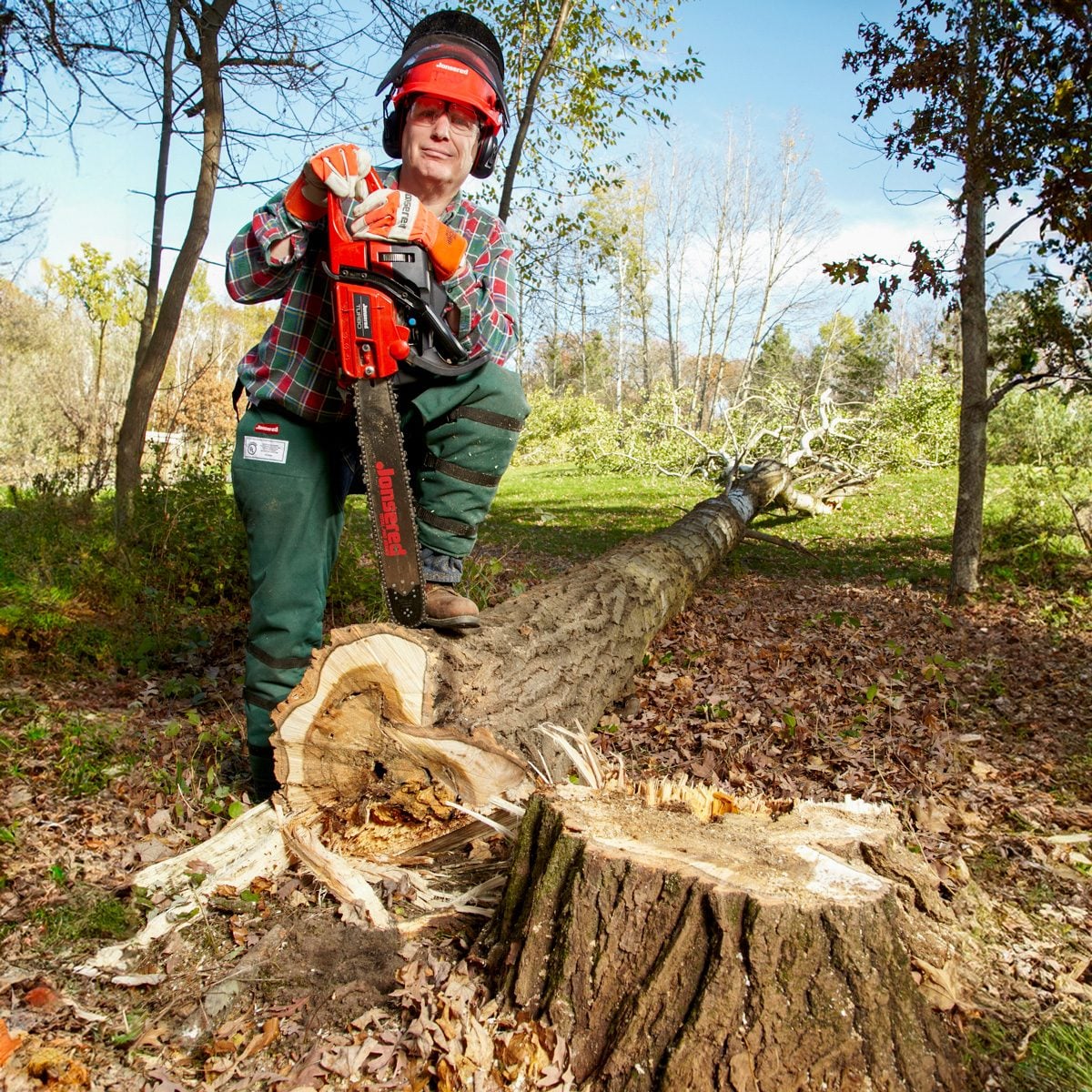
For any chainsaw-related tree work, personal protective equipment is not optional decoration. It is the difference between a close call and a hospital visit. Proper tree removal PPE includes a hard hat, eye protection, hearing protection, chainsaw-resistant chaps or pants, gloves, and sturdy boots with good traction. A face shield can help protect against chips, but it does not replace safety glasses.
Loose clothing, dangling drawstrings, jewelry, and open-toe shoes do not belong anywhere near a chainsaw. Sneakers may be comfortable, but they are not tree work footwear. Flip-flops are even worse; they are basically a resignation letter for your toes.
Protective gear cannot make a dangerous job safe by itself. PPE is the last line of defense, not the whole plan. If the tree is beyond your skill level, do not dress like a professional and hope the rest of the situation politely cooperates.
Understand Chainsaw Safety Before Any Tree Work
A chainsaw is efficient because it is aggressive. That same quality makes it dangerous. Anyone using a chainsaw should read the owner’s manual, understand the chain brake, know how kickback happens, and receive practical training from a qualified instructor or experienced professional. The saw should be properly maintained, sharp, fueled safely, and sized for the task.
Do Not Work Alone
Tree work should never be a solo adventure. A second responsible adult should be nearby, outside the danger zone, able to call emergency services, and aware of the plan. That person should not stand under the tree, hold branches, pull ropes casually, or record the event for social media while wandering into danger. Their job is safety support, not documentary filmmaking.
Do Not Use a Ladder With a Chainsaw
Using a chainsaw from a ladder is one of the classic bad ideas of yard work. Ladders can shift, branches can swing, and a saw requires two-handed control. If cutting requires climbing, aerial work, rigging, or working above shoulder height, hire a trained tree-care professional. Gravity is undefeated, and it does not offer rematches.
Avoid Storm-Damaged and Tensioned Wood
Storm cleanup is especially risky because branches and trunks may be under pressure. A bent branch can spring back when cut. A fallen tree can roll. A partially uprooted tree can shift without warning. These hazards are difficult to judge without training. When a tree is hung up, split, leaning on another tree, or resting on a structure, leave it to professionals.
Plan the Work Before the First Cut
Safe tree cutting requires a plan that covers the fall direction, landing zone, communication, emergency response, tools, weather, and cleanup. Wind, rain, poor visibility, fatigue, and distractions all increase risk. Do not cut in strong wind, during storms, at dusk, or when you are tired. The tree will still be there tomorrow, unless the wind removes it tonight, in which case you have a new problem and should probably call a pro anyway.
Keep People Out of the Danger Zone
Set a wide exclusion area around the work. Children, pets, neighbors, and curious relatives should stay far away. People often want to “help” by pointing, pulling, or offering commentary. Commentary is not a control measure. Keep the area quiet, controlled, and limited to necessary helpers only.
Have Emergency Supplies Ready
Before work begins, have a charged phone, first-aid kit, vehicle access, and the address of the job site ready. Know how emergency responders can reach the area. If working on rural land, share the location with someone who can guide help in. The best emergency plan is the one you never use, but it should still exist.
Use Professional Techniques Only With Training
Tree felling involves specialized cutting methods that control hinge wood, direction, release, and movement. Those techniques should be learned through hands-on training, not copied from a short paragraph online. A blog can tell you what risks to respect; it cannot watch your stance, correct your saw handling, or see the hidden crack in the trunk. For anything beyond very small, simple material on open ground, training and professional help matter.
After the Tree Is Down: Cleanup Can Still Be Dangerous
Many injuries happen after the tree hits the ground, when people relax and start cutting limbs. This stage, called limbing and bucking, can involve rolling logs, trapped branches, spring-loaded wood, unstable footing, and saw kickback. The tree may be down, but the danger has not clocked out.
Work slowly, keep footing stable, and avoid cutting anything under tension unless you know how it will move. Never stand downhill from a log that can roll. Keep bystanders away during cleanup. If the trunk is large, twisted, suspended, or tangled, let a professional handle it. A fallen tree can still behave like a giant wooden mousetrap.
Decide What to Do With the Stump
Tree removal often leaves a stump. Options include stump grinding, natural decay, landscaping around it, or full removal. Stump grinding is usually faster and cleaner, but it requires specialized machinery. If the tree was diseased, ask an arborist or local extension office whether the wood, chips, or stump should be handled differently to reduce pest or disease spread.
Think About Replanting
Removing a tree changes shade, soil moisture, wind exposure, wildlife habitat, and curb appeal. Before planting a replacement, choose a species suited to your region, soil, space, and overhead clearance. Planting the right tree in the right place is the long-term version of safety. Future you will be grateful when the new tree does not grow into the roof, sewer line, or power service.
Common Mistakes Homeowners Make
One of the biggest mistakes is underestimating lean. A tree does not always fall where the trunk points, because crown weight, wind, decay, and uneven branches can influence movement. Another mistake is failing to clear an escape route. People often focus on the tree and forget their own feet until they are stepping backward over a rake, garden hose, or decorative gnome named Gary.
Other common errors include using a dull chainsaw, skipping PPE, cutting in bad weather, working alone, standing under suspended limbs, using ropes without knowing load forces, and assuming a dead tree is easier to remove. Dead trees can be more brittle and unpredictable. They may break apart during cutting, dropping limbs before the trunk moves.
The most expensive mistake is trying to save money on a job that clearly needs a professional. Tree services can cost more than expected, but property damage, medical bills, electrical hazards, and liability can cost far more. Cheap tree removal becomes very expensive when the tree lands on a garage, a neighbor’s car, or a power line.
How to Hire a Tree Removal Professional
If the job is risky, hire carefully. Look for a certified arborist or reputable tree care company with proper insurance, worker protection, references, and a written estimate. Ask how the company will protect structures, control falling limbs, manage debris, and handle permits. A professional should be willing to explain the plan in plain language.
Be cautious with door-to-door offers after storms, especially from crews that pressure you to decide immediately. Storm damage creates real urgency, but urgency should not erase due diligence. Ask for proof of insurance and avoid paying the full amount upfront. A trustworthy company will not be offended by basic safety and business questions.
Questions to Ask Before Hiring
- Are you insured for tree removal work?
- Do you have certified arborists on staff or available for assessment?
- Will the job require permits or utility coordination?
- How will you protect nearby structures and landscaping?
- Is stump grinding included?
- Will debris removal be included in the written estimate?
- What happens if hidden decay changes the removal plan?
Real-World Experience: What Safe Tree Removal Looks Like in Practice
Experience teaches that the safest tree jobs usually feel a little boring. That is a compliment. The crew arrives, walks the site, talks through the plan, sets boundaries, checks overhead hazards, stages equipment, and keeps everyone away from the work zone. There is no shouting, no guessing, and no heroic “watch this” energy. The best tree removal looks controlled, almost calm, because the dangerous decisions were made before the saw started.
Consider a typical backyard maple that appears healthy from the patio but has mushrooms growing at the base. A homeowner might see shade, leaves, and a weekend project. An arborist sees possible root or trunk decay, uneven crown weight, and a tree that may not respond predictably. The lesson is simple: the outside of a tree does not always reveal the inside story. Trees can hide weakness the way people hide messy closets before guests arrive.
Another common example is the leaning pine near a garage. The homeowner may believe a rope tied to a pickup truck can “help” pull the tree away from the building. In reality, ropes introduce forces that can snap, shift, or pull unpredictably if not properly rated and used. A professional may remove the tree in sections, lower limbs with rigging, or use equipment to control each piece. That method takes longer than one dramatic cut, but the garage remains a garage instead of becoming modern art.
Storm cleanup offers the clearest safety lesson. After high winds, people often rush outside with chainsaws because the driveway is blocked or the yard looks chaotic. The temptation is understandable. But storm-damaged trees can be loaded with tension. A branch pinned under a trunk may spring when released. A tree leaning against another tree may slide. A cracked trunk may split further as weight changes. The safe response is to slow down, identify what is under pressure, and call help when the situation is unstable.
Good tree work also respects fatigue. Many incidents happen late in the job, when the tree is already down and everyone thinks the hard part is over. Cleanup feels repetitive, and that is when attention drifts. Smart workers take breaks, sharpen or service tools when needed, and stop before exhaustion turns simple choices into risky ones. A tired person with a chainsaw is not “pushing through.” They are negotiating with bad odds.
The biggest practical takeaway is this: safety is not a single trick. It is a chain of decisions. Check the site. Respect electricity. Wear PPE. Keep people away. Avoid ladders. Understand your limits. Hire professionals for complex removals. When those decisions line up, tree removal becomes less about luck and more about control. And when the decision is to call an arborist, that is not failure. That is wisdom wearing work boots.
Conclusion: The Safest Cut May Be the One You Do Not Make
Learning how to cut down a tree safely starts with knowing when not to cut it yourself. Small, simple cleanup on open ground may be manageable for trained adults with the right equipment, but large trees, leaning trees, storm-damaged trees, power-line hazards, and trees near structures require professional skill. The goal is not to prove courage. The goal is for everyone, including the house, the fence, the neighbor’s car, and your toes, to survive the day in their original shape.
Note: This article is for general safety education and web publishing. Tree removal can be dangerous and should be handled by qualified professionals whenever hazards are present.
SEO Tags