
Finding a square root without a calculator may sound like something a math teacher invented during a thunderstorm, but it is actually one of the most useful number skills you can learn. Whether you are checking homework, estimating measurements, solving geometry problems, preparing for a test, or simply refusing to let a tiny glowing screen do all your thinking, knowing how to find a square root by hand gives you real mathematical confidence.
The good news? You do not need wizard robes, a graphing calculator, or a secret handshake. You only need a clear process, a few perfect squares, and the patience to let the numbers introduce themselves. In this guide, you will learn how to find a square root without a calculator in five practical steps, from basic estimation to a more accurate manual method. We will use simple examples, friendly explanations, and just enough humor to keep your brain from packing a suitcase and leaving.
By the end, you will know how to estimate square roots, recognize perfect squares, refine your answer, and use a classic long-division-style square root method when you need more precision.
What Is a Square Root?
A square root is a number that, when multiplied by itself, gives the original number. For example, the square root of 25 is 5 because 5 × 5 = 25. The square root of 81 is 9 because 9 × 9 = 81. In symbols, this looks like √25 = 5 and √81 = 9.
The number inside the radical symbol is called the radicand. In √64, the radicand is 64. The radical symbol usually means the principal square root, which is the positive square root. Technically, positive numbers have two square roots: one positive and one negative. For example, both 8 and -8 square to 64. But when you see √64, the expected answer is 8 unless the problem specifically asks for both roots.
Square roots appear in algebra, geometry, physics, construction, design, finance, and computer science. They help calculate distances, side lengths, areas, standard deviations, and more. In other words, square roots are not just hanging around in textbooks trying to ruin your afternoon. They have jobs.
Why Learn to Find Square Roots Without a Calculator?
Calculators are great, but they can make math feel like a vending machine: press buttons, receive answer, hope it is not stuck. Manual square root methods help you understand what the calculator is doing. They also make it easier to spot unreasonable answers. If you know √100 = 10 and √121 = 11, then an answer like √110 = 47 should immediately make your eyebrows file a complaint.
Learning to calculate square roots by hand also improves number sense. You become better at estimating, comparing values, simplifying radicals, and solving problems faster. This is especially helpful on tests where calculators are limited or when you need a quick mental approximation.
Step 1: Memorize or Recognize Common Perfect Squares
The first step in finding a square root without a calculator is knowing your perfect squares. A perfect square is a number made by multiplying a whole number by itself. For example, 36 is a perfect square because 6 × 6 = 36.
Common Perfect Squares to Know
- 1² = 1
- 2² = 4
- 3² = 9
- 4² = 16
- 5² = 25
- 6² = 36
- 7² = 49
- 8² = 64
- 9² = 81
- 10² = 100
- 11² = 121
- 12² = 144
- 13² = 169
- 14² = 196
- 15² = 225
- 20² = 400
- 25² = 625
- 30² = 900
You do not need to memorize every square number in existence. Start with 1 through 15, then add 20, 25, 30, 40, 50, and 100 as you get more comfortable. These landmarks help you estimate quickly.
For example, suppose you want to find √70. You know that 8² = 64 and 9² = 81. Since 70 is between 64 and 81, √70 must be between 8 and 9. Already, you have trapped the answer in a tiny mathematical fence. Nice work.
Step 2: Find the Two Perfect Squares Around Your Number
Once you know your perfect squares, the next step is to locate the perfect square just below and just above your number. This is called bracketing. It helps you create a safe estimate.
Example: Find √50 Without a Calculator
Start by finding nearby perfect squares:
- 7² = 49
- 8² = 64
Since 50 is between 49 and 64, √50 is between 7 and 8. Because 50 is very close to 49, √50 is only slightly bigger than 7. A reasonable first estimate is about 7.1.
Check it:
7.1 × 7.1 = 50.41
That is slightly too high, but very close. So √50 is a little less than 7.1. The actual value is about 7.07, and you reached the neighborhood without a calculator. No batteries required.
Example: Find √73 Without a Calculator
Find the nearby perfect squares:
- 8² = 64
- 9² = 81
Since 73 is between 64 and 81, √73 is between 8 and 9. Now look at where 73 falls. It is 9 away from 64 and 8 away from 81, so it is almost in the middle, slightly closer to 81. That means √73 should be a little above 8.5.
Try 8.5:
8.5 × 8.5 = 72.25
That is slightly low. Try 8.55:
8.55 × 8.55 = 73.1025
That is slightly high. So √73 is between 8.5 and 8.55, roughly 8.54. For most everyday purposes, that is an excellent estimate.
Step 3: Estimate the Decimal Using Distance
After bracketing the number, you can improve your estimate by looking at how far the number is from each perfect square. This method is not always exact, but it gives a smart starting point.
Let us estimate √40.
- 6² = 36
- 7² = 49
The number 40 is between 36 and 49. The full gap is 49 – 36 = 13. The number 40 is 4 units above 36. So 40 is about 4/13 of the way from 36 to 49.
4/13 is about 0.31, so a quick estimate is:
√40 ≈ 6.31
Check it:
6.31 × 6.31 = 39.8161
That is a little low. Try 6.32:
6.32 × 6.32 = 39.9424
Still a tiny bit low. Try 6.325:
6.325 × 6.325 ≈ 40.0056
So √40 is about 6.32. The distance method got us very close, very quickly.
A Simple Estimation Formula
Here is a handy way to think about it:
If your number is N, and it falls between a² and b², then √N is between a and b. Estimate how far N is between those two squares, then add that fraction to a.
This works especially well for quick approximations. It is not perfect because square roots do not increase in a perfectly straight line, but it is practical, fast, and usually good enough for mental math.
Step 4: Refine Your Answer by Squaring Your Guess
Once you have an estimate, test it by multiplying it by itself. This is the heart of manual square root calculation: guess, square, adjust, repeat. It sounds fancy if you call it iteration. It sounds normal if you call it “try again, but smarter.”
Example: Estimate √120
First, bracket it:
- 10² = 100
- 11² = 121
Since 120 is very close to 121, √120 is close to 11, but slightly less. Try 10.95:
10.95 × 10.95 = 119.9025
That is slightly low. Try 10.96:
10.96 × 10.96 = 120.1216
That is slightly high. So √120 is between 10.95 and 10.96. A good rounded estimate is 10.95.
Use the Average Method for Faster Refinement
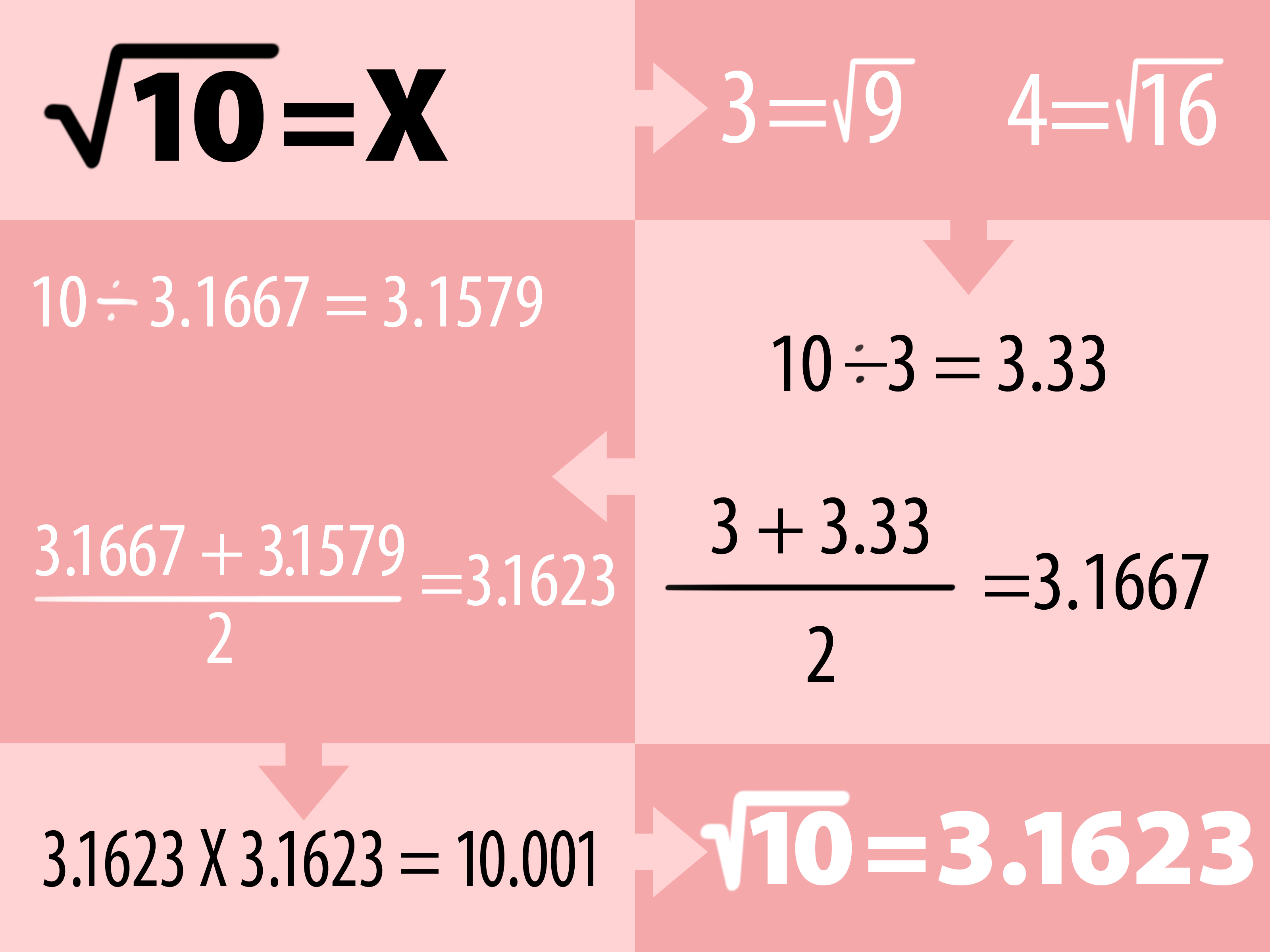
There is another elegant trick for refining square roots. If you want √N and you have a guess x, divide N by x, then average the result with x.
The formula is:
New guess = (x + N/x) ÷ 2
This is related to Newton’s method, a powerful approximation method used in higher math and computing. Do not panic. You are not being asked to wear a lab coat. The process is simple.
Example: Use the Average Method for √50
We already know √50 is a little above 7. Start with 7:
50 ÷ 7 ≈ 7.14
Now average 7 and 7.14:
(7 + 7.14) ÷ 2 = 7.07
That gives √50 ≈ 7.07, which is highly accurate for a quick hand calculation. This method is one of the best ways to find square roots without a calculator when you need a decimal approximation.
Step 5: Use the Long Division Method for More Precision
If you want a more formal method, use the long division square root method. It looks a little like regular long division, but it works digit by digit to build the square root. This method is especially useful for large numbers or when you want several decimal places.
Example: Find √4096 by Hand
We will use a simplified explanation of the digit-by-digit method.
First, group the digits in pairs from right to left:
40 | 96
Now find the largest square less than or equal to 40. Since 6² = 36 and 7² = 49, use 6.
Write 6 as the first digit of the answer. Subtract 36 from 40:
40 – 36 = 4
Bring down the next pair, 96, to get 496.
Now double the current answer, 6, to get 12. Think of this as the beginning of a new divisor: 12_ × _. You need to find a digit that fits in both blanks so the product is less than or equal to 496.
Try 4:
124 × 4 = 496
Perfect. Add 4 to the answer, making it 64.
So:
√4096 = 64
This method can continue with decimal pairs if the square root is not a whole number. Add a decimal point and pairs of zeros, then keep repeating the process. It may look mysterious at first, but the logic is based on building the square root one digit at a time.
How to Simplify Square Roots Without a Calculator
Sometimes you do not need a decimal. Instead, you need to simplify a radical expression. This means removing perfect square factors from inside the radical.
Example: Simplify √72
Look for the largest perfect square factor of 72.
72 = 36 × 2
So:
√72 = √(36 × 2)
√72 = √36 × √2
√72 = 6√2
So the simplified form of √72 is 6√2.
Example: Simplify √200
Find a perfect square factor:
200 = 100 × 2
So:
√200 = √100 × √2
√200 = 10√2
This is useful in algebra because exact radical form is often preferred over a rounded decimal. For example, 10√2 is exact, while 14.14 is only an approximation.
Common Mistakes to Avoid
Mistake 1: Forgetting That Square Roots Are Not Linear
It is tempting to think that because 25 is halfway between 0 and 50, its square root should be halfway between 0 and √50. That is not how square roots behave. Always use perfect squares as your guide.
Mistake 2: Rounding Too Early
If you round your estimate too soon, small errors can grow. Keep one or two extra decimal places while working, then round at the end.
Mistake 3: Ignoring Perfect Square Factors
When simplifying radicals, always check for perfect square factors. For example, √48 is not just “some weird decimal waiting to happen.” It can be simplified because 48 = 16 × 3, so √48 = 4√3.
Mistake 4: Mixing Up √a + √b With √(a + b)
Do not assume that √9 + √16 equals √25. In this case, √9 + √16 = 3 + 4 = 7, while √25 = 5. The radical symbol is powerful, but it does not magically distribute over addition.
Quick Practice Problems
Problem 1: Estimate √30
Nearby perfect squares:
- 5² = 25
- 6² = 36
So √30 is between 5 and 6. Since 30 is closer to 25 than 36, estimate about 5.5. Check:
5.5² = 30.25
So √30 is about 5.48.
Problem 2: Simplify √98
98 = 49 × 2
√98 = √49 × √2 = 7√2
Problem 3: Estimate √150
Nearby perfect squares:
- 12² = 144
- 13² = 169
Since 150 is close to 144, √150 is a little above 12. Try 12.25:
12.25² = 150.0625
So √150 is about 12.25.
Real-Life Uses for Finding Square Roots by Hand
Manual square root skills are more useful than they first appear. In geometry, if you know the area of a square, the square root gives you the side length. If a square garden has an area of 196 square feet, each side is √196 = 14 feet.
In the distance formula, square roots help calculate the distance between two points. In physics, square roots appear in formulas involving speed, energy, waves, and motion. In statistics, standard deviation uses square roots to measure how spread out data is. In construction and design, square roots help with diagonal measurements, layout, and scaling.
Even if you do not use square roots every day, the thinking process behind them is valuable: estimate, test, adjust, and verify. That is not just math. That is problem-solving with better posture.
Experience Notes: What Learning Square Roots by Hand Actually Feels Like
The first time many students try to find a square root without a calculator, the process feels strangely old-fashioned, like churning butter or writing with a feather. But after a few examples, something interesting happens: the numbers start to feel less random. You begin seeing 49, 64, 81, 100, 121, and 144 as familiar landmarks instead of lonely numbers standing around at a math party.
One of the best experiences when learning this method is realizing that you do not need to know the exact answer immediately. In school, math often feels like a race to be correct as quickly as possible. Square root estimation teaches a different habit: get close first, then improve. For example, when finding √52, you do not need to panic. You know 49 and 64 are the nearest perfect squares, so the answer is between 7 and 8. Since 52 is close to 49, the answer is a little above 7. Try 7.2, square it, and you get 51.84. That is close enough to make your calculator feel slightly unemployed.
Another useful experience is learning to check answers for reasonableness. Suppose someone says √90 is 12. A quick mental check says 9² = 81 and 10² = 100, so √90 must be between 9 and 10. The answer 12 cannot be right. This kind of number sense is extremely helpful on tests, especially multiple-choice tests where one or two answer choices are clearly nonsense wearing a fake mustache.
Students also tend to like the average method once they see how fast it works. Start with a rough guess, divide the original number by that guess, and average the two. It feels almost like a shortcut, but it is based on serious mathematical logic. For √80, you know the answer is between 8 and 9 because 8² = 64 and 9² = 81. Start with 9. Then 80 ÷ 9 ≈ 8.89. Average 9 and 8.89, and you get about 8.945. That is already very close.
The long division square root method can feel intimidating at first because it has several steps and a layout that looks like regular division’s more dramatic cousin. But the more you practice it, the more it becomes a pattern. Group digits in pairs, find the largest square, subtract, bring down, double the root, test a digit, repeat. It is not magic. It is organized guessing with excellent manners.
The biggest lesson from practicing square roots by hand is that accuracy grows from structure. You do not have to be naturally “good at math.” You need a method. Perfect squares give you the boundaries. Estimation gives you a first answer. Squaring your guess tells you whether to move up or down. Refinement makes the answer sharper. That is the whole game.
And honestly, there is a small but satisfying joy in solving √50 as about 7.07 by hand. It is the math version of fixing a wobbly chair yourself. Could someone else do it faster with a machine? Sure. But now you understand the process, and that understanding sticks.
Conclusion
Learning how to find a square root without a calculator is not about rejecting technology. It is about understanding numbers well enough that technology becomes a helper, not a crutch. Start with perfect squares, bracket the number, estimate the decimal, refine by squaring your guess, and use the long division method when you need more precision.
The five-step method is simple: recognize perfect squares, locate the nearest squares, estimate the root, test and refine, then use a formal digit-by-digit method if needed. With a little practice, square roots become less mysterious and much more manageable. You may not become the person who calculates radicals at parties, but if you do, please choose your parties carefully.
Most importantly, manual square root skills build number sense. They help you estimate, verify answers, simplify radicals, and think more clearly. That is useful in math class, test prep, real-world measurements, and any moment when your calculator is missing, dead, or hiding under the couch.