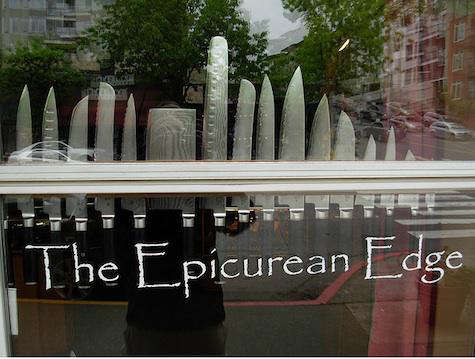

The Epicurean Edge in Kirkland, Washington is the kind of kitchen shop that makes a perfectly normal person start speaking in sentences like, “This santoku has excellent geometry,” while holding a tomato with the seriousness of a courtroom exhibit. Long associated with Kirkland’s refined culinary culture and now operating from a larger Seattle showroom, The Epicurean Edge has earned a loyal following among chefs, collectors, home cooks, and anyone who has ever tried to slice a ripe peach with a dull supermarket knife and questioned every life choice that led to that moment.
At its heart, The Epicurean Edge is not merely a kitchen store. It is a specialist destination for professional chef knives, Japanese kitchen knives, handmade blades, sharpening services, waterstones, and knife-care education. The shop has been praised for its gallery-like approach to cutlery, presenting knives not as anonymous tools in plastic packaging, but as functional works of craft. That matters because in a serious kitchen, the knife is not an accessory. It is the daily driver, the prep-table partner, the quiet hero behind every clean dice, thin slice, and dramatic “watch this” moment before dinner guests arrive.
A Kitchen Shop With a Blade-Smithing Soul
The Epicurean Edge became especially notable because of Daniel O’Malley, a bladesmith and owner associated with the shop’s curatorial identity. Older design and culinary coverage highlighted O’Malley’s training with legendary knife maker Bob Kramer, one of America’s most respected master bladesmiths. That connection helps explain why the shop feels different from a typical retail counter. It is built around knowledge: steel, balance, bevels, heat treatment, handles, geometry, sharpening technique, and the small but meaningful differences that turn a knife from “nice” into “where have you been all my life?”
The shop’s selection has traditionally emphasized custom-made knives from artisans in the United States, Japan, Sweden, Canada, and beyond. That international mix gives The Epicurean Edge its distinctive personality. A shopper might compare a nimble Japanese gyuto, a practical German-style chef’s knife, a delicate petty knife, or a dramatic Damascus blade that looks like it was forged during a thunderstorm by someone with excellent taste.
Kirkland Roots, Seattle Showroom, Same Sharp Reputation
Many people still search for The Epicurean Edge in Kirkland, Washington because the shop was long associated with Kirkland and featured in design-minded coverage under that location. However, public business information now points to its current brick-and-mortar showroom in Seattle’s SODO area, where the larger space supports a broader range of knives, sharpening services, and in-person classes. For readers planning a visit, that distinction matters: the Kirkland name carries the legacy, while the current showroom carries the inventory.
Kirkland itself remains a fitting backdrop for the story. The city’s Lake Washington setting, polished downtown, waterfront restaurants, and strong home-design culture make it the kind of place where a beautifully made kitchen knife feels right at home. It is not hard to imagine a customer leaving the shop inspired to cook something ambitious, then immediately realizing that “ambitious” may still mean a grilled cheese sandwichbut now with artisan-level tomato slices.
What Makes The Epicurean Edge Special?
1. A Curated Selection Instead of a Wall of Guesswork
One of the biggest frustrations in buying kitchen knives is the overload of choices. Stainless steel or carbon steel? Western handle or wa handle? Gyuto or chef’s knife? Santoku or nakiri? Heavy or featherlight? Expensive heirloom or hardworking daily tool? The Epicurean Edge stands out because its model is based on curation. Rather than tossing shoppers into a sea of shiny objects, the shop organizes knives by purpose, maker, material, feature, and style.
That structure helps both professionals and home cooks make smarter choices. A serious cook may arrive searching for a single-bevel yanagiba for fish slicing. A beginner may simply need a comfortable 8-inch chef’s knife and permission not to buy a 17-piece block set that includes six knives nobody can identify without a field guide. The best knife is not always the most expensive one. It is the one that fits the cook, the cutting style, and the food being prepared.
2. Japanese Knives With Real Context
Japanese kitchen knives have become hugely popular in American kitchens, and for good reason. Many are thin, precise, hard, and beautifully balanced. A gyuto can glide through onions with less resistance than a thicker Western blade. A santoku is compact and versatile. A nakiri makes vegetable prep feel strangely meditative, which is impressive because we are still talking about cabbage.
But Japanese knives also require respect. Harder steels may hold an edge beautifully but can chip if abused. Carbon steel can develop a patina and may rust if left wet. Some blades are not designed for bones, frozen food, or aggressive twisting. The Epicurean Edge’s educational approach is useful because it helps customers understand not only what to buy, but how to live with the knife afterward. That is the difference between owning a great tool and accidentally turning it into a decorative regret.
3. Sharpening Services That Treat Knives Like Tools, Not Lawn Mower Blades
A major part of The Epicurean Edge’s reputation is its sharpening service. The shop has described its process as using Japanese waterstones, buffers, and wet belt grinders to create long-lasting edges while avoiding the heat damage associated with harsher sharpening methods. That detail matters. Heat can affect blade temper, remove too much metal, and shorten a knife’s useful life.
The shop also handles practical repairs such as broken tips, bent blades, thinning, geometry correction, and handle replacement. For anyone with a beloved knife that has survived years of weeknight dinners, holiday prep, and one unfortunate encounter with a frozen chicken breast, that repair-minded service is valuable. A good knife can last for decades when properly maintained. A bad sharpening job, on the other hand, can make it look like it fought a raccoon and lost.
Knife Care Lessons Every Home Cook Should Learn
The Epicurean Edge’s philosophy aligns with a broader truth repeated by chefs and kitchen-equipment experts: sharp knives are safer, more efficient, and more enjoyable to use. A dull knife requires more pressure, slips more easily, and turns simple prep into a tiny wrestling match. If a tomato has ever defeated your knife, the tomato was not the problem.
Honing Is Not Sharpening
Many home cooks use the words “honing” and “sharpening” as if they mean the same thing. They do not. Honing realigns the edge of a blade. Sharpening removes metal to create a fresh edge. A honing rod can help maintain a knife between sharpening sessions, but it cannot magically resurrect a truly dull blade. Think of honing as brushing your hair and sharpening as getting a haircut. Both help, but only one fixes the shaggy situation.
Hand-Wash and Dry Immediately
Quality knives do not belong in the dishwasher. High heat, harsh detergent, water exposure, and rattling contact with other utensils can damage the edge and handle. Hand-wash with mild soap, dry immediately, and store safely. This is especially important for carbon steel knives, which may discolor or rust if neglected. A little patina is character. Orange rust is a cry for help.
Use the Right Cutting Surface
Wood and quality plastic boards are generally kinder to knife edges than glass, stone, ceramic, or granite. Cutting directly on a countertop may feel rebellious, but the blade will remember. It will remember by becoming dull faster and silently judging you from the drawer.
Buy Fewer, Better Knives
A common lesson from professional kitchens and expert testing is that most cooks do not need a giant knife block. A chef’s knife or gyuto, a paring knife, and a serrated bread knife can handle the majority of everyday tasks. Add a santoku, petty knife, nakiri, boning knife, or slicer only when your cooking habits justify it. The Epicurean Edge’s specialized inventory supports this smarter approach: choose tools intentionally, not because a box set promised “ultimate culinary domination” in twelve pieces.
For Professionals, Collectors, and Curious Home Cooks
The Epicurean Edge appeals to several audiences at once. Professional chefs appreciate performance, balance, and edge retention. Collectors appreciate rare makers, custom handles, Damascus patterns, and craftsmanship. Home cooks appreciate honest guidance and the thrill of discovering that chopping onions does not have to feel like punishment for skipping meal prep on Sunday.
That broad appeal is part of the shop’s charm. A restaurant cook might be comparing blade steels for daily prep. A design lover might be drawn to the sculptural quality of a handmade knife. A beginner might simply ask, “What should I buy if I want one great knife?” A good shop can serve all three without making anyone feel foolish. That is especially important in the knife world, where jargon can get sharp enough to need its own sheath.
The Art Gallery Feeling
One of the most memorable descriptions associated with The Epicurean Edge is its art-gallery atmosphere. That phrase is not just decorative. Many handmade knives genuinely blur the line between tool and art object. Pattern-welded Damascus blades show flowing layers of steel. Handles may use stabilized wood, horn, resin, or carefully shaped natural materials. The proportions of blade, tang, bolster, and handle can make a knife feel alive in the hand.
Still, the best kitchen knives are not meant to sit untouched forever. Their beauty is completed by use. A chef’s knife earns its keep through garlic, herbs, squash, fish, carrots, roasts, and the occasional midnight apple slice over the sink. The Epicurean Edge understands that dual identity. A knife can be collectible and practical. It can be admired under good lighting and then put to work on a pile of shallots.
Why Knife Fit Matters More Than Knife Fame
One of the smartest ways to shop for a knife is to focus on fit. A blade praised by experts may still feel awkward in your hand. A heavy German-style knife may suit someone who likes rocking cuts and durable heft. A thin Japanese gyuto may suit someone who prefers push cuts and precision. A santoku may feel more comfortable for cooks who want a shorter, nimble all-purpose blade.
Handle shape also matters. Some cooks like rounded Japanese wa handles. Others prefer Western handles with rivets and familiar contours. Balance can be blade-forward, handle-heavy, or centered. None of these qualities is universally “best.” The best knife is the one that makes you want to cook more often. That is where a specialist shop becomes far more useful than a generic online product grid.
Specific Examples: What a Shopper Might Look For
The Everyday Home Cook
A practical buyer might start with an 8-inch chef’s knife or Japanese gyuto in stainless steel. Stainless steel is easier to maintain, especially for busy households where someone may forget to dry the knife immediately because the dog is barking, the timer is screaming, and the broccoli has chosen violence.
The Vegetable Enthusiast
A vegetable-focused cook might consider a nakiri or santoku. These blades are excellent for controlled chopping, slicing, and prep work. A nakiri’s flat profile can make quick work of greens, carrots, cucumbers, and herbs.
The Precision Cook
A petty knife is useful for small tasks such as trimming fruit, slicing shallots, cleaning mushrooms, or doing delicate prep when a large chef’s knife feels like bringing a canoe paddle to a tea party.
The Enthusiast Ready for Carbon Steel
Carbon steel knives can take beautiful edges and sharpen efficiently, but they require care. They should be washed and dried promptly, stored properly, and used with awareness. For the right cook, the reward is a responsive blade that develops character over time.
Experience Section: Visiting, Learning, and Cooking With Better Knives
There is a particular kind of excitement that happens when someone visits a serious knife shop for the first time. It starts with curiosity and quickly turns into a quiet recalibration of standards. The knives feel different. The edges catch the light differently. The handles invite comparison. Suddenly, the old knife at homethe one that has been living loose in a drawer beside a pizza cutter and a mystery corn holderseems less like a tool and more like a kitchen fossil.
An experience with The Epicurean Edge, whether in its Kirkland-era reputation or its current Seattle showroom, is best approached slowly. This is not a place to rush through like a grocery aisle. Pick up a knife, feel the balance, notice the weight, and imagine the food you cook most often. Do you prep onions every night? Do you break down chickens? Do you slice fish? Do you mostly cut fruit and vegetables? The right knife begins with honest habits, not fantasy cooking. Many of us imagine ourselves filleting whole salmon on a cedar board at sunset. Many of us are actually cutting quesadillas into triangles. Both deserve a sharp blade.
The educational side of the shop is just as important as the shopping experience. A sharpening class or knife-care conversation can change how a person cooks. Learning how an edge works makes every slice more intentional. Understanding why honing matters prevents unnecessary sharpening. Discovering that a knife should not be scraped edge-first across a board may save years of blade life. These lessons are small, but they compound. A better-maintained knife makes prep faster, safer, and more satisfying.
There is also a sensory pleasure to using a properly sharpened knife that is hard to explain until you feel it. An onion separates cleanly instead of crushing. Herbs stay green instead of bruising into sadness. Tomatoes slice without requiring the user to whisper threats. Carrots stop rolling away like tiny orange escape artists. Cooking becomes calmer because the tool is cooperating. That cooperation is the real luxury.
For home cooks, the biggest takeaway is not that everyone needs a rare custom blade. They do not. The better lesson is that tools matter, maintenance matters, and expert guidance can prevent expensive mistakes. A $150 knife cared for properly can outperform a $600 knife neglected badly. A modest blade sharpened well is better than a famous blade left dull. The Epicurean Edge represents a culture of respect for the tool: choose thoughtfully, sharpen correctly, store safely, and use the knife for the job it was designed to do.
That experience can also change how people think about the kitchen itself. A kitchen is not only cabinets, appliances, and countertops. It is a workspace. A beautiful kitchen with dull knives is like a sports car with flat tires: impressive until you try to go somewhere. A sharp, well-balanced knife brings function back to the center of the room. It makes cooking feel less like a chore and more like a craft, even when dinner is just stir-fried vegetables, soup, or a very respectable sandwich.
In that sense, The Epicurean Edge is more than a shop remembered from Kirkland or visited in Seattle. It is a reminder that everyday cooking improves when we pay attention to the objects we touch most. A good knife will not make anyone a chef overnight. It will, however, remove a surprising amount of friction from the process. And sometimes that is enough to make a person cook more, waste less, experiment confidently, and finally stop blaming the tomato.
Conclusion
The Epicurean Edge in Kirkland, Washington remains a meaningful name in the Pacific Northwest kitchen world because it represents more than retail. It represents craftsmanship, expert sharpening, international knife culture, and a practical belief that cooking gets better when tools are chosen and maintained with care. Although the showroom is now listed in Seattle, the Kirkland association still captures the shop’s original design-world charm and local culinary reputation.
For anyone serious about kitchen knives, Japanese chef knives, custom blades, or professional sharpening, The Epicurean Edge is a compelling destination. For everyone else, it is a friendly warning: once you experience a truly sharp knife, your old drawer knife may never look innocent again.
Note: This article is based on current public information and historical coverage of The Epicurean Edge, including its Kirkland legacy, Seattle showroom update, sharpening services, knife classes, and broader expert guidance on kitchen knife selection and care. No source links are included in the article body by request.