
Every few years, the internet receives a new blurry object in the sky and immediately does what the internet was born to do: zoom in too far, argue loudly, and blame aliens before lunch. The leaked government UFO photo described as a hovering, cube-shaped object is one of those images. It is mysterious enough to raise eyebrows, official enough to avoid easy dismissal, and vague enough to let everyone’s imagination put on a tiny lab coat.
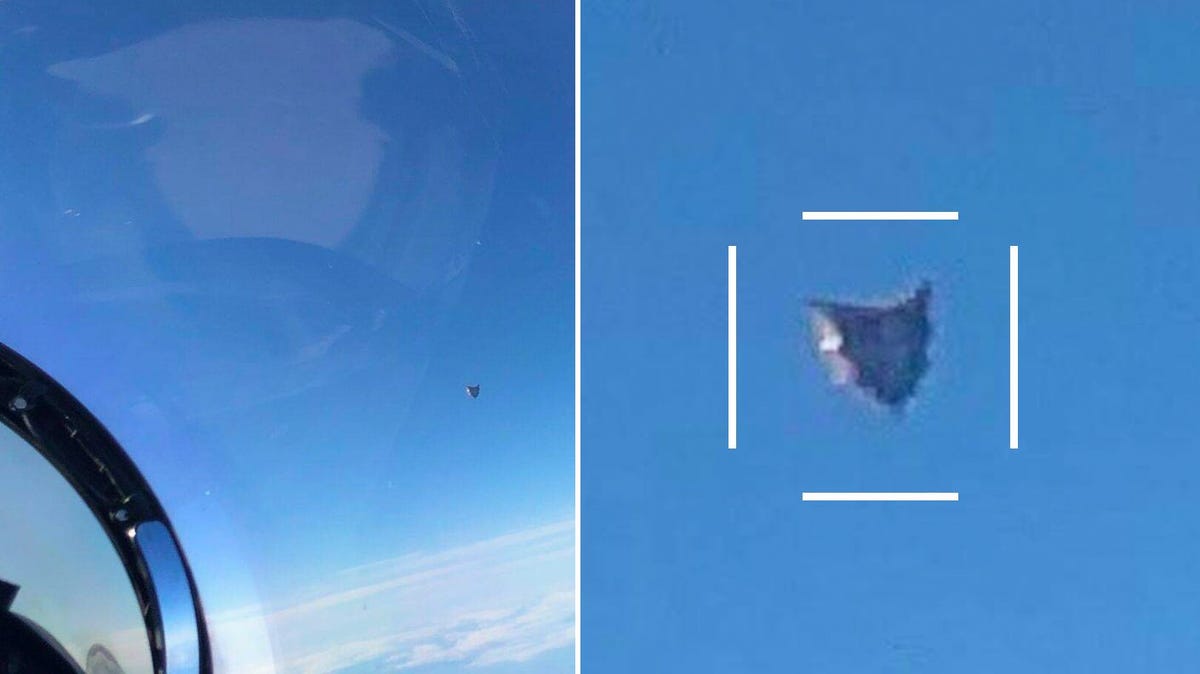
The photo, reportedly circulated within U.S. intelligence channels and connected to the government’s work on unidentified aerial phenomena, or UAP, shows what officials and media reports described as a silver, cube-shaped object hovering over the ocean. It was said to have been photographed from an F/A-18 fighter jet during a Navy encounter off the East Coast. That combinationfighter pilots, restricted airspace, a motionless object, and a shape that sounds like geometry homework escaped into the atmospheremade the story irresistible.
But what is it really? A secret aircraft? A weather device? A balloon? A sensor artifact? A misidentified object? Or, as some would eagerly whisper while dramatically closing the blinds, something not from here?
The honest answer is less cinematic but more useful: the cube-shaped UFO photo remains unresolved in public reporting, but the strongest analysis points toward a narrow set of possibilities. The mystery is not just about one image. It is about how the U.S. government, military pilots, scientists, and the public handle strange aerial encounters in an age when drones, balloons, satellites, classified aircraft, and camera quirks all share the same sky.
What the Leaked Government UFO Photo Reportedly Shows
The object at the center of the story was described as a silver, cube-shaped UAP hovering motionless over the ocean. According to early reporting, it was connected to a 2018 intelligence position report associated with the Pentagon’s Unidentified Aerial Phenomena Task Force, often shortened to UAPTF. The image was reportedly unclassified but marked for official use, which is government-speak for “not top secret, but please do not turn it into a meme before breakfast.” Naturally, the internet did exactly that.
The most interesting detail is not simply the cube shape. It is the reported behavior. The object was said to be hovering or remaining still, apparently without obvious wings, rotors, exhaust, or visible propulsion. For pilots, that matters. A weird shape is one thing. A weird shape holding position in the sky, especially near training areas, becomes a safety and national security question.
Another detail that makes the case compelling is the apparent platform involved. Reports suggested the photo was taken from the cockpit area of an F/A-18 fighter jet. Military aviators are trained observers, and they operate with radar, infrared systems, radio communications, and strict flight safety procedures. That does not make them magically immune to mistakespilots are human, not flying spreadsheetsbut it does make their reports harder to shrug off than someone seeing a “UFO” after three energy drinks in a parking lot.
Why a Cube-Shaped UFO Sounds So Strange
Most people expect UFOs to look like saucers, triangles, glowing orbs, cigars, or the classic “Tic Tac” shape made famous by Navy encounters. A cube sounds different. Cubes are not exactly aerodynamic. If aircraft design had a dating profile, “sharp corners and no wings” would not get many matches.
That is partly why the leaked cube-shaped UFO photo became so fascinating. A cube-like object floating in the air does not fit neatly into common aviation categories. Traditional aircraft need lift, thrust, control surfaces, and an energy source. Drones usually have rotors, wings, or recognizable body structures. Balloons can hover or drift, but they are typically shaped by pressure, wind, payload, and tethering systems. A cube hovering over the ocean feels visually wrong, which is why the story spread so quickly.
However, “cube-shaped” may not mean a perfect cube. It may mean the object appeared boxy, angular, or square from the pilot’s viewpoint. At distance, shape can be deceptive. Lighting, angle, motion, haze, camera focus, and image compression can turn ordinary objects into sky puzzles. A partially inflated balloon, a sensor package, a parachute-like structure, or an atmospheric instrument can look much stranger than it is, especially when photographed quickly through a cockpit canopy.
The Dropsonde Theory: Weather Science Wearing a UFO Costume
One of the most practical explanations discussed in relation to the image is a dropsonde. A dropsonde is a weather instrument dropped from aircraft, usually into storms or remote atmospheric systems, to measure conditions such as temperature, pressure, humidity, and wind. It can be attached to a small parachute-like structure and descend through the atmosphere while transmitting data.
Why does this matter? Because certain dropsonde parachutes or weather payloads can look oddly geometric from a distance. A square-cone parachute or dangling instrument package might appear cube-like or angular in a quick photograph. The object in the leaked image was compared by some observers to a dropsonde, although critics of that explanation noted that expected trailing equipment did not appear clearly visible in the photo.
This is where the mystery gets less like science fiction and more like a very expensive episode of “Is That a Weather Balloon?” Many UAP cases eventually turn out to involve balloons, drones, aircraft, satellites, or optical effects. That does not make the witnesses foolish. The modern sky is busy, layered, and occasionally ridiculous. A weather instrument released into the atmosphere can be perfectly ordinary to a meteorologist and deeply weird to a fighter pilot who was not expecting to meet one at altitude.
Could It Be a Balloon?
The balloon explanation is both boring and strong, which is a terrible combination for headline writers but a very useful one for analysts. Balloons can appear to hover when wind conditions are stable or when an aircraft passes them quickly. They can reflect sunlight in strange ways. Some carry payloads, sensor packages, or unusual shapes that look nothing like a child’s birthday balloon unless that birthday party is hosted by the Defense Advanced Research Projects Agency.
High-altitude balloons are used for weather research, communications experiments, surveillance, scientific data collection, and military testing. They can be silver, white, dark, reflective, transparent, or oddly shaped. They may also be difficult to identify from a single still image, particularly if the photo lacks metadata such as precise location, altitude, range, lens information, time, and environmental conditions.
That missing context is crucial. A photo without full metadata is like a mystery novel with the last chapter removed and half the suspects wearing sunglasses. It can suggest possibilities, but it cannot prove much by itself. Analysts need sensor data, pilot testimony, radar tracks, weather records, air traffic information, and knowledge of nearby military or scientific activity to make a confident identification.
How the Cube Photo Fits Into the Bigger UAP Story
The leaked cube-shaped UFO photo did not appear in a vacuum. It surfaced during a period when the U.S. government was slowly shifting from decades of UFO stigma to a more formal UAP framework. In 2020, the Department of Defense officially released three Navy videos that had already circulated publicly. In 2021, the Office of the Director of National Intelligence submitted a preliminary UAP assessment to Congress. In 2022, the Department of Defense established the All-domain Anomaly Resolution Office, known as AARO, to coordinate investigations into unidentified anomalous phenomena across air, sea, space, and other domains.
That bureaucratic evolution is important. The government did not suddenly announce that flying saucers were parking behind the Pentagon. Instead, officials acknowledged that pilots and sensors sometimes detect objects that cannot be immediately identified, and that some of these incidents may affect flight safety or national security. That is a major shift from “nothing to see here” to “there is something to study here.” It is less dramatic than an alien ambassador stepping out of a glowing cube, but it is more consequential.
AARO has repeatedly emphasized a scientific, data-driven approach. NASA’s independent UAP study also pushed for better data collection, improved sensor calibration, reduced stigma, and a clearer reporting process. The message from serious investigators is consistent: extraordinary claims require high-quality evidence, not just dramatic screenshots and all-caps comment sections.
The “Cube Inside a Sphere” Connection
The leaked cube-shaped photo is often discussed alongside another famous UAP description: the “cube inside a sphere.” Former Navy pilot Ryan Graves has described encounters involving objects that looked like dark cubes inside clear spheres near training airspace off Virginia Beach. In one account given during congressional testimony, an object reportedly came dangerously close to fighter jets and caused the mission to be terminated.
It is tempting to merge every cube-related UAP story into one grand theory. But that would be sloppy. The leaked silver cube-shaped object and the “cube inside a clear sphere” accounts may not refer to the same object, event, or technology. They belong to the same broader conversation about unusual aerial objects reported by trained military personnel, but each case needs its own evidence trail.
Still, the similarity matters because it shows that unusual geometric descriptions are not limited to one photo. Pilots have reported spheres, cubes, triangles, cylinders, orbs, and other shapes. Some may be misidentifications. Some may be classified technology. Some may be sensor artifacts. Some may remain unidentified because the data is simply not good enough. “Unidentified” is not a synonym for “alien.” It means the case has not been resolved, which is less exciting but much more accurate.
Why the Government Often Says So Little
One of the reasons UAP stories become so combustible is that official responses are usually cautious, brief, and wrapped in operational security language. The Pentagon often confirms whether imagery was taken by military personnel, but it usually avoids discussing detailed analysis, sensor capabilities, locations, or conclusions. That frustrates the public, but it is not surprising.
Military training ranges, aircraft sensors, radar systems, and intelligence methods are sensitive. Even if an object turns out to be a balloon, the way the military detected it may reveal capabilities that officials do not want adversaries studying. In other words, the secret may not be the object. The secret may be the camera, radar, aircraft position, or response procedure.
This creates a perfect storm for speculation. The public sees a strange image. Officials confirm just enough to make it real but not enough to explain it. Then every theory, from advanced drones to alien delivery cubes, rushes in to fill the silence. The information gap becomes the story.
What Would Analysts Need to Identify the Object?
A single leaked image is rarely enough. To determine what the hovering cube-shaped object was, analysts would need several categories of information. First, they would need original image data, not a compressed copy reposted across the internet until it looks like it was painted with a potato. Original metadata could reveal the camera type, time, focal length, and image conditions.
Second, they would need flight data from the observing aircraft: altitude, speed, heading, distance to the object, and relative motion. An object that appears stationary may be drifting with the wind, descending slowly, or moving in a way that is hard to judge from a fast-moving jet.
Third, investigators would need weather information. Wind layers, cloud conditions, sunlight angle, visibility, and atmospheric distortion can all affect interpretation. Fourth, they would need nearby airspace activity: balloons, drones, aircraft, naval operations, scientific missions, or test programs. Finally, they would need radar or infrared corroboration. Multiple independent sensors make a case much stronger than a single visual image.
Without that evidence, the best public answer remains probabilistic. The object could plausibly be a balloon-like atmospheric device, a weather instrument, a misidentified payload, or something else ordinary but unfamiliar. It could also be a genuinely anomalous object, meaning not yet explainable from available public information. That is not a failure. That is how evidence works. Sometimes the most honest sentence in the room is “we do not know yet.”
Why This Story Still Matters
The cube-shaped UFO photo matters less because it might be exotic and more because it shows why better UAP reporting is necessary. Pilots should be able to report strange objects without becoming punchlines. Investigators should have access to standardized data. The public should get clear explanations when possible. And everyone should resist the urge to treat every blurry dot like the opening scene of an invasion movie.
UAP cases also matter for aviation safety. Even if every unexplained object were eventually identified as a drone, balloon, aircraft, or atmospheric effect, that would still be important. Unknown objects in training airspace can endanger pilots. Misidentified objects can cause confusion. Foreign surveillance platforms, if present, would raise national security concerns. The “alien or nothing” framing misses the real issue: unidentified objects near aircraft are worth investigating no matter where they come from.
The leaked photo also reveals how public trust works. When government agencies release partial information after years of secrecy, people naturally wonder what else is missing. Transparency does not require wild claims. It requires clear processes, credible evidence, and honest limits. That may not trend as hard as “cube UFO shocks Pentagon,” but it is how serious knowledge gets built.
So, What Is the Hovering Cube-Shaped Object?
Based on public information, the most responsible answer is this: the hovering cube-shaped object is an unidentified aerial phenomenon that may have a conventional explanation, but the available public evidence is insufficient to identify it conclusively. A balloon-like object, dropsonde, atmospheric instrument, or unusual sensor payload remains plausible. A secret drone or classified test article cannot be ruled out from public data. An extraterrestrial craft is not supported by publicly available evidence.
That last sentence will disappoint some readers, but disappointment is cheaper than misinformation. The best UAP analysis lives between two bad extremes. On one side is automatic dismissal, where every witness is treated as confused and every object becomes a balloon by default. On the other side is automatic belief, where every blurry object becomes a visitor from another star system with suspiciously poor navigation skills. The truth usually requires more patience.
The cube photo is fascinating because it sits in the messy middle. It is not nothing. It is not proof of aliens. It is a data-poor but intriguing case connected to a larger government effort to understand strange aerial reports. In other words, it is exactly the kind of case that deserves careful investigation instead of instant mythology.
Experience Section: Watching a UFO Story Travel Through the Internet
The experience of following the leaked government UFO photo is almost as interesting as the photo itself. First comes the image: small, strange, and just unclear enough to feel important. Then comes the headline. A “motionless cube-shaped UFO” sounds like a phrase engineered in a laboratory to make people stop scrolling. Within minutes, everyone becomes an analyst. One person enhances the image. Another declares it a weather device. Someone else announces that geometry has achieved sentience. A fourth person says their uncle saw the same thing in 1997 near a lake, because there is always an uncle.
That public reaction says something important about UAP culture. People are not only looking for aliens. They are looking for certainty. A mysterious photo offers a rare little doorway into an unknown world, and everyone wants to be the first to label what is on the other side. The problem is that certainty arrives much faster than evidence. A single still image becomes a battlefield of assumptions.
Reading through reports about the cube-shaped object, the most useful experience is learning to slow down. Ask what is actually known. Was the image confirmed as taken by military personnel? Was the object identified? Was there radar data? Was the altitude confirmed? Was the shape directly measured or only described visually? Was the original image available, or only a copy? These questions may not be as thrilling as “Are we alone?” but they are the questions that keep curiosity from turning into confusion wearing a shiny hat.
There is also a human side. Imagine being a pilot in fast-moving military airspace and seeing something that does not belong. You do not have the luxury of sitting back with popcorn and a comment thread. You have seconds to assess whether the object is a collision risk, whether it is part of a training scenario, whether it is hostile, whether it is drifting, and whether you should report it. In that moment, the label matters less than the hazard. Whether the object is a balloon, drone, secret platform, or unexplained phenomenon, it is still something unexpected in a place where unexpected things can become dangerous quickly.
For everyday readers, the cube-shaped UFO photo is a reminder to practice disciplined wonder. Wonder is good. Wonder gets people into science, aviation, astronomy, engineering, journalism, and public records research. But disciplined wonder asks for data. It enjoys the mystery without forcing the conclusion. It can say, “That is weird,” and then follow with, “What evidence would help us understand it?” That is a healthier reaction than either laughing it away or building an interstellar civilization out of six pixels.
The best experience this story can offer is not fear or certainty. It is curiosity with brakes. The leaked government UFO photo may someday be identified as a mundane object. It may remain unresolved. Either way, it has already done something useful: it pushed more people to talk seriously about airspace safety, government transparency, sensor data, and the difference between unidentified and impossible. That is not a bad legacy for a little cube in the sky.
Conclusion: The Cube Remains a Question Mark, Not a Spaceship
The leaked government UFO photo of a hovering cube-shaped object is one of the more memorable UAP stories of the modern disclosure era. It combines trained military observers, official interest, an unusual shape, and limited public evidence. That makes it intriguing. It does not make it proof of alien technology.
The strongest public explanations include a balloon-like object, dropsonde, atmospheric instrument, or other aerial device seen under unusual conditions. The strongest reason to keep studying it is not because it screams “extraterrestrial,” but because unidentified objects in military airspace deserve serious attention. The sky is crowded, technology is changing fast, and the old habit of laughing off strange reports is no longer good enough.
For now, the cube-shaped UFO remains what the term UAP was designed to describe: unidentified. Not magical. Not meaningless. Just unresolved. And sometimes, in a world addicted to instant answers, unresolved is the most honest answer we have.