"Narcissist": Meghan Markle Slammed for "Focus" on Herself in Birthday Post for Lilibet

Editorial note: The term "narcissist" is used in this article solely because it appeared in online criticism of Meghan Markle. It is not presented as a clinical diagnosis, and a social media post cannot establish that someone has a personality disorder.
A birthday tribute involving Meghan Markle, Princess Lilibet, several intimate family photographs, and one unexpectedly energetic delivery-room dance became another royal social media controversy in June 2025. Because apparently even a four-year-old’s birthday cannot pass peacefully when the internet has screenshots, opinions, and a fully charged phone.
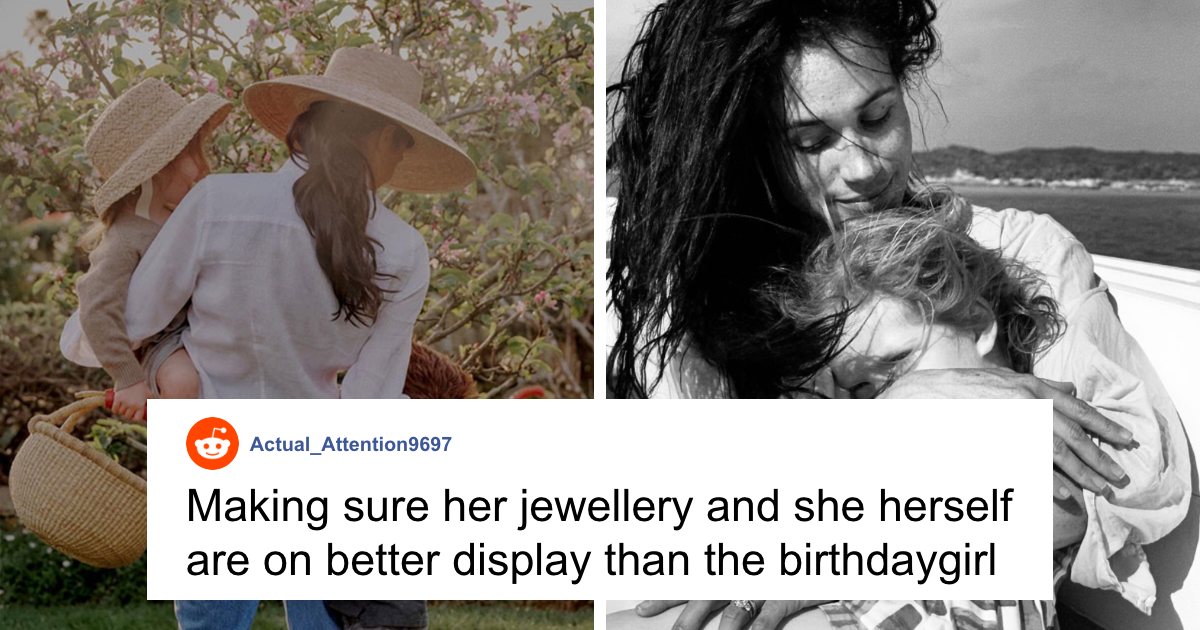
Meghan marked Lilibet’s fourth birthday on June 4, 2025, by publishing previously unseen images of her daughter. The initial post included two black-and-white mother-daughter photographs: one showing Meghan holding Lilibet on what appeared to be a boat and another showing the duchess cradling her daughter as a newborn. Meghan wrote that the arrival of their “beautiful girl” had made every day brighter and thanked people who were celebrating her special day.
Most readers saw a warm family tribute. Some critics, however, argued that Meghan occupied too much visual space in a post supposedly honoring Lilibet. The word “narcissist” quickly appeared in hostile reactions, transforming a collection of family memories into an online debate about self-promotion, celebrity parenting, privacy, branding, and whether anyone on social media remembers how ordinary family photo albums work.
What Meghan Markle Actually Posted for Lilibet’s Birthday
The Mother-Daughter Photographs
The first photograph showed Lilibet nestled in her mother’s arms as wind moved through their hair. Lilibet’s face was only partially visible, consistent with Meghan and Prince Harry’s general practice of limiting clear, front-facing images of their children.
The second photograph was considerably more intimate. It showed Meghan holding newborn Lilibet close to her chest. Reporting later noted that the baby appeared to be wrapped in the same style of traditional shawl previously used for her older brother, Prince Archie. Rather than being a polished royal portrait, the image looked like a private moment from the earliest days of motherhood.
Critics focused on the fact that Meghan was clearly visible in both images. To them, the composition made the mother, rather than the birthday girl, the visual center of attention. Yet photographs of a newborn usually require an adult to hold the newborn. Babies are famously unreliable at sitting for independent editorial portraits.
Prince Harry’s Father-Daughter Tribute
The mother-daughter carousel was not the only birthday content published that day. Meghan followed it with two photographs centered on Prince Harry and Lilibet. One showed Harry holding his daughter when she was younger, while another captured them walking together and holding hands.
Meghan described their relationship as a sweet bond and called Lilibet her father’s “favorite adventurer.” That second post complicates the claim that the birthday coverage was designed exclusively to keep Meghan in the spotlight. Viewed as a sequence, the posts celebrated Lilibet’s relationships with both parents.
The Delivery-Room Dance Video
The most viral part of the celebration was a video recorded before Lilibet’s birth in 2021. It showed a heavily pregnant Meghan and Prince Harry dancing beside a hospital bed to “The Baby Momma Dance.” Meghan explained that both of her children had arrived after their expected due dates and that dancing was attempted after walking, spicy food, and acupuncture had failed to get things moving.
The clip was playful, personal, and considerably less formal than the carefully staged hospital steps traditionally associated with royal births. It also placed Meghan and Harry, rather than Lilibet, at the center because Lilibet had not technically entered the room yet. Biology can be inconvenient for photo composition.
Why Critics Accused Meghan of Focusing on Herself
The Photographs Featured Meghan Prominently
The most straightforward criticism concerned framing. In the first two photographs, Meghan’s face, clothing, posture, and jewelry were easier to examine than Lilibet’s features. People expecting a conventional birthday portrait may therefore have felt that the child was concealed while the celebrity parent remained carefully presented.
That interpretation is understandable at a surface level. Birthday posts are usually expected to place the person celebrating the birthday front and center. When a parent dominates the frame, audiences may wonder whether the post is partly about the parent’s identity, memories, or public image.
But parent-child birthday tributes are often about shared history. Parents regularly post hospital photographs, pregnancy images, newborn cuddles, or stories about the day a child arrived. These posts do not merely say, “Here is what my child looks like today.” They also say, “Here is what this child’s arrival meant to our family.”
Meghan’s Public Image Shaped the Reaction
Social media users rarely evaluate a celebrity post in isolation. They bring years of preexisting opinions to it. Meghan’s admirers tend to see her as an independent woman rebuilding her life after an unhappy period within the British royal system. Her critics tend to interpret almost everything she publishes as calculated image management.
As a result, the photographs became a kind of digital inkblot test. Supporters saw affection and guarded family privacy. Critics saw branding, performance, and self-promotion. The pixels stayed exactly the same; the story changed depending on who was holding the phone.
Coverage of the backlash collected hostile comments accusing Meghan of making the occasion about herself. The same discussion also included readers defending the couple’s decision to avoid clearly identifying their children and asking critics to leave the family alone. The response was not unanimous, despite headlines that made the internet sound like one very angry person.
Her Business Projects Added Another Layer
By June 2025, Meghan had returned to Instagram, launched the As Ever lifestyle brand, released her Netflix series With Love, Meghan, and started sharing more glimpses of her life in California. Lilibet had also appeared from behind or at a distance in some material connected to the brand.
That overlap between motherhood and entrepreneurship gave critics additional ammunition. They questioned whether family content was being used to soften or strengthen a commercial identity. Supporters countered that work and family naturally overlap for many parents, especially founders whose brands are based on cooking, gardening, hospitality, and home life.
The tension is real. When a public figure’s business is built around personal taste and domestic living, even an authentic family moment may contribute to the brand. That does not prove the moment was staged, but it does make the boundaries harder for audiences to identify.
Why Calling Meghan a “Narcissist” Goes Too Far
There is a meaningful difference between saying a post appears self-focused and claiming its author has a personality disorder. The first is an interpretation of content. The second sounds like a clinical conclusion.
Narcissistic personality disorder involves a persistent pattern of behavior and difficulties affecting relationships, self-esteem, empathy, and the need for admiration. Proper evaluation requires much more than examining two photographs, a caption, or a dance video. Instagram users may be talented at detecting an outdated kitchen backsplash from three pixels, but pixels do not carry medical licenses.
The casual use of mental health terminology also weakens serious conversations about harmful behavior. Words such as “narcissist,” “psychopath,” “bipolar,” and “OCD” are frequently thrown around online as dramatic substitutes for “I dislike this person.” That turns medical language into a rhetorical tomato.
It is reasonable to analyze Meghan’s communication strategy. It is reasonable to question whether celebrity family content can be promotional. It is reasonable to dislike the photographs. None of those reactions provides enough evidence to diagnose the person who posted them.
The Complicated Privacy Question
Why Was Lilibet’s Face Partially Hidden?
One reason Meghan appeared more prominently may be that she and Harry have generally avoided publishing unobstructed images of Archie and Lilibet. Publications covering the birthday noted that the couple often photographed their children from behind, at a distance, or with their faces partly concealed.
That decision inevitably creates unusual compositions. When the child’s identity is intentionally protected, the parent may become the clearest person in the image. Critics can read that as vanity, while privacy-conscious parents may see it as a sensible compromise.
The broader practice of parents posting information about their children is sometimes called “sharenting.” Experts encourage families to consider consent, identifying details, future embarrassment, and the permanence of online material before publishing. Celebrity parents face an amplified version of the same dilemma because one photograph can be copied, enlarged, analyzed, and redistributed across thousands of accounts.
Privacy Does Not Always Mean Total Secrecy
Harry and Meghan’s desire for privacy has frequently been treated as a promise that they would never share family content. That is an overly rigid interpretation. Privacy generally means maintaining control over access, not disappearing into a woodland cabin and communicating exclusively through carrier pigeons.
Meghan later said that returning to social media gave her a place to share personal moments on her own terms. That phrase explains much of the couple’s approach: they may publish selected material while resisting uncontrolled photography, aggressive press intrusion, or constant access to their children.
Readers may still find that strategy inconsistent, especially when personal posts appear beside commercial announcements. Nevertheless, choosing what to disclose is not automatically hypocritical. Most people practice selective privacy every day; celebrities simply do it while millions of strangers keep score.
What Supporters Saw in the Birthday Tribute
Supporters interpreted the images as a mother reflecting on the day her daughter entered the world. The newborn photograph represented vulnerability and memory. The boat image showed physical closeness while still limiting the child’s exposure. The separate Harry post honored the father-daughter relationship, and the dance video offered a rare glimpse of the couple behaving like ordinary expectant parents.
They also noted that Meghan’s caption focused directly on Lilibet, describing the child as someone who had made family life brighter. There was no product link, sales message, discount code, or request to subscribe before midnight.
From this perspective, the outrage illustrates a problem that follows highly polarizing celebrities: every gesture becomes evidence for a case that audiences decided years ago. A photograph cannot merely be sweet, awkward, sentimental, or imperfect. It must prove that Meghan is either a misunderstood heroine or the mastermind of an elaborate jam-scented publicity operation.
Experience-Based Lessons From the Meghan Markle Backlash
1. Online Audiences Judge the Person Before the Post
Anyone who has managed a public account, business page, community group, or even a particularly dramatic family chat has probably encountered this pattern. Once people form a strong opinion about someone, neutral actions are filtered through that opinion.
A supporter interprets a personal photograph as warm and authentic. A critic interprets the same photograph as calculated. This is why changing a caption or choosing a different crop rarely ends a controversy. The disagreement is not really about the crop. It is about trust.
For public figures, reputation acts like a permanent photo filter. It colors everything before viewers have examined the content itself.
2. Family Photographs Rarely Have One Main Character
Parents often experience a child’s birthday as an anniversary of their own transformation. A birthday marks the child’s growth, but it also reminds the adults of pregnancy, labor, adoption, sleepless nights, first words, medical scares, school mornings, and approximately 14 million missing socks.
Sharing a birth photograph is therefore not inherently an attempt to steal attention. It may be a way of telling the family story. The key question is whether the child is respected, not whether the parent disappears completely from the frame.
3. Privacy Choices Can Look Awkward From the Outside
Parents who want to share a family moment without clearly exposing a child’s identity have limited options. They can use distant shots, partial profiles, photographs from behind, face-covering emojis, silhouettes, or images in which an adult shields the child.
None is visually perfect. A hidden face may prompt accusations that the picture is strange. A visible face may prompt accusations that the child is being exploited. The celebrity parent is effectively asked to win a game whose rules change after every move.
4. A Personal Brand Makes Authenticity Harder to Prove
Entrepreneurs who build businesses around their personalities face a genuine credibility challenge. A cooking video may be both a real family activity and a marketing asset. A photograph may be affectionate and strategically useful at the same time.
Those possibilities are not mutually exclusive. Human motives are often mixed. A restaurant owner can genuinely love feeding people while also hoping the dining room remains fully booked. Likewise, a celebrity can treasure a family memory while understanding that it supports a broader public narrative.
5. Criticism Is Stronger Without Amateur Diagnosis
People can make sharper, more persuasive arguments by describing what they actually observe. Saying, “The framing places more visual emphasis on Meghan than on Lilibet” is specific. Saying, “I think the post blurs the line between family life and branding” identifies a legitimate concern.
Calling someone a narcissist based on a birthday carousel skips the analysis and jumps directly to a label. It may generate more clicks, but it usually produces less understanding.
6. Children Should Not Become Props in Adult Culture Wars
The most important lesson is easily forgotten. Lilibet was a four-year-old child whose birthday photographs were being inspected by adults determined to prove larger arguments about her parents.
Public discussion should avoid speculating about a child’s appearance, development, emotions, or relationships based on selected images. Whatever people think of Meghan and Harry, their children did not volunteer to become evidence in a global royal debate.
Conclusion: A Birthday Post Became a Royal Rorschach Test
Meghan Markle’s Lilibet birthday post was undeniably centered on motherhood as well as the birthday girl. Meghan appeared prominently in the initial images, reflected on her daughter’s birth, and later shared a video featuring herself and Prince Harry before the delivery.
Critics were free to find the presentation self-conscious or overly curated. Yet the full sequence also included photographs celebrating Harry’s relationship with Lilibet, affectionate words about the child, and efforts to limit clear exposure of her face.
The fairest conclusion is not that the photographs prove Meghan is a “narcissist.” They prove that she chose to tell her daughter’s birthday story through family memories in which she, as Lilibet’s mother, was naturally present. Whether viewers found that touching or theatrical depended largely on what they already believed about her.
In the end, the controversy revealed less about one mother-daughter photograph than it did about celebrity culture. Online audiences no longer merely view personal moments. They investigate them, prosecute them, defend them, diagnose them, and occasionally remember to wish the child a happy birthday.