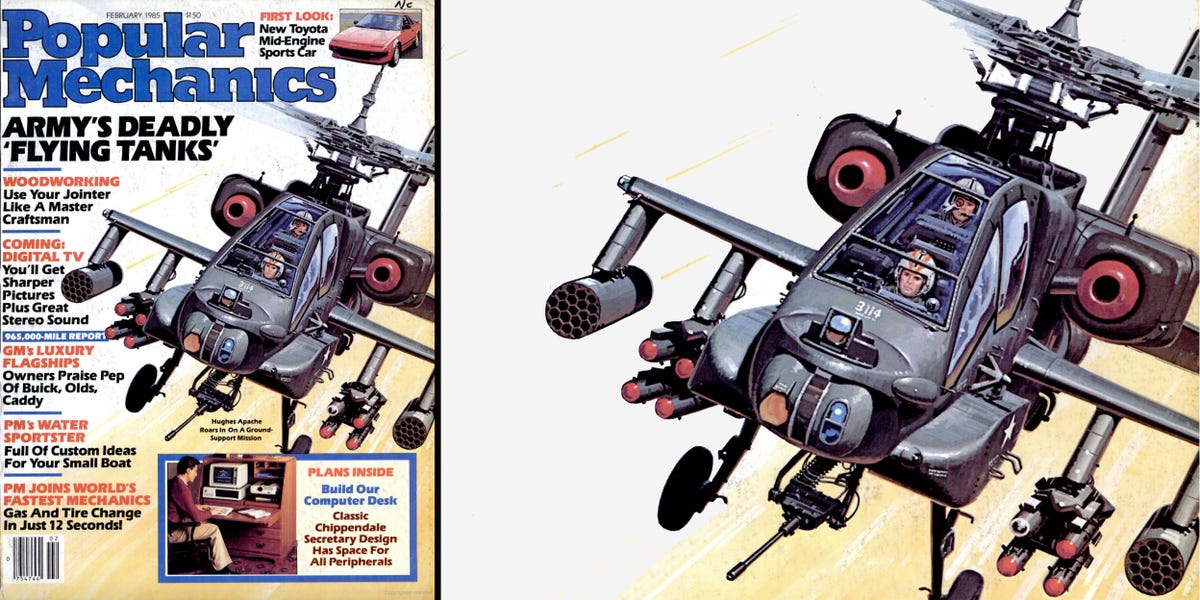

The AH-64 Apache does not make a subtle first impression. It crouches on its landing gear like an irritated mechanical insect, with a 30 mm cannon under its chin, weapons hanging from stub wings, and two helmeted crew members seated beneath angular glass. Even while parked, it looks as though it has already identified the parking lot as a potential threat.
When Popular Mechanics introduced readers to the Apache in the mid-1980s, the helicopter represented a major change in Army aviation. Earlier attack helicopters could deliver serious firepower, but the AH-64 was designed to enter a dangerous battlefield, find armored targets at night, survive damage, and hit back before the enemy finished saying, “Is that a helicopter?”
Four decades of combat, modernization, and hard-earned operational lessons have transformed that original “flying tank” into the networked AH-64E Apache Guardian. Yet its basic philosophy remains unchanged: see first, strike accurately, protect the crew, and make attacking the helicopter an exceptionally poor career decision.
Why the Army Needed a Helicopter That Could Fight Back
The Apache grew from lessons learned during the Vietnam War and from Cold War concerns about massed armored forces in Europe. The Bell AH-1 Cobra had demonstrated that a dedicated attack helicopter could escort troop-carrying aircraft and support soldiers on the ground. The Army’s next helicopter, however, would need better sensors, heavier weapons, improved night-fighting capability, and much greater resistance to battle damage.
Hughes Helicopters developed the YAH-64 for the Army’s Advanced Attack Helicopter competition. The prototype first flew in 1975, the Army selected it over Bell’s rival design in 1976, and full-scale production was approved in 1982. Production aircraft began reaching Army units in the 1980s, with the Apache formally entering operational service in 1986.
The manufacturing family tree became slightly complicated. Hughes built the original design, McDonnell Douglas acquired Hughes Helicopters in 1984, and Boeing inherited the Apache program when it merged with McDonnell Douglas in 1997. Through all those corporate nameplates, the aircraft continued evolving rather than being replaced by a completely new machine.
Inside the AH-64 Apache’s Unmistakable Design
The Apache is a twin-engine, four-blade attack helicopter with a tandem cockpit. The co-pilot/gunner occupies the forward seat, while the pilot sits behind and above. That arrangement provides both crew members with useful visibility while keeping the fuselage narrow. Both stations have flight and weapons controls, giving the crew flexibility if one member becomes injured or overwhelmed.
Current AH-64E specifications list a rotor diameter of approximately 48 feet, a length of 48.2 feet, and a maximum operating weight of 23,000 pounds. Despite that weight, the helicopter can climb at more than 2,800 feet per minute under suitable conditions. Two GE Aerospace T700-GE-701D turboshaft engines provide the power.
The Apache is not particularly graceful in the traditional sense. Nobody looks at its sensor-packed nose, riveted armor, and ammunition bay and thinks, “What a delicate little flower.” Its beauty comes from purpose. Almost every visible component exists to help it fly low, detect danger, deliver weapons, communicate with other forces, or protect the crew.
A Cockpit Built Around Information
The Apache’s crew does far more than steer and shoot. Pilot and gunner must manage navigation, sensors, weapons, radios, threat warnings, friendly-force positions, and information arriving from other aircraft or ground units. In newer versions, the cockpit functions as an airborne command-and-control station as much as a conventional set of flight controls.
The Integrated Helmet and Display Sighting System projects essential information in front of a crew member’s eye. The system can also connect the crew member’s line of sight with sensors and the M230 cannon. In simple terms, the gun can be directed toward where the operator is looking. That sounds like science fiction until one remembers that the original concept dates to the era of cassette tapes and aggressively patterned living-room furniture.
The Apache’s Eyes Work After Dark
One of the AH-64’s defining advantages has always been its ability to operate at night and in poor visibility. The nose-mounted Target Acquisition Designation Sight and Pilot Night Vision Sensor give the crew infrared views for flying, searching, tracking, and engaging targets.
Modernized TADS/PNVS equipment provides improved image quality, reliability, and target-identification capability compared with early systems. The pilot can use infrared imagery to fly at low altitude in darkness, while the gunner searches for potential threats. Darkness may hide a target from human eyes, but it is considerably less effective against a helicopter carrying advanced thermal sensors.
Longbow-equipped Apaches add the AN/APG-78 fire-control radar above the rotor mast. Its elevated position allows the helicopter to use terrain, trees, or structures as cover while exposing relatively little of the aircraft. The radar can detect, locate, classify, and prioritize multiple moving or stationary targets, including in smoke, dust, and adverse weather.
AH-64 Apache Weapons: A Carefully Chosen Toolbox
The Apache does not carry one universal weapon. Its load can be configured according to the mission, target types, expected threats, weather, range, and desired precision.
M230 30 mm Chain Gun
The M230 chain gun is mounted beneath the forward fuselage and supplied from an internal ammunition magazine. It can be aimed through the crew’s sighting systems or helmet-mounted display. The cannon is used against personnel, light vehicles, equipment, firing positions, and other appropriate targets.
Its flexible mount gives the Apache the ability to engage targets without pointing the entire helicopter directly at them. The weapon is not a decorative chin accessory. It is a fast, responsive option when a missile would be excessive or when a target appears with very little notice.
Hydra 70 Rockets
Pods of 2.75-inch Hydra 70 rockets provide another layer of firepower. Depending on the warhead and guidance configuration, rockets can be employed against area targets, light vehicles, personnel, structures, or specific point targets. They can also support missions involving smoke, marking, or illumination.
Modern guided rockets have narrowed the gap between traditional unguided rockets and larger missiles. Greater precision can reduce the number of weapons required while helping crews match the response to the target.
Hellfire and Joint Air-to-Ground Missiles
AGM-114 Hellfire missiles became closely associated with the Apache because they offered accurate, hard-hitting performance against armored vehicles and other high-value targets. Different Hellfire variants use laser or radar-frequency guidance and can carry warheads suited to different target sets.
The newer Joint Air-to-Ground Missile builds upon the Hellfire family with a multi-mode seeker intended to give aircrews greater flexibility against moving, stationary, armored, and maritime targets. The practical goal is straightforward: allow the crew to select the right guidance method without requiring a separate missile for every possible battlefield inconvenience.
What Makes the Apache a “Flying Tank”?
The famous nickname is useful, although the Apache is not literally a tank with a rotor attached. Helicopters remain vulnerable to small-arms fire, anti-aircraft guns, missiles, drones, difficult terrain, bad weather, mechanical failures, and the universal enemy of machinery: maintenance paperwork.
What distinguishes the AH-64 is its layered approach to survivability. The design incorporates armor around critical areas, crashworthy seats and landing gear, self-sealing fuel components, redundant systems, and widely separated engines. Critical components were arranged to reduce the chance that one hit would disable everything at once.
Survivability also means avoiding a hit in the first place. The Apache uses terrain masking, low-altitude flight, warning receivers, infrared countermeasures, electronic systems, coordinated tactics, and long-range sensors. Its weapons permit engagements from outside the effective range of many ground threats. The aircraft fights back with information before it fights back with ammunition.
The AH-64 Apache in Combat
Opening a Door in Operation Desert Storm
The Apache’s most famous early mission occurred during the opening hours of Operation Desert Storm on January 17, 1991. Eight Army AH-64As, guided by Air Force MH-53J Pave Low helicopters, flew at low altitude toward Iraqi early-warning radar sites.
The Apaches attacked the installations with Hellfire missiles, rockets, and cannon fire, helping create a corridor through which coalition aircraft could enter Iraqi airspace. The mission demonstrated that attack helicopters could perform more than close support and tank hunting. They could contribute directly to a complex joint air campaign.
During the wider ground war, Apaches attacked armored vehicles, artillery, air-defense equipment, and other targets. Their night vision and precision weapons allowed them to operate when older systems would have struggled. Desert Storm established the aircraft’s reputation, but later conflicts complicated the picture in useful ways.
From Open Desert to Urban and Mountain Warfare
Operations in the Balkans exposed the logistical and tactical difficulty of deploying attack helicopters into unfamiliar terrain under serious air-defense threats. A force of Apaches sent to Albania during the Kosovo conflict never flew a combat mission. The episode underscored that a powerful aircraft still depends on planning, maintenance, intelligence, fuel, ammunition, security, and suitable operating bases.
In Afghanistan and Iraq, Apache crews encountered mountains, dust, cities, dispersed fighters, and threats far different from the Cold War tank formations the aircraft had originally been designed to destroy. The helicopter increasingly performed armed reconnaissance, convoy protection, overwatch, close combat support, and rapid response for troops under fire.
Those missions emphasized judgment as much as firepower. Crews had to distinguish hostile activity from civilian movement, coordinate closely with ground forces, understand restrictive rules of engagement, and select weapons appropriate to the situation. The most important button in the cockpit was sometimes the one nobody pressed.
The AH-64E Apache Guardian Joins the Network
The AH-64E is more than a faster, stronger update to the original Apache. Improved engines, rotor blades, transmission components, digital communications, sensors, and mission computers allow it to operate as part of a connected force.
Manned-unmanned teaming is among its most important capabilities. Apache crews can receive imagery and targeting information from unmanned aircraft, allowing a drone to examine terrain beyond the helicopter’s immediate line of sight. Depending on the equipment and configuration, the crew may control a drone’s sensor or exercise a higher level of control over the aircraft.
This changes the engagement sequence. Instead of flying over a ridge simply to discover what is waiting on the other side, the Apache can use a remotely positioned sensor to build situational awareness. Information can then be shared with other aircraft, artillery units, commanders, or soldiers on the ground.
The Version 6 configuration further improves networking, maritime-target detection, radar performance, navigation, and decision support. The modern Apache is therefore both a shooter and an information node. It may detect a target for another platform, receive a target from a drone, or coordinate several weapons without firing its own.
Why the Apache Has Lasted for Decades
The AH-64’s longevity does not mean battlefield technology has stood still. Modern air defenses, electronic warfare, inexpensive drones, and long-range weapons make low-altitude aviation increasingly dangerous. Attack helicopters cannot be treated as invulnerable machines that may orbit wherever they please.
The Apache remains relevant because its architecture has accepted repeated upgrades. Sensors, software, communications, weapons, engines, and defensive systems have evolved while the basic airframe continues to perform attack and reconnaissance missions. Its global user community also supports training, logistics, manufacturing, and continued modernization.
Most importantly, the helicopter offers a combination that remains difficult to reproduce in one platform: a trained crew on the scene, powerful sensors, precision weapons, low-altitude maneuverability, and direct communication with ground troops. Drones and long-range missiles complement those capabilities, but they have not made the need for rapid airborne judgment disappear.
Conclusion: The Helo Still Fights Back
When the AH-64 Apache appeared in the pages of Popular Mechanics, its ability to see at night, absorb punishment, and return fire seemed revolutionary. Today’s AH-64E surrounds those original qualities with radar, digital networking, drone integration, improved sensors, and newer weapons.
The Apache is neither indestructible nor frozen in its Cold War role. It survives through preparation, maintenance, smart tactics, and constant modernization. The result is a helicopter that does not merely carry an impressive arsenal. It finds, interprets, shares, and acts on battlefield informationthen fights back with considerable enthusiasm.
What Meeting an AH-64 Apache Feels Like: An Immersive Experience
Seeing an Apache in photographs creates the impression of a compact aircraft. Meeting one at close range corrects that idea immediately. The 48-foot rotor system stretches above the aircraft like an enormous mechanical ceiling, while the tail seems to continue several postal codes beyond the cockpit. The helicopter sits low, wide, and purposeful, with sensors staring from the nose and the cannon hanging underneath like a warning written in very large punctuation.
This description is a composite based on publicly documented aircrew, maintainer, training, and demonstration experiences rather than a claim of personal flight. The details that impress visitors are usually not glamorous. They are access panels, cables, fasteners, safety pins, inspection points, and the dense packaging of machinery. The Apache is less like a sports car and more like a flying industrial district.
Climbing into the cockpit changes the scale again. The tandem crew stations feel narrow because the aircraft is built around protection, sensors, controls, and mission equipment rather than passenger comfort. Displays, switches, handles, and warning lights surround the seat. A new visitor sees clutter; a trained aviator sees systems arranged according to function, emergency priorities, and thousands of hours of instruction.
The helmet-mounted display is particularly disorienting at first. Information appears in front of one eye, requiring the brain to combine a digital presentation with the surrounding world. Apache aviators learn to interpret that image while flying, navigating, communicating, and monitoring the aircraft. Looking toward a point and having a sensoror the cannon during authorized operationsfollow that direction makes the machine feel unusually responsive. It also reveals why training takes so long. The system responds quickly, so the operator must think carefully.
Then the engines start. Conversation gives way to turbine noise, vibration, and a rushing wall of rotor wash. Loose dust and grass depart the area with sudden enthusiasm. Even at a controlled demonstration, the physical energy is unmistakable. The aircraft does not gently announce that it is ready to fly; it rearranges the local atmosphere.
From the cockpit, low-level flight is a deeply three-dimensional experience. Hills, trees, buildings, wires, weather, and friendly positions are not scenery. They are obstacles, cover, navigation references, and pieces of a changing tactical picture. At night, infrared imagery turns warm objects bright and familiar landscapes strange. Depth and distance require disciplined interpretation because a flat display cannot reproduce every cue available to unaided vision.
A live-fire range adds another layer. The gun produces a hard mechanical burst, rockets leave with sharp flashes and smoke, and a missile engagement can seem surprisingly brief after extensive preparation. Yet the dramatic moment represents only the final seconds of a much longer process involving identification, authorization, aircraft positioning, range checks, crew coordination, and confirmation of what lies around the target.
The lasting impression is therefore not simply firepower. It is workload. Every Apache sortie depends on pilots, ammunition specialists, avionics technicians, engine mechanics, crew chiefs, fuel teams, planners, intelligence personnel, and ground forces. Maintenance inspections can involve opening the aircraft from nose to tail, examining critical parts, correcting faults, and verifying that everything was reassembled properly.
Meeting the Apache up close makes its nickname feel both appropriate and incomplete. “Flying tank” captures the armor and weapons, but not the sensors, teamwork, software, maintenance, or restraint behind them. The aircraft fights back because an entire organization has prepared two crew members and one complicated machine to make good decisions in very bad circumstances.
Note: This article presents a historical and technical overview for general educational purposes. Specifications and capabilities can vary by Apache model, mission equipment, weapons configuration, operating environment, and modernization status.