
New York has always had a soft spot for things that look like they have survived something. Brick walls with a past. Factory windows with a little attitude. Floorboards that creak as if they know secrets. So it makes perfect sense that Scrapwood by Piet Hein Eek in NYC feels less like a trend and more like a reunion between old materials and a city that respects character.
Piet Hein Eek’s scrapwood furniture is not polished in the usual luxury-furniture way. It is polished in the better way: emotionally. His surfaces are patched together from reclaimed wood pieces that do not pretend to match, and somehow that is exactly why they work. The result is furniture that feels handcrafted, honest, and slightly rebellious. In New York, where design lovers can spot a fake “authentic” finish from across the room, that honesty matters.
What makes Scrapwood especially compelling in NYC is the tension it carries. It looks rough but behaves like collectible design. It nods to salvage yards and workshop floors, yet it sits comfortably in refined galleries, downtown lofts, brownstones, and highly edited apartments. It is rustic without becoming country, modern without becoming cold, and artistic without throwing a dramatic tantrum in the middle of the room. Quite a résumé for wood that was once headed for the reject pile.
What Is Scrapwood, Exactly?
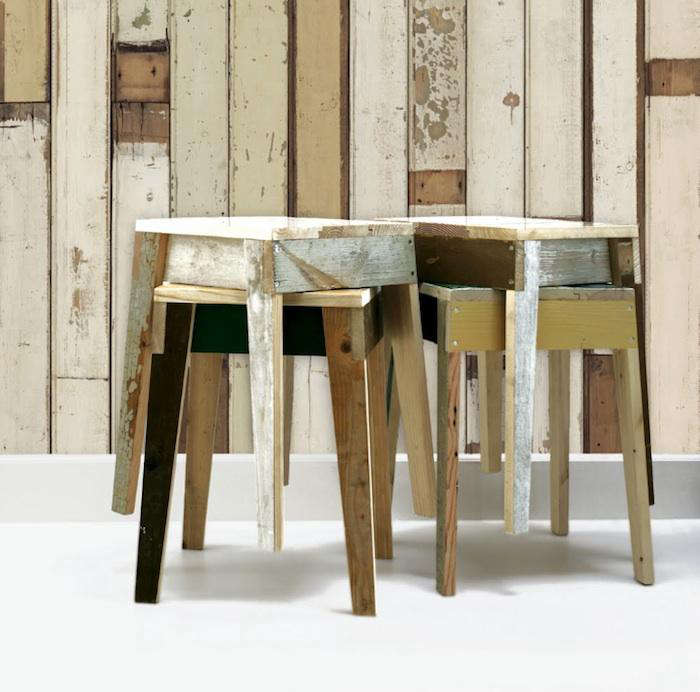
Scrapwood is the signature aesthetic most associated with Dutch designer Piet Hein Eek, who built his reputation by turning discarded timber into furniture with unmistakable visual rhythm. Instead of hiding wear, nail holes, scratches, paint traces, and tonal variation, he makes them part of the design language. That choice turned what could have been a sustainability lecture into something much more powerful: a visual style people actually desire.
The genius of Scrapwood is that it does not sanitize reuse. Many “reclaimed” products smooth everything down until the material’s former life disappears. Eek goes in the opposite direction. He keeps the evidence. His surfaces look patched, pieced, and assembled in full view. That makes each table, stool, cabinet, or chair feel less like a product and more like a small architecture project.
There is also an important philosophical layer here. Scrapwood pushes back against the idea that good design must be flawless, machine-perfect, and anonymous. Eek’s work argues that beauty can come from labor, irregularity, and repair. In a city like New York, where people routinely romanticize old factories, adaptive reuse, and imperfect apartments with “good bones,” this argument lands beautifully.
Why New York Was Always Going to Fall for It
NYC has long been a city that rewards contrast. High and low. Grit and polish. Historic shell, modern insert. Piet Hein Eek’s Scrapwood furniture fits that visual culture almost suspiciously well. Put a Scrapwood table under a pristine pendant in Tribeca and it looks deliberate. Place a Scrapwood stool against white gallery walls in NoHo and it suddenly reads like functional sculpture. Slide a Scrapwood bedside table into a Brooklyn townhouse and it feels as if it has lived there longer than the owner.
That flexibility explains why the work resonated in New York design circles. Scrapwood can soften minimal interiors, roughen up luxurious ones, and keep eclectic rooms from becoming too precious. It offers visual texture without screaming for attention every second. In a city full of apartments where every square foot has to earn its keep, furniture that provides storage, function, story, and personality is not merely attractive. It is practically civic-minded.
New York also understands reinvention. So does Scrapwood. Taking what is worn, overlooked, or discarded and giving it a compelling second act is basically the city’s favorite hobby. Eek’s work channels that spirit without becoming sentimental. It is not about nostalgia for old wood. It is about proving that waste can become high design when intelligence, craftsmanship, and stubbornness show up for work.
How Scrapwood Entered the NYC Design Conversation
One of the key reasons Scrapwood by Piet Hein Eek in NYC became a recognizable design reference is The Future Perfect. The gallery-retailer played a major role in bringing Eek’s work to New York audiences, first through its Brooklyn roots and then through its Manhattan presence. Design coverage from the early 2010s treated the arrival of Scrapwood in New York less like a simple retail update and more like a sighting.
That reaction makes sense. At the time, New Yorkers were already primed for furniture that fused craft, sustainability, and collectible design. The Future Perfect gave Eek’s work the right stage: not a hardware-store context, but a sharply curated environment where reclaimed materials could sit beside advanced lighting, ceramics, and experimental forms. Suddenly Scrapwood was not “salvage style.” It was part of the larger contemporary design conversation.
The New York relationship deepened through exhibitions and design-week moments. Eek’s Wonder Room presentation for New York Design Week helped translate the spirit of his Eindhoven workshop into Manhattan, mixing his own work with related makers and emphasizing his process-driven approach. Later New York appearances and presentations tied to The Future Perfect continued to reinforce the connection. In other words, Scrapwood did not just pass through the city. It set up camp, made friends, and started influencing the neighborhood.
Signature Scrapwood Pieces That Make Sense in NYC
Tables That Do More Than Hold Your Coffee
If there is a single category where Eek’s Scrapwood vocabulary hits hardest, it is tables. Dining tables, coffee tables, side tables, and console pieces all benefit from the patchwork surface because a tabletop is basically a stage. You notice it immediately. In New York apartments, where the dining table is often also a desk, meeting room, dinner-party anchor, and emotional support surface, it helps when that stage has charisma.
A Scrapwood table adds pattern without using fabric, and warmth without using color. That is a neat trick. It can hold its own against concrete floors, steel windows, plaster walls, or jewel-toned upholstery. It also helps bridge the visual gap between vintage finds and contemporary pieces, which is useful in NYC homes where interiors are often layered over time rather than purchased in one dramatic weekend.
Chairs and Stools with Instant Personality
Scrapwood chairs and stools make particularly good sense in New York because they deliver impact in a compact footprint. A stool can function as a side table, landing spot, improvised plant stand, or extra seating when six people somehow become ten. A dining chair in Scrapwood does not fade into the background, but it also does not demand its own lighting designer and press release.
Their charm comes from the contrast between strict forms and lively surfaces. The silhouettes can be straightforward, even familiar. The surfaces are where the jazz happens. That keeps them useful in smaller spaces, where overly sculptural furniture can feel like an uninvited performance artist.
Cabinets and Storage That Earn Their Floor Space
New Yorkers respect storage the way desert travelers respect water. A cabinet must be beautiful, yes, but it must also justify its existence. Scrapwood cabinets do both. They offer function while reading almost like assembled wall art. A classic cupboard or display cabinet introduces mass, texture, and material history all at once. In a home office, dining area, or entry, that kind of presence is gold.
Better still, Scrapwood storage avoids the sterile look that can plague contemporary cabinetry. It feels lived-in from day one, which can be deeply comforting in a city where so much new development arrives looking as if nobody is allowed to touch it.
Scrapwood Wallpaper: The Flat Version of a Very Three-Dimensional Idea
One of the smartest extensions of Eek’s aesthetic is Scrapwood wallpaper. Instead of merely copying generic woodgrain, the wallpaper reproduces the actual surfaces and irregularity of pieced-together reclaimed planks. That means visible scrapes, paint traces, nail marks, and tonal shifts become part of the wall treatment. It is faux bois with a better backstory and much better manners.
For New Yorkers, this is particularly useful because not everyone can install actual reclaimed paneling in a rental, a prewar apartment, or a compact renovation budget. Wallpaper gives the illusion of material richness without the structural drama. It can transform a powder room, an entry niche, a dining banquette wall, or a bedroom accent wall into something moodier and more tactile.
The effect is especially successful in NYC because city interiors often rely on a limited palette. White walls, black metal, oak floors, stone counters, and neutral upholstery can be gorgeous, but sometimes they need a little friction. Scrapwood wallpaper introduces that friction. It adds depth, history, and humor without making the room feel theme-y. Nobody walks in and says, “Ah yes, the cabin fantasy.” They just think the wall looks unexpectedly great.
Why Scrapwood Still Feels Relevant
Good design ages well when it solves more than one problem. Scrapwood does. It speaks to sustainability, craftsmanship, material intelligence, and individuality all at once. It also sidesteps one of the biggest traps in eco-conscious design: smugness. Eek’s work does not lecture. It seduces.
That is a big reason the work still feels current in New York. The city’s design culture has moved well beyond surface-level minimalism and into a deeper appreciation for objects with provenance, process, and texture. People want interiors that feel thoughtful, not algorithmically generated. They want rooms that suggest human choices were made. Scrapwood does that beautifully.
It also remains relevant because it can live in very different design ecosystems. In a collector’s apartment, it reads as design history with edge. In a younger creative’s rental, it reads as smart and soulful. In hospitality or retail settings, it brings warmth and material honesty. Few design languages can move that easily between gallery, home, and showroom without losing credibility.
How to Style Scrapwood in a New York Interior
Pair It with Clean Lines
Let the surface complexity do the heavy lifting. A Scrapwood table sings when paired with simple chairs, restrained lighting, and quiet architecture. Too much visual competition and the room starts sounding like three bands rehearsing in one basement.
Mix It with Metals and Stone
Scrapwood works especially well with blackened steel, unlacquered brass, zinc, marble, soapstone, and concrete. These materials create a strong city-meets-workshop atmosphere without turning the room into an industrial costume party.
Use It to Wake Up Neutrals
If your palette leans white, gray, beige, charcoal, or olive, Scrapwood can be the move that keeps the room from drifting into tasteful sleepiness. It introduces pattern through material rather than print, which tends to feel richer and more lasting.
Do Not Overdo the Rustic Angle
This is the crucial point. Piet Hein Eek’s work is not farmhouse décor. It is contemporary design built from reclaimed material. Treat it like an artful contrast, not a license to buy twelve crates, two lanterns, and a sign that says “Gather.”
The Real Appeal of Scrapwood by Piet Hein Eek in NYC
At its best, Scrapwood captures something New York understands in its bones: imperfection can be a form of sophistication. The city does not love polished surfaces because they are polished. It loves surfaces that have survived, adapted, and kept going. That is exactly the story Scrapwood tells.
Piet Hein Eek’s work brings together craftsmanship and contradiction in a way that feels tailor-made for New York. It is humble material made ambitious. It is rough texture placed in refined settings. It is design that remembers where it came from but is not stuck there. And maybe that is why it still lands so well here. In NYC, reinvention is not a bonus feature. It is the whole plot.
Experience Section: Living with Scrapwood in New York
To really understand Scrapwood by Piet Hein Eek in NYC, you have to imagine it not as a catalog object, but as part of an actual New York day. Picture walking into a downtown gallery space on a gray afternoon, the kind where the sky looks like a rolled-up painter’s drop cloth. The room is quiet, but not cold. Light hits a Scrapwood table and suddenly the surface starts doing what photographs never fully capture: it flickers. One plank looks honey-colored, another goes smoky brown, another holds a stubborn trace of old paint. Up close, the piece does not feel chaotic. It feels composed, like a city block where every building is different but somehow the street still makes sense.
Then imagine that piece leaving the showroom and entering a real apartment. Not a fantasy loft the size of a basketball court, but a real New York home where the front door opens too close to the kitchen and the radiator has opinions. A Scrapwood bedside table beside crisp white bedding suddenly makes the bedroom less generic. A Scrapwood stool in the entry catches keys, mail, a tote bag, and maybe a half-dead bodega tulip arrangement, and somehow looks better for it. A cabinet in the dining area becomes the thing guests drift toward before dinner, running their eyes over the surface, trying to figure out whether it is rustic, modern, artistic, or all three.
That is the experience of Scrapwood in NYC: it makes interiors feel more human. The city can be hard-edged and fast, and many apartments lean toward sleekness because space is limited and clutter shows up quickly. Scrapwood interrupts that slickness in the nicest possible way. It adds visual patience. It reminds you that a room can be edited without being sterile.
There is also something deeply satisfying about how the material ages in a New York context. In a city where wear is inevitable, precious furniture can feel stressful. Scrapwood is the opposite. It already understands scuffs, sunlight shifts, and the little abrasions of daily life. It is not fragile in spirit. You do not spend all your time worrying about whether a coaster is six inches too far left. You live with it. That may be the most luxurious thing about it.
And emotionally, the work lands because New York is a city of second lives. Warehouses become condos. Factories become galleries. Old neighborhoods become new neighborhoods and then argue about it for twenty years. Piet Hein Eek’s Scrapwood belongs in that story. It takes what has been overlooked and gives it a future that is more beautiful, more deliberate, and more useful than anyone expected. In a New York apartment, that idea does not just look good. It feels right.
SEO Tags