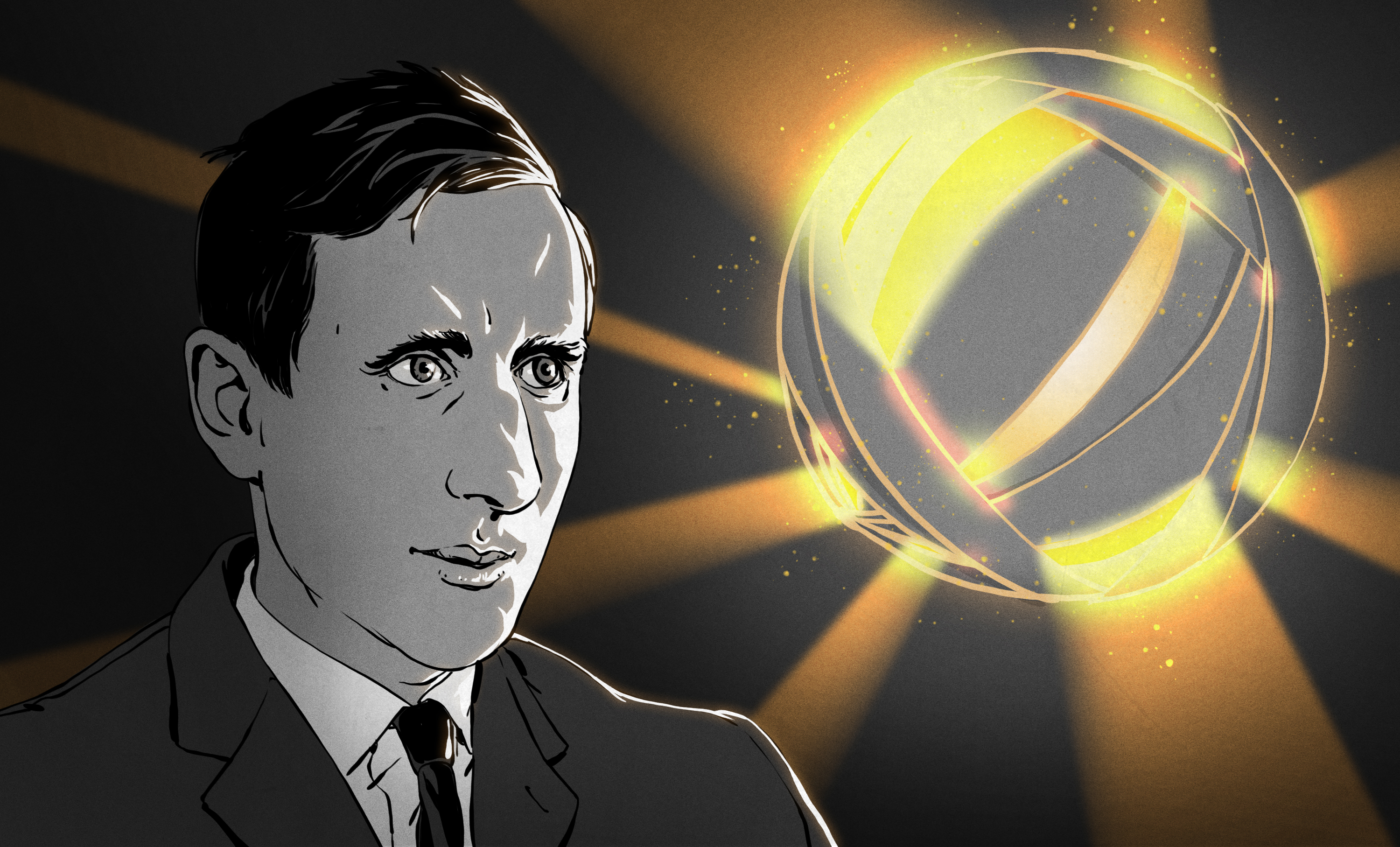

Some scientists build a career by going deep into one narrow tunnel. Freeman Dyson preferred to carry a lantern, wander into every tunnel, and occasionally discover that the tunnels connected under the mountain. Mathematician, theoretical physicist, essayist, futurist, nuclear engineer, public intellectual, space dreamer, and professional question-asker, Dyson was the rare scientist whose mind seemed allergic to staying in one department for too long.
Born in England in 1923 and later becoming a British-born American scientific icon, Dyson helped shape modern quantum electrodynamics, influenced nuclear engineering, imagined civilizations harvesting the energy of stars, and wrote books that made difficult science feel like a conversation with a brilliant uncle who had somehow read every book in the library and still had time for tea. His legacy is not just a list of achievements. It is a way of thinking: curious, skeptical, playful, mathematically sharp, morally restless, and sometimes controversial enough to make the academic dinner table go quiet.
To understand Freeman Dyson’s legacy, we need to look at the scientist, the writer, the rebel, and the dreamer. Conveniently, he was all four before breakfast.
Who Was Freeman Dyson?
Freeman John Dyson was born on December 15, 1923, in Crowthorne, Berkshire, England. From early childhood, he showed a fierce love for numbers and patterns. As a student, he attended Winchester College and later studied mathematics at Trinity College, Cambridge. World War II interrupted his academic path, and Dyson served as a civilian scientist with the Royal Air Force Bomber Command, where he used mathematics in the grim machinery of wartime analysis.
That wartime experience mattered. It gave Dyson a lifelong suspicion of easy answers and technological arrogance. He saw that intelligence without humility could become dangerous. This theme returned again and again in his writing, especially when he discussed nuclear weapons, military strategy, and the moral responsibilities of scientists.
After earning his mathematics degree from Cambridge in 1945, Dyson moved to the United States in 1947 as a Commonwealth Fellow. At Cornell University, he worked with Hans Bethe and met Richard Feynman. Soon after, he spent time at the Institute for Advanced Study in Princeton, the legendary intellectual home associated with Albert Einstein, J. Robert Oppenheimer, Kurt Gödel, and other giants. Dyson would remain closely tied to the Institute for most of his life.
Dyson’s Great Scientific Breakthrough: Making QED Speak One Language
Freeman Dyson’s most important contribution to physics came early. In the late 1940s, quantum electrodynamics, or QED, was undergoing a revolution. The theory describes how light and matter interact, especially how electrons and photons behave. Three major physicistsRichard Feynman, Julian Schwinger, and Sin-Itiro Tomonagahad developed powerful but different approaches to the same fundamental problem.
The trouble was that their methods looked like separate languages. Feynman’s approach used visual diagrams that made particle interactions easier to calculate. Schwinger and Tomonaga used more formal mathematical approaches. Dyson saw that these were not rival theories but equivalent descriptions. He built bridges between them.
This achievement was enormous. Dyson helped make Feynman diagrams respectable, usable, and understandable to the broader physics community. He showed that the different formulations of QED were mathematically connected and physically consistent. In plain English: he helped turn a brilliant mess into a working toolkit.
Feynman, Schwinger, and Tomonaga later received the Nobel Prize in Physics in 1965 for their work in QED. Dyson did not share the prize, although many physicists believed his role was essential. Dyson himself seemed less bothered by this than other people were on his behalf. He once joked in spirit that the Nobel Prize rewards people who stay focused on one big problem for a long time. Dyson, by contrast, preferred intellectual hopping. He was a frog, not an eaglehis own famous metaphor for thinkers who explore the mud of many small ponds instead of surveying everything from above.
A Scientist Without a Ph.D.And Without Much Patience for Academic Snobbery
One of the most delicious facts about Freeman Dyson is that he never earned a Ph.D. Cornell made him a professor anyway. This is the kind of academic plot twist that makes graduate students stare into the distance and whisper, “So it was possible?”
Dyson’s lack of a doctorate was not a gap in ability. It was more like a clerical inconvenience. His papers, lectures, and reputation made the credential almost irrelevant. He belonged to a generation when a person could still enter the highest levels of science through raw originality, mathematical skill, and the ability to solve problems nobody else could untangle.
This part of Dyson’s story remains especially powerful today. Modern science requires training, discipline, peer review, and institutions. But Dyson reminds us that credentials are not the same as creativity. A diploma can open the door, but it cannot guarantee that a person knows what to do once inside the room.
Beyond Physics: Nuclear Reactors, Solid State Physics, Biology, and Mathematics
Dyson did not stop at QED. Over his long career, he contributed to nuclear reactor design, solid state physics, ferromagnetism, astrophysics, biology, applied mathematics, number theory, random matrix theory, and more. Listing his fields can feel like reading the course catalog of a university that has gone slightly overboard.
His work on random matrices helped connect mathematical physics with number theory. His insights touched problems involving the distribution of prime numbers and the energy levels of heavy atomic nuclei. To Dyson, mathematics was not a cage but a universal set of tools. If a pattern appeared in one field, he was happy to test whether it belonged somewhere else too.
This cross-disciplinary instinct is one of Dyson’s most important legacies. In a world where knowledge is often divided into tiny professional boxes, Dyson treated science like a landscape. He walked across borders because he did not believe nature cared much about university department names.
Project Orion: The Atomic Spaceship That Almost Was
One of Dyson’s boldest adventures was Project Orion, a Cold War-era proposal for a spacecraft propelled by nuclear explosions. The idea sounds like something invented by a science fiction writer after too much coffee: place a giant pusher plate behind a spacecraft, set off a series of small nuclear blasts, and ride the shock waves into deep space.
Project Orion was technically serious, even if it sounded like the universe’s loudest bad idea. Dyson worked with the team at General Atomics and studied the possibility of using nuclear pulse propulsion for ambitious missions. Advocates imagined trips to Mars, Saturn, and perhaps even interstellar destinations.
The project eventually faded, especially after the 1963 Partial Test Ban Treaty limited nuclear explosions in the atmosphere, underwater, and in space. Still, Orion reveals something crucial about Dyson: he was willing to think at civilization-scale. He did not ask only, “Can we improve the engine?” He asked, “What kind of future becomes possible if we stop thinking small?”
The Dyson Sphere: A Big Idea That Escaped Its Author
For the general public, Freeman Dyson may be best known for the “Dyson sphere.” In a 1960 paper, Dyson suggested that advanced extraterrestrial civilizations might harvest energy from their stars on a massive scale. Such a civilization could build orbiting structures that capture starlight and re-radiate waste heat as infrared radiation. Astronomers could then search for unusual infrared signatures as possible evidence of advanced life.
Science fiction later transformed the idea into a solid shell surrounding a star. Dyson himself did not insist on that image. He imagined more like a swarm of orbiting habitats or collectors. But the name stuck. Today, “Dyson sphere” is a standard phrase in discussions of megastructures, SETI, astrobiology, and speculative engineering.
The most fascinating thing about the Dyson sphere is not whether anyone will build one. It is the way the idea changes the scale of imagination. Dyson turned the search for extraterrestrial intelligence away from simply listening for radio signals and toward looking for engineering footprints. If intelligence becomes powerful enough, he suggested, it may leave traces in the energy budget of a star. That is a very Freeman Dyson thought: elegant, outrageous, testable, and just weird enough to be useful.
Dyson the Writer: Science With a Human Face
Dyson was not only a scientist’s scientist. He was also a writer’s scientist. His books include Disturbing the Universe, Weapons and Hope, Origins of Life, Infinite in All Directions, Imagined Worlds, The Sun, the Genome, and the Internet, and The Scientist as Rebel. These works made him one of the great scientific essayists of the late twentieth and early twenty-first centuries.
His writing had range. He could discuss particle physics, nuclear strategy, biology, religion, ethics, literature, and the future of humanity without sounding like he had wandered into the wrong seminar. He was especially good at showing science as a human activityfull of ambition, mistakes, friendship, rivalry, humor, moral tension, and wonder.
That matters because science communication is not just about simplifying facts. It is about preserving meaning. Dyson did not flatten science into slogans. He invited readers into complexity and trusted them to enjoy the view.
The Rebel: Brilliant, Independent, and Sometimes Wrong
No honest account of Freeman Dyson should turn him into a marble statue. Statues are bad at asking questions, and Dyson asked too many questions to be carved comfortably.
His views on climate change became especially controversial. Dyson accepted that carbon dioxide could contribute to warming, but he criticized climate models, doubted some projections, and argued that other global problems deserved more urgent attention. Many climate scientists strongly rejected his conclusions and considered his public comments misleading, especially because Dyson was not a climate specialist.
This controversy is an important part of his legacy because it shows both the power and danger of intellectual independence. Dyson’s habit of challenging consensus made him creative in fields where outsiders could see new possibilities. But the same habit could lead him into debates where deep specialized knowledge mattered more than contrarian instinct.
The lesson is not that rebels are always right. They are not. The lesson is that science needs both imagination and correction. Dyson gave the world extraordinary imagination. On climate, many experts believed the correction was necessary.
Why Freeman Dyson Still Matters
Freeman Dyson’s legacy is not confined to one theorem, one machine, or one famous phrase. His larger gift was intellectual style. He showed that serious science can be playful, that mathematics can migrate between disciplines, that technology must be judged morally, and that the future is not a straight hallway but a branching forest.
He also made curiosity look dignified. In a culture that often rewards instant certainty, Dyson modeled a different rhythm: read widely, think deeply, change subjects when necessary, and never assume the official map is complete. He believed in the fertility of small questions. He distrusted grand systems when they became too neat. He preferred messy reality to tidy ideology.
Modern scientists, writers, engineers, and students can learn from Dyson not by copying his conclusions but by adopting his courage to explore. The world does not need everyone to become Freeman Dyson. One was already enough to keep several fields busy. But the world does need more people willing to connect ideas, challenge assumptions, and treat imagination as a serious scientific instrument.
Experiences and Reflections Inspired by Freeman Dyson’s Legacy
Spending time with Freeman Dyson’s life story feels like walking through a museum where the exhibits keep opening secret doors. You enter through the physics wing, expecting quantum electrodynamics, and suddenly there is a room full of nuclear rockets. Behind that is a hallway about alien civilizations. Around the corner is a shelf of essays on war, ethics, biology, poverty, and the future of technology. Then, just when you think you have reached the exit, Dyson appears again in number theory, smiling like he has been hiding there all along.
One experience Dyson’s legacy creates for modern readers is permission. Not permission to be careless, but permission to be wide-ranging. Many students and young professionals feel pressure to specialize early and permanently. Dyson’s career offers a refreshing counterexample. He became great not by ignoring discipline, but by carrying discipline across boundaries. His mathematics gave him a passport. Wherever he traveled intellectually, he brought precision with him.
For a reader interested in science, Dyson also changes the emotional texture of learning. Physics can feel intimidating, especially when it arrives wearing equations like armor. Dyson made hard ideas feel alive. His essays suggest that behind every technical problem is a human story: someone argued, someone doubted, someone made a mistake, someone saw a pattern at 2 a.m. and forgot to sleep. That is comforting. It means science is not a machine that produces truth automatically. It is a community of imperfect people trying to understand a stubbornly beautiful universe.
Dyson’s life is also a useful experience in intellectual humility. He was obviously brilliant, but brilliance did not make him universally correct. His climate views are a reminder that intelligence is not a magic shield against error. In fact, very smart people can sometimes defend unusual positions with unusual confidence. The healthy lesson is not to distrust genius, but to ask better questions: What is the evidence? What do specialists say? Where does imagination help, and where does it outrun the data?
For writers, Dyson’s legacy is equally valuable. He wrote with clarity because he respected readers. He did not treat the public as a crowd waiting for simplified crumbs. He believed people could handle big ideas if those ideas were presented with honesty, rhythm, and human context. Anyone writing about science today can learn from that. Good science writing should not merely explain; it should enlarge the reader’s sense of what is possible.
Finally, Dyson’s legacy offers a kind of optimistic restlessness. He lived through war, nuclear fear, scientific revolutions, political conflict, and technological acceleration, yet he kept asking what humanity might become. His optimism was not soft or sugary. It had steel in it. He understood danger, but he refused to let danger be the only story. That may be the most useful Dyson experience of all: the feeling that the future is serious, uncertain, risky, and still worth imagining boldly.
Conclusion: The Bright Star That Refused One Orbit
Freeman Dyson died in 2020 at the age of 96, but his ideas continue to travel. Some move through physics. Some orbit distant stars in the imaginations of astronomers and science fiction writers. Some live in essays that remind us science is not separate from ethics, politics, wonder, or human destiny.
His legacy is best understood not as a monument but as motion. Dyson moved between fields, between certainty and doubt, between equations and dreams. He helped build modern physics, challenged scientific culture, imagined technologies on cosmic scales, and wrote with rare grace about the strange adventure of being human in a universe that keeps refusing to be boring.
If science has bright stars, Freeman Dyson was not a fixed one. He was a cometbrilliant, unpredictable, occasionally alarming, and impossible to ignore.
Note: This article is written in original American English for web publication and is based on verified historical and scientific information from reputable science, academic, and biographical sources.